
Recent from talks
Traffic warning sign
Knowledge base stats:
Talk channels stats:
Members stats:
Traffic warning sign
A warning sign is a type of sign which indicates a potential hazard, obstacle, or condition requiring special attention. Some are traffic signs that indicate hazards on roads that may not be readily apparent to a driver.
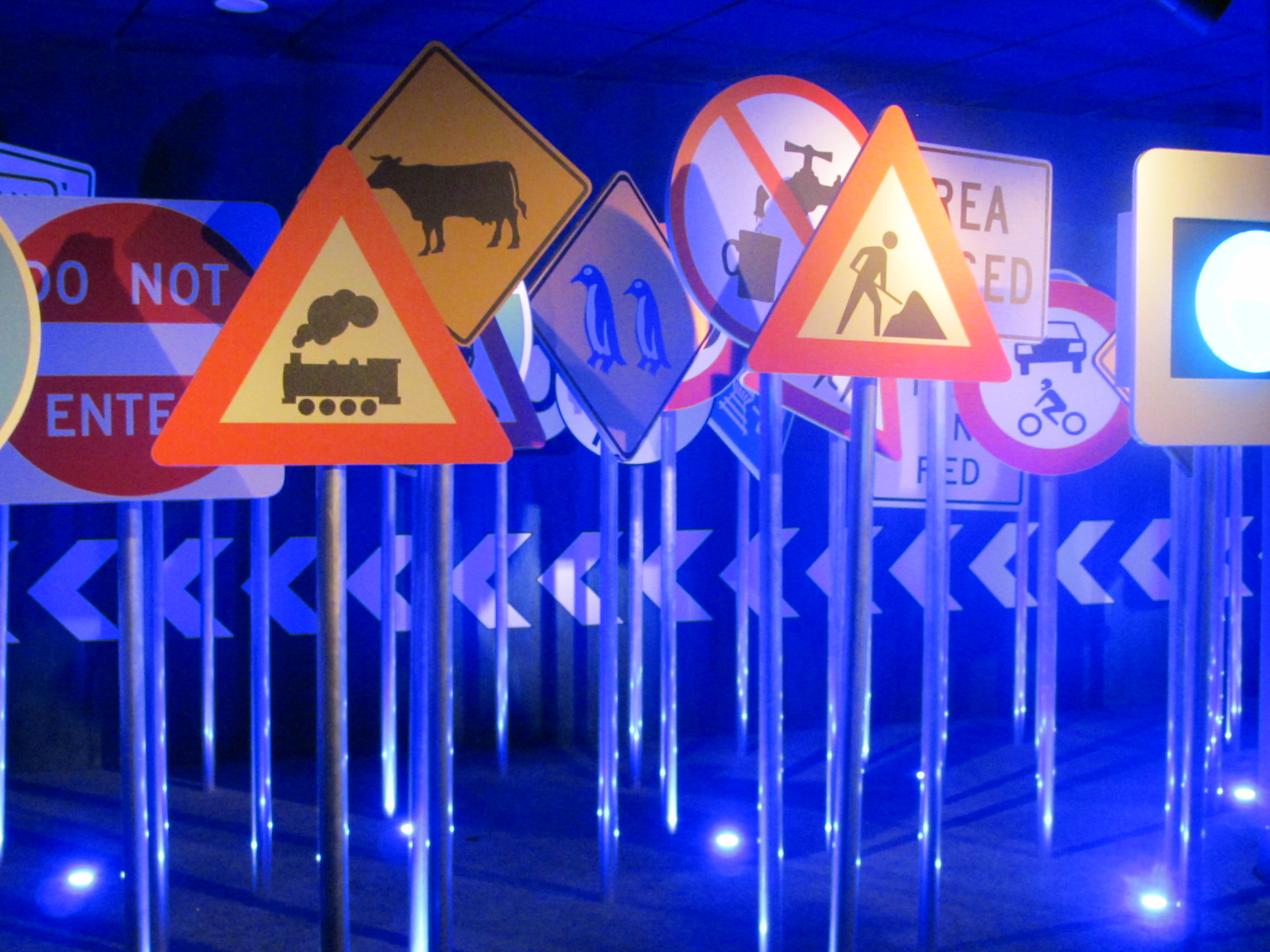
While warning traffic sign designs vary, they usually take the shape of an equilateral triangle with a white background and thick red border. In the People's Republic of China (excluding Macau and Hong Kong) and North Korea, they appear with a black border and a yellow background. In Sweden, Greece, Finland, Iceland, Poland, Cuba, Nigeria, South Korea and Vietnam, they have a red border with an amber background. The polar bear warning sign in Svalbard recently changed from displaying a black bear on white background to a white bear on black background (both signs are triangular with a red border). Some countries (like France, Norway and Spain) that normally use a white background have adopted an orange or amber background for road work or construction signs.
Warning signs in some countries have a diamond shape in place of the standard triangular shape. In the United States, Canada, Mexico, Australia, Japan, Liberia, Sri Lanka, New Zealand, most of Central and South America, some countries of Southeast Asia, and also Ireland (diverging from the standards of the rest of Europe) warning signs are black on a yellow background and usually diamond-shaped, while temporary signs (which are typically construction signs) are black on an orange background. Some other countries, like Argentina and Taiwan, use a combination of triangle and diamond-shaped warning signs.
The warning signs usually contain a symbol. In Europe they are based on the UNECE Vienna Convention on Road Signs and Signals. In the United States they are based on the MUTCD standard and often contain text only.
Some of the first roadside signs—ancient milestones—merely gave distance measures. Hazard warnings were rare though occasional specimens appeared, such as the specific warning about horse-drawn vehicles backing up which was carved in stone in Lisbon's Alfama neighborhood in 1686. The early signs did not have high-contrast lettering and their messages might have been easily overlooked. Signs were written in the local language (example); symbolic signs, though long used on certain tradesmen's signs (like the pawnbrokers' tri-ball symbol) were to be used for traffic only much later in history.

Complex signage systems emerged with the appearance of motorcars. In 1908 the automobile association in West London erected some warning signs. In 1909, nine European governments agreed on the use of four pictorial symbols, indicating bump, curve, intersection, and railroad crossing. The intensive work on international road signs that took place between 1926 and 1949 eventually led to the development of the European road sign system.
As the 20th century progressed, and traffic volume and vehicle speeds increased, so did the importance of road sign visibility. Earlier flat-painted signs gave way to signs with embossed letters, which in turn gave way to button copy signs— round retroreflective "buttons" helped to achieve greater night visibility. Flat metal signs reappeared in the 1980s with the widespread use of surfaces covered with retroflective sheeting materials like Scotchlite.

In Europe, 1968 Vienna Convention on Road Signs and Signals (which became effective in 1978) tried, among other things, to standardize important signs. After the fall of the Iron Curtain and greater ease of country-to-country driving in the EU, European countries moved toward lessening the regional differences in warning signs.
Hub AI
Traffic warning sign AI simulator
(@Traffic warning sign_simulator)
Traffic warning sign
A warning sign is a type of sign which indicates a potential hazard, obstacle, or condition requiring special attention. Some are traffic signs that indicate hazards on roads that may not be readily apparent to a driver.
While warning traffic sign designs vary, they usually take the shape of an equilateral triangle with a white background and thick red border. In the People's Republic of China (excluding Macau and Hong Kong) and North Korea, they appear with a black border and a yellow background. In Sweden, Greece, Finland, Iceland, Poland, Cuba, Nigeria, South Korea and Vietnam, they have a red border with an amber background. The polar bear warning sign in Svalbard recently changed from displaying a black bear on white background to a white bear on black background (both signs are triangular with a red border). Some countries (like France, Norway and Spain) that normally use a white background have adopted an orange or amber background for road work or construction signs.
Warning signs in some countries have a diamond shape in place of the standard triangular shape. In the United States, Canada, Mexico, Australia, Japan, Liberia, Sri Lanka, New Zealand, most of Central and South America, some countries of Southeast Asia, and also Ireland (diverging from the standards of the rest of Europe) warning signs are black on a yellow background and usually diamond-shaped, while temporary signs (which are typically construction signs) are black on an orange background. Some other countries, like Argentina and Taiwan, use a combination of triangle and diamond-shaped warning signs.
The warning signs usually contain a symbol. In Europe they are based on the UNECE Vienna Convention on Road Signs and Signals. In the United States they are based on the MUTCD standard and often contain text only.
Some of the first roadside signs—ancient milestones—merely gave distance measures. Hazard warnings were rare though occasional specimens appeared, such as the specific warning about horse-drawn vehicles backing up which was carved in stone in Lisbon's Alfama neighborhood in 1686. The early signs did not have high-contrast lettering and their messages might have been easily overlooked. Signs were written in the local language (example); symbolic signs, though long used on certain tradesmen's signs (like the pawnbrokers' tri-ball symbol) were to be used for traffic only much later in history.
Complex signage systems emerged with the appearance of motorcars. In 1908 the automobile association in West London erected some warning signs. In 1909, nine European governments agreed on the use of four pictorial symbols, indicating bump, curve, intersection, and railroad crossing. The intensive work on international road signs that took place between 1926 and 1949 eventually led to the development of the European road sign system.
As the 20th century progressed, and traffic volume and vehicle speeds increased, so did the importance of road sign visibility. Earlier flat-painted signs gave way to signs with embossed letters, which in turn gave way to button copy signs— round retroreflective "buttons" helped to achieve greater night visibility. Flat metal signs reappeared in the 1980s with the widespread use of surfaces covered with retroflective sheeting materials like Scotchlite.
In Europe, 1968 Vienna Convention on Road Signs and Signals (which became effective in 1978) tried, among other things, to standardize important signs. After the fall of the Iron Curtain and greater ease of country-to-country driving in the EU, European countries moved toward lessening the regional differences in warning signs.
Recent media