



Community hub
Recent from talks
Knowledge base stats:
Talk channels stats:
Members stats:
(84522) 2002 TC302
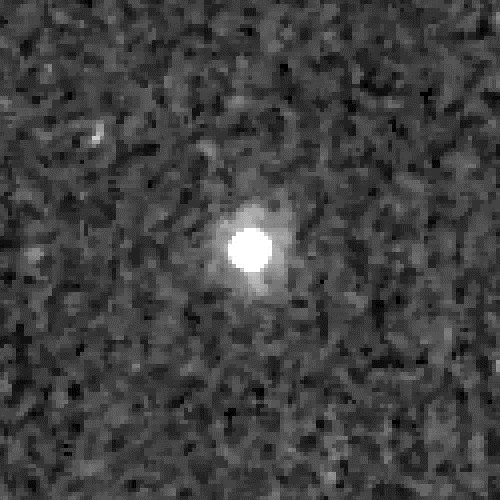
(84522) 2002 TC302 (provisional designation 2002 TC302) is a mid-sized trans-Neptunian object located in the outermost region of the Solar System. It was discovered on 9 October 2002, by American astronomers Mike Brown, Chad Trujillo and David Rabinowitz at the Palomar Observatory in California. The resonant trans-Neptunian object stays in a 2:5 resonance with Neptune. It has a reddish color, a rotation period of 56.1 hours and measures 500 kilometers (300 miles) in diameter.
2002 TC302 orbits the Sun at a distance of 39.2–71.4 AU once every 410 years and 12 months (150,105 days; semi-major axis of 55.28 AU). Its orbit has an eccentricity of 0.29 and an inclination of 35° with respect to the ecliptic. In December 2058, it will come to perihelion (minimum distance from the Sun) at 39.2 AU, which is about the same as Pluto's semi-major axis (average distance from the Sun). Given the long orbit that TNOs have around the Sun, 2002 TC302 comes to opposition in late October of each year at an apparent magnitude of 20.5.
Both the Minor Planet Center (MPC) and the Deep Ecliptic Survey (DES) show 2002 TC302 to be a resonant trans-Neptunian object in a 2:5 resonance with Neptune, meaning it completes two orbits for every five orbits of Neptune.
2002 TC302 has an absolute magnitude of 3.78. It has an estimated diameter of 584.1+105.6
−88.0 km. Using the Spitzer Space Telescope, it was previously estimated to have a diameter of 1145+337
−325 km, which would have made it one of the largest TNOs. This overestimation was due to insufficient motion to allow for a good sky subtraction, and because 2002 TC302 was very close to a brighter background object. Brown noted that the Spitzer measurement involved a very large potential error and that the object would likely be much smaller.
An occultation of a 15.3 magnitude star by 2002 TC302 on 28 January 2018 over Europe suggests that it has highly oblate shape with dimensions of 543.2±18 × 459.5±11 km and a projected axial ratio of a/c=1.18. The area equivalent diameter of 2002 TC302 is 499.6 km.
On 11 November 2021, an occultation across North America and Europe detected an oblate shape of 530 × 467 km (mean 499 km), in strong agreement with the 2018 occultation results. No satellites were detected.
Its rotation period was initially estimated by Thirouin et al. to be 5.41 h, based on a light-curve amplitude of 0.04±0.01 mag. However, this short rotation period was most likely an alias due to a bias for shorter and more easily discernable shorter periods. 2002 TC302 is highly oblate, and Ortiz et al. suggest a longer rotation period estimate of 56.1 hours.
In visible light, the surface of 2002 TC302 appears dark and reddish in color, with a geometric albedo of about 0.15. Spectroscopic observations by the James Webb Space Telescope (JWST) in 2023 have shown that 2002 TC302's surface is composed of water ice, carbon dioxide (CO2) ice, carbon monoxide (CO) ice, and various organic compounds (tholins). This composition is common among Kuiper belt objects. Analysis of JWST's spectroscopic observations has shown that the surface of 2002 TC302 is more abundant in CO2 ice than water ice, which suggests that its surface is covered with a thin (a few micrometres thick) layer of fine, micron-sized CO2 ice particles. CO ice is also abundant in 2002 TC302's surface, contrary to theoretical predictions that CO should sublimate and escape from 2002 TC302's surface at its temperature and distance from the Sun. Planetary scientists Michael E. Brown and Wesley C. Fraser have hypothesized that the Sun's ultraviolet light produces CO in 2002 TC302's surface by irradiating and breaking down CO2 molecules, and leaves the CO trapped within the surrounding CO2 ice. A similar scenario has been hypothesized for 145452 Ritona, another CO2-rich Kuiper belt object observed by JWST.
Hub AI
(84522) 2002 TC302 AI simulator
(@(84522) 2002 TC302_simulator)
(84522) 2002 TC302
(84522) 2002 TC302 (provisional designation 2002 TC302) is a mid-sized trans-Neptunian object located in the outermost region of the Solar System. It was discovered on 9 October 2002, by American astronomers Mike Brown, Chad Trujillo and David Rabinowitz at the Palomar Observatory in California. The resonant trans-Neptunian object stays in a 2:5 resonance with Neptune. It has a reddish color, a rotation period of 56.1 hours and measures 500 kilometers (300 miles) in diameter.
2002 TC302 orbits the Sun at a distance of 39.2–71.4 AU once every 410 years and 12 months (150,105 days; semi-major axis of 55.28 AU). Its orbit has an eccentricity of 0.29 and an inclination of 35° with respect to the ecliptic. In December 2058, it will come to perihelion (minimum distance from the Sun) at 39.2 AU, which is about the same as Pluto's semi-major axis (average distance from the Sun). Given the long orbit that TNOs have around the Sun, 2002 TC302 comes to opposition in late October of each year at an apparent magnitude of 20.5.
Both the Minor Planet Center (MPC) and the Deep Ecliptic Survey (DES) show 2002 TC302 to be a resonant trans-Neptunian object in a 2:5 resonance with Neptune, meaning it completes two orbits for every five orbits of Neptune.
2002 TC302 has an absolute magnitude of 3.78. It has an estimated diameter of 584.1+105.6
−88.0 km. Using the Spitzer Space Telescope, it was previously estimated to have a diameter of 1145+337
−325 km, which would have made it one of the largest TNOs. This overestimation was due to insufficient motion to allow for a good sky subtraction, and because 2002 TC302 was very close to a brighter background object. Brown noted that the Spitzer measurement involved a very large potential error and that the object would likely be much smaller.
An occultation of a 15.3 magnitude star by 2002 TC302 on 28 January 2018 over Europe suggests that it has highly oblate shape with dimensions of 543.2±18 × 459.5±11 km and a projected axial ratio of a/c=1.18. The area equivalent diameter of 2002 TC302 is 499.6 km.
On 11 November 2021, an occultation across North America and Europe detected an oblate shape of 530 × 467 km (mean 499 km), in strong agreement with the 2018 occultation results. No satellites were detected.
Its rotation period was initially estimated by Thirouin et al. to be 5.41 h, based on a light-curve amplitude of 0.04±0.01 mag. However, this short rotation period was most likely an alias due to a bias for shorter and more easily discernable shorter periods. 2002 TC302 is highly oblate, and Ortiz et al. suggest a longer rotation period estimate of 56.1 hours.
In visible light, the surface of 2002 TC302 appears dark and reddish in color, with a geometric albedo of about 0.15. Spectroscopic observations by the James Webb Space Telescope (JWST) in 2023 have shown that 2002 TC302's surface is composed of water ice, carbon dioxide (CO2) ice, carbon monoxide (CO) ice, and various organic compounds (tholins). This composition is common among Kuiper belt objects. Analysis of JWST's spectroscopic observations has shown that the surface of 2002 TC302 is more abundant in CO2 ice than water ice, which suggests that its surface is covered with a thin (a few micrometres thick) layer of fine, micron-sized CO2 ice particles. CO ice is also abundant in 2002 TC302's surface, contrary to theoretical predictions that CO should sublimate and escape from 2002 TC302's surface at its temperature and distance from the Sun. Planetary scientists Michael E. Brown and Wesley C. Fraser have hypothesized that the Sun's ultraviolet light produces CO in 2002 TC302's surface by irradiating and breaking down CO2 molecules, and leaves the CO trapped within the surrounding CO2 ice. A similar scenario has been hypothesized for 145452 Ritona, another CO2-rich Kuiper belt object observed by JWST.