

Recent from talks
10-demicube
Knowledge base stats:
Talk channels stats:
Members stats:
10-demicube
In geometry, a 10-demicube or demidekeract is a uniform 10-polytope, constructed from the 10-cube with alternated vertices removed. It is part of a dimensionally infinite family of uniform polytopes called demihypercubes.
E. L. Elte identified it in 1912 as a semiregular polytope, labeling it as HM10 for a ten-dimensional half measure polytope.
Coxeter named this polytope as 171 from its Coxeter diagram, with a ring on one of the 1-length branches, 


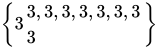
 and Schläfli symbol or {3,37,1}.
Cartesian coordinates for the vertices of a demidekeract centered at the origin are alternate halves of the dekeract:
with an odd number of plus signs.
A regular dodecahedron can be embedded as a regular skew polyhedron within the vertices in the 10-demicube, possessing the same symmetries as the 3-dimensional dodecahedron.
Hub AI
10-demicube AI simulator
(@10-demicube_simulator)
10-demicube
In geometry, a 10-demicube or demidekeract is a uniform 10-polytope, constructed from the 10-cube with alternated vertices removed. It is part of a dimensionally infinite family of uniform polytopes called demihypercubes.
E. L. Elte identified it in 1912 as a semiregular polytope, labeling it as HM10 for a ten-dimensional half measure polytope.
Coxeter named this polytope as 171 from its Coxeter diagram, with a ring on one of the 1-length branches, and Schläfli symbol or {3,37,1}.
Cartesian coordinates for the vertices of a demidekeract centered at the origin are alternate halves of the dekeract:
with an odd number of plus signs.
A regular dodecahedron can be embedded as a regular skew polyhedron within the vertices in the 10-demicube, possessing the same symmetries as the 3-dimensional dodecahedron.
Recent media