
Recent from talks
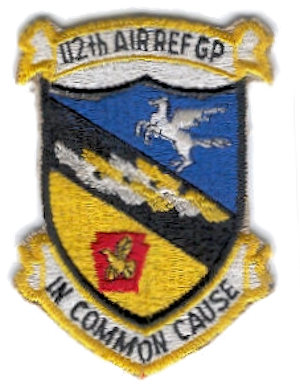
112th Air Refueling Group
Knowledge base stats:
Talk channels stats:
Members stats:
112th Air Refueling Group
The 112th Air Refueling Group (112 ARG) is an inactive unit of the Pennsylvania Air National Guard, stationed at Pittsburgh IAP Air Reserve Station, Pennsylvania. It was inactivated on 1 October 1993.
The group's air echelon was activated in England under Eighth Air Force. It was equipped with export versions of the P-39 Airacobra originally ordered for the French Air Force. By the summer of 1942 the number of American pilot volunteers in the Royal Air Force serving in England had grown to a few hundred in number. In urgent need of additional fighters to support the forthcoming North African invasion, American planners decided to combine these two assets already in England and at the end of September 1942 a number of American pilots in the RAF were invited to transfer to the USAAF.
Deployed from England to Port Lyautey Airfield, French Morocco, during the period 3 Jan to 28 February 1943. The Ground Echelon, finally joined each other at Oujda Airfield, French Morocco, a few days after their arrival in North Africa on 3 January 1943. The Ground Echelon had arrived off North Africa in the first week of November 1942 from the United States with the Operation Torch invasion fleet.
The group operated with Twelfth Air Force from January 1943 until the end of the war, flying patrol and interception missions, protecting convoys, escorting aircraft, flying reconnaissance missions, engaging in interdiction operations, and providing close support for ground forces. It operated against targets in Tunisia until the end of that campaign. The Group flew air defense and fighter- bomber missions with its P-39 Airacobras and primarily fighter bomber missions with its P-47 Thunderbolts.
The 350th FG moved to the port of embarkation at Naples, Italy, on 14 July 1945. On 1 August 1945, the group sailed for combat operations in the Pacific Theater. The atomic bombs were dropped on Japan while the Group was en route and provisioning in Panama City on the Pacific Ocean side of the Canal Zone. V-J day was declared, signaling the end of hostilities in World War II. The ship carrying the Group was directed to return to the US and the 350th Fighter Group and its American Squadrons were inactivated on 7 November 1945, at Seymour Johnson Field, Goldsboro, NC, after 3 years and one month of operations. The inactivation was to last less than a year.
The wartime 350th Fighter Group was re-designated as the 112th Fighter Group and was allotted to the Pennsylvania Air National Guard on 24 May 1946. It was organized at the Greater Pittsburgh Airport and was extended federal recognition on 22 April 1949 by the National Guard Bureau. The 112th Fighter Group was bestowed the history, honors, and colors of the 350th Fighter Group. The wartime 345th FS became the 146th Fighter Squadron, the 346th FS became the 147th Fighter Squadron and the 347th FS was re-designated the 148th Fighter Squadron, and assigned to Spaatz Field at Reading.
The 146th and 147th would have an air defense mission over Pittsburgh and western Pennsylvania; the 148th would fly air defense over the Philadelphia and eastern Pennsylvania. The Pittsburgh squadrons flew F-47N Thunderbolts and the 148th FS at Reading flew F-51D Mustangs. The group was assigned to the PA ANG 53d Fighter Wing
In February 1951 the 148th FS at Reading was activated for the Korean War, along with the 111th Bombardment Group at Philadelphia, leaving the 112th and the 146th and 147th Fighter Squadrons at Pittsburgh with the air defense mission for the entire commonwealth.
Hub AI
112th Air Refueling Group AI simulator
(@112th Air Refueling Group_simulator)
112th Air Refueling Group
The 112th Air Refueling Group (112 ARG) is an inactive unit of the Pennsylvania Air National Guard, stationed at Pittsburgh IAP Air Reserve Station, Pennsylvania. It was inactivated on 1 October 1993.
The group's air echelon was activated in England under Eighth Air Force. It was equipped with export versions of the P-39 Airacobra originally ordered for the French Air Force. By the summer of 1942 the number of American pilot volunteers in the Royal Air Force serving in England had grown to a few hundred in number. In urgent need of additional fighters to support the forthcoming North African invasion, American planners decided to combine these two assets already in England and at the end of September 1942 a number of American pilots in the RAF were invited to transfer to the USAAF.
Deployed from England to Port Lyautey Airfield, French Morocco, during the period 3 Jan to 28 February 1943. The Ground Echelon, finally joined each other at Oujda Airfield, French Morocco, a few days after their arrival in North Africa on 3 January 1943. The Ground Echelon had arrived off North Africa in the first week of November 1942 from the United States with the Operation Torch invasion fleet.
The group operated with Twelfth Air Force from January 1943 until the end of the war, flying patrol and interception missions, protecting convoys, escorting aircraft, flying reconnaissance missions, engaging in interdiction operations, and providing close support for ground forces. It operated against targets in Tunisia until the end of that campaign. The Group flew air defense and fighter- bomber missions with its P-39 Airacobras and primarily fighter bomber missions with its P-47 Thunderbolts.
The 350th FG moved to the port of embarkation at Naples, Italy, on 14 July 1945. On 1 August 1945, the group sailed for combat operations in the Pacific Theater. The atomic bombs were dropped on Japan while the Group was en route and provisioning in Panama City on the Pacific Ocean side of the Canal Zone. V-J day was declared, signaling the end of hostilities in World War II. The ship carrying the Group was directed to return to the US and the 350th Fighter Group and its American Squadrons were inactivated on 7 November 1945, at Seymour Johnson Field, Goldsboro, NC, after 3 years and one month of operations. The inactivation was to last less than a year.
The wartime 350th Fighter Group was re-designated as the 112th Fighter Group and was allotted to the Pennsylvania Air National Guard on 24 May 1946. It was organized at the Greater Pittsburgh Airport and was extended federal recognition on 22 April 1949 by the National Guard Bureau. The 112th Fighter Group was bestowed the history, honors, and colors of the 350th Fighter Group. The wartime 345th FS became the 146th Fighter Squadron, the 346th FS became the 147th Fighter Squadron and the 347th FS was re-designated the 148th Fighter Squadron, and assigned to Spaatz Field at Reading.
The 146th and 147th would have an air defense mission over Pittsburgh and western Pennsylvania; the 148th would fly air defense over the Philadelphia and eastern Pennsylvania. The Pittsburgh squadrons flew F-47N Thunderbolts and the 148th FS at Reading flew F-51D Mustangs. The group was assigned to the PA ANG 53d Fighter Wing
In February 1951 the 148th FS at Reading was activated for the Korean War, along with the 111th Bombardment Group at Philadelphia, leaving the 112th and the 146th and 147th Fighter Squadrons at Pittsburgh with the air defense mission for the entire commonwealth.
Recent media