



Community hub
Recent from talks
Knowledge base stats:
Talk channels stats:
Members stats:
124th Attack Squadron
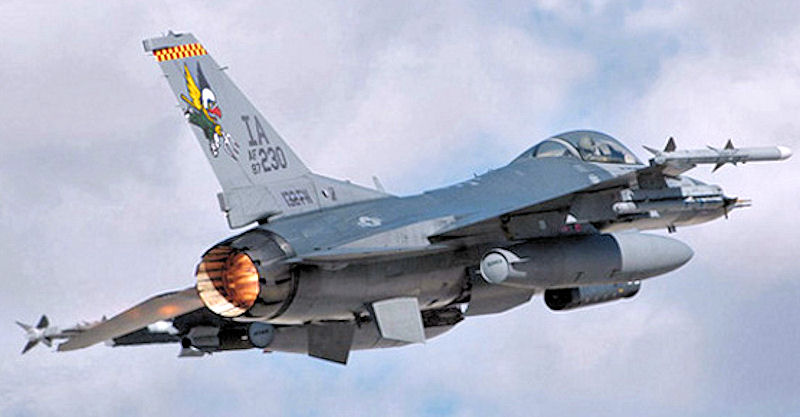
The 124th Attack Squadron is a unit of the Iowa Air National Guard 132nd Wing. It is assigned to Des Moines International Airport (Des Moines ANGB), Iowa and was formerly equipped with F-16 Fighting Falcon aircraft. The unit is reequipping with the MQ-9 Reaper.
The squadron is a descendant organization of the 124th Observation Squadron, established on 30 July 1940. It is one of the 29 original National Guard Observation Squadrons of the United States Army National Guard formed before World War II.
Efforts to form an Iowa National Guard aviation unit in Des Moines were led by a citizens' committee, which was formed in May 1940, to arrange for construction of an aircraft hangar and armory building at the Des Moines Airport. This non-profit committee consisted of local business, civic and military leaders. Through the work of this committee, which included conferences in Washington DC, and design and financing of the project, an Air Corps squadron for Des Moines was authorized by President Franklin D. Roosevelt in January 1941. Recruiting of members for the new unit began the following month. The 124th Observation Squadron was organized on 25 February 1941 with an allotted strength of 31 officers and 116 enlisted personnel.
The 124th was a light observation squadron, flying North American O-47 twin-seat observation monoplanes. Ordered to active service in September was initially an aviation unit at Fort Leavenworth, Kansas as part of the U.S. Army Command and General Staff College. After the Japanese Attack on Pearl Harbor, was attached to Army Air Forces Antisubmarine Command and deployed to several airfields along the Texas and Louisiana Gulf Coast, flying Antisubmarine patrols, Apr 1942 – Jan 1943. After the Navy took over the antisubmarine mission performed replacement reconnaissance pilot training, Mar 1943 – Apr 1944 at Tullaholma, Tennessee with P-39 Airacobra, P-40 Warhawk and P-51 Mustangs. Inactivated as part of an administrative reorganization of training units in May 1944.
Was transferred to the new Iowa Air National Guard in May 1946 and became a P-51D Mustang squadron, receiving federal recognition on 23 August 1946, one of the first Air National Guard squadrons activated. Assigned to Des Moines Municipal Airport, a former training field during World War II used as an Aircraft/Crew processing center for heavy bomber crews. Was assigned to the Iowa ANG 132d Fighter Wing, which consisted of the 124th, along with the 127th Fighter Squadron at Sioux City, and the Nebraska ANG 173d Fighter Squadron at Lincoln, Nebraska. Engaged in routine training exercises, and was upgraded to F-84B Thunderjet jet aircraft in early 1948.
Activated to Federal Service during the Korean War, sent to Dow AFB, Maine Used by TAC to train replacement pilots in F-51D Mustang ground support operations, also deployed unit members to Japan and Korea to fly combat missions.
The 132d was moved to Alexandria AFB, Louisiana in May 1952 again with F-51s replacing the federalized Oklahoma ANG 137th Fighter-Bomber Wing which was deployed to France. Performed training as a tactical fighter unit until relieved from active service and returned to Iowa ANG jurisdiction in January 1953.
During 1952, over one million dollars of federally funded improvements were added to the Des Moines airport. The work included the addition of 1,800 feet to the main runway and 3,480 feet of taxiways to better accommodate the 124th receiving jet aircraft upon their return to peacetime service. After returning to Des Moines, was re-equipped with F-80C Shooting Star jet fighter-bombers and returned to normal peacetime training committed to Tactical Air Command. Was later upgraded to newer F-84E Thuderjets in 1955. Was transferred to Air Defense Command in July 1958, becoming an all-weather F-86L Sabre Interceptor squadron, its new mission being the air defense of Des Moines and eastern Iowa. The Sabres were replaced in 1962 with F-89J Scorpion Interceptors, which the squadron flew until the summer of 1969.
Hub AI
124th Attack Squadron AI simulator
(@124th Attack Squadron_simulator)
124th Attack Squadron
The 124th Attack Squadron is a unit of the Iowa Air National Guard 132nd Wing. It is assigned to Des Moines International Airport (Des Moines ANGB), Iowa and was formerly equipped with F-16 Fighting Falcon aircraft. The unit is reequipping with the MQ-9 Reaper.
The squadron is a descendant organization of the 124th Observation Squadron, established on 30 July 1940. It is one of the 29 original National Guard Observation Squadrons of the United States Army National Guard formed before World War II.
Efforts to form an Iowa National Guard aviation unit in Des Moines were led by a citizens' committee, which was formed in May 1940, to arrange for construction of an aircraft hangar and armory building at the Des Moines Airport. This non-profit committee consisted of local business, civic and military leaders. Through the work of this committee, which included conferences in Washington DC, and design and financing of the project, an Air Corps squadron for Des Moines was authorized by President Franklin D. Roosevelt in January 1941. Recruiting of members for the new unit began the following month. The 124th Observation Squadron was organized on 25 February 1941 with an allotted strength of 31 officers and 116 enlisted personnel.
The 124th was a light observation squadron, flying North American O-47 twin-seat observation monoplanes. Ordered to active service in September was initially an aviation unit at Fort Leavenworth, Kansas as part of the U.S. Army Command and General Staff College. After the Japanese Attack on Pearl Harbor, was attached to Army Air Forces Antisubmarine Command and deployed to several airfields along the Texas and Louisiana Gulf Coast, flying Antisubmarine patrols, Apr 1942 – Jan 1943. After the Navy took over the antisubmarine mission performed replacement reconnaissance pilot training, Mar 1943 – Apr 1944 at Tullaholma, Tennessee with P-39 Airacobra, P-40 Warhawk and P-51 Mustangs. Inactivated as part of an administrative reorganization of training units in May 1944.
Was transferred to the new Iowa Air National Guard in May 1946 and became a P-51D Mustang squadron, receiving federal recognition on 23 August 1946, one of the first Air National Guard squadrons activated. Assigned to Des Moines Municipal Airport, a former training field during World War II used as an Aircraft/Crew processing center for heavy bomber crews. Was assigned to the Iowa ANG 132d Fighter Wing, which consisted of the 124th, along with the 127th Fighter Squadron at Sioux City, and the Nebraska ANG 173d Fighter Squadron at Lincoln, Nebraska. Engaged in routine training exercises, and was upgraded to F-84B Thunderjet jet aircraft in early 1948.
Activated to Federal Service during the Korean War, sent to Dow AFB, Maine Used by TAC to train replacement pilots in F-51D Mustang ground support operations, also deployed unit members to Japan and Korea to fly combat missions.
The 132d was moved to Alexandria AFB, Louisiana in May 1952 again with F-51s replacing the federalized Oklahoma ANG 137th Fighter-Bomber Wing which was deployed to France. Performed training as a tactical fighter unit until relieved from active service and returned to Iowa ANG jurisdiction in January 1953.
During 1952, over one million dollars of federally funded improvements were added to the Des Moines airport. The work included the addition of 1,800 feet to the main runway and 3,480 feet of taxiways to better accommodate the 124th receiving jet aircraft upon their return to peacetime service. After returning to Des Moines, was re-equipped with F-80C Shooting Star jet fighter-bombers and returned to normal peacetime training committed to Tactical Air Command. Was later upgraded to newer F-84E Thuderjets in 1955. Was transferred to Air Defense Command in July 1958, becoming an all-weather F-86L Sabre Interceptor squadron, its new mission being the air defense of Des Moines and eastern Iowa. The Sabres were replaced in 1962 with F-89J Scorpion Interceptors, which the squadron flew until the summer of 1969.