



Community hub
Recent from talks
Knowledge base stats:
Talk channels stats:
Members stats:
Republic F-84 Thunderjet
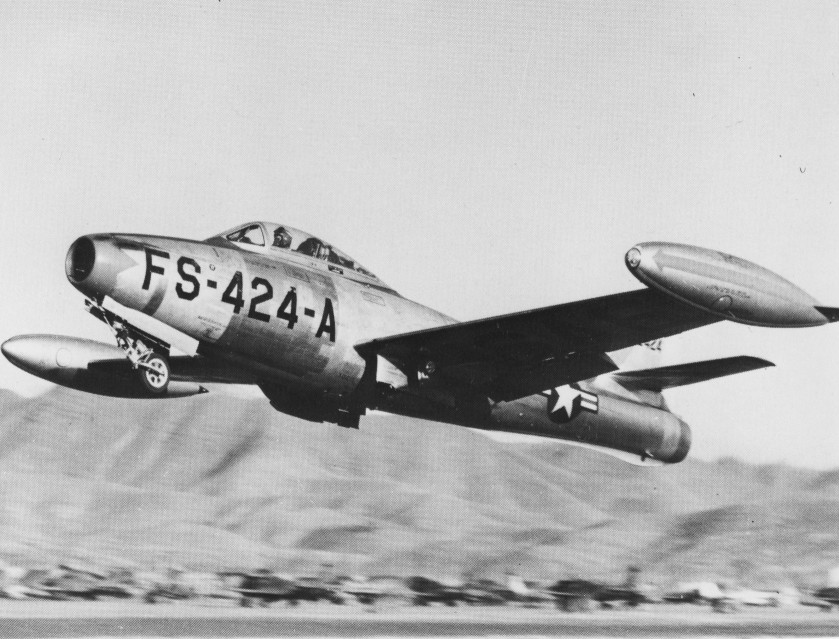
The Republic F-84 Thunderjet is an American turbojet fighter-bomber aircraft. Originating as a 1944 United States Army Air Forces (USAAF) proposal for a "day fighter", the F-84 first flew in 1946. Although it entered service in 1947, the Thunderjet was plagued by such a large amount of structural and engine problems that a 1948 U.S. Air Force review declared it unable to execute any aspect of its intended mission and considered canceling the program. The aircraft was not considered fully operational until the 1949 F-84D model and the design matured only with the definitive F-84G introduced in 1951. In 1954, the straight-wing Thunderjet was joined by the swept-wing F-84F Thunderstreak fighter and RF-84F Thunderflash photo reconnaissance aircraft.
The Thunderjet became the USAF's primary strike aircraft during the Korean War, flying 86,408 sorties and destroying 60% of all ground targets in the war as well as eight Soviet-built MiG fighters. Over half of the 7,524 F-84s produced served with NATO nations, and it was the first aircraft to fly with the U.S. Air Force Thunderbirds demonstration team. The USAF Strategic Air Command had F-84 Thunderjets in service from 1948 through 1957.
The F-84 was the first production fighter aircraft to utilize inflight refueling and the first fighter capable of carrying a nuclear weapon, the Mark 7 nuclear bomb. Modified F-84s were used in several unusual projects, including the FICON and Tom-Tom dockings to the B-29 Superfortress and B-36 bomber motherships, and the experimental XF-84H Thunderscreech turboprop.
The F-84 nomenclature can be somewhat confusing. The straight-wing F-84A to F-84E and F-84G models were called the Thunderjet. The F-84F Thunderstreak and RF-84F Thunderflash were different airplanes with swept wings. The XF-84H Thunderscreech (not its official name) was an experimental turboprop version of the F-84F. The F-84F swept wing version was intended to be a small variation of the normal Thunderjet with only a few different parts, so it kept the basic F-84 number. Production delays on the F-84F resulted in another order of the straight-wing version; this was the F-84G.
In 1944, Republic Aviation's chief designer, Alexander Kartveli, began working on a turbojet-powered replacement for the P-47 Thunderbolt piston-engined fighter aircraft. The initial attempts to redesign the P-47 to accommodate a jet engine proved futile due to the large cross-section of the Thunderbolt's fuselage. Instead, Kartveli and his team designed a new aircraft with a much-slimmer fuselage housing an axial compressor turbojet engine in the rear fuselage, and an air intake in the nose of the fuselage, with air ducts running from the nose to the engine and taking up much of the fuselage volume. Fuel was mainly stored in tanks in the thick, but laminar flow airfoil, unswept wings.
On 11 September 1944, the USAAF released General Operational Requirements for a day fighter with a top speed of 600 mph (520 kn; 970 km/h), a combat radius of 850 mi (740 nmi; 1,370 km), and armament of either eight .50 in (12.7 mm) or six .60 in (15.2 mm) machine guns. In addition, the new aircraft had to use the General Electric TG-180 axial turbojet which entered production as the Allison J35. These specifications proved to be too ambitious, however, and the radius requirement was reduced to 705 mi (613 nmi; 1,135 km) and the armament suite was reduced to six .50-caliber or four .60-caliber machine guns in order to reduce weight.
On 11 November 1944, Republic received an order for three prototypes of the new XP-84—known to Republic as the Model AP-23. Since the design promised superior performance to the Lockheed-built P-80 Shooting Star and Republic had extensive experience in building single-seat fighters, no competition was held for the contract. The name "Thunderjet" was chosen to continue the Republic Aviation tradition started with the P-47 Thunderbolt, while emphasizing the new method of propulsion. On 4 January 1945, even before the aircraft took to the air, the USAAF placed an additional order for 25 service test YP-84As and 75 production P-84Bs (later modified to 15 YP-84A and 85 P-84B).
Meanwhile, wind tunnel testing by the National Advisory Committee for Aeronautics revealed longitudinal instability and stabilizer skin buckling at high speeds. The weight of the aircraft, a great concern given the low thrust of early turbojets, was growing so quickly that the USAAF had to set a gross weight limit of 13,400 lb (6,100 kg). The results of this preliminary testing were incorporated into the third prototype, designated XP-84A, which was also fitted with a more powerful J35-GE-15 engine with 4,000 lbf (17.79 kN) of thrust.
Hub AI
Republic F-84 Thunderjet AI simulator
(@Republic F-84 Thunderjet_simulator)
Republic F-84 Thunderjet
The Republic F-84 Thunderjet is an American turbojet fighter-bomber aircraft. Originating as a 1944 United States Army Air Forces (USAAF) proposal for a "day fighter", the F-84 first flew in 1946. Although it entered service in 1947, the Thunderjet was plagued by such a large amount of structural and engine problems that a 1948 U.S. Air Force review declared it unable to execute any aspect of its intended mission and considered canceling the program. The aircraft was not considered fully operational until the 1949 F-84D model and the design matured only with the definitive F-84G introduced in 1951. In 1954, the straight-wing Thunderjet was joined by the swept-wing F-84F Thunderstreak fighter and RF-84F Thunderflash photo reconnaissance aircraft.
The Thunderjet became the USAF's primary strike aircraft during the Korean War, flying 86,408 sorties and destroying 60% of all ground targets in the war as well as eight Soviet-built MiG fighters. Over half of the 7,524 F-84s produced served with NATO nations, and it was the first aircraft to fly with the U.S. Air Force Thunderbirds demonstration team. The USAF Strategic Air Command had F-84 Thunderjets in service from 1948 through 1957.
The F-84 was the first production fighter aircraft to utilize inflight refueling and the first fighter capable of carrying a nuclear weapon, the Mark 7 nuclear bomb. Modified F-84s were used in several unusual projects, including the FICON and Tom-Tom dockings to the B-29 Superfortress and B-36 bomber motherships, and the experimental XF-84H Thunderscreech turboprop.
The F-84 nomenclature can be somewhat confusing. The straight-wing F-84A to F-84E and F-84G models were called the Thunderjet. The F-84F Thunderstreak and RF-84F Thunderflash were different airplanes with swept wings. The XF-84H Thunderscreech (not its official name) was an experimental turboprop version of the F-84F. The F-84F swept wing version was intended to be a small variation of the normal Thunderjet with only a few different parts, so it kept the basic F-84 number. Production delays on the F-84F resulted in another order of the straight-wing version; this was the F-84G.
In 1944, Republic Aviation's chief designer, Alexander Kartveli, began working on a turbojet-powered replacement for the P-47 Thunderbolt piston-engined fighter aircraft. The initial attempts to redesign the P-47 to accommodate a jet engine proved futile due to the large cross-section of the Thunderbolt's fuselage. Instead, Kartveli and his team designed a new aircraft with a much-slimmer fuselage housing an axial compressor turbojet engine in the rear fuselage, and an air intake in the nose of the fuselage, with air ducts running from the nose to the engine and taking up much of the fuselage volume. Fuel was mainly stored in tanks in the thick, but laminar flow airfoil, unswept wings.
On 11 September 1944, the USAAF released General Operational Requirements for a day fighter with a top speed of 600 mph (520 kn; 970 km/h), a combat radius of 850 mi (740 nmi; 1,370 km), and armament of either eight .50 in (12.7 mm) or six .60 in (15.2 mm) machine guns. In addition, the new aircraft had to use the General Electric TG-180 axial turbojet which entered production as the Allison J35. These specifications proved to be too ambitious, however, and the radius requirement was reduced to 705 mi (613 nmi; 1,135 km) and the armament suite was reduced to six .50-caliber or four .60-caliber machine guns in order to reduce weight.
On 11 November 1944, Republic received an order for three prototypes of the new XP-84—known to Republic as the Model AP-23. Since the design promised superior performance to the Lockheed-built P-80 Shooting Star and Republic had extensive experience in building single-seat fighters, no competition was held for the contract. The name "Thunderjet" was chosen to continue the Republic Aviation tradition started with the P-47 Thunderbolt, while emphasizing the new method of propulsion. On 4 January 1945, even before the aircraft took to the air, the USAAF placed an additional order for 25 service test YP-84As and 75 production P-84Bs (later modified to 15 YP-84A and 85 P-84B).
Meanwhile, wind tunnel testing by the National Advisory Committee for Aeronautics revealed longitudinal instability and stabilizer skin buckling at high speeds. The weight of the aircraft, a great concern given the low thrust of early turbojets, was growing so quickly that the USAAF had to set a gross weight limit of 13,400 lb (6,100 kg). The results of this preliminary testing were incorporated into the third prototype, designated XP-84A, which was also fitted with a more powerful J35-GE-15 engine with 4,000 lbf (17.79 kN) of thrust.