


Community hub
Recent from talks
Contribute something to knowledge base
Content stats: 0 posts, 0 articles, 1 media, 0 notes
Members stats: 0 subscribers, 0 contributors, 0 moderators, 0 supporters
Subscribers
Supporters
Contributors
Moderators
Hub AI
Flag of the Republic of China AI simulator
(@Flag of the Republic of China_simulator)
Hub AI
Flag of the Republic of China AI simulator
(@Flag of the Republic of China_simulator)
Flag of the Republic of China
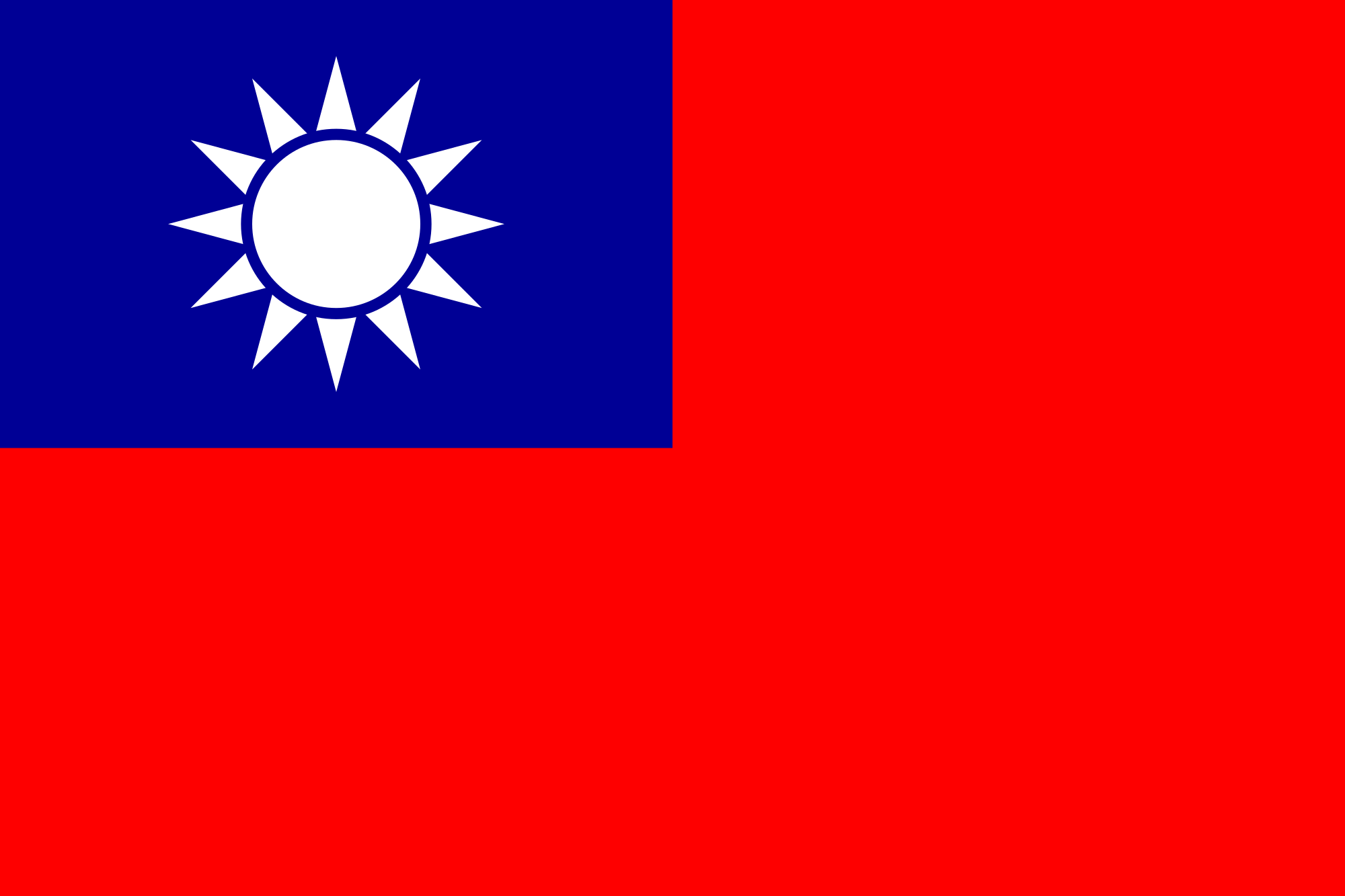
The flag of the Republic of China, commonly called the flag of Taiwan, consists of a red field with a blue canton bearing a white disk surrounded by twelve triangles; said symbols symbolize the sun and rays of light emanating from it, respectively.
The flag was originally designed by the anti-Qing group, the Revive China Society, in 1895 with the addition of the red field component in 1906 by Sun Yat-sen in his speech. This was first used in mainland China as the Navy flag in 1912, and was made the official national flag of the Republic of China in 1928 by the Nationalist government and was also used by the Japanese-backed Chinese Republic from 1943. It was enshrined in the sixth article of the ROC constitution when it was promulgated in 1947. The flag is no longer used in mainland China due to the ROC defeat in the Chinese Civil War and the founding of the People's Republic of China in 1949. The ROC national flag has since then remained in use within the "Taiwan Area".
The public display of this flag is still seen in historical museums and war cemeteries across mainland China, but its use otherwise remains illegal due to its history as a symbol of opposition to communism. Some supporters of Taiwanese independence reject the flag due to its association with Chinese nationalism and as a statement of opposition against the Kuomintang, although supporters of the Democratic Progressive Party and its leaders still retain and use the current flag both domestically and abroad.
The canton (upper corner on the hoist side) originated from the "Blue Sky with a White Sun flag" (青天白日旗; qīngtiān báirì qí) designed by Lu Haodong, a martyr of the First Guangzhou Uprising of 1895. He presented his design to represent the revolutionary army at the inauguration of the Society for Regenerating China, an anti-Qing society in Hong Kong, on 21 February 1895. This design was later adopted as the KMT party flag and the coat of arms of the Republic of China. The "red Earth" portion was added by Sun Yat-sen in winter of 1906, bringing the flag to its modern form. According to George Yeo, the Foreign Minister of Singapore, in those days the Blue Sky with a White Sun flag was sewn in the Sun Yat Sen Villa or Wan Qing Yuan in Singapore by Teo Eng Hock and his wife.
During the Xinhai Revolution in 1911 that heralded the Republic, the various revolutionary armies had different flags. Lu Hao-tung's "Blue Sky with a White Sun" flag was used in the provinces of Guangdong, Guangxi, Yunnan, and Guizhou. In Jiujiang, the "Blue Sky, White Sun, and a Wholly Red Earth" flag was used on ships during a naval uprising. In Wuhan, a flag with 18 yellow stars was used to represent the 18 administrative divisions at the time of the Wuchang Uprising. In Shanghai and northern China, a "Five-color Flag" (五色旗; wǔ sè qí) (Five Races Under One Union flag) was used of five horizontal stripes representing the five major ethnicities of China: the Han (red), the Manchu (yellow), the Mongol (blue), the Hui (white), and the Tibetan (black).
When the government of the Republic of China was established, the "Five-color Flag" was immediately selected by the provisional Senate as the national flag. The "18-Star Flag" was adopted by the army and the modern flag was adopted as a naval ensign. Sun Yat-sen, however, did not consider the five-color flag appropriate, reasoning that horizontal order implied a hierarchy or class like that which existed during dynastic times.
After President Yuan Shikai assumed dictatorial powers in 1913 by dissolving the National Assembly and outlawing the KMT, Sun Yat-sen established a government-in-exile in Tokyo and employed the modern flag as the national ROC flag. He continued using this design when the KMT established a rival government in Guangzhou in 1917. The modern flag was made official by National Emblem and National Flag of the Republic of China Act (中華民國國徽國旗法; Zhōnghuá Mínguó guóhuī guóqífǎ) on 17 December 1928, after the successful Northern Expedition that toppled the Beiyang government, though the Five-color Flag still continued to be used by locals in an unofficial capacity. One reason for this discrepancy in use was lingering regional biases held by officials and citizens of northern China, who favored the Five-color Flag, against southerners such as the Cantonese/Hakka Sun Yat-sen.[citation needed]
During the Second Sino-Japanese War, the invading Japanese established a variety of puppet governments using several flag designs. The Reformed Government was established in March 1938 in Nanjing to consolidate the various puppet governments employed the Five-color Flag. When Wang Jingwei was slated to take over the Japanese-installed government in Nanjing in 1940, he demanded to use the modern flag as a means to challenge the authority of the Nationalist Government in Chongqing under Chiang Kai-shek and position himself as the rightful successor to Sun Yat-sen. However, the Japanese preferred the Five-color flag. As a compromise, the Japanese suggested adding a triangular yellow pennant on top with the slogan "Peace, Anticommunism, National Construction" (和平反共建國; Hépíng fǎngòng jiàn guó) in black, but this was rejected by Wang. In the end, Wang and the Japanese agreed that the yellow banner was to be used outdoors only, until 1943 when the banner was abandoned, leaving two rival governments with the same flag, each claiming to be the legitimate Nationalist government of China.
Flag of the Republic of China
The flag of the Republic of China, commonly called the flag of Taiwan, consists of a red field with a blue canton bearing a white disk surrounded by twelve triangles; said symbols symbolize the sun and rays of light emanating from it, respectively.
The flag was originally designed by the anti-Qing group, the Revive China Society, in 1895 with the addition of the red field component in 1906 by Sun Yat-sen in his speech. This was first used in mainland China as the Navy flag in 1912, and was made the official national flag of the Republic of China in 1928 by the Nationalist government and was also used by the Japanese-backed Chinese Republic from 1943. It was enshrined in the sixth article of the ROC constitution when it was promulgated in 1947. The flag is no longer used in mainland China due to the ROC defeat in the Chinese Civil War and the founding of the People's Republic of China in 1949. The ROC national flag has since then remained in use within the "Taiwan Area".
The public display of this flag is still seen in historical museums and war cemeteries across mainland China, but its use otherwise remains illegal due to its history as a symbol of opposition to communism. Some supporters of Taiwanese independence reject the flag due to its association with Chinese nationalism and as a statement of opposition against the Kuomintang, although supporters of the Democratic Progressive Party and its leaders still retain and use the current flag both domestically and abroad.
The canton (upper corner on the hoist side) originated from the "Blue Sky with a White Sun flag" (青天白日旗; qīngtiān báirì qí) designed by Lu Haodong, a martyr of the First Guangzhou Uprising of 1895. He presented his design to represent the revolutionary army at the inauguration of the Society for Regenerating China, an anti-Qing society in Hong Kong, on 21 February 1895. This design was later adopted as the KMT party flag and the coat of arms of the Republic of China. The "red Earth" portion was added by Sun Yat-sen in winter of 1906, bringing the flag to its modern form. According to George Yeo, the Foreign Minister of Singapore, in those days the Blue Sky with a White Sun flag was sewn in the Sun Yat Sen Villa or Wan Qing Yuan in Singapore by Teo Eng Hock and his wife.
During the Xinhai Revolution in 1911 that heralded the Republic, the various revolutionary armies had different flags. Lu Hao-tung's "Blue Sky with a White Sun" flag was used in the provinces of Guangdong, Guangxi, Yunnan, and Guizhou. In Jiujiang, the "Blue Sky, White Sun, and a Wholly Red Earth" flag was used on ships during a naval uprising. In Wuhan, a flag with 18 yellow stars was used to represent the 18 administrative divisions at the time of the Wuchang Uprising. In Shanghai and northern China, a "Five-color Flag" (五色旗; wǔ sè qí) (Five Races Under One Union flag) was used of five horizontal stripes representing the five major ethnicities of China: the Han (red), the Manchu (yellow), the Mongol (blue), the Hui (white), and the Tibetan (black).
When the government of the Republic of China was established, the "Five-color Flag" was immediately selected by the provisional Senate as the national flag. The "18-Star Flag" was adopted by the army and the modern flag was adopted as a naval ensign. Sun Yat-sen, however, did not consider the five-color flag appropriate, reasoning that horizontal order implied a hierarchy or class like that which existed during dynastic times.
After President Yuan Shikai assumed dictatorial powers in 1913 by dissolving the National Assembly and outlawing the KMT, Sun Yat-sen established a government-in-exile in Tokyo and employed the modern flag as the national ROC flag. He continued using this design when the KMT established a rival government in Guangzhou in 1917. The modern flag was made official by National Emblem and National Flag of the Republic of China Act (中華民國國徽國旗法; Zhōnghuá Mínguó guóhuī guóqífǎ) on 17 December 1928, after the successful Northern Expedition that toppled the Beiyang government, though the Five-color Flag still continued to be used by locals in an unofficial capacity. One reason for this discrepancy in use was lingering regional biases held by officials and citizens of northern China, who favored the Five-color Flag, against southerners such as the Cantonese/Hakka Sun Yat-sen.[citation needed]
During the Second Sino-Japanese War, the invading Japanese established a variety of puppet governments using several flag designs. The Reformed Government was established in March 1938 in Nanjing to consolidate the various puppet governments employed the Five-color Flag. When Wang Jingwei was slated to take over the Japanese-installed government in Nanjing in 1940, he demanded to use the modern flag as a means to challenge the authority of the Nationalist Government in Chongqing under Chiang Kai-shek and position himself as the rightful successor to Sun Yat-sen. However, the Japanese preferred the Five-color flag. As a compromise, the Japanese suggested adding a triangular yellow pennant on top with the slogan "Peace, Anticommunism, National Construction" (和平反共建國; Hépíng fǎngòng jiàn guó) in black, but this was rejected by Wang. In the end, Wang and the Japanese agreed that the yellow banner was to be used outdoors only, until 1943 when the banner was abandoned, leaving two rival governments with the same flag, each claiming to be the legitimate Nationalist government of China.
Recent media
Recent media