
Recent from talks
1962 Rangoon University protests
Knowledge base stats:
Talk channels stats:
Members stats:
1962 Rangoon University protests
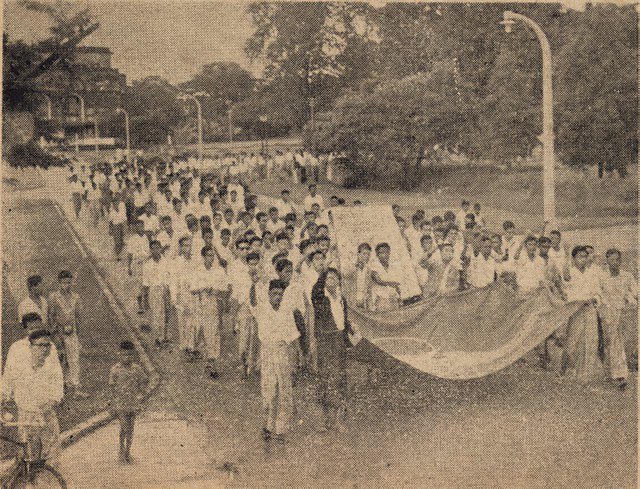
The 1962 Rangoon University protests, also known as the 7 July Student Uprising (Burmese: ဆဲဗင်းဂျူလိုင် ကျောင်းသား အရေးတော်ပုံ), were a series of marches, demonstrations, and protests against stricter campus regulations, the end of the system of university self-administration, and the policy of the new military regime of General Ne Win. The main events took place in Rangoon, Burma (present-day Yangon, Myanmar), from 7 to 8 July 1962. On 7 July the military regime violently suppressed a student demonstration at Rangoon University attended by some 5,000 students. This resulted in the deaths of more than one hundred, and the arrest of more than 6,000 students according to unofficial sources. However, official government statements put the death toll at 15. In the morning hours of the next day, the military regime blew up the historic Rangoon University Students' Union (RUSU) building, which had been the symbol of the anti-colonial nationalism struggle since the 1920s.
The reaction of the military regime disclosed for the first time its new tough stance against all regime opponents as part of implementing the new state ideology, the Burmese Way to Socialism, which included bringing "almost all of Burma's political, social, and economic life under strict military control". It also demonstrated that the effective suppression of student activism and the de-politicisation of the universities ranked high among the strategic goals of the new government. Students had been in the vanguard of the Burmese anti-colonial nationalist struggle ever since the first student protests in Burma began in 1920. Although the regime had been successful in ending the student protests, the violent reaction nonetheless undermined its support among the broader population and created a symbolic focal point for later student protests in the following decades.
In the aftermath of the violent crackdown on the student protests, the Government of Ne Win immediately closed all universities for four months and sent all students home. Broad institutional reforms introduced by the 1964 University Education Act, then, brought Burma's universities under strict government control and profoundly hampered cohesive open student activism in subsequent decades. In this respect, the result of the 1962 Rangoon University protests ushered a new era of underground student activism in which open mass student involvement in national politics erupted only sporadically, most prominently during the student protests of the mid-1970s and during the 8888 Uprising in 1988.
The reverberation of the events on 7–8 July 1962 can be felt to this day. General Ne Win prominently illustrated the continuing symbolic power associated with the protests when he referred in his departure speech in 1988 to the destruction of the RUSU building as "one of the key episodes" during his time in power. As recently as 2012 around 14 persons were "taken into custody by local authorities ... to prevent them from going ahead with planned events to mark the 50th anniversary" of the 7 July incidents.
Since Rangoon University was founded in 1920 as the first university in the British colony of Burma, student activism persistently influenced the development of Burma throughout entirely different regimes. The academic autonomy of Rangoon University was protected by the Rangoon University Act. Students at varies schools even protested the passing of the University Act leading to the formation, in 1921, of the National College which unlike Rangoon included courses taught in Burmese.
Taking advantage of the fact that students—together with the sangha (monastic communities)—enjoyed the greatest degree of freedom of all Burmese societal groups during colonial times, they positioned themselves in the vanguard of the anti-colonial movement, especially during the anti-colonial struggles of the 1930s. Rangoon University featured prominently as the centre of civil discontent in Burma during the colonial period with all three major strikes against British rule (1920, 1936 and 1938) starting there. It was during this time, when students filled the power vacuum left by the domestic opposition, they were able to develop a strong shared student identity which became the focal point for later political student activities to come. Moreover, higher education proved crucial for elite formation, which was manifested, among other things, in Rangoon University producing some of the most influential political leaders of Burma.
A relatively high degree of autonomy from the government characterised student unions during the parliamentary phase in post-independence Burma. Nonetheless, they were able to exercise considerable political influence because of their close entanglement with the political parties on the national level. However, student activists were divided along party lines. Consequently, all three large student organisations were "affiliated to various political groups that were competing for political power". Overall, student activities exhibited a propensity to act in favour of anti-government activities as left-wing students, who were members or supporters of various left-wing political parties, dominated the student unions.
Military rule, however, heralded a new phase of student activism in Burma characterised by violent confrontations between protesting students and government forces. On 2 March 1962, the military led by General Ne Win took control of Burma through a coup d'état. Not encountering strong resistance from any segment of Burmese society the new regime seized power with almost no use of violence. The army arrested leading elites of the toppled regime, including "the president, the prime minister, members of the cabinet, and justices of the court" as well as leaders of Burmese ethnic minority groups.
Hub AI
1962 Rangoon University protests AI simulator
(@1962 Rangoon University protests_simulator)
1962 Rangoon University protests
The 1962 Rangoon University protests, also known as the 7 July Student Uprising (Burmese: ဆဲဗင်းဂျူလိုင် ကျောင်းသား အရေးတော်ပုံ), were a series of marches, demonstrations, and protests against stricter campus regulations, the end of the system of university self-administration, and the policy of the new military regime of General Ne Win. The main events took place in Rangoon, Burma (present-day Yangon, Myanmar), from 7 to 8 July 1962. On 7 July the military regime violently suppressed a student demonstration at Rangoon University attended by some 5,000 students. This resulted in the deaths of more than one hundred, and the arrest of more than 6,000 students according to unofficial sources. However, official government statements put the death toll at 15. In the morning hours of the next day, the military regime blew up the historic Rangoon University Students' Union (RUSU) building, which had been the symbol of the anti-colonial nationalism struggle since the 1920s.
The reaction of the military regime disclosed for the first time its new tough stance against all regime opponents as part of implementing the new state ideology, the Burmese Way to Socialism, which included bringing "almost all of Burma's political, social, and economic life under strict military control". It also demonstrated that the effective suppression of student activism and the de-politicisation of the universities ranked high among the strategic goals of the new government. Students had been in the vanguard of the Burmese anti-colonial nationalist struggle ever since the first student protests in Burma began in 1920. Although the regime had been successful in ending the student protests, the violent reaction nonetheless undermined its support among the broader population and created a symbolic focal point for later student protests in the following decades.
In the aftermath of the violent crackdown on the student protests, the Government of Ne Win immediately closed all universities for four months and sent all students home. Broad institutional reforms introduced by the 1964 University Education Act, then, brought Burma's universities under strict government control and profoundly hampered cohesive open student activism in subsequent decades. In this respect, the result of the 1962 Rangoon University protests ushered a new era of underground student activism in which open mass student involvement in national politics erupted only sporadically, most prominently during the student protests of the mid-1970s and during the 8888 Uprising in 1988.
The reverberation of the events on 7–8 July 1962 can be felt to this day. General Ne Win prominently illustrated the continuing symbolic power associated with the protests when he referred in his departure speech in 1988 to the destruction of the RUSU building as "one of the key episodes" during his time in power. As recently as 2012 around 14 persons were "taken into custody by local authorities ... to prevent them from going ahead with planned events to mark the 50th anniversary" of the 7 July incidents.
Since Rangoon University was founded in 1920 as the first university in the British colony of Burma, student activism persistently influenced the development of Burma throughout entirely different regimes. The academic autonomy of Rangoon University was protected by the Rangoon University Act. Students at varies schools even protested the passing of the University Act leading to the formation, in 1921, of the National College which unlike Rangoon included courses taught in Burmese.
Taking advantage of the fact that students—together with the sangha (monastic communities)—enjoyed the greatest degree of freedom of all Burmese societal groups during colonial times, they positioned themselves in the vanguard of the anti-colonial movement, especially during the anti-colonial struggles of the 1930s. Rangoon University featured prominently as the centre of civil discontent in Burma during the colonial period with all three major strikes against British rule (1920, 1936 and 1938) starting there. It was during this time, when students filled the power vacuum left by the domestic opposition, they were able to develop a strong shared student identity which became the focal point for later political student activities to come. Moreover, higher education proved crucial for elite formation, which was manifested, among other things, in Rangoon University producing some of the most influential political leaders of Burma.
A relatively high degree of autonomy from the government characterised student unions during the parliamentary phase in post-independence Burma. Nonetheless, they were able to exercise considerable political influence because of their close entanglement with the political parties on the national level. However, student activists were divided along party lines. Consequently, all three large student organisations were "affiliated to various political groups that were competing for political power". Overall, student activities exhibited a propensity to act in favour of anti-government activities as left-wing students, who were members or supporters of various left-wing political parties, dominated the student unions.
Military rule, however, heralded a new phase of student activism in Burma characterised by violent confrontations between protesting students and government forces. On 2 March 1962, the military led by General Ne Win took control of Burma through a coup d'état. Not encountering strong resistance from any segment of Burmese society the new regime seized power with almost no use of violence. The army arrested leading elites of the toppled regime, including "the president, the prime minister, members of the cabinet, and justices of the court" as well as leaders of Burmese ethnic minority groups.
Recent media