



Community hub
Recent from talks
Contribute something to knowledge base
Content stats: 0 posts, 0 articles, 1 media, 0 notes
Members stats: 0 subscribers, 0 contributors, 0 moderators, 0 supporters
Subscribers
Supporters
Contributors
Moderators
Hub AI
1989 German Grand Prix AI simulator
(@1989 German Grand Prix_simulator)
Hub AI
1989 German Grand Prix AI simulator
(@1989 German Grand Prix_simulator)
1989 German Grand Prix
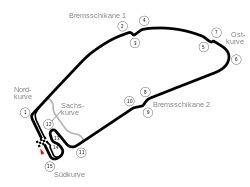
The 1989 German Grand Prix was a Formula One motor race held at the Hockenheimring on 30 July 1989. The race was won by Ayrton Senna, ahead of Alain Prost and Nigel Mansell.
Prior to the race meeting there had been a major shakeup of management at Team Lotus. Long time Lotus man and team boss since Colin Chapman's untimely death in 1982 Peter Warr had been asked to leave the team and was replaced as team manager by Rupert Manwaring, while Lotus also had a new chairman in Tony Rudd.[citation needed]
Pre-qualifying had been reorganised going into the second half of the season, with several drivers and teams either losing or gaining the right to progress without the need to pre-qualify. Brabham, Dallara and Rial had scored enough points across the opening rounds of the season to enable them to escape the Friday morning sessions entirely. Larrousse, with their Lamborghini V12-engined Lolas had scored no points thus far, so were required to pre-qualify for Grands Prix. Philippe Alliot was now partnered by Michele Alboreto who had left Tyrrell after a sponsorship dispute, replacing Éric Bernard, who had stood in at Larrousse for two races.[citation needed]
Also new to pre-qualifying was Roberto Moreno, joining his Coloni team-mate Pierre-Henri Raphanel; and Gabriele Tarquini, joining his AGS team-mate Yannick Dalmas in the Friday morning sessions. This was despite Tarquini's sixth-place finish at the Mexican Grand Prix, as Minardi had scored three points at Silverstone. Onyx had also only scored two points so were forced to continue to pre-qualify. Osella, EuroBrun and Zakspeed had scored no points thus far, so also had to continue to pre-qualify.[citation needed]
Bertrand Gachot topped the pre-qualifying session for the third time in a row, with his Onyx team-mate Stefan Johansson second. The two Larrousse-Lola drivers were third and fourth, with Alboreto edging out Dalmas in the AGS by a thousandth of a second. Nicola Larini was sixth in his Osella, with his team-mate Piercarlo Ghinzani again failing at this stage, down in eighth. Moreno and Raphanel were ninth and tenth, with Gregor Foitek eleventh in the new, untested EuroBrun ER189. The Zakspeeds were bottom of the time sheets, with Aguri Suzuki outpacing Bernd Schneider for only the second time this season.
* Driver failed to pre-qualify.
The McLaren-Honda's of Ayrton Senna and Alain Prost dominated qualifying on the ultra fast Hockenheim circuit, with Senna just under a second faster than Prost, who was himself almost eight-tenths faster than the Ferrari 640 of Nigel Mansell.[citation needed]
During the Friday session Senna ran over a stone which put a sizeable hole in his car's undertray and the resulting damage would require a complete change of car, the problem being that the team only had three of the new transverse gearbox cars in Germany. As a precaution, team manager Jo Ramírez instructed the team's secondary (test) crew, who were on their way to Imola for a week of testing with the new car, to stop in Dijon (eastern France) in case the race team needed a replacement chassis. When Senna's car was deemed too badly damaged, the test crew made their way to Hockenheim and McLaren were back to having three full cars ready for use by Saturday's morning practice.[citation needed]
1989 German Grand Prix
The 1989 German Grand Prix was a Formula One motor race held at the Hockenheimring on 30 July 1989. The race was won by Ayrton Senna, ahead of Alain Prost and Nigel Mansell.
Prior to the race meeting there had been a major shakeup of management at Team Lotus. Long time Lotus man and team boss since Colin Chapman's untimely death in 1982 Peter Warr had been asked to leave the team and was replaced as team manager by Rupert Manwaring, while Lotus also had a new chairman in Tony Rudd.[citation needed]
Pre-qualifying had been reorganised going into the second half of the season, with several drivers and teams either losing or gaining the right to progress without the need to pre-qualify. Brabham, Dallara and Rial had scored enough points across the opening rounds of the season to enable them to escape the Friday morning sessions entirely. Larrousse, with their Lamborghini V12-engined Lolas had scored no points thus far, so were required to pre-qualify for Grands Prix. Philippe Alliot was now partnered by Michele Alboreto who had left Tyrrell after a sponsorship dispute, replacing Éric Bernard, who had stood in at Larrousse for two races.[citation needed]
Also new to pre-qualifying was Roberto Moreno, joining his Coloni team-mate Pierre-Henri Raphanel; and Gabriele Tarquini, joining his AGS team-mate Yannick Dalmas in the Friday morning sessions. This was despite Tarquini's sixth-place finish at the Mexican Grand Prix, as Minardi had scored three points at Silverstone. Onyx had also only scored two points so were forced to continue to pre-qualify. Osella, EuroBrun and Zakspeed had scored no points thus far, so also had to continue to pre-qualify.[citation needed]
Bertrand Gachot topped the pre-qualifying session for the third time in a row, with his Onyx team-mate Stefan Johansson second. The two Larrousse-Lola drivers were third and fourth, with Alboreto edging out Dalmas in the AGS by a thousandth of a second. Nicola Larini was sixth in his Osella, with his team-mate Piercarlo Ghinzani again failing at this stage, down in eighth. Moreno and Raphanel were ninth and tenth, with Gregor Foitek eleventh in the new, untested EuroBrun ER189. The Zakspeeds were bottom of the time sheets, with Aguri Suzuki outpacing Bernd Schneider for only the second time this season.
* Driver failed to pre-qualify.
The McLaren-Honda's of Ayrton Senna and Alain Prost dominated qualifying on the ultra fast Hockenheim circuit, with Senna just under a second faster than Prost, who was himself almost eight-tenths faster than the Ferrari 640 of Nigel Mansell.[citation needed]
During the Friday session Senna ran over a stone which put a sizeable hole in his car's undertray and the resulting damage would require a complete change of car, the problem being that the team only had three of the new transverse gearbox cars in Germany. As a precaution, team manager Jo Ramírez instructed the team's secondary (test) crew, who were on their way to Imola for a week of testing with the new car, to stop in Dijon (eastern France) in case the race team needed a replacement chassis. When Senna's car was deemed too badly damaged, the test crew made their way to Hockenheim and McLaren were back to having three full cars ready for use by Saturday's morning practice.[citation needed]
Recent media
Recent media