
Recent from talks
Lamborghini V12
Knowledge base stats:
Talk channels stats:
Members stats:
Lamborghini V12
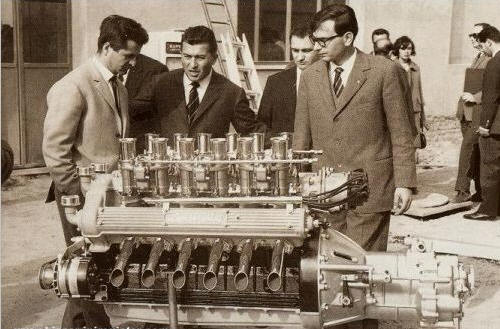
The Lamborghini V12 refers to the flagship V12 engine used by Lamborghini. Lamborghini has had two generations of V12 engines through their history, both of which were developed in-house. The first-generation Lamborghini V12 was a sixty degree (60°) V12 petrol engine designed by Lamborghini, and was the first internal combustion engine ever produced by the firm.
It entered production in 1963 as a 3.5 litre displacing 3,465 cubic centimetres (211.4 cu in) fitted on Lamborghini's first car, the Lamborghini 350GT. The engine remained in use for almost fifty years; the final version of 6.5 litre displacement was installed in the Lamborghini Murciélago. Lamborghini discontinued their first-generation V12 after the Murcielago, opting for a brand-new V12 that first saw use on the Lamborghini Aventador.
When Ferruccio Lamborghini set out to compete with Ferrari, he contracted Giotto Bizzarrini to design the engine for his car and, according to some accounts, paid him a bonus for every horsepower over what Ferrari's V12 could produce. The finished 3.5-litre (214 cu in) V12, with minor improvements, went on to become the 6.5 litre powering the Lamborghini Murciélago LP 640, and completed its service for Lamborghini with the final version of the Murciélago, the Murciélago LP 670-4 SuperVeloce.
The engine was designed from the start to be a quad cam 60 degree V12 - as an intentional snub to Ferrari's single overhead camshaft per-bank design. When the 3,464-cubic-centimetre (211.4 cu in) prototype was tested in 1963, it was able to produce 370 brake horsepower (276 kW; 375 PS) at 9,000 (rpm), or almost 107 brake horsepower (80 kW; 108 PS) per litre. Bizzarrini insisted the engine was mechanically capable of reaching 400 brake horsepower (298 kW; 406 PS) at 11,000 rpm with an uprated fuel system, but the design was judged adequate, and when fitted with production carburettors, all the auxiliary systems, and detuned for road use, the engine still made 280 brake horsepower (209 kW; 284 PS).
Over the years, this V12 engine has nearly doubled in displacement - first to 6,192 cubic centimetres (377.9 cu in), and later to 6,496 cubic centimetres (396.4 cu in). It has seen the modification of the cylinder heads to allow four valves per cylinder, the replacement of Weber carburettors with electronic fuel injection, and the re-engineering of the lubrication system from a wet to a dry sump design. However, the engine that powers the Murciélago LP 640 can trace its lineage directly to the F1-inspired design of Bizzarrini and his team more than forty years ago.
When Automobili Lamborghini was purchased in 1998 by the German Volkswagen Group subsidiary Audi AG, the V12 engine continued undergoing constant upgrades, growing its displacement from 5.7 litres (Diablo VT) to the final displacement of 6.5 litres in the Murciélago LP670-4 Superveloce.
It took years to decide that a new engine was needed to be built from scratch, finally an all-new engine codenamed L539 having a displacement of 6.5 litres for the 2011 Aventador was developed. The new engine has a maximum power output of 700 PS (515 kW; 690 hp), is 18 kg lighter, is over-square (95 mm bore, 76.4 mm stroke) and has a different firing order: 1–12–4–9–2–11–6–7–3–10–5–8 instead of 1–7–4–10–2–8–6–12–3–9–5–11.
Lamborghini made the move to Formula One in 1989 when the FIA outlawed turbocharged engines. Former Scuderia Ferrari designer / engineer Mauro Forghieri was commissioned to design and build a new, 3.5 litre V12 engine for use by the French Larrousse team in 1989. Dubbed the Lamborghini LE3512, (Lamborghini Engineering 3.5 liters 12 cylinders) the 3,493 cc (213.2 cu in), 80° V12 engine was reported to be the best sounding engine of the new 3.5L naturally aspirated formula. Lamborghini representatives stated at the engines début race, the 1989 Brazilian Grand Prix in Rio de Janeiro, that they chose a lower ranked team to join Formula One (Larrousse was in its third season using Lola chassis') as it was felt at the early stage of its development the 3512 would not be able to do justice to one of the teams usually closer to the front of the grid. Also, the front running teams already had existing engine suppliers in place (McLaren with Honda, Williams with Renault, Benetton with Ford, and Ferrari who made their own V12 engines).
Hub AI
Lamborghini V12 AI simulator
(@Lamborghini V12_simulator)
Lamborghini V12
The Lamborghini V12 refers to the flagship V12 engine used by Lamborghini. Lamborghini has had two generations of V12 engines through their history, both of which were developed in-house. The first-generation Lamborghini V12 was a sixty degree (60°) V12 petrol engine designed by Lamborghini, and was the first internal combustion engine ever produced by the firm.
It entered production in 1963 as a 3.5 litre displacing 3,465 cubic centimetres (211.4 cu in) fitted on Lamborghini's first car, the Lamborghini 350GT. The engine remained in use for almost fifty years; the final version of 6.5 litre displacement was installed in the Lamborghini Murciélago. Lamborghini discontinued their first-generation V12 after the Murcielago, opting for a brand-new V12 that first saw use on the Lamborghini Aventador.
When Ferruccio Lamborghini set out to compete with Ferrari, he contracted Giotto Bizzarrini to design the engine for his car and, according to some accounts, paid him a bonus for every horsepower over what Ferrari's V12 could produce. The finished 3.5-litre (214 cu in) V12, with minor improvements, went on to become the 6.5 litre powering the Lamborghini Murciélago LP 640, and completed its service for Lamborghini with the final version of the Murciélago, the Murciélago LP 670-4 SuperVeloce.
The engine was designed from the start to be a quad cam 60 degree V12 - as an intentional snub to Ferrari's single overhead camshaft per-bank design. When the 3,464-cubic-centimetre (211.4 cu in) prototype was tested in 1963, it was able to produce 370 brake horsepower (276 kW; 375 PS) at 9,000 (rpm), or almost 107 brake horsepower (80 kW; 108 PS) per litre. Bizzarrini insisted the engine was mechanically capable of reaching 400 brake horsepower (298 kW; 406 PS) at 11,000 rpm with an uprated fuel system, but the design was judged adequate, and when fitted with production carburettors, all the auxiliary systems, and detuned for road use, the engine still made 280 brake horsepower (209 kW; 284 PS).
Over the years, this V12 engine has nearly doubled in displacement - first to 6,192 cubic centimetres (377.9 cu in), and later to 6,496 cubic centimetres (396.4 cu in). It has seen the modification of the cylinder heads to allow four valves per cylinder, the replacement of Weber carburettors with electronic fuel injection, and the re-engineering of the lubrication system from a wet to a dry sump design. However, the engine that powers the Murciélago LP 640 can trace its lineage directly to the F1-inspired design of Bizzarrini and his team more than forty years ago.
When Automobili Lamborghini was purchased in 1998 by the German Volkswagen Group subsidiary Audi AG, the V12 engine continued undergoing constant upgrades, growing its displacement from 5.7 litres (Diablo VT) to the final displacement of 6.5 litres in the Murciélago LP670-4 Superveloce.
It took years to decide that a new engine was needed to be built from scratch, finally an all-new engine codenamed L539 having a displacement of 6.5 litres for the 2011 Aventador was developed. The new engine has a maximum power output of 700 PS (515 kW; 690 hp), is 18 kg lighter, is over-square (95 mm bore, 76.4 mm stroke) and has a different firing order: 1–12–4–9–2–11–6–7–3–10–5–8 instead of 1–7–4–10–2–8–6–12–3–9–5–11.
Lamborghini made the move to Formula One in 1989 when the FIA outlawed turbocharged engines. Former Scuderia Ferrari designer / engineer Mauro Forghieri was commissioned to design and build a new, 3.5 litre V12 engine for use by the French Larrousse team in 1989. Dubbed the Lamborghini LE3512, (Lamborghini Engineering 3.5 liters 12 cylinders) the 3,493 cc (213.2 cu in), 80° V12 engine was reported to be the best sounding engine of the new 3.5L naturally aspirated formula. Lamborghini representatives stated at the engines début race, the 1989 Brazilian Grand Prix in Rio de Janeiro, that they chose a lower ranked team to join Formula One (Larrousse was in its third season using Lola chassis') as it was felt at the early stage of its development the 3512 would not be able to do justice to one of the teams usually closer to the front of the grid. Also, the front running teams already had existing engine suppliers in place (McLaren with Honda, Williams with Renault, Benetton with Ford, and Ferrari who made their own V12 engines).
Recent media