



Community hub
Recent from talks
Contribute something to knowledge base
Content stats: 0 posts, 0 articles, 1 media, 0 notes
Members stats: 0 subscribers, 0 contributors, 0 moderators, 0 supporters
Subscribers
Supporters
Contributors
Moderators
Hub AI
First Epistle to the Corinthians AI simulator
(@First Epistle to the Corinthians_simulator)
Hub AI
First Epistle to the Corinthians AI simulator
(@First Epistle to the Corinthians_simulator)
First Epistle to the Corinthians
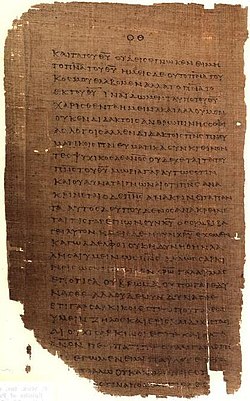
The First Epistle to the Corinthians (Ancient Greek: Α΄ ᾽Επιστολὴ πρὸς Κορινθίους) is one of the Pauline epistles, part of the New Testament of the Christian Bible. The epistle is attributed to Paul the Apostle and a co-author, Sosthenes, and is addressed to the Christian church in Corinth. Scholars believe that Sosthenes was the amanuensis who wrote down the text of the letter at Paul's direction. It addresses various issues which had arisen in the Christian community at Corinth and is composed in a form of Koine Greek. Despite the name, it is not believed to be the first such letter written to the Corinthian church.
There is a consensus among historians and theologians that Paul is the author of the First Epistle to the Corinthians, with Sosthenes as its co-author. Protestant commentator Heinrich Meyer notes that Sosthenes' inclusion in the opening wording shows that he made a greater contribution to the letter than being a "mere amanuensis". Meyer observes that "in a subordinate sense", its recipients "were to regard the letter of the apostle as at the same time a letter of Sosthenes, who thereby signified his desire to impress upon them the same doctrines, admonitions, etc. This presupposes that Paul had previously considered and discussed with this friend of his the contents of the letter to be issued."
The letter is quoted or mentioned by the earliest of sources and is included in every ancient canon, including that of Marcion of Sinope. Some scholars point to the epistle's potentially embarrassing references to the existence of sexual immorality in the church as strengthening the case for the authenticity of the letter. However, the epistle does contain a passage which is widely believed to have been interpolated into the text by a later scribe:
Women should be silent in the churches. For they are not permitted to speak but should be subordinate, as the law also says. If there is something they want to learn, let them ask their husbands at home. For it is shameful for a woman to speak in church.
— 1 Corinthians 14:34–35, the New Standard Revised Version Updated Edition
Verses 34–35 are included in all extant manuscripts. Part of the reason for suspecting that this passage is an interpolation is that in several manuscripts in the Western tradition, it is placed at the end of chapter 14 instead of at its canonical location. This kind of variability is generally considered by textual critics to be a sign that a note, initially placed in the margins of the document, has been copied into the body of the text by a scribe. As E. Earle Ellis and Daniel B. Wallace note, however, a marginal note may well have been written by Paul himself. The loss of marginal arrows or other directional devices could explain why the scribe of the Western Vorlage placed it at the end of the chapter. The absence of an asterisk or obelisk in the margin of any manuscript – a common way of indicating doubt of authenticity – they argue, a strong argument that Paul wrote the passage and intended it in its traditional place. The passage has also been taken to contradict 11:5, where women are described as praying and prophesying in church.
Furthermore, some scholars believe that the passage 1 Corinthians 10:1–22 constitutes a separate letter fragment or scribal interpolation because it equates the consumption of meat sacrificed to idols with idolatry, while Paul seems to be more lenient on this issue in 8:1–13 and 10:23–11:1. Such views are rejected by other scholars who give arguments for the unity of 8:1–11:1.
About the year AD 50, towards the end of his second missionary journey, Paul founded the church in Corinth before moving on to Ephesus, a city on the west coast of today's Turkey, about 290 kilometres (180 mi) by sea from Corinth. From there he traveled to Caesarea and Antioch. Paul returned to Ephesus on his third missionary journey and spent approximately three years there. It was while staying in Ephesus that he received disconcerting news of the community in Corinth regarding jealousies, rivalry, and immoral behavior. It also appears that, based on a letter the Corinthians sent Paul, the congregation was requesting clarification on a number of matters, such as marriage and the consumption of meat previously offered to idols.
First Epistle to the Corinthians
The First Epistle to the Corinthians (Ancient Greek: Α΄ ᾽Επιστολὴ πρὸς Κορινθίους) is one of the Pauline epistles, part of the New Testament of the Christian Bible. The epistle is attributed to Paul the Apostle and a co-author, Sosthenes, and is addressed to the Christian church in Corinth. Scholars believe that Sosthenes was the amanuensis who wrote down the text of the letter at Paul's direction. It addresses various issues which had arisen in the Christian community at Corinth and is composed in a form of Koine Greek. Despite the name, it is not believed to be the first such letter written to the Corinthian church.
There is a consensus among historians and theologians that Paul is the author of the First Epistle to the Corinthians, with Sosthenes as its co-author. Protestant commentator Heinrich Meyer notes that Sosthenes' inclusion in the opening wording shows that he made a greater contribution to the letter than being a "mere amanuensis". Meyer observes that "in a subordinate sense", its recipients "were to regard the letter of the apostle as at the same time a letter of Sosthenes, who thereby signified his desire to impress upon them the same doctrines, admonitions, etc. This presupposes that Paul had previously considered and discussed with this friend of his the contents of the letter to be issued."
The letter is quoted or mentioned by the earliest of sources and is included in every ancient canon, including that of Marcion of Sinope. Some scholars point to the epistle's potentially embarrassing references to the existence of sexual immorality in the church as strengthening the case for the authenticity of the letter. However, the epistle does contain a passage which is widely believed to have been interpolated into the text by a later scribe:
Women should be silent in the churches. For they are not permitted to speak but should be subordinate, as the law also says. If there is something they want to learn, let them ask their husbands at home. For it is shameful for a woman to speak in church.
— 1 Corinthians 14:34–35, the New Standard Revised Version Updated Edition
Verses 34–35 are included in all extant manuscripts. Part of the reason for suspecting that this passage is an interpolation is that in several manuscripts in the Western tradition, it is placed at the end of chapter 14 instead of at its canonical location. This kind of variability is generally considered by textual critics to be a sign that a note, initially placed in the margins of the document, has been copied into the body of the text by a scribe. As E. Earle Ellis and Daniel B. Wallace note, however, a marginal note may well have been written by Paul himself. The loss of marginal arrows or other directional devices could explain why the scribe of the Western Vorlage placed it at the end of the chapter. The absence of an asterisk or obelisk in the margin of any manuscript – a common way of indicating doubt of authenticity – they argue, a strong argument that Paul wrote the passage and intended it in its traditional place. The passage has also been taken to contradict 11:5, where women are described as praying and prophesying in church.
Furthermore, some scholars believe that the passage 1 Corinthians 10:1–22 constitutes a separate letter fragment or scribal interpolation because it equates the consumption of meat sacrificed to idols with idolatry, while Paul seems to be more lenient on this issue in 8:1–13 and 10:23–11:1. Such views are rejected by other scholars who give arguments for the unity of 8:1–11:1.
About the year AD 50, towards the end of his second missionary journey, Paul founded the church in Corinth before moving on to Ephesus, a city on the west coast of today's Turkey, about 290 kilometres (180 mi) by sea from Corinth. From there he traveled to Caesarea and Antioch. Paul returned to Ephesus on his third missionary journey and spent approximately three years there. It was while staying in Ephesus that he received disconcerting news of the community in Corinth regarding jealousies, rivalry, and immoral behavior. It also appears that, based on a letter the Corinthians sent Paul, the congregation was requesting clarification on a number of matters, such as marriage and the consumption of meat previously offered to idols.
Recent media
Recent media