Recent from talks
Contribute something
Nothing was collected or created yet.
Ancient Corinth
View on Wikipedia37°54′19″N 22°52′49″E / 37.9053455°N 22.8801924°E
Corinth (/ˈkɒrɪnθ/ KORR-inth; Ancient Greek: Κόρινθος Kórinthos; Doric Greek: Ϙόρινθος Qórinthos; Latin: Corinthus) was a city-state (polis) on the Isthmus of Corinth, the narrow stretch of land that joins the Peloponnese peninsula to the mainland of Greece, roughly halfway between Athens and Sparta. The modern city of Corinth is located approximately 5 kilometres (3.1 mi) northeast of the ancient ruins. Since 1896, systematic archaeological investigations of the Corinth Excavations by the American School of Classical Studies at Athens have revealed large parts of the ancient city, and recent excavations conducted by the Greek Ministry of Culture have brought to light important new facets of antiquity.
Key Information
For Christians, Corinth is well known from the two letters from Paul the Apostle in the New Testament, the First Epistle to the Corinthians and the Second Epistle to the Corinthians. Corinth is also mentioned in the Acts of the Apostles as part of Paul the Apostle's missionary travels. In addition, the second book of Pausanias' Description of Greece is devoted to Corinth.
Ancient Corinth was one of the largest and most important cities of Greece, with a population of 90,000 in 400 BC.[1] The Romans demolished Corinth in 146 BC, built a new city in its place in 44 BC, and later made it the provincial capital of Greece.
History
[edit]Geographical setting and topography
[edit]The geophysical situation at Corinth is in many ways ideal for human habitation. The city is situated on two large geomorphic terraces, at the southern edge of which is located both arable plains and a number of natural springs.[2] These abundant sources of fresh water are further supplemented by seasonal rivers descending from the Ayios Vasilios valley and Mount Ziria. Natural drainage patterns in the region have formed a broad valley, enabling the movement of wheeled and pedestrian traffic between the terraces.[3]
The geological makeup of Corinth provided the basic materials for the city's construction. The oolitic limestone of the region’s marine sand bars was used extensively in both domestic and public architecture, and local Corinthian stone was quarried extensively and traded widely across the Aegean.[4] Supplementing this resource are abundant local deposits of calcareous marl, which served as a rich source for the production of ceramics. These marls, when dug, dried, powdered, heated, and mixed with water, made for a highly workable clay, excellent for the production of lightweight ceramic vessels. Pottery created from Corinthian limestone concrete was exported widely in various periods.[5]
Prehistory and founding myths
[edit]This section needs additional citations for verification. (June 2011) |
Neolithic pottery suggests that the site of Corinth was occupied from at least as early as 6500 BC, and continually occupied into the Early Bronze Age,[6] when, it has been suggested, the settlement acted as a centre of trade.[7] However, there is a huge drop in ceramic remains during the Early Helladic II phase and only sparse ceramic remains in the EHIII[clarification needed] and MH[clarification needed] phases; thus, it appears that the area was very sparsely inhabited in the period immediately before the Mycenaean period. There was a settlement on the coast near Lechaion which traded across the Corinthian Gulf; the site of Corinth itself was likely not heavily occupied again until around 900 BC, when it is believed that the Dorians settled there.[8]
According to Corinthian myth as reported by Pausanias, the city was founded by Corinthos, a descendant of the god Zeus.[9] However, other myths hold that it was founded by the goddess Ephyra, a daughter of the Titan Oceanus, thus the ancient name of the city (also Ephyra).
It seems likely that Corinth was also the site of a Bronze Age Mycenaean palace-city, like Mycenae, Tiryns, or Pylos. According to myth, Sisyphus was the founder of a race of ancient kings at Corinth. It was also in Corinth that Jason, the leader of the Argonauts, abandoned Medea.[10] The Catalogue of Ships in the Iliad lists the Corinthians amid the contingent fighting in the Trojan War under the leadership of Agamemnon.
In a Corinthian myth recounted to Pausanias in the 2nd century AD,[11] Briareus, one of the Hecatonchires, was the arbitrator in a dispute between Poseidon and Helios, respectively gods of the sea and the sun. His verdict was that the Isthmus of Corinth, the area closest to the sea, belonged to Poseidon, and the acropolis of Corinth (Acrocorinth), closest to the sky, belonged to Helios.[12]
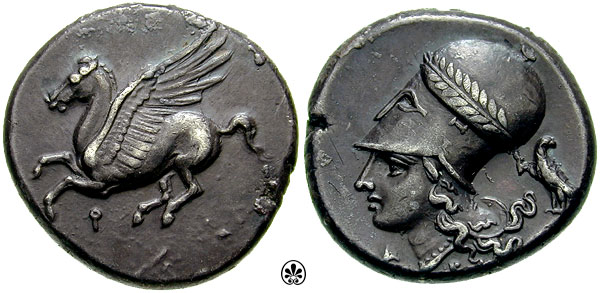
The Upper Peirene spring is located within the walls of the acropolis. Pausanias (2.5.1) says that it was put there by Asopus, repaying Sisyphus for information about the abduction of Aegina by Zeus.[13] According to legend, the winged horse Pegasus drank at the spring,[14] and was captured and tamed by the Corinthian hero Bellerophon.
Corinth under the Bacchiadae
[edit]Corinth had been a backwater in Greece in the 8th century BC.[15] The Bacchiadae (Βακχιάδαι, Bakkhiádai) were a tightly-knit Doric clan and the ruling kinship group of archaic Corinth in the 8th and 7th centuries BC, a period of expanding Corinthian cultural power. In 747 BC (a traditional date), an aristocracy ousted the Bacchiadai Prytaneis and reinstituted the kingship, about the time the Kingdom of Lydia (the endonymic Basileia Sfard) was at its greatest, coinciding with the ascent of Basileus Meles, King of Lydia. The Bacchiadae, numbering perhaps a couple of hundred adult males, took power from the last king Telestes (from the House of Sisyphos) in Corinth.[16] The Bacchiads dispensed with kingship and ruled as a group, governing the city by annually electing a prytanis (who held the kingly position[17] for his brief term),[18] probably a council (though none is specifically documented in the scant literary materials), and a polemarchos to head the army.
During Bacchiad rule from 747 to 650 BC, Corinth became a unified state. Large scale public buildings and monuments were constructed at this time. In 733 BC, Corinth established colonies at Corcyra and Syracuse. By 730 BC, Corinth emerged as a highly advanced Greek city with at least 5,000 people.[19]
Aristotle tells the story of Philolaus of Corinth, a Bacchiad who was a lawgiver at Thebes. He became the lover of Diocles, the winner of the Olympic games. They both lived for the rest of their lives in Thebes. Their tombs were built near one another and Philolaus' tomb points toward the Corinthian country, while Diocles' faces away.[20]
In 657 BC, polemarch Cypselus obtained an oracle from Delphi which he interpreted to mean that he should rule the city.[21] He seized power and exiled the Bacchiadae.[22]
Corinth under the tyrants
[edit]Cypselus (Κύψελος, Kýpselos) was the first tyrant of Corinth in the 7th century BC. From 658–628 BC, he removed the Bacchiad aristocracy from power and ruled for three decades. He built temples to Apollo and Poseidon in 650 BC.


Cypselus was the son of Eëtion and a disfigured woman named Labda. He was a member of the Bacchiad kin and usurped the power in archaic matriarchal right of his mother. According to Herodotus, the Bacchiadae heard two prophecies from the Delphic oracle that the son of Eëtion would overthrow their dynasty, and they planned to kill the baby once he was born. However, the newborn smiled at each of the men sent to kill him, and none of them could bear to strike the blow.
Labda then hid the baby in a chest,[23] and the men could not find him once they had composed themselves and returned to kill him. (Compare the infancy of Perseus.) The ivory chest of Cypselus was richly worked and adorned with gold. It was a votive offering at Olympia, where Pausanias gave it a minute description in his 2nd century AD travel guide.[24]
Cypselus grew up and fulfilled the prophecy. Corinth had been involved in wars with Argos and Corcyra, and the Corinthians were unhappy with their rulers. Cypselus was polemarch at the time (around 657 BC), the archon in charge of the military, and he used his influence with the soldiers to expel the king. He also expelled his other enemies, but allowed them to set up colonies in northwestern Greece.
He also increased trade with the colonies in Italy and Sicily. He was a popular ruler and, unlike many later tyrants, he did not need a bodyguard and died a natural death. Aristotle reports that "Cypselus of Corinth had made a vow that if he became master of the city, he would offer to Zeus the entire property of the Corinthians. Accordingly, he commanded them to make a return of their possessions."[25]
The city sent forth colonists to found new settlements in the 7th century BC, under the rule of Cypselus (r. 657–627 BC) and his son Periander (r. 627–587 BC). Those settlements were Epidamnus (modern day Durrës, Albania), Syracuse, Ambracia, Corcyra (modern day town of Corfu), and Anactorium. Periander also founded Apollonia in Illyria (modern day Fier, Albania) and Potidaea (in Chalcidice). Corinth was also one of the nine Greek sponsor-cities to found the colony of Naukratis in Ancient Egypt, founded to accommodate the increasing trade volume between the Greek world and pharaonic Egypt during the reign of Pharaoh Psammetichus I of the 26th Dynasty.


He ruled for thirty years and was succeeded as tyrant by his son Periander in 627 BC.[26] The treasury that Cypselus built at Delphi was apparently still standing in the time of Herodotus, and the chest of Cypselus was seen by Pausanias at Olympia in the 2nd century AD. Periander brought Corcyra to order in 600 BC.
Periander was considered one of the Seven Wise Men of Greece.[27] During his reign, the first Corinthian coins were struck. He was the first to attempt to cut across the Isthmus to create a seaway between the Corinthian and the Saronic Gulfs. He abandoned the venture due to the extreme technical difficulties that he met, but he created the Diolkos instead (a stone-built overland ramp). The era of the Cypselids was Corinth's golden age, and ended with Periander's nephew Psammetichus (Corinthian tyrant), named after the hellenophile Egyptian Pharaoh Psammetichus I (see above).
Periander killed his wife Melissa. His son Lycophron found out and shunned him, and Periander exiled the son to Corcyra.[28] Periander later wanted Lycophron to replace him as ruler of Corinth, and convinced him to come home to Corinth on the condition that Periander go to Corcyra. The Corcyreans heard about this and killed Lycophron to keep away Periander.[29][30]
Corinth after the tyrants
[edit]581 BC: Periander's nephew and successor was assassinated, ending the tyranny.
581 BC: the Isthmian Games were established by leading families.
570 BC: the inhabitants started to use silver coins called 'colts' or 'foals'.
550 BC: Construction of the Temple of Apollo at Corinth (early third quarter of the 6th century BC).[31]
550 BC: Corinth allied with Sparta.
525 BC: Corinth formed a conciliatory alliance with Sparta against Argos.
519 BC: Corinth mediated between Athens and Thebes.
Around 500 BC: Athenians and Corinthians entreated Spartans not to harm Athens by restoring the tyrant.[32]
Just before the classical period, according to Thucydides, the Corinthians developed the trireme which became the standard warship of the Mediterranean until the late Roman period. Corinth fought the first naval battle on record against the Hellenic city of Corcyra.[33] The Corinthians were also known for their wealth due to their strategic location on the isthmus, through which all land traffic had to pass en route to the Peloponnese, including messengers and traders.[34]
Classical Corinth
[edit]


In classical times, Corinth rivaled Athens and Thebes in wealth, based on the Isthmian traffic and trade. Until the mid-6th century, Corinth was a major exporter of black-figure pottery to city-states around the Greek world, later losing their market to Athenian artisans.
In classical times and earlier, Corinth had a temple of Aphrodite, the goddess of love, employing some thousand hetairas (temple prostitutes) (see also Temple prostitution in Corinth). The city was renowned for these temple prostitutes, who served the wealthy merchants and the powerful officials who frequented the city. Lais, the most famous hetaira, was said to charge tremendous fees for her extraordinary favours. Referring to the city's exorbitant luxuries, Horace is quoted as saying: "non licet omnibus adire Corinthum" ("not everyone is able to go to Corinth").[35]
Corinth was also the host of the Isthmian Games. During this era, Corinthians developed the Corinthian order, the third main style of classical architecture after the Doric and the Ionic. The Corinthian order was the most complicated of the three, showing the city's wealth and the luxurious lifestyle, while the Doric order evoked the rigorous simplicity of the Spartans, and the Ionic was a harmonious balance between these two following the cosmopolitan philosophy of Ionians like the Athenians.
The city had two main ports: to the west on the Corinthian Gulf lay Lechaion, which connected the city to its western colonies (Greek: apoikiai) and Magna Graecia, while to the east on the Saronic Gulf the port of Kenchreai served the ships coming from Athens, Ionia, Cyprus and the Levant. Both ports had docks for the city's large navy.

In 491 BC, Corinth mediated between Syracuse and Gela in Sicily.
During the years 481–480 BC, the Conference at the Isthmus of Corinth (following conferences at Sparta) established the Hellenic League, which allied under the Spartans to fight the war against Persia. The city was a major participant in the Persian Wars, sending 400 soldiers to defend Thermopylae[36] and supplying forty warships for the Battle of Salamis under Adeimantos and 5,000 hoplites with their characteristic Corinthian helmets[citation needed]) in the following Battle of Plataea. The Greeks obtained the surrender of Theban collaborators with the Persians. Pausanias took them to Corinth where they were put to death.[37]
Following the Battle of Thermopylae and the subsequent Battle of Artemisium, which resulted in the captures of Euboea, Boeotia, and Attica,[38] the Greco-Persian Wars were at a point where now most of mainland Greece to the north of the Isthmus of Corinth had been overrun.[39]

Herodotus, who was believed to dislike the Corinthians, mentions that they were considered the second best fighters after the Athenians.[40]
In 458 BC, Corinth was defeated by Athens at Megara.
Peloponnesian War
[edit]In 435 BC, Corinth and its colony Corcyra went to war over Epidamnus.[41] In 433 BC, Athens allied with Corcyra against Corinth.[42] The Corinthian war against the Corcyrans was the largest naval battle between Greek city states until that time.[43] In 431 BC, one of the factors leading to the Peloponnesian War was the dispute between Corinth and Athens over Corcyra, which possibly stemmed from the traditional trade rivalry between the two cities or, as Thucydides relates – the dispute over the colony of Epidamnus.[44]
The Syracusans sent envoys to Corinth and Sparta to seek allies against Athenian invasion.[45] The Corinthians "voted at once to aid [the Syracusans] heart and soul".[46] The Corinthians also sent a group to Lacedaemon to rouse Spartan assistance. After a convincing speech from the Athenian renegade Alcibiades, the Spartans agreed to send troops to aid the Sicilians.[46]
In 404 BC, Sparta refused to destroy Athens, angering the Corinthians. Corinth joined Argos, Boeotia, and Athens against Sparta in the Corinthian War.[citation needed][clarification needed]
Demosthenes later used this history in a plea for magnanimous statecraft, noting that the Athenians of yesteryear had had good reason to hate the Corinthians and Thebans for their conduct during the Peloponnesian War,[47] yet they bore no malice whatever.[48]
Corinthian War
[edit]In 395 BC, after the end of the Peloponnesian War, Corinth and Thebes, dissatisfied with the hegemony of their Spartan allies, moved to support Athens against Sparta in the Corinthian War.[49][50]
As an example of facing danger with knowledge, Aristotle used the example of the Argives who were forced to confront the Spartans in the battle at the Long Walls of Corinth in 392 BC.[51]
379–323 BC
[edit]In 379 BC, Corinth, switching back to the Peloponnesian League, joined Sparta in an attempt to defeat Thebes and eventually take over Athens.[citation needed][clarification needed]
In 366 BC, the Athenian Assembly ordered Chares to occupy the Athenian ally and install a democratic government. This failed when Corinth, Phlius and Epidaurus allied with Boeotia.
Demosthenes recounts how Athens had fought the Spartans in a great battle near Corinth. The city decided not to harbor the defeated Athenian troops, but instead sent heralds to the Spartans. But the Corinthian heralds opened their gates to the defeated Athenians and saved them. Demosthenes notes that they “chose along with you, who had been engaged in battle, to suffer whatever might betide, rather than without you to enjoy a safety that involved no danger.”[52]
These conflicts further weakened the city-states of the Peloponnese and set the stage for the conquests of Philip II of Macedon.
Demosthenes warned that Philip's military force exceeded that of Athens and thus they must develop a tactical advantage. He noted the importance of a citizen army as opposed to a mercenary force, citing the mercenaries of Corinth who fought alongside citizens and defeated the Spartans.[53]
In 338 BC, after having defeated Athens and its allies, Philip II created the League of Corinth to unite Greece (included Corinth and Macedonia) in the war against Persia. Philip was named hegemon of the League.
In the spring of 337 BC, the Second congress of Corinth established the Common Peace.
Hellenistic period
[edit]By 332 BC, Alexander the Great was in control of Greece, as hegemon.
During the Hellenistic period, Corinth, like many other Greece cities, never quite had autonomy. Under the successors of Alexander the Great, Greece was contested ground, and Corinth was occasionally the battleground for contests between the Antigonids, based in Macedonia, and other Hellenistic powers. In 308 BC, the city was captured from the Antigonids by Ptolemy I, who claimed to come as a liberator of Greece from the Antigonids. However, the city was recaptured by Demetrius in 304 BC.[54]
Corinth remained under Antigonid control for half a century. After 280 BC, it was ruled by the faithful governor Craterus; but, in 253/2 BC, his son Alexander of Corinth, moved by Ptolemaic subsidies, resolved to challenge the Macedonian supremacy and seek independence as a tyrant. He was probably poisoned in 247 BC; after his death, the Macedonian king Antigonus II Gonatas retook the city in the winter of 245/44 BC.
The Macedonian rule was short-lived. In 243 BC, Aratus of Sicyon, using a surprise attack, captured the fortress of Acrocorinth and convinced the citizenship to join the Achaean League.
Thanks to an alliance agreement with Aratus, the Macedonians recovered Corinth once again in 224 BC; but, after the Roman intervention in 197 BC, the city was permanently brought into the Achaean League. Under the leadership of Philopoemen, the Achaeans went on to take control of the entire Peloponnesus and made Corinth the capital of their confederation.[55]
Classical Roman era
[edit]
Roman occupation and development
[edit]In 146 BC, Rome declared war on the Achaean League. A series of Roman victories culminated in the Battle of Corinth, after which the army of Lucius Mummius besieged, captured, and burned the city. Mummius killed all the men and sold the women and children into slavery; he was subsequently given the cognomen Achaicus as the conqueror of the Achaean League.[56] There is archeological evidence of some minimal habitation in the years afterwards, but Corinth remained largely deserted until Julius Caesar refounded the city as Colonia Laus Iulia Corinthiensis ("colony of Corinth in honour of Julius") in 44 BC, shortly before his assassination. At this time, an amphitheatre was built (37°54′35″N 22°53′31″E / 37.909824°N 22.892078°E).
Under the Romans, Corinth was rebuilt as a major city in Southern Greece or Achaia. It had a large[57] mixed population of Romans, Greeks, and Jews. The city was an important locus for activities of The Roman Imperial Cult, and both Temple E[58] and the Julian Basilica[59] have been suggested as locations of imperial cult activity.
New Testament Corinth
[edit]
Corinth is mentioned many times in the New Testament, largely in connection with Paul the Apostle's mission there, testifying to the success of Caesar's refounding of the city. Traditionally, the Church of Corinth is believed to have been founded by Paul, making it an Apostolic See.
The apostle Paul first visited the city in AD 49 or 50, when Gallio, the brother of Seneca, was proconsul of Achaia.[60] Paul resided here for eighteen months (see Acts 18:11). Here he first became acquainted with Priscilla and Aquila, with whom he later traveled. They worked here together as tentmakers (from which is derived the modern Christian concept of tentmaking), and regularly attended the synagogue.
In AD 51/52, Gallio presided over the trial of the Apostle Paul in Corinth. Silas and Timothy rejoined Paul here, having last seen him in Berea (Acts 18:5). Acts 18:6 suggests that Jewish refusal to accept his preaching here led Paul to resolve no longer to speak in the synagogues where he travelled: "From now on I will go to the Gentiles".[61] However, on his arrival in Ephesus (Acts 18:19), the narrative records that Paul went to the synagogue to preach.
Paul wrote at least two epistles to the Christian church, the First Epistle to the Corinthians (written from Ephesus) and the Second Epistle to the Corinthians (written from Macedonia). Both canonical epistles occasionally[where?] reflect the conflict between the missionary ambitions of the thriving Christian church and a strong desire to remain separate from the surrounding community.[62]
Some scholars believe that Paul visited Corinth for an intermediate "painful visit" (see 2 Corinthians 2:1) between the first and second epistles. After writing the second epistle, he stayed in Corinth for about three months[63] in the late winter, and there wrote his Epistle to the Romans.[64]
Based on clues within the Corinthian epistles themselves, some scholars have concluded that Paul wrote possibly as many as four epistles to the church at Corinth.[65] Only two are contained within the Christian canon (First and Second Epistles to the Corinthians); the other two letters are lost. (The lost letters would probably represent the very first letter that Paul wrote to the Corinthians and the third one, and so the First and Second Letters of the canon would be the second and the fourth if four were written.) Many scholars think that the third one (known as the "letter of the tears"; see 2 Cor 2:4) is included inside the canonical Second Epistle to the Corinthians (it would be chapters 10–13). This letter is not to be confused with the so-called "Third Epistle to the Corinthians", which is a pseudepigraphical letter written many years after the death of Paul.
There are speculations from Bruce Winter that the Jewish access to their own food in Corinth was disallowed after Paul's departure. By this theory, Paul had instructed Christian Gentiles to maintain Jewish access to food according to their dietary laws. This speculation is contested by David Rudolph, who argues that there is no evidence to support this theory. He argues instead that Paul had desired the Gentile Christians to remain assimilated within their Gentile communities and not adopt Jewish dietary procedures.[66]
Medieval Roman (Byzantine) era
[edit]
The city was largely destroyed in the earthquakes of AD 365 and AD 375, followed by Alaric's invasion in 396. The city was rebuilt after these disasters on a monumental scale, but covered a much smaller area than previously. Four churches were located in the city proper, another on the citadel of the Acrocorinth, and a monumental basilica at the port of Lechaion.[67]
During the reign of Emperor Justinian I (527–565), a large stone wall was erected from the Saronic to the Corinthian gulfs, protecting the city and the Peloponnese peninsula from the barbarian invasions from the north. The stone wall was about six miles (10 km) long and was named Hexamilion ("six-miles").
Corinth declined from the 6th century on, and may even have fallen to barbarian invaders in the early 7th century. The main settlement moved from the lower city to the Acrocorinth. Despite its becoming the capital of the theme of Hellas and, after c. 800, of the theme of the Peloponnese, it was not until the 9th century that the city began to recover, reaching its apogee in the 11th and 12th centuries, when it was the site of a flourishing silk industry.[67]
In November 856, an earthquake in Corinth killed an estimated 45,000.[68]
The wealth of the city attracted the attention of the Italo-Normans under Roger II of Sicily, who plundered it in 1147, carrying off many captives, most notably silk weavers. The city never fully recovered from the Norman sack.[67]
Principality of Achaea
[edit]Following the sack of Constantinople by the Fourth Crusade, a group of Crusaders under the French knights William of Champlitte and Geoffrey of Villehardouin carried out the conquest of the Peloponnese. The Corinthians resisted the Frankish conquest from their stronghold in Acrocorinth, under the command of Leo Sgouros, from 1205 until 1210. In 1208 Leo Sgouros killed himself by riding off the top of Acrocorinth, but resistance continued for two more years. Finally, in 1210 the fortress fell to the Crusaders, and Corinth became a full part of the Principality of Achaea, governed by the Villehardouins from their capital in Andravida in Elis. Corinth was the last significant town of Achaea on its northern borders with another crusader state, the Duchy of Athens. The Ottomans captured the city in 1395. The Byzantines of the Despotate of the Morea recaptured it in 1403, and the Despot Theodore II Palaiologos, restored the Hexamilion wall across the Isthmus of Corinth in 1415.
Ottoman rule
[edit]In 1458, five years after the final Fall of Constantinople, the Turks of the Ottoman Empire conquered the city and its mighty castle. The Ottomans renamed it Gördüs (گوردوس) and made it a sanjak (district) centre within the Rumelia Eyalet.[69] The Venetians captured the city in 1687 during the Morean War, and it remained under Venetian control until the Ottomans retook the city in 1715. Corinth was the capital of the Mora Eyalet in 1715–1731 and then again a sanjak capital until 1821.
Independence
[edit]
During the Greek War of Independence, 1821–1830 the city was contested by the Ottoman forces. At that time, the Christian Albanian tribes living to the north of the Isthmus of Corinth attacked the acropolis of the city. They were around 2000 musketeers against the Ottoman troops.[70] The city was officially liberated in 1832 after the Treaty of London. In 1833, the site was considered among the candidates for the new capital city of the recently founded Kingdom of Greece, due to its historical significance and strategic position. Nafplio was chosen initially, then Athens.
Ancient city and its environs
[edit]Acrocorinth, the acropolis
[edit]The Acrocorinth (Ἀκροκόρινθος, Akrokórinthos), the acropolis of ancient Corinth, is a monolithic rock that was continuously occupied from archaic times to the early 19th century. The city's archaic acropolis, already an easily defensible position due to its geomorphology, was further heavily fortified during the Byzantine Empire as it became the seat of the strategos of the Thema of Hellas. Later it was a fortress of the Franks after the Fourth Crusade, the Venetians and the Ottoman Turks. With its secure water supply, Acrocorinth's fortress was used as the last line of defense in southern Greece because it commanded the isthmus of Corinth, repelling foes from entry into the Peloponnesian peninsula. Three circuit walls formed the man-made defense of the hill. The highest peak on the site was home to a temple to Aphrodite which was Christianized as a church, and then became a mosque.[71] The American School began excavations on it in 1929. Currently, Acrocorinth is one of the most important medieval castle sites of Greece.
Two ports: Lechaeum and Cenchreae
[edit]Corinth had two harbours: Lechaeum on the Corinthian Gulf and Cenchreae on the Saronic Gulf. Lechaeum was the principal port, connected to the city with a set of long walls of about 3 kilometres (1.9 mi) length, and was the main trading station for Italy and Sicily, where there were many Corinthian colonies, while Cenchreae served the commerce with the Eastern Mediterranean. Ships could be transported between the two harbours by means of the diolkos constructed by the tyrant Periander.
Excavations
[edit]

The Corinth Excavations by the American School of Classical Studies at Athens began in 1896 and have continued with little interruption until today. Restricted by the modern village of Ancient Corinth, which directly overlies the ancient city, the main focus of School investigations has been on the area surrounding the mid-6th century B.C. Temple of Apollo. This dominating monument has been one of the only features of the site visible since antiquity. Archaeologists such as Bert Hodge Hill, Carl Blegen, William Dinsmoor Sr., Oscar Broneer, and Rhys Carpenter worked to uncover much of the site before WWII.[72] Since then, under the leadership of directors Henry Robinson (1959–1965), Charles K. Williams II (1965–1997) and Guy D. R. Sanders (1997–present), excavation has clarified the archaeological history of the city. Investigations have revealed remains extending from the Early Neolithic period (6500-5750 B.C.) through to early modern times.
Archaeological work has also been done outside the immediate area of the village center including at the Sanctuary of Demeter and Kore on the slopes of Acrocorinth, in the Potters’ Quarter, at the sites of the Sanctuary of Asklepios and the Kenchreian Gate Basilica.[73] Current investigations focus on the area of the Panayia Field, located to the southeast of the Forum. School excavations and projects affiliated to the ASCSA have also intensively explored the wider area of the Corinthia including the surrounding settlements of Korakou, Kenchreai and Isthmia. Finds from these works are housed in the Archaeological Museum of Ancient Corinth.
Modern Corinth
[edit]In 1858, the village surrounding the ruins of Ancient Corinth was destroyed by an earthquake, leading to the establishment of New Corinth 3 km (1.9 mi) north east of the ancient city.
Important monuments
[edit]Notable people
[edit]Ancient Greece
[edit]- Archias (8th century BC), founder of Syracuse
- Desmon (8th century BC), athlete
- Diocles (8th century BC), athlete
- Diogenes of Sinope, 4th century BC, one of the world's best known cynics
- Eumelus (8th century BC), poet
- Periander (7th century BC), listed as one of the Seven Sages of Greece
- Xeniades (5th century BC), philosopher
- Xenophon (5th century BC), athlete
- Dinarchus (4th century BC), orator and logographer
- Timoleon (4th century BC), statesman and general
- Euphranor (4th century BC), sculptor and painter
- Achaicus (1st century AD), Christian
- Adrian of Corinth (3rd century AD), Christian saint and martyr
- Quadratus (3rd century AD), Christian saint and martyr
Medieval
[edit]- Cyriacus the Anchorite (5th century), Christian saint
- William of Moerbeke (13th century), first translator of Aristotle's works into Latin
In literature
[edit]- Alcmaeon in Corinth, a play by Greek dramatist Euripides, premiered in 405 BC
- The Queen of Corinth, a play by English dramatist John Fletcher, published in 1647
See also
[edit]References
[edit]- ^ Dillon, Matthew; Garland, Lynda (2000). Ancient Greece: Social and Historical Documents from Archaic Times to the Death of Socrates (c. 800–399 B.C.). Psychology Press. p. 352. ISBN 978-0415217552.
- ^ Herbst, James; Guy, Sanders; Palinkas, Jennifer; Tzonou-Herbst, Ioulia (March 2018). Ancient Corinth: Site Guide (7th ed.). Athens: The American School of Classical Studies at Athens. p. 16.
- ^ Sanders, Guy D.R. (2005). "Urban Corinth: An Introduction". Urban Religion in Roman Corinth: Interdisciplinary Approaches. Cambridge: Harvard Theological Studies, Harvard Divinity School. p. 12.
- ^ Lavezzi, J. C. (2003). "Corinth before the Myceneans". Corinth. 20: 63–74. doi:10.2307/4390716. JSTOR 4390716.
- ^ Blegen, C. W. (1920). "Corinth in Prehistoric Times". American Journal of Archaeology. 24 (1): 1–13. doi:10.2307/497547. JSTOR 497547. S2CID 191377774.
- ^ Dunbabin, T. J. (1948). "The Early History of Corinth". Journal of Hellenic Studies. 68: 59–69. doi:10.2307/626300. JSTOR 626300. S2CID 162279819.
- ^ Pausanias, Description of Greece 2.1.1
- ^ Euripides, Medea
- ^ Pausanias, Description of Greece ii. 1.6 and 4.7.
- ^ Grummond and Ridgway, p. 69, "Helios' higher position would correspond to the sun's location in the sky versus Poseidon's lower venue in the sea, opposite Demeter on land."
- ^ "Pausanias, Description of Greece 2.1–14 – Theoi Classical Texts Library". Theoi.com. Retrieved 5 November 2018.
- ^ Anthony, J. Collecting Ancient Greek Coins Part Seven: Corinth Coins and Antiquities magazine August 1999 p.51
- ^ Édouard Will, Korinthiaka: recherches sur l'histoire et la civilisation de Corinth des origines aux guerres médiques (Paris: Boccard) 1955.
- ^ Telestes was murdered by two Bacchiads named Arieus and Perantas. (Smith, Dictionary of Greek and Roman Biography and Mythology, vol. I p. 450). It has been debated what extent this early history is a genealogical myth.
- ^ ; (Stewart Irvin Oost, "Cypselus the Bacchiad" Classical Philology 67.1 (January 1972, pp. 10–30) p. 10f.) See: rex sacrorum.
- ^ Diodorus Siculus, 7.9.6; Pausanias 2.4.4.
- ^ Storey, Glenn (2006). Urbanism in the Preindustrial World: Cross-Cultural Approaches. University of Alabama Press. p. 37. ISBN 978-0817352462.
- ^ Politics, 1274a
- ^ Histories, Herodotus, Book 5.92 E
- ^ His mother had been of the Bacchiadae, but she was lame and married outside the clan.
- ^ An etiological myth-element to account for the name Cypselus (cypsele, "chest")
- ^ Pausanias, 5.18.7.
- ^ Economics, Book 2. 1346a, Aristotle
- ^ Histories, Herodotus, Book 5.92F
- ^ Diogenes Laertius, i. 13.
- ^ Histories, Herodotus, Book 3.52
- ^ Histories, Herodotus, Book 3.53
- ^ Herodotus relates that Arion the harpist was sailing home on a Corinthian vessel when the crew decided to rob and kill him. He begged them to let him sing a last song before killing him. He threw himself overboard and escaped to Taernarus on the back of a dolphin. He presented himself to Periander, who then condemned the sailors (Herodotus Histories Book 1.24).
- ^ Bookidis N., "Corinthian Terracotta Sculpture and the Temple of Apollo," Hesperia 69, 4, 2000, p. 386
- ^ Histories, Herodotus, Book 5.93
- ^ Thucydides 1:13
- ^ Thucydides, Book 1:13
- ^ Stone, Jon R. (2004). The Routledge Dictionary of Latin Quotations. Psychology Press. p. 76. ISBN 0415969093.
- ^ Histories, Herodotus, Book 7:202
- ^ Histories, Book 9:88, Herodotus
- ^ Lazenby, John Francis (1993). The Defence of Greece, 490–479 B.C. Aris & Phillips. pp. 248–253. ISBN 978-0856685910.
- ^ Carey, Brian Todd; Allfree, Joshua; Cairns, John (2006). Warfare in the Ancient World. Pen and Sword. p. 32. ISBN 978-1848846302.
- ^ Histories, Herodotus, Book 9:105
- ^ The Peloponnesian War, Thucydides, Book 1.29
- ^ The Peloponnesian War, Thucydides, Book 1.45
- ^ Thucycdides, Book 1, "The dispute over Corcyra", 50
- ^ Thucydides, Book 1.24–1.29
- ^ Thucydides, Book 6.73
- ^ a b Thucydides, Book 6.88
- ^ especially the latter part, the Decelan War
- ^ On The Crown Book 18.96
- ^ On the Peace, Isocrates, Speech 68, section 68
- ^ Hellenica, Books 3–7, Xenophon
- ^ Nicomachean Ethics, Book 3.8
- ^ Demosthenes Against Leptines 20.52–20.53
- ^ Philippic I, Book 4.24
- ^ Shipley, Graham (2000). The Greek World After Alexander 323–30 BC. London: Routledge. pp. 121–122. ISBN 978-0415046183.
- ^ Shipley, G. 2000. The Greek World After Alexander 323–30 BC. London: Routledge (pp. 137–138).
- ^ Shipley, G. 2000. The Greek World After Alexander 323–30 BC. London: Routledge (pp. 384–385).
- ^ Josiah Russell, in "Late Ancient and Medieval Population", estimates 50,000 people in Roman Corinth.
- ^ Walbank, Mary (1989). "Pausanias, Octavia and Temple E at Corinth". The Annual of the British School at Athens. 84: 385–386. doi:10.1017/S0068245400021055. S2CID 191854233.
- ^ Scotton, Paul; Vanderpool, Catherine; Roncaglia, Carolynn (2014). Actas VIII Congreso Internacional Arqueología Clásica. Museo Nacional de Arte Romano. p. 1629. ISBN 978-8460679493.
- ^ Acts 18:12
- ^ Paul and Barnabas had said the same thing to the Jews of Antioch in Acts 13:46
- ^ MacDonald, M., 66. 2 Corinthians, in Barton, J. and Muddiman, J. (2001), The Oxford Bible Commentary, p. 1137, archived on 2 November 2017
- ^ Acts 20:3
- ^ Bryant, T. A. (1982). Today's Dictionary of the Bible. Bethany House Publishers, NY.
- ^ Orr, William F. and James Arthur Walther (1976), 1 Corinthians: A New Translation (Anchor Bible). Doubleday, p. 120.
- ^ David J. Rudolph (21 October 2016). A Jew to the Jews: Jewish Contours of Pauline Flexibility in 1 Corinthians 9:19–23. Second Edition. Wipf and Stock Publishers. pp. 100–. ISBN 978-1498296168.
- ^ a b c Gregory, Timothy E. (1991). "Corinth". In Kazhdan, Alexander (ed.). Oxford Dictionary of Byzantium. London and New York: Oxford University Press. pp. 531–533. ISBN 978-0195046526.
- ^ Gunn, Angus Macleod (2007). Encyclopedia of Disasters: Environmental Catastrophes and Human Tragedies. p. 32.
- ^ Sezen, Tahir (2017). Osmanlı Yer Adları [Ottoman Place Names] (PDF) (in Turkish) (2nd ed.). Ankara: T.C. Başbakanlık Devlet Arşivleri Genel Müdürlüğü. p. 304. ISBN 978-9751966827. Archived from the original (PDF) on 18 March 2023.
- ^ Isabella, Maurizio (2023). Southern Europe in the Age of Revolutions. Princeton University Press. p. 129.
- ^ "Acrocorinth Mosque (Τζαμιού του Ακροκόρινθου)". Madain Project. Archived from the original on 12 April 2023. Retrieved 10 September 2023.
- ^ "Chronicle of Corinth Excavations". Archived from the original on 12 January 2011. Retrieved 6 April 2011.
- ^ N. Bookidis and R. S. Stroud, Corinth XVIII, iii: The Sanctuary of Demeter and Kore: Topography and Architecture, Princeton 1997.
Further reading
[edit]- A. B. West, Corinth VIII, ii: Latin Inscriptions, 1896–1926, Cambridge, Massachusetts, 1931.
- A. N. Stillwell and J. L. Benson, Corinth XV, iii: The Potters’ Quarter: The Pottery, Princeton 1984.
- A. N. Stillwell, Corinth XV, i: The Potters’ Quarter, Princeton 1948.
- A. N. Stillwell, Corinth XV, ii: The Potters' Quarter: The Terracottas, Princeton 1952.
- Adkins, Lesley and Roy A. Adkins. Handbook to Life in Ancient Greece. New York: Facts on File. 1997.
- Alcock, Susan E. and Robin Osborne (ed.s). Classical Archaeology Malden: Blackwell Publishing. 2007.
- B. D. Meritt, Corinth VIII, i: Greek Inscriptions, 1896–1927, Cambridge, Massachusetts, 1931.
- B. H. Hill, Corinth I, vi: The Springs: Peirene, Sacred Spring, Glauke, Princeton 1964.
- British Admiralty charts: BA1085, BA1093, BA1600
- C. A. Roebuck, Corinth XIV: The Asklepieion and Lerna, Princeton 1951.
- C. H. Morgan, Corinth XI: The Byzantine Pottery, Cambridge, Massachusetts, 1942.
- C. K. Williams and N. Bookidis, Corinth XX: The Centenary, Princeton 2003.
- C. W. Blegen, H. Palmer, and R. S. Young, Corinth XIII: The North Cemetery, Princeton 1964.
- C. W. Blegen, O. Broneer, R. Stillwell, and A. R. Bellinger, Corinth III, i: Acrocorinth: Excavations in 1926, Cambridge, Massachusetts, 1930.
- D. A. Amyx and P. Lawrence, Corinth VII, ii: Archaic Corinthian Pottery and the Anaploga Well, Princeton 1975.
- Del Chiaro, Mario A (ed). Corinthiaca: Studies in Honor of Darrell A. Amyx. Columbia: University of Missouri Press. 1986.
- Dixon, M. Late Classical and Early Hellenistic Corinth: 338–196 BC. London: Routledge. 2014.
- E. G. Pemberton, Corinth XVIII, i: The Sanctuary of Demeter and Kore: The Greek Pottery, Princeton 1989.
- Excavation reports and articles in Hesperia, Princeton.
- F. P. Johnson, Corinth IX: Sculpture, 1896–1923, Cambridge, Massachusetts, 1931.
- Friesen, Steven J., Daniel N. Schowalter, James C. Walters (ed.), Corinth in Context: Comparative Studies on Religion and Society. Supplements to Novum Testamentum, 134. Leiden; Boston: Brill, 2010.
- G. R. Davidson, Corinth XII: The Minor Objects, Princeton 1952.
- G. R. Edwards, Corinth VII, iii: Corinthian Hellenistic Pottery, Princeton 1975.
- G. S. Merker, Corinth XVIII, iv: The Sanctuary of Demeter and Kore: Terracotta Figurines of the Classical, Hellenistic, and Roman Periods, Princeton 2000.
- Gebhard, Elizabeth R. and Timothy E. Gregory (ed.), Bridge of the Untiring Sea: The Corinthian Isthmus from Prehistory to Late Antiquity. Hesperia Supplement, 48. Princeton, NJ: American School of Classical Studies at Athens, 2015.
- Grant, Michael. The Rise of the Greeks. New York: Macmillan Publishing Company. 1987.
- Grummond, Nancy T.; Ridgway, Brunilde S., From Pergamon to Sperlonga: Sculpture and Context, University of California Press, 2000, ISBN 0-520-22327-6. Google books.
- H. N. Fowler and R. Stillwell, Corinth I: Introduction, Topography, Architecture, Cambridge, Massachusetts, 1932.
- Hammond, A History of Greece. Oxford University Press. 1967. History of Greece, including Corinth from the early civilizations (6000–850) to the splitting of the empire and Antipater's occupation of Greece (323–321).
- I. Thallon-Hill and L. S. King, Corinth IV, i: Decorated Architectural Terracottas, Cambridge, Massachusetts, 1929.
- J. C. Biers, Corinth XVII: The Great Bath on the Lechaion Road, Princeton 1985.
- J. H. Kent, Corinth VIII, iii: The Inscriptions, 1926–1950, Princeton 1966.
- K. M. Edwards, Corinth VI: Coins, 1896–1929, Cambridge, Massachusetts, 1933.
- K. W. Slane, Corinth XVIII, ii: The Sanctuary of Demeter and Kore: The Roman Pottery and Lamps, Princeton 1990.
- Kagan, Donald. The Fall of the Athenian Empire. New York: Cornell University Press. 1987.
- M. C. Sturgeon, Corinth IX, ii: Sculpture: The Reliefs from the Theater, Princeton 1977.
- M. K. Risser, Corinth VII, v: Corinthian Conventionalizing Pottery, Princeton 2001.
- N. Bookidis and R. S. Stroud, Corinth XVIII, iii: The Sanctuary of Demeter and Kore: Topography and Architecture, Princeton 1997.
- O. Broneer, Corinth I, iv: The South Stoa and Its Roman Successors, Princeton 1954.
- O. Broneer, Corinth IV, ii: Terracotta Lamps, Cambridge, Massachusetts, 1930.
- O. Broneer, Corinth X: The Odeum, Cambridge, Massachusetts, 1932.
- Partial text from Easton's Bible Dictionary, 1897
- R. Carpenter and A. Bon, Corinth III, ii: The Defenses of Acrocorinth and the Lower Town, Cambridge, Massachusetts, 1936.
- R. L. Scranton, Corinth I, iii: Monuments in the Lower Agora and North of the Archaic Temple, Princeton 1951.
- R. L. Scranton, Corinth XVI: Mediaeval Architecture in the Central Area of Corinth, Princeton 1957.
- R. Stillwell, Corinth II: The Theatre, Princeton 1952.
- R. Stillwell, R. L. Scranton, and S. E. Freeman, Corinth I, ii: Architecture, Cambridge, Massachusetts, 1941.
- Results of the American School of Classical Studies Corinth Excavations published in Corinth Volumes I to XX, Princeton.
- Romano, David Gilman. Athletics and Mathematics in Archaic Corinth: the Origins of the Greek Stadion. Memoirs of the American Philosophical Society, vol. 206. 1993.
- S. Herbert, Corinth VII, iv: The Red-Figure Pottery, Princeton 1977.
- S. S. Weinberg, Corinth I, v: The Southeast Building, The Twin Basilicas, The Mosaic House, Princeton 1960.
- S. S. Weinberg, Corinth VII, i: The Geometric and Orientalizing Pottery, Cambridge, Massachusetts, 1943.
- Salmon, J. B. Wealthy Corinth: A History of the City to 338 BC. Oxford: Clarendon Press. 1984.
- Scahill, David. The Origins of the Corinthian Capital. In Structure, Image, Ornament: Architectural Sculpture in the Greek World. Edited by Peter Schultz and Ralf von den Hoff, 40–53. Oxford: Oxbow. 2009.
- see also Hesperia (journal) for numerous excavation reports and synthetic articles.
- T. L. Shear, Corinth V: The Roman Villa, Cambridge, Massachusetts, 1930.
- Tartaron, Thomas F., Daniel J. Pullen, Timothy E. Gregory, Jay S. Noller, Richard M. Rothaus, William R. Caraher, Joseph L. Rife, David K. Pettegrew, Lisa Tzortzopoulou-Gregory, Dimitri Nakassis, and Robert Schon. "The Eastern Korinthia Archaeological Survey: Integrated Methods for a Dynamic Landscape." Hesperia 75:453–523, 2006.
- Will, E. Korinthiaka. Recherches sur l'histoire et la civilisation de Corinthe des origines aux guerres médiques. Paris : de Boccard, 1955.
External links
[edit]- Ancient Corinth – The Complete Guide
- Hellenic Ministry of Culture: Fortress of Acrocorinth
- Excavations at Ancient Corinth (American School of Classical Studies at Athens)
- ASCSA.net: Online archaeological databases of the Corinth Excavations
- History timeline
- Coins of Ancient Corinth (Greek)
- Coins of Ancient Corinth under the Romans
- Corinthian Matters: a blog whose subject is Corinthian Archaeology
- American School of Classical Studies at Athens
- Corinth Excavations of the ASCSA
- GIS data and Maps for Corinth and Greece
Ancient Corinth
View on GrokipediaGeography and Topography
Isthmus Location and Strategic Importance
Ancient Corinth occupied a commanding position on the Isthmus of Corinth, a narrow land bridge approximately 32 kilometers long and 6 to 13 kilometers wide that connected the Peloponnese peninsula to the mainland of central Greece.[7] This isthmus separated the Gulf of Corinth to the west from the Saronic Gulf to the east, granting the city dual access to the Ionian and Aegean Seas through its harbors of Lechaeum and Cenchreae, respectively.[1] The topography featured faulted limestone terraces rising to a central plateau about 90 meters above sea level, which facilitated overland transport while posing natural barriers to unchecked passage.[1] The isthmus's constricted width made Corinth the indispensable gateway for all overland traffic between northern Greece and the Peloponnese, enabling the city to levy tolls on merchants and armies traversing the route.[8] This control over terrestrial movement generated substantial revenue and conferred military leverage, as adversaries seeking to invade the peninsula or advance northward had few alternatives to sailing around the perilous Cape Malea at the southern tip of the Peloponnese.[9] Corinthian prosperity stemmed directly from this positional monopoly, which Thucydides attributed to the city's facilitation of commerce across the isthmus rather than inherent agricultural advantages.[8] To capitalize further on its location, Corinth developed the Diolkos, a engineered portage road dating to the mid-7th century BC, consisting of grooved limestone slabs spanning roughly 6 to 8 kilometers across the isthmus's narrowest section.[10] This infrastructure allowed smaller ships and heavy cargo to be hauled overland on rollers or sledges, avoiding the time-consuming and risky sea voyage around the peninsula, thus accelerating trade between the western and eastern Mediterranean.[9] Archaeological evidence, including parallel ruts preserved in the pavement, confirms its use into the Roman era, though its peak significance lay in bolstering Corinth's Archaic-period economy through expedited maritime transit fees.[11] Militarily, the isthmus functioned as a strategic bulwark; Corinth could fortify the crossing to defend the Peloponnese from northern incursions, as demonstrated in classical conflicts where the city leveraged its position to influence alliances and block enemy advances.[1] The hosting of the Isthmian Games every two years from around 582 BC further amplified Corinth's prestige, drawing competitors and spectators from across Greece to the sanctuary of Poseidon near the isthmus, reinforcing cultural and economic ties.[1] Overall, the isthmus's geography not only underpinned Corinth's wealth—evident in its ceramic exports and colonial foundations—but also its recurring role in regional power dynamics.[8]Acrocorinth and Defenses
The Acrocorinth, serving as the acropolis of ancient Corinth, comprises a monolithic limestone promontory elevating to 575 meters above sea level and situated roughly 3 kilometers south of the urban core.[12] This imposing formation offered inherent defensive advantages through its sheer cliffs and elevated vantage, enabling surveillance over the Corinthian plain and the Isthmus, thereby facilitating control of terrestrial pathways linking northern Greece to the Peloponnese interior.[1] Perennial water sources, notably the Upper Peirene spring at its summit, sustained garrisons during extended sieges, augmenting its military viability independent of the lowland city.[13] Fortifications encompassed three concentric circuit walls encircling the approximately 1.5-kilometer-long plateau, with the outermost perimeter extending over 2 kilometers in total length.[14] Archaic-era defenses, initiated in the late 7th century BCE, featured rudimentary enclosures, but substantial reconstruction occurred during the Classical period, employing polygonal masonry techniques for enhanced resilience against battering and siege engines.[15] These included fortified gates, such as the western propylaea with flanking towers, and retaining structures to negotiate the irregular terrain. Hellenistic reinforcements under Macedonian influence in the 4th century BCE further bolstered the system, integrating Acrocorinth into broader regional defenses amid conflicts involving Philip II and Alexander the Great, who capitalized on Corinth's strategic nexus.[16] The ensemble's design prioritized inaccessibility, with steep ascents and limited access points, rendering it a formidable redoubt that withstood assaults until the Roman sack in 146 BCE, after which segments were rebuilt using salvaged materials.[14]Ports of Lechaeum and Cenchreae
Lechaeum served as Corinth's primary western port on the Gulf of Corinth, facilitating trade with western Greek colonies and serving as a key naval base.[17] This artificial harbor, excavated in a marshy area and linked to the open sea via a channel, was constructed during the Archaic period, likely in the 6th century BC.[18] Connected to the city by Long Walls approximately 12 stadia (about 2.2 kilometers) in length, Lechaeum supported Corinth's maritime dominance and was in use from the Mycenaean era through late antiquity until around 500 CE.[19] Archaeological evidence from the Lechaion Harbor and Settlement Land Project reveals extensive Roman engineering, including moles and basins that handled Phoenician, Mycenaean, Byzantine, and Roman shipping, underscoring its role as potentially the largest harbor in ancient Greece.[20] Cenchreae, the eastern port on the Saronic Gulf, complemented Lechaeum by connecting Corinth to eastern Mediterranean routes, including Athens, Ionia, Cyprus, and the Levant.[17] Operational since at least the Classical period, as noted in accounts of the Peloponnesian War, Cenchreae featured docks for Corinth's navy and supported commerce that generated port fees and tolls, contributing to the city's wealth.[21] Underwater excavations conducted in the 1960s uncovered Roman-era structures, subsidence layers, and destruction evidence linked to earthquakes, highlighting its vulnerability and historical continuity from Greek to Roman times.[22] Together, these ports amplified Corinth's strategic position on the Isthmus, enabling control over inter-sea trade without circumnavigating the Peloponnese and bolstering military operations through naval access on both gulfs.[23] Lechaeum's focus on western expansion and Cenchreae's eastern orientation made Corinth a pivotal hub for goods transfer, including via the overland diolkos, though the ports themselves handled direct maritime traffic and hosted shipyards where innovations like the trireme may have originated.[24] Their dual setup not only drove economic prosperity but also exposed Corinth to sieges and blockades in conflicts, such as Athenian assaults during the Peloponnesian War.[21]Founding Myths and Prehistory
Legendary Foundations
The legendary foundations of Corinth trace to myths involving divine arbitration and eponymous heroes, as recorded by the 2nd-century AD traveler Pausanias. According to Corinthian tradition reported by Pausanias, Poseidon disputed ownership of the land with Helios, prompting the Hecatoncheir Briareos to arbitrate; he awarded the narrow Isthmus to Poseidon while granting the higher Acrocorinth and surrounding territory to Helios, reflecting the site's topographic division between coastal plain and commanding hill.[25] This myth underscores the perceived divine origins of Corinth's strategic geography, with Poseidon's domain linked to maritime control and Helios' to the elevated citadel. The city was originally named Ephyra after the Oceanid nymph Ephyra, daughter of the Titan Oceanus, who served as its eponymous founder in some accounts; this name persisted into historical times before shifting to Corinth.[26] Pausanias further notes that the region derived its later name from Corinthus, possibly a son of Zeus or more likely the son of Marathon, an eponymous hero tying the site to broader Argive mythic lineages rather than direct divine progeny.[25] Sisyphus, son of Aeolus and founder of the local dynasty, emerged as the principal legendary king of Ephyra (Corinth), credited with establishing the city's early royal line through cunning exploits, including the institution of the Isthmian Games in honor of Melicertes (later Palaimon).[25] His rule symbolized the transition from mythic eponyms to a heroic monarchy, though his notoriety for defying death—chaining Thanatos and later escaping Hades—highlighted themes of mortal hubris in Corinthian lore. Alternative traditions attributed founding to Corinthos, a mortal descendant of Helios, aligning the city's identity with solar patronage post-arbitration.[27] These narratives, drawn from local oral histories and epics like Eumelus' Corinthiaca, served to legitimize Corinth's preeminence among Peloponnesian states without verifiable historical basis.Neolithic to Bronze Age Evidence
Archaeological excavations at Corinth have uncovered evidence of human occupation dating to the Early Neolithic period, characterized by pottery such as variegated ware, black monochrome ware, and red-slip ware, along with chert blades exhibiting sickle sheen indicative of early agriculture.[28] Middle Neolithic layers, approximately 0.20 meters thick, yielded Urfirnis ware in monochrome and patterned varieties, as well as clay figurines and tools like chert lunates.[28] The Late Neolithic phase, around 4500 BC, represents the most substantial finds, including black burnished pottery (comprising about 30% of assemblages), matt-painted ware (29%), and ritual vessels, with over 260 obsidian pieces pointing to exchange networks extending to Melos and Thessaly.[28] These artifacts, recovered from sites such as the Babbius Monument area and Forum West, suggest small farming communities engaged in mixed subsistence economies involving agriculture, pastoralism, hunting, and fishing, though the precise balance remains undetermined.[28] Transitioning into the Early Bronze Age (Early Helladic I-II, circa 3200-2000 BC), Corinth shows continuity of settlement with characteristic sauceboat vessels (24 fragments noted) and red-slipped pottery, alongside obsidian points and evidence of specialized pottery production using varied local fabrics.[28][29] Excavations at nearby Korakou and Keramidaki reveal a flourishing proto-urban context, including farmhouses like that at Koutoumatsa, while alluvial deposits in the Panayia Field from the late 4th millennium BC indicate agricultural expansion supporting population growth.[30][31] At least eight settlements spanned the region from Isthmia to Cenchreae, fostering early trade and craftsmanship that positioned Corinth as a regional hub.[32] The Middle and Late Bronze Ages exhibit sparser but persistent evidence, with Mycenaean (Late Helladic) pottery and structures appearing in limited quantities, lacking confirmation of a major palace center comparable to Mycenae or Pylos despite earlier speculations.[33] Recent discoveries beneath a Roman bath complex include ram figurines, storage vases, and decorated clay hearths, attesting to domestic and possibly ritual activities.[34] Geoarchaeological analysis at the port of Lechaion reveals lead pollution from port-related industries and brown coal fragments carbon-dated to the Late Bronze Age/Early Iron Age transition, marking the earliest such evidence in Greece and underscoring economic ties involving metallurgy and maritime exchange.[35] Sub-Mycenaean activity persists, bridging to the Protogeometric period around 1100-900 BC, with no abrupt abandonment but gradual decline in material density.[1]Archaic Period Politics
Bacchiadae Rule and Oligarchy
The Bacchiadae, a Dorian clan claiming Heraclid descent from the legendary king Bacchis, established oligarchic control over Corinth around 750 BCE after suppressing the hereditary monarchy. This elite group, numbering approximately 200 families, governed exclusively through endogamous marriages that preserved their closed kinship network and political dominance. Herodotus describes their rule as that of "the Few," who intermarried solely among themselves and managed city affairs without broader participation.[36] Under Bacchiad governance, Corinth unified politically and expanded commercially, leveraging its isthmian position for trade and early colonization efforts, such as the founding of Syracuse around 734 BCE under the Bacchiad noble Archias. However, their restrictive policies fostered resentment among the demos, as the oligarchs monopolized wealth from pottery exports, maritime commerce, and colonial ventures while limiting access to power. Ancient accounts, including Herodotus, attribute oracular prophecies to growing internal discord: one foretold woe from a "lion" (interpreted as Cypselus, son of Eetion and a Bacchiad woman), which the Bacchiadae misunderstood until it manifested in rebellion.[37] The oligarchy endured for about 90 years until its overthrow by Cypselus circa 657 BCE, who mobilized popular support against Bacchiad exclusivity, marking the transition to tyranny in Corinth. Cypselus, born of a Bacchiad mother but raised outside the clan's inner circle, exploited prophecies and military prowess to dismantle the regime, executing or exiling many Bacchiads. This shift reflected broader Archaic Greek patterns where narrow oligarchies yielded to autocrats amid economic growth and social stratification.[38][39]Rise of Tyrants: Cypselus and Periander
Cypselus seized power in Corinth around 657 BC by overthrowing the aristocratic Bacchiadae clan, which had dominated the city since suppressing the monarchy circa 750 BC.[39] [40] Born to a Bacchiad mother and non-Bacchiad father Eëtion, Cypselus leveraged popular discontent against the exclusive oligarchy, which restricted citizenship and intermarriage to their 200 members.[41] His coup established the earliest recorded tyrannical dynasty in Greece, marking a shift from narrow elite rule to broader autocratic control supported by the demos.[39] Cypselus ruled Corinth until approximately 627 BC, a period characterized by relative mildness compared to later tyrants, though ancient accounts attribute to him exiles, executions, and confiscations of Bacchiad property to consolidate power.[39] He expanded Corinthian influence through colonies and alliances, fostering economic growth via the city's strategic isthmian position, though specific military campaigns remain sparsely documented beyond oracle-inspired legitimacy narratives in Herodotus.[42] Archaeological evidence from the period supports increased Corinthian pottery exports, indicating commercial prosperity under his regime.[43] Upon Cypselus' death in 627 BC, his son Periander assumed tyranny, governing until circa 585 BC and extending the dynasty's duration to over seven decades.[44] Early in his rule, Periander maintained prosperity by promoting trade, constructing infrastructure like the Diolkos portage way across the Isthmus to facilitate ship transport, and establishing colonies such as Potidaea in 600 BC.[44] He cultivated alliances with figures like Thales and hosted cultural exchanges, contributing to Corinth's reputation as a commercial hub.[45] Periander's later years saw a shift toward harsher measures, including alleged brutality advised by Lydian tyrant Thrasybulus—symbolized by cropping a grain field to eliminate potential rivals—and tyrannicide attempts, as reported in Aristotle's Politics.[44] Despite such accounts, Periander appeared in several ancient lists of the Seven Sages for maxims like "Nothing in excess," reflecting a tradition of pragmatic wisdom amid autocracy.[45] The Cypselid tyranny ended shortly after his death, with his nephew Psammetichus briefly ruling before assassination in 581 BC, restoring oligarchic elements.[44]Classical Period Conflicts
Involvement in Peloponnesian War
Corinth's disputes with Athens over colonial interests were central to the outbreak of the Peloponnesian War in 431 BC. In 433 BC, Corcyra, a prosperous but rebellious Corinthian colony, sought an alliance with Athens to counter Corinthian pressure amid a conflict over the sub-colony of Epidamnus; Athens dispatched 10 triremes initially, later reinforced by 20 more, to aid Corcyra against a Corinthian armada of about 150 ships, culminating in the Battle of Sybota where both sides claimed victory amid heavy casualties, including over 70 Corcyraean vessels lost.[46] This intervention preserved Corcyra's fleet but heightened Corinthian resentment, as it marked Athenian expansion into Ionian Sea trade routes vital to Corinth's commercial dominance.[46] The crisis intensified with the revolt of Potidaea, another Corinthian colony and Athenian tributary, in 432 BC; Corinth dispatched 1,600 heavy infantry and 400 light troops under Aristeus to bolster the rebels, prompting Athens to besiege the city with 2,000 hoplites and 40 ships, thereby imposing financial and strategic costs on Corinth while underscoring Athenian resolve to suppress secession.[46] At the subsequent Spartan congress in 432 BC, Corinthian envoys delivered an accusatory speech decrying Athenian imperialism—from the subjugation of Scyros and Aegina to the Corcyra and Potidaea affairs—and lambasting Sparta's inaction as a betrayal of league oaths, effectively pressuring Sparta to declare war the following year.[46] Thucydides attributes the war's initiation largely to Corinth's aggressive advocacy, which overcame Sparta's initial hesitation despite the latter's fear of Athenian naval power.[47] As a core Peloponnesian League member, Corinth leveraged its shipbuilding capacity—hastened after Sybota by constructing vessels throughout 432–431 BC—and strategic ports to support Sparta's campaigns during the Archidamian phase (431–421 BC).[46] Corinth contributed ships alongside allies like Megara and Sicyon to early Peloponnesian fleets, including a 40-ship squadron in 429 BC aimed at operations in Acarnania, though these efforts often faltered against Athenian seamanship.[48] That year, in the Corinthian Gulf, a Peloponnesian force of 47 triremes, including Corinthian elements under Cnêmus, attempted to outflank Athenian admiral Phormio but suffered defeats at Rhium—where the Athenians' 20 ships exploited wind and formation—and Naupactus, sinking most enemy vessels despite Corinth's numerical edge and local knowledge.[48] Corinth's naval role persisted into later phases, hosting Persian envoys for subsidy negotiations and providing bases for anti-Athenian raids, though direct engagements highlighted tactical disparities with Athens' professional rowers and commanders.[47] Despite setbacks, Corinth's commitment bolstered Spartan logistics until the decisive Peloponnesian victory at Aegospotami in 405 BC, after which Athens surrendered in 404 BC; Corinth's steadfast alliance reflected its stake in curbing Athenian hegemony over trade and colonies.[47]Corinthian War and Alliances
The Corinthian War (395–387 BC) arose from Corinth's grievances against Sparta following the latter's victory in the Peloponnesian War (431–404 BC), where Corinth had been a key Spartan ally but received no share of the territorial or financial spoils despite its contributions.[49] Spartan policies, including the harsh treatment of former enemies like Mantinea—dismantled into villages in 385 BC—and interventions in Elis, exacerbated tensions, as Corinth viewed these as signs of overreach that threatened Peloponnesian stability and its own commercial interests.[50] These factors, combined with Sparta's Asian campaign under King Agesilaus II in 396–395 BC, prompted Corinthian leaders to seek alternatives to Spartan hegemony, prioritizing self-preservation and regional balance over continued loyalty.[51] In late 395 BC, Corinth formed an initial alliance with Thebes after the latter's revolt against Spartan garrisons in Boeotia, leveraging Corinth's strategic position at the Isthmus to block Spartan access from the Peloponnese to central Greece.[50] Argos soon joined, motivated by similar Peloponnesian rivalries, followed by Athens, which rebuilt its fleet with Persian subsidies to counter Spartan naval threats; this coalition, often termed the Corinthian League, convened assemblies in Corinth to coordinate strategy against Sparta.[51][52] The alliance marked a rare unity among former Peloponnesian League members and Athens, driven by shared opposition to Spartan imperialism rather than ideological alignment, with Corinth providing land forces and its ports at Lechaeum and Cenchreae for allied logistics.[53] Militarily, Corinth fortified its long walls connecting the city to its ports, creating a defensive perimeter that frustrated Spartan invasions; in 394 BC, Spartan forces under Aristodemus won the Battle of Nemea near Corinth but failed to capture the city, allowing the allies to maintain control.[53] Spartan raids, such as the 390 BC victory at Lechaeum where a Corinthian battalion was annihilated, highlighted vulnerabilities, yet the coalition's numerical superiority and Persian funding—initially anti-Spartan—sustained resistance, including Athenian naval successes at Cnidus (394 BC).[53] Internally, Corinth experienced political upheaval, with oligarchic exiles favoring Sparta suppressed by a more populist regime aligned with the allies, reflecting the war's domestic impacts.[49] The war concluded with the King's Peace (387–386 BC), a Persian-dictated settlement via Satrap Antalcidas that restored Spartan influence in Asia Minor and mandated autonomy for Greek states, effectively dissolving the alliance; Corinth, however, initially rejected the terms, continuing sporadic conflict until Spartan reconciliation efforts around 382 BC.[51] This outcome underscored the alliance's dependence on Persian vacillation—shifting from support for the coalition to Sparta—and Corinth's limited ability to sustain independent resistance without broader backing, though it temporarily checked Spartan dominance.[52]Fourth-Century Dynamics
Following the King's Peace of 386 BC, which concluded the Corinthian War, Corinth shifted its allegiance back to Sparta, forming a defensive alliance against Theban expansionism in central Greece.[54] This realignment positioned Corinth as a key Peloponnesian partner in resisting Theban incursions during the 370s and 360s BC, including Epaminondas's repeated invasions of the region, where Corinthian forces helped repel Theban armies alongside Spartan and other allied troops.[55] Archaeological evidence from the period, such as fortified long walls extending to the port of Lechaion by the mid-fourth century BC, underscores Corinth's strategic preparations for such conflicts, enhancing its defensive capabilities amid volatile interstate rivalries.[43] Internally, Corinth's oligarchic governance emphasized collective rule and aversion to autocracy, as demonstrated by the mid-century crisis involving Timoleon, a prominent Corinthian, who in approximately 365 BC assassinated his brother Timophanes after the latter seized tyrannical power with mercenary support. Timoleon's action, motivated by a commitment to civic liberty, initially led to his condemnation and exile by Timophanes's partisans but ultimately earned public approval, reflecting the city's underlying preference for balanced oligarchy over personal despotism. This episode highlights the tensions between ambitious individuals and institutional constraints in Corinthian politics, where popular assemblies and elite consensus could override familial or mercenary bids for control. In the late fourth century BC, Corinth projected its influence abroad while navigating emerging Macedonian power. In 344 BC, the Corinthian assembly dispatched Timoleon—now rehabilitated—to Sicily at the behest of Syracusan exiles, where he led a small force of mercenaries and colonists to overthrow the tyrant Dionysius II and defeat Carthaginian armies, liberating multiple Greek cities and establishing democratic governments. Domestically stable yet diplomatically pragmatic, Corinth accepted Philip II's hegemony following his victory at Chaeronea in 338 BC, hosting the congress that formalized the League of Corinth in 337 BC, an alliance binding Greek states under Macedonian oversight for mutual defense and the Persian campaign.[56] This transition marked the culmination of fourth-century dynamics, blending internal resilience with adaptive external partnerships amid the decline of traditional poleis autonomy.[56]Hellenistic to Roman Transition
Macedonian Influence and Independence Struggles
Following the decisive Macedonian victory at the Battle of Chaeronea in 338 BC, Philip II imposed hegemony over Corinth by incorporating the city into the League of Corinth, a federation designed to bind Greek poleis under Macedonian leadership; to enforce compliance, he stationed a garrison in the strategically vital Acrocorinth, the fortified acropolis overlooking the Isthmus.[57] This military presence ensured Corinth's alignment with Macedonian foreign policy, including support for Alexander the Great's campaigns, and transformed the city into a key base for projecting power into the Peloponnese, where its control of the isthmus routes facilitated logistics and deterred rebellion.[58] The garrison endured through the turbulent Wars of the Diadochi after Alexander's death in 323 BC, as Corinth oscillated between claimants but remained a Macedonian stronghold; Ptolemy I briefly influenced the region, followed by Demetrius Poliorcetes' occupation around 303 BC, yet Antigonus II Gonatas solidified control by 277 BC following his victory at Lysimacheia, installing garrisons and backing local tyrants to maintain dominance without constant large-scale troop commitments.[59] Under Gonatas, Corinth served as a linchpin in the Antigonid system, hosting fortifications that deterred Achaean and Aetolian incursions, though internal proxies like the tyrant Alexander of Corinth (ruling until his assassination in 245 BC) governed day-to-day affairs while pledging loyalty to Macedon.[60] Independence efforts intensified in the early 3rd century BC amid weakening Macedonian grip, culminating in the Achaean League's campaigns against garrisons; Aratus of Sicyon, elected strategos in 244 BC, exploited intelligence from Syrian mercenaries revealing a steep but unguarded ravine path to Acrocorinth's walls, launching a night assault with 400 men armed with concealed daggers who scaled the cliffs undetected, seized the gates, and compelled the surrender of the outnumbered garrison by dawn in 243 BC. This audacious capture, defying the fortress's reputation for impregnability, expelled Macedonian forces and prompted Corinth's immediate accession to the Achaean League, expanding its influence and shifting regional power dynamics away from Antigonid hegemony.[61] Gonatas' subsequent counteroffensives failed to reclaim Acrocorinth, as Achaean reinforcements under Aratus repelled sieges, marking a pyrrhic setback for Macedon and emboldening Greek federalism; however, intermittent alliances and Roman interventions later complicated full autonomy, with Corinth's strategic value drawing renewed Macedonian pressures until the mid-2nd century BC.[62] These struggles highlighted Corinth's role as a contested gateway, where Macedonian garrisons symbolized external domination, and local initiatives like Aratus' raid demonstrated the efficacy of surprise tactics and league coordination in restoring self-governance.[63]Roman Sack of 146 BC
The sack of Corinth occurred in 146 BC as the culmination of the Achaean War, during which the Roman Republic intervened against the Achaean League's expansionist policies and resistance to Roman directives.[64] Lucius Mummius, the Roman consul, commanded the forces that defeated the Achaean army led by Diaeus at the Battle of Leucopetra on the Isthmus of Corinth earlier that year.[65] Following this victory, Mummius advanced on Corinth, the league's key stronghold, which was defended by a garrison of approximately 5,000 troops but largely evacuated by its civilian population in anticipation of the assault.[64] Roman troops entered the undefended city on the third day of the siege, initiating a systematic plunder that lasted several days.[66] Soldiers looted vast quantities of artworks, bronzes, and precious metals, with Mummius reportedly instructing his men to exercise caution in handling valuable paintings and statues to preserve their worth for auction or transport to Rome. Adult males encountered were systematically killed, while women, children, and non-combatants were enslaved, resulting in the near-total depopulation of the city.[25] The historian Polybius, an eyewitness to related events and a former Achaean leader, described the soldiers' initial contempt for Greek artistic treasures, many of which were later displayed in Roman triumphs and public spaces. After the looting, Mummius ordered the systematic destruction of Corinth's buildings, walls, and infrastructure, with fires set to raze structures and a reported curse invoked to prevent rebuilding.[67] Archaeological evidence from the site reveals layers of burning and abandonment, including disrupted pottery deposits and structural collapses consistent with deliberate demolition, though some scholars argue the extent of total annihilation has been overstated in ancient accounts.[67] The Roman Senate decreed the territory of Corinth as public land (ager publicus), prohibiting resettlement and leaving the site desolate for over a century, a measure intended to deter further Greek resistance to Roman hegemony.[64] This event, contemporaneous with the destruction of Carthage, marked a pivotal assertion of Roman dominance in the eastern Mediterranean.[68]Refounding as Roman Colony
Following the sack of Corinth by Roman forces in 146 BC, the site remained largely abandoned for nearly a century, with only sporadic occupation by squatters and traders, until Julius Caesar refounded it as a Roman colony in 44 BC, designating it Colonia Laus Iulia Corinthiensis.[1][69] Caesar's initiative aimed to capitalize on Corinth's strategic position controlling the Isthmus of Corinth, facilitating trade between the Adriatic and Aegean seas, while asserting Roman dominance in the eastern Mediterranean after the civil wars.[5] The colony's territory was surveyed and divided into centuriae for allocation, reflecting standard Roman colonial practices of land redistribution to stabilize frontiers and reward supporters.[70] The settlement comprised approximately 16,000 colonists, primarily drawn from freedmen, discharged veterans, merchants, and urban poor from Italy, supplemented by eastern immigrants including Syrians, Egyptians, and Jews, rather than elite Roman families.[1][71] This diverse, lower-status populace—many of freedman origin—formed the basis of the colony's emergent elite, as evidenced by epigraphic records of magistrates and patrons with servile names or eastern cognomina.[72] The urban layout was imposed atop the Greek ruins, featuring a rectilinear grid of cardo and decumanus streets, a central forum, basilica, and baths, adapting the site's topography while erasing much of the prior Hellenistic fabric.[69] Archaeological surveys confirm the rapid construction of these Roman infrastructure elements, underscoring the colony's engineered revival as a provincial hub.[70] Under Augustus and subsequent emperors, the colony's status was elevated, receiving ius Italicum privileges exempting it from provincial taxation and incorporating it into the senatorial province of Achaea, with Corinth serving as the administrative capital.[1] This refounding spurred economic resurgence through revived Isthmian Games, harbor developments at Lechaion and Cenchreae, and exploitation of Corinth's role in overland transshipment, attracting capital and fostering a hybrid Romano-Greek material culture.[2] Epigraphic and numismatic evidence from the early imperial period reveals a community oriented toward Rome, with dedications to imperial cults and Latin inscriptions dominating public spaces, though local Greek traditions persisted in private spheres.[70]Economy and Trade
Maritime Commerce and Colonies
Corinth's strategic position on the Isthmus facilitated maritime commerce through its two principal harbors: Lechaion, on the Corinthian Gulf facing westward toward Sicily and Italy, and Cenchreae, on the Saronic Gulf linking to the Aegean Sea. These ports enabled the city to control east-west trade flows, importing staples like grain and timber from the Adriatic and western regions while exporting manufactured goods, including ceramics and metalwork.[73][17] Lechaion, operational from at least the late 8th century BCE, served as the primary hub for bulk cargo, with evidence of extensive quays and warehouses supporting high-volume exchanges until the Roman sack in 146 BCE.[73] Archaeological finds reveal Corinth's role in long-distance trade, including imports of Punic transport amphoras from the 5th century BCE onward, indicating direct contacts with Carthaginian networks for wine, oil, and possibly slaves. Exports featured distinctive Corinthian pottery—Protocorinthian aryballoi and later black-figure wares—which circulated widely via sea routes to Etruria, Sicily, and the Levant, bolstering the city's economy through specialized production in clays sourced locally.[74][1] The emporion, a dedicated commercial zone near the Isthmus, amplified this activity by handling overland portage of goods avoiding the hazardous circumnavigation of the Peloponnese, though maritime voyages remained dominant for bulk traffic.[75] To secure these routes and expand markets, Corinth initiated a colonial program in the 8th century BCE, establishing daughter cities as trading enclaves rather than mere settlements. Key foundations included Corcyra (modern Corfu, circa 730 BCE) and Syracuse (733 BCE), both leveraging coastal access to dominate western Mediterranean exchanges.[76] Further colonies such as Ambracia (circa 660 BCE), Epidamnus (625 BCE), and Apollonia (600 BCE) lined the Ionian shores, providing naval bases and outlets for Corinthian products while importing raw materials and luxury items.[77] These outposts, often governed by oikistai (founders) from Corinthian elites, fostered economic interdependence, with pottery distributions confirming sustained maritime links; for instance, early Corinthian imports at Syracuse underscore the colonies' role in perpetuating mother-city commerce.[78] By the 6th century BCE, this network elevated Corinth to a preeminent naval and mercantile power, though tensions with colonies like Corcyra later erupted into conflict.[77]Isthmian Trade Routes and Tariffs
Corinth's strategic location on the Isthmus of Corinth positioned it as a pivotal node in ancient Mediterranean trade networks, bridging the Gulf of Corinth to the west and the Saronic Gulf to the east. This narrow land strip, approximately 6 kilometers wide at its narrowest, enabled merchants to avoid the perilous and time-consuming circumnavigation of the Peloponnese peninsula via Cape Malea, which could extend voyages by hundreds of kilometers and expose ships to storms. Overland transport across the isthmus facilitated the movement of bulk goods such as grain, timber, metals, and pottery between the Ionian and Aegean Seas, integrating northern Greek, Italian, and Sicilian commerce with eastern markets. The city's dual harbors—Lechaeum on the Corinthian Gulf and Cenchreae on the Saronic Gulf—served as endpoints for these routes, handling unloading, portage, and reloading operations.[79][75] Central to these operations was the Diolkos, a paved limestone trackway constructed around 600 BC, likely under Periander or earlier tyrants, stretching roughly 8-11 kilometers with a width of 3-6 meters and featuring parallel grooves for wooden rollers used in hauling ships or cargoes. Primarily employed for transferring smaller vessels, especially warships during conflicts like the Peloponnesian War, and heavy goods, the Diolkos expedited transit, reducing reliance on seasonal sailing risks. Archaeological evidence from excavations reveals multiple phases of construction and repair, indicating sustained use through the Hellenistic period, though not as a high-volume commercial railway but as a supplementary infrastructure enhancing regional connectivity.[9][10][80] Corinth derived substantial revenue from tariffs and tolls imposed on isthmian portage and harbor usage, which ancient sources attribute as a primary source of its famed wealth. Strabo notes that Corinth exacted duties from merchants "obliged" to transit the isthmus, leveraging its monopoly over the shortest safe path between seas, with tolls likely applied per load or vessel size, though exact rates remain undocumented. These fees, combined with customs on imports and exports through the emporion (commercial quarter), funded public works, military, and monumental architecture, reinforcing Corinth's economic preeminence from the Archaic period onward. Modern scholarship qualifies the Diolkos's direct commercial role, emphasizing the harbors and market functions, yet affirms the isthmus's overall contribution to transit-based income.[81][82]Pottery and Manufacturing Exports
Corinth's pottery production leveraged abundant local clays of exceptional quality, facilitating the manufacture of both fine decorated wares and coarse transport vessels from the Geometric period onward, with peak activity in the Archaic era (ca. 720–500 BC).[1] Archaeological excavations at the site have uncovered multiple kilns and workshop areas, such as those in the Potters' Quarter, evidencing organized, specialized production involving wheel-throwing, incising, and firing techniques that produced distinctive black-figure styles.[83] Protocorinthian pottery (ca. 720–640 BC), characterized by small-scale vessels like aryballoi with thistle-pattern and figural incisions, represented an early innovation in narrative decoration, while subsequent Corinthian wares emphasized linear and animal motifs on larger forms such as olpai and pyxides.[84] Exports of Corinthian pottery extended across the Mediterranean, with fine wares appearing in Etruscan tombs in Italy, Punic sites in North Africa, and colonies in Sicily and the Black Sea region, underscoring Corinth's role as a commercial hub linking Greece to western markets by the 7th century BC.[85][86] Amphorae, coarse two-handled jars for shipping liquids like olive oil and wine, comprised a significant export category; three distinct Corinthian classes have been identified through fabric analysis and stamped handles, with wrecks and deposits confirming their distribution to Italy and the Levant from the 6th century BC.[87][88] This production not only supported local trade but also generated revenue through bulk shipments, as evidenced by amphora fragments in foreign emporia that correlate with Corinth's maritime networks.[74] Beyond pottery, Corinth's manufacturing included bronze-working and possibly textile production, though archaeological evidence prioritizes ceramics as the dominant export good due to the durability of fired clay remains. Hellenistic-period deposits reveal continued fine ware output, including imported influences adapted locally, suggesting resilient workshops despite reduced scale post-146 BC destruction, with Italian commodities later filling gaps in supply.[89] Competition from Attic black-figure pottery contributed to a decline in Corinthian fine ware exports by the late 6th century BC, shifting emphasis toward utilitarian amphorae and regional trade.[90] Overall, pottery manufacturing exemplified Corinth's economic strategy of exploiting natural resources and strategic position to export standardized goods, fostering connections evident in widespread stylistic imitations like Etrusco-Corinthian wares.[91]Society and Daily Life
Population and Social Hierarchy
Ancient Corinth's population in the Classical period (c. 500–146 BC) is estimated at around 90,000 inhabitants circa 400 BC, reflecting its status as a major commercial hub with extensive territory including colonies.[92] [93] This figure encompassed citizens, metics, and slaves, though precise breakdowns are uncertain due to limited census data; alternative scholarly estimates suggest a lower range of 40,000–60,000 for the urban core and immediate environs, emphasizing density driven by trade rather than agriculture.[94] Social hierarchy in Classical Corinth was oligarchic, dominated by a wealthy elite of citizen families like the Bacchiads, who controlled land, commerce, and politics through councils and magistrates, excluding broader democratic participation seen in Athens.[1] Below them ranked free male citizens of lesser means, primarily artisans and small traders, followed by metics—resident foreigners vital to maritime and manufacturing economies but denied citizenship and property rights. Slaves, often war captives or purchased from trade networks, formed a substantial underclass, comprising perhaps 20–30% of the population based on analogies from other Greek poleis, laboring in households, workshops, and ports without legal personhood. Women, regardless of status, held subordinate roles, managing households and limited economic activities, with elite females occasionally influencing through family alliances but lacking public voice. Following destruction in 146 BC and refounding as Laus Julia Corinthiensis in 44 BC, the colony began with approximately 16,000 settlers—mostly Roman freedmen, veterans, and their families—imposed on a landscape of surviving Greek peasants, fostering a hybrid society.[1] Population expanded rapidly to an estimated 200,000 by the 1st century AD, fueled by immigration, manumissions, and economic revival, though regional surveys suggest the broader Corinthia supported 40,000–60,000 total.[95] [94] Roman Corinth's hierarchy blended imperial structures with local traditions: at the apex were Roman citizen elites, including duumviri magistrates and wealthy Augustales priests, often freedmen who amassed fortunes in trade and rose via patronage. Greek notables integrated as synoikoi or allied elites, while freedmen (liberti)—prominent due to colonial origins—filled mercantile roles and could gain equestrian status, comprising up to one-third of inhabitants per epigraphic analyses. Slaves persisted as one-third of the populace, integral to workshops and agriculture, with manumission offering paths to partial integration but enduring stigma; the remaining third were freeborn Greeks and Romans, stratified by wealth and origin rather than strict ethnicity.[71] This fluid yet unequal system prioritized economic utility over classical civic exclusivity, enabling social mobility for capable individuals amid Corinth's cosmopolitan trade.[96]Slavery and Labor Economy
Slavery was integral to the economy of ancient Corinth across its classical, Hellenistic, and Roman phases, providing a flexible and inexpensive labor force that supported commercial expansion and urban development. Slaves, often acquired as war captives, debtors, or through maritime trade via Corinth's ports, performed essential roles in sustaining the city's prosperity as a key Mediterranean hub.[97] This system mirrored broader ancient Greek practices, where unfree labor enabled free male citizens to focus on trade, governance, and military service rather than manual toil.[97] In domestic and agricultural contexts, slaves handled household maintenance, food production, and rural estate work, including the cultivation of olives, grapes, and grains on peri-urban farms that supplied Corinth's markets. Industrial applications were prominent in workshops producing high-value exports like black-figure pottery, bronze artifacts, and textiles, where skilled slaves operated as craftsmen under overseers, contributing to Corinth's reputation for manufacturing innovation.[97] The city's strategic position facilitated slave importation, with evidence of active markets handling foreign laborers from regions like Thrace and Asia Minor, bolstering sectors such as shipbuilding and the operation of the diolkos portage system.[1] Following the Roman destruction of Corinth in 146 BC, which resulted in the enslavement and dispersal of much of the surviving population, the refounded colony of 44 BC under Julius Caesar reintegrated slavery into its economy, emphasizing construction labor for monumental projects and service in elite households.[1] Manumission offered some slaves pathways to freed status, allowing them to participate in commerce as independent traders or artisans, though the majority remained bound, underpinning the colony's rapid growth as a provincial trade center.[98] This reliance on coerced labor generated wealth disparities, with slave productivity driving tariffs, exports, and infrastructure that positioned Corinth as a linchpin in Roman supply chains.[99]Family and Gender Roles
The household (oikos) in ancient Corinth served as the core social and economic unit, encompassing the male householder, his wife, dependent children, and often slaves or freedmen who contributed to production and maintenance. The patriarch exercised authority over property, inheritance, and family decisions, reflecting a patrilineal structure common in Greek poleis where sons inherited and perpetuated the lineage. Archaeological iconography from pre-classical Corinthian vase paintings and terracotta figurines frequently depicts women alongside children in domestic scenes, underscoring the centrality of motherhood and household management to female identity within the oikos. Gender roles exhibited a clear division of labor, with skeletal analyses from Corinthian burials revealing biomechanical markers—such as greater muscle robusticity in male limb bones—indicative of men's engagement in physically demanding activities like maritime trade, metalworking, or infantry service, activities aligned with Corinth's commercial and military prominence. Women, by contrast, showed patterns consistent with less strenuous tasks, primarily domestic production including textile weaving, food processing, and child-rearing, though Corinth's port economy may have occasionally involved elite women in supervisory roles over household workshops. This division aligns with broader Greek norms but is evidenced locally through bioarchaeological data spanning the archaic to classical periods.[100] Marriage reinforced patriarchal control, typically arranged by the bride's father or guardian to secure alliances, dowries, and legitimate heirs, with girls marrying in their mid-teens to men in their late twenties or older, as inferred from comparative Greek demographic patterns and the emphasis on fertility in Corinthian religious iconography. Women lacked independent legal capacity, remaining under male guardianship (kyrios), and divorce or widowhood often returned them to paternal oversight unless they bore sons. While direct epigraphic evidence from classical Corinth is limited, ritual landscapes and dedications suggest women held auxiliary roles in family-centric cults, such as those honoring maternal deities, blending domestic duties with periodic public piety.[101]Religion and Cult Practices
Temples to Aphrodite, Apollo, and Others
The Temple of Apollo, constructed around 560 BCE as an Archaic Doric peripteral structure on Temple Hill north of the ancient forum, featured 38 limestone columns and served as a prominent landmark visible from the Lechaion Road.[102] Its dedication to Apollo is supported by Pausanias' description of a bronze statue within the temple (Pausanias 2.3.6), corroborated by epigraphic evidence including a terracotta pinax possibly inscribed to Apollo, and archaeological remains such as a rectangular base measuring approximately 2.75 by 2.00 meters.[102] Excavations by the American School of Classical Studies at Athens (ASCSA) from 1896 onward revealed foundations and architectural terracottas linking it to earlier structures from Periander's era (ca. 626/5–586/5 BCE), with seven columns still standing today as remnants of its original form before Roman-era modifications removed interior supports.[102] [103] The Temple of Aphrodite occupied the summit of Acrocorinth, the fortified citadel overlooking the city, where 1926 ASCSA excavations uncovered its foundations during probes led by Carl W. Blegen and colleagues.[104] Measuring roughly 33 feet wide by 52 feet long based on excavated traces, the sanctuary aligned with literary accounts of Aphrodite's prominence in Corinthian cult life, though direct archaeological confirmation of associated practices like sacred prostitution remains absent, relying instead on later sources such as Strabo (Geographica 8.6.20).[71] The temple's location emphasized Aphrodite's role in maritime and fertility rites, with the structure likely dating to the Classical or Hellenistic period before falling into ruin by the Roman refounding in 44 BCE.[104] Other notable temples included a sanctuary to Poseidon near the city, tied to Corinth's maritime identity, though major worship occurred at the Isthmian site; smaller shrines to Athena and Hera existed within the urban area, evidenced by votive offerings and inscriptions from ASCSA digs.[103] A temple to Demeter and Kore on the North Hill yielded terracotta figurines and pottery from the 6th century BCE onward, indicating chthonic cults integrated into civic religion.[103] These structures, often modest compared to Apollo's, reflected Corinth's polytheistic landscape, with evidence from stratified deposits showing continuity from Geometric to Roman times despite the 146 BCE destruction.[103]Isthmian Games and Sanctuaries
The Isthmian Games constituted one of the four major Panhellenic athletic festivals of ancient Greece, held biennially at the Sanctuary of Poseidon on the Isthmus of Corinth in honor of the god Poseidon. Established around 582 BC, these games occurred in the spring during the second and fourth years of each Olympiad cycle, complementing the quadrennial Olympic schedule. Organized primarily by the city-state of Corinth, the event featured competitions in footraces, wrestling, boxing, pankration, chariot racing, and musical performances, with victors awarded wreaths fashioned from wild celery or pine.[105][106] The games enhanced Corinth's regional influence, drawing participants and spectators from across the Greek world and stimulating trade and cultural exchange, though their prestige ranked below that of the Olympics.[107] Following the Roman destruction of Corinth in 146 BC, control of the games shifted temporarily to neighboring Sicyon, with events relocating there until Corinth's refounding as a Roman colony in 44 BC under Julius Caesar, after which they resumed at Isthmia with Roman modifications, including gladiatorial elements. The festival's religious core persisted, centered on sacrifices and rituals at the Poseidon sanctuary, underscoring the games' function as a theoxeny—a hospitality for the divine—rather than purely secular athletics. Archaeological evidence, including victory statues and dedications, attests to the games' continuity into the Roman era, though participation declined amid shifting imperial priorities.[105][107] The principal sanctuary at Isthmia encompassed the Temple of Poseidon, a Doric peripteral structure measuring approximately 66 by 38 meters, originally surrounded by a temenos wall enclosing altars and votive offerings. Excavations conducted by the American School of Classical Studies from 1952 onward, supplemented by Michigan State University projects, uncovered the temple's foundations, revealing construction phases dating primarily to the Archaic period with later Hellenistic and Roman rebuilds after fires, including a major conflagration around 150 BC. The site yielded over 128 coins from various city-states, terracotta figurines, and athletic implements, indicating diverse pilgrimage and competitive activities.[108][109][110] Adjacent structures included the Temple of Palaimon (Melikertes), a subterranean shrine linked to chthonic rites and the myth of the child's transformation into the hero after drowning, featuring an adyton for mystery cults. The complex also housed an early stadium (ca. 6th century BC, later expanded to hold 6,000 spectators), a theater for dramatic contests, and an East Field for equestrian events. Post-1960s digs exposed a Roman bath complex and Justinianic fortifications repurposing sanctuary materials, evidencing the site's layered occupation from Mycenaean precursors through Late Antiquity. These findings, documented in Hesperia reports, highlight Isthmia's role as a multifunctional religious and agonistic hub, with minimal evidence of interruption despite geopolitical upheavals.[111][109][108]Sacred Prostitution: Evidence and Debates
The primary ancient literary reference to sacred prostitution in Corinth derives from the geographer Strabo, who in the early 1st century AD described a temple of Aphrodite on the Acrocorinth where more than a thousand hierodouloi (sacred slaves) reportedly prostituted themselves voluntarily, dedicating their earnings to the goddess and thereby enriching the city.[112] Strabo's account, however, pertains to the classical Greek period before the city's destruction by Rome in 146 BC, and he drew on earlier sources like the 4th-century BC polemon of Athens, whose reliability is questioned due to potential ethnographic exaggeration of foreign or rival customs.[113] A related poetic allusion appears in Pindar (fr. 122, ca. 5th century BC), preserved in Athenaeus, praising Corinthian courtesans as blessings to sailors, though this likely celebrates secular hetairai rather than temple-sanctioned ritual sex.[114] Archaeological investigations, including excavations by the American School of Classical Studies at Athens since 1896, have identified a sanctuary of Aphrodite on the Acrocorinth with votive terracottas and inscriptions from the 6th–4th centuries BC, but uncover no direct evidence of prostitution, such as dedicatory inscriptions from sex workers or structures implying ritual brothels.[115] In the refounded Roman Corinth (44 BC onward), Aphrodite's cult merged with Venus, evidenced by coins depicting her with erotic attributes and inscriptions to Venus Erycina, yet these suggest temple personnel managed secular prostitution for economic gain amid the city's port traffic, not obligatory sacred rites.[116] Bioarchaeological and epigraphic data indicate widespread prostitution tied to Corinth's maritime commerce, but classify it as voluntary or enslaved labor without ritual connotations.[117] Scholarly consensus increasingly rejects the historicity of organized sacred prostitution, viewing Strabo's claim as a projection of Mesopotamian customs onto Greek practices, lacking corroboration in contemporary Greek sources or material remains.[113] Stephanie Budin argues in her 2008 analysis that hierodouloi denoted temple servants for menial or cultic duties, not sexual ones, and that Greek religion emphasized purity over impurity in worship, rendering ritual defilement implausible.[118] Proponents, often citing New Testament interpretations like 1 Corinthians 6:15–20, maintain cultural persistence into the Roman era, positing Paul's warnings against "porneia" targeted Aphrodite-linked temple sex, though this relies on inferential links without epigraphic proof.[115] Empirical scrutiny favors skepticism: Corinth's notoriety for vice stemmed from its strategic isthmus position fostering transient trade and hetairai guilds, economically rational without necessitating religious framing, as no panhellenic parallels exist beyond rhetorical topoi in comedy or historiography.[119]Military Contributions
Naval Innovations and Trireme Development
Corinth's strategic location at the Isthmus facilitated early maritime dominance, prompting innovations in ship design that transitioned from penteconters—single-banked oared vessels used for trade and piracy suppression—to more advanced warships. Thucydides records that Corinthians pioneered the trireme, a galley with three tiers of oars per side enabling 170 rowers to achieve speeds up to 9 knots and superior maneuverability for ramming tactics, marking a shift from Archaic boarding-focused combat.[120][121] This development, dated by ancient sources to circa 700 BCE but refined by scholars to the mid-7th century BCE based on colonization patterns and Samiote adoption, enhanced Corinth's control over Aegean trade routes and colonial ventures in Sicily and Italy.[122][123] The Corinthian shipwright Ameinokles exemplifies this expertise, constructing four triremes for Samos around 650–610 BCE, which spread the design eastward and influenced Phoenician adaptations. Archaeological evidence is scarce due to perishable wood construction, but iconography on Attic vases and reliefs corroborates the trireme's slender hull (length about 35–37 meters) and reinforced bronze ram, optimized for the diekplous—breaking through enemy lines. Corinth's shipyards, leveraging local timber and bronze resources, produced fleets that supported Bacchiad oligarchic expansion, with estimates of over 100 triremes by the 6th century BCE aiding victories like the Battle of Sybota in 433 BCE.[123][124] These innovations stemmed from economic imperatives: Corinth's monopoly on Isthmian overland transport necessitated naval protection against piracy, fostering a professional rower class distinct from hoplites. Unlike broader Greek adoption, which emphasized Athenian mass production, Corinthian triremes prioritized agility for commerce raiding, as evidenced by Periander's thalassocracy circa 625–585 BCE. Scholarly consensus attributes the trireme's evolution to iterative Corinthian experiments rather than singular invention, with no direct wrecks but hull blueprints inferred from Olympias reconstructions matching Thucydidean descriptions.[125][126]Corinthian Helmet and Infantry Tactics
The Corinthian helmet, a bronze full-face design originating in the city-state of Corinth during the 7th century BC, represented a significant advancement in ancient Greek armor technology. Crafted from a single hammered sheet of bronze to form a deep bowl covering the head, face, and neck, it featured narrow almond-shaped eye slits, a prominent T-shaped nasal guard, and small openings for the mouth and ears, providing comprehensive protection against downward spear thrusts and slashes common in close combat.[127][128] This one-piece construction demanded skilled metallurgy, as the metal had to be thinned at stress points while maintaining structural integrity, weighing typically 1-2 kg to balance defense with wearability.[128] Worn primarily by hoplite infantry, the helmet became a hallmark of Corinthian warriors by the 6th century BC, exported widely across Greece and influencing variants in other poleis, though its restrictive field of vision and muffled hearing—reducing peripheral awareness to about 15-20 degrees—posed tactical trade-offs in fluid engagements.[129][130] Archaeological examples, such as those from Corinthian graves and sanctuaries dated circa 650-500 BC, confirm its prevalence among middle-class citizen-soldiers who funded their own panoply, underscoring Corinth's role in standardizing heavy infantry equipment amid rising interstate rivalries.[127] The helmet's design prioritized survival in the phalanx's crush, where individual mobility yielded to collective pushing, but later adaptations like cheek-piece removal in the 5th century BC addressed auditory limitations for commands during maneuvers.[130] Corinthian infantry tactics centered on the hoplite phalanx, a dense rectangular formation of 8-16 ranks where spearmen (dory) advanced shield-to-shield (hoplon aspis), thrusting overhand at foes while the rear ranks exerted forward pressure to disrupt enemy cohesion.[131] This othismos ("shoving") method, evidenced in Corinth's victories like the Battle of Megara circa 500 BC, leveraged the Corinthian helmet's facial enclosure to shield against probing overarm strikes amid the phalanx's interlocking porpax grips and aspis overlaps, minimizing exposure during the initial shield-clash phase.[131] Tactics emphasized flank security via deeper files on vulnerable ends and coordinated advances over uneven terrain, with Corinthian forces—numbering up to 5,000 hoplites by the Archaic period—excelling in defensive stands, as at the Isthmus, where geographic chokepoints amplified phalanx rigidity against numerically superior foes like Sparta.[131] While the phalanx demanded discipline over individual prowess, Corinthian innovations included early integration of lighter skirmishers (psiloi) for harassing flanks before main engagement, allowing hoplites to close without missile disruption, a refinement seen in 6th-century conflicts predating broader Greek adoption.[131] The helmet's protective emphasis aligned with this attrition-focused warfare, where battles lasted hours until one side's formation fractured, but its sensory constraints necessitated reliance on rhythmic paeans and horn signals for maintaining alignment, as isolated retreats invited collapse. By the 5th century BC, evolving threats from Persian archery prompted Corinth to supplement phalanxes with more mobile elements, though the core tactic persisted until Macedonian reforms rendered it obsolete.[130][131]Alliances and Wars: Realpolitik Analysis
Corinth's geopolitical strategy in the Archaic and Classical periods centered on safeguarding its commercial dominance through the Isthmus, which facilitated overland transport via the diolkos and naval trade between the Aegean and Ionian Seas. This position necessitated alliances that preserved Corinthian influence over colonies and prevented rival naval powers from diverting trade routes. Early colonial foundations, such as Corcyra around 734 BC, aimed to extend markets and alleviate population pressures but bred conflicts when colonies asserted independence, as seen in seventh-century BC tensions where Corcyra sought to monopolize western trade, prompting Corinthian retaliation to reassert metropolitan control.[132][133] The crisis escalating to the Peloponnesian War exemplified Corinth's realpolitik maneuvering. In 435 BC, Corinth intervened in Epidamnus, a sub-colony of its rebellious offspring Corcyra, dispatching a fleet after Corcyra's blockade failed. Corcyra's subsequent defensive alliance with Athens in 433 BC threatened Corinth's naval supremacy, leading to the Battle of Sybota where Corinth's reinforced fleet clashed inconclusively but inflicted heavy Corcyraean losses. Corinth then lobbied Sparta, its Peloponnesian League partner, emphasizing Athenian aggression as an existential threat to Corinthian commerce and autonomy, thereby catalyzing the broader war in 431 BC despite Sparta's initial reluctance. This pressure reflected Corinth's calculation that Spartan land power could offset Athenian sea dominance, restoring balance without ideological commitment.[134][47][135] During the Peloponnesian War (431–404 BC), Corinth contributed significantly to the Spartan alliance, funding fleets and hosting strategy councils, driven by the need to dismantle Athens' empire that encroached on Corinthian trade spheres. Victory in 404 BC, however, yielded Spartan hegemony, which Corinth perceived as equally stifling; Spartan garrisons in former allies and interference in Corinthian oligarchic politics alienated the city. By 395 BC, Corinth pivoted to an anti-Spartan coalition with Athens, Thebes, and Argos, backed by Persian subsidies, initiating the Corinthian War. This opportunistic realignment prioritized diluting Spartan control over the Peloponnese to preserve Corinth's strategic independence and economic leverage, culminating in battles like Nemea where Corinthian forces fought alongside former enemies.[47][136] The King's Peace of 387/386 BC, imposed by Persia, nominally restored Spartan primacy but left Corinth wary, leading to sporadic revolts and eventual integration into Macedonian spheres under Philip II's League of Corinth in 338 BC after Chaeronea. This pattern of fluid alliances—shifting from Sparta against Athens, then against Sparta, and later accommodating Macedon—underscored Corinth's causal prioritization of power equilibrium and trade security over fixed loyalties, a pragmatic adaptation to Greece's multipolar rivalries that sustained its prosperity until Roman intervention in 146 BC.[136][137]Archaeology and Discoveries
Early 20th-Century Excavations
The American School of Classical Studies at Athens (ASCSA) conducted systematic excavations at Ancient Corinth throughout the early 20th century, extending the initial campaigns launched in 1896 to systematically explore the site's Greek, Roman, and later strata. These efforts prioritized the central urban core, including the agora and surrounding monuments, often navigating overlying Byzantine and Ottoman layers that had accumulated since antiquity. Annual or multi-month seasons yielded foundational data on Corinth's urban layout and material culture, with methodologies emphasizing stratigraphic recording and architectural documentation.[138][139] Key figures included Rhys Carpenter, who directed excavations in the 1920s, overseeing work on the Acrocorinth defenses in 1926 and the Odeum in 1928. Richard Stillwell also led campaigns during this period, contributing to publications on major structures like the Temple of Apollo and Roman villas. The 1926 season, the nineteenth overall, began on March 8 and focused on expanding knowledge of the lower town's fortifications and public buildings, despite interruptions for preservation and analysis.[140][141] Significant discoveries illuminated Corinth's architectural and artistic heritage. In 1900, two colossal Parian marble statues of Phrygian captives were unearthed, exemplifying Roman imperial sculpture techniques. Later campaigns revealed elements of the Odeum, a Roman-era theater structure, and advanced mapping of the city's defensive systems, including gates and walls. These findings, documented in preliminary reports and monographs, established Corinth as a benchmark for understanding colonial Roman urbanism in Greece.[142][143][141]American School Projects
The American School of Classical Studies at Athens (ASCSA) commenced systematic excavations at Ancient Corinth in 1896, establishing a foundational program for uncovering the site's multilayered history spanning from the Early Neolithic period around 6500 B.C. to late antiquity and beyond.[103] [138] These efforts, conducted with minimal interruptions over more than a century, have prioritized the ancient city center while adapting to the overlay of the modern village of Old Corinth.[103] Early projects centered on the mid-6th century B.C. Temple of Apollo, yielding architectural remains and associated artifacts that illuminated Archaic Greek religious practices.[103] Expansion in subsequent decades targeted key sanctuaries and quarters, including the Sanctuary of Demeter and Kore on the Acrocorinth slopes, where ritual deposits revealed cult activities from the 7th century B.C. onward; the Potters’ Quarter, documenting industrial pottery production in the 7th–6th centuries B.C.; and the Sanctuary of Asklepios, exposing healing cult infrastructure from the 4th century B.C.[103] Further initiatives excavated the Kenchreian Gate Basilica, a Late Roman structure, and extended to peripheral sites in the Corinthia such as Korakou (Neolithic–Bronze Age settlement), Kenchreai (harbor with Roman mosaics), and Isthmia (Panhellenic sanctuary).[103] In the broader Corinthia, ASCSA projects have integrated survey and targeted digs to map territorial development, contributing empirical data on trade networks and urbanization patterns verifiable through stratified ceramics and inscriptions.[138] Recent fieldwork includes operations northeast of the ancient theater, probing Hellenistic and Roman overlays, and the Frankish Area clearance from 2014 to 2017, which removed modern overburden to expose medieval fortifications prior to public integration.[103] [144] Specialized initiatives augment core excavations, such as the Corinth Computer Project, which employs geospatial analysis to reconstruct the orthogonal planning of the Roman colony refounded in 44 B.C. under Julius Caesar, using excavation grids and monumental alignments for causal inference on colonial imposition.[145] [146] The ASCSA has also produced the first comprehensive field manual for its Corinth operations, standardizing methodologies for stratigraphic recording and artifact processing.[147] Results from these projects are disseminated through the Corinth monograph series—exceeding 45 volumes—as well as periodicals like Hesperia and the American Journal of Archaeology, ensuring peer-reviewed validation of findings such as fine ware typologies and bioarchaeological samples.[148] [103] Ongoing commitments encompass training in excavation techniques, public outreach via educational programs, and heritage management to preserve exposed structures against environmental degradation.[138]Recent Findings and Bioarchaeology
Excavations in the Frankish Area of Ancient Corinth, conducted between 2014 and 2017 by the American School of Classical Studies at Athens (ASCSA), uncovered additional graves north of a small church's narthex, some of which showed reuse with bones of original occupants displaced and later re-interred.[144] Among the human remains, osteological analysis by Larkin Kennedy identified pathologies including trepanning, bone cancers, complications from childbirth, and evidence of Brucellosis, indicating health challenges in the medieval population.[144] The 2015 season alone yielded 642 coins, providing stratigraphic data to refine dating of the church's construction phase.[144] Since 2018, ASCSA excavations northeast of the theater have targeted the urban layout of Roman Corinth, from its colonial founding to late antiquity, including potential locations of the city's agora and earlier phases.[149] This three-stremmata area, between the theater district and the "Gymnasium" zone, aims to clarify district functions through stratified deposits, though specific artifact yields remain under publication.[149] In 2022, work revealed sections of a north-south Byzantine road from the 12th century, extending prior identifications.[150] Broader site management, including a 2025 master plan for regeneration, continues to expose evidence of daily life, trade, and religious practices via ongoing surveys and conservation.[151] Bioarchaeological research on Corinthian skeletal assemblages has emphasized health stressors and population dynamics. Hannah Lee's analysis of 153 individuals from Geometric to Classical cemeteries (ca. 1050–330 BCE), excavated by ASCSA (1916–2003) and the Ephorate of Antiquities (2000s–2010s), employed macroscopic osteology for age, sex, stature, trauma, and stress markers, alongside stable isotope analysis of carbon, nitrogen, and oxygen for diet and mobility.[152] Findings include high childhood physiological stress, degenerative joint disease from mechanical loads, fractures suggestive of violence (e.g., metacarpal breaks in a presumed male "hero" figure), and poor dental health with caries and calculus indicating dietary inadequacies and arduous lifestyles.[152] An osteological study spanning the 7th century BCE to 4th century CE assessed Roman rule's biological impacts on Corinthian remains, documenting shifts in pathology prevalence tied to imperial integration, such as increased stress indicators post-colonization compared to pre-Roman baselines.[153] At nearby Isthmia, Roman and Byzantine graves (excavated 1954–1976, analyzed recently) reveal burial practices and remains reflecting community rituals, with evidence of trauma and disease informing end-of-life patterns.[154] These datasets, drawn from curated collections like those studied by Larry Angel, underscore Corinth's role in broader Greek bioarchaeological trends of urbanization-linked morbidity, though sample sizes limit generalizations without further isotopic or aDNA corroboration.[155]Architecture and Monuments
Major Public Structures
The Temple of Apollo, located at the heart of ancient Corinth, was constructed in the mid-6th century BCE, replacing an earlier 7th-century BCE predecessor on Temple Hill.[156] This Doric temple exemplified early Archaic Greek architecture with its elongated plan, measuring approximately 50 meters in length, and featured monolithic limestone columns, of which seven remain standing today.[157] The structure served as a central religious and civic focal point, underscoring Apollo's patronage over the city's prosperity and oracles.[158] The Agora formed the commercial and social core of Corinth, evolving from Archaic layouts into a expansive rectangular forum by the Hellenistic and Roman periods, spanning roughly 160 by 70 meters.[159] Bordered by multi-storied stoas, it included the prominent South Stoa, a two-level edifice built around 330 BCE with 71 Doric columns on the ground floor facade and 34 Ionic columns on the upper portico, functioning as shops, offices, and public assembly spaces.[160] Excavations by the American School of Classical Studies since 1896 have revealed its role in daily trade and governance, with evidence of shops, basilicas, and markets extending northward.[161] The Peirene Fountain, Corinth's primary water source, originated in the Greek period through tunnels excavated into the underlying limestone aquifer beneath the Lechaion Road valley, supplying fresh water via arched niches and basins.[162] Successive rebuilds, including elaborate Roman phases with niches for statues and mythological frescoes, enhanced its monumental scale, drawing on legends of Pegasus striking the ground to form the spring.[163] Archaeological layers indicate continuous use from the 7th century BCE through late antiquity, with minimal disruption from the Roman destruction of 146 BCE.[164] The ancient Theater, initiated in the late 5th century BCE with wooden elements and permanent stone seats, accommodated up to 15,000 spectators for dramatic and civic events.[165] Hellenistic expansions around 350–325 BCE introduced a stone orchestra of 8.58-meter radius and a larger scene building (22.2 by 10 meters), while Roman modifications added marble seating and a vaulted stage.[166] Positioned northeast of the Agora, it integrated with the urban grid, reflecting Corinth's cultural prominence.[167] Adjacent to the theater, the Odeon—a smaller, roofed venue for musical contests—featured a three-storied design with a cavea seating about 2,000, constructed in the Roman imperial era using reused materials from earlier structures.[168] The Bema, a raised limestone platform nearby, served as a rostra for public orations and judgments, notably associated with St. Paul's addresses in Roman Corinth around 50–51 CE, though its precise dating remains Archaic to Roman.[169] These structures, amid baths, roads like the Lechaion colonnade, and sanctuaries such as the Asklepieion, evidenced Corinth's engineering prowess and adaptation across Greek and Roman phases.[2]Private Residences and Infrastructure
Private residences in ancient Corinth are poorly preserved and documented compared to public structures, owing to the focus of excavations on agoras, temples, and sanctuaries since the late 19th century. Archaeological evidence consists mainly of fragmentary walls, hearths, and storage features from the Archaic and Classical periods, suggesting modest courtyard houses with multiple rooms arranged around an open space, often incorporating workshops for pottery or metalworking consistent with Corinth's commercial economy.[170] By the Roman refounding in 44 BC, domestic buildings included multi-room complexes with peristyle courts and mosaics, as seen in a Late Roman example covering approximately 350 square meters with integrated nymphaea and baths, reflecting elite adaptation of Greek layouts to imperial amenities.[171] Complete insulae or neighborhood plans remain elusive, as over a century of digging has prioritized monumental zones, leaving residential areas partially explored or overlaid by later construction.[172] Infrastructure supported Corinth's role as a trade hub, with a grid-like network of paved streets facilitating wheeled traffic and pedestrian movement; the Lechaion Road, a broad east-west artery over 10 meters wide, connected the forum to the port and featured colonnades in Roman phases. Water management centered on the Peirene spring, tapped via tunnels into the limestone bedrock from at least the 7th century BC, evolving into a multi-chambered fountain house by the 2nd century AD with arched niches, stucco decoration, and capacity for public distribution from four reservoirs via conduits extending hundreds of meters.[162] [164] Sewage systems comprised covered drains under street pavements, channeling wastewater and stormwater downhill toward natural outlets, augmented in the Roman era by Hadrianic aqueducts that integrated with existing pipes for enhanced supply and hygiene.[173] These elements underscore pragmatic engineering responsive to the site's terraced topography and seismic risks, prioritizing durability over ostentation.[174]Notable Individuals
Political Leaders and Tyrants
Prior to the establishment of tyranny, Corinth was governed by the Bacchiad oligarchy, a hereditary aristocracy claiming descent from the Heracleid Bacchis, which maintained control from approximately the mid-eighth century BCE until around 657 BCE. This elite group, numbering about 200 families or roughly 1,000 adult males, restricted full citizenship and political power to its members, fostering economic expansion through trade and colonization but engendering resentment among the broader population due to exclusionary practices.[175][41] Cypselus, son of Eëtion (a non-Bacchiad) and Labda (of Bacchiad lineage), capitalized on this discontent to overthrow the Bacchiads circa 657 BCE, establishing the first recorded tyrannical dynasty in Greece and ruling until approximately 627 BCE. Supported by the demos and possibly mercenaries, Cypselus exiled or executed many Bacchiads, redistributed wealth, and expanded Corinthian influence through colonies in northwest Greece and possibly beyond, promoting prosperity without the need for constitutional reforms. Ancient sources like Herodotus attribute his rise to Delphic oracles foretelling doom for the Bacchiads from Labda's offspring, though these may reflect later mythic rationalization.[175][176][41] Succeeding his father, Periander ruled from circa 627 BCE to 585 BCE, initially emulating Cypselus's policies of infrastructure development, such as the Diolkos portage way, and colonial expansion, which sustained Corinth's commercial dominance. However, later accounts portray him as increasingly despotic, including acts like the murder of his wife Melissa (prompted by a dream interpretation) and the mass humiliation of Corcyra's elite by stripping 300 boys for service in Lycia, actions Herodotus and others cite as evidence of tyrannical excess. Despite such reports, Periander's inclusion among the Seven Sages underscores his reputation for pragmatic wisdom in governance and diplomacy, including alliances with Miletus and contributions to panhellenic sanctuaries.[41][177][178] Following Periander's death around 585 BCE, brief rule by his nephew Psammetichus ended in assassination, leading to an oligarchic restoration dominated by a council of seven or eight elite families, which persisted into the classical period without notable individual tyrants. This system emphasized collective aristocratic control, aligning Corinth with oligarchic peers like Thebes and Sparta in interstate politics, though specific named leaders beyond the tyrants remain sparsely documented in surviving records.[38][176]Philosophers, Poets, and Artists
Arion, a semilegendary poet and musician active in the late 7th century BC, spent much of his career at the court of the Corinthian tyrant Periander, where he is credited with inventing the dithyramb, a choral lyric form honoring Dionysus that involved a solo singer with chorus accompaniment.[179] According to ancient accounts preserved in Herodotus, Arion composed hymns and processional songs for Corinthian festivals, enhancing the city's cultural prestige through innovative musical performances that blended poetry, dance, and instrumentation.[179] His legendary escape from Sicilian pirates via a dolphin's aid, recounted in Herodotus' Histories (1.23–24), underscores his fame, though the tale's veracity relies on oral traditions rather than contemporary inscriptions, reflecting Corinth's role as a hub for itinerant artists.[179] Euphranor of Corinth, a sculptor, painter, and theorist flourishing around 390–325 BC, exemplified the city's contributions to visual arts as a contemporary of Praxiteles.[180] He produced notable works including a bronze statue of Apollo Paropion at Athens and paintings such as Theseus, Democracy, and Demos in the Stoa of Zeus, emphasizing heroic scale and emotional intensity in figures.[180] Euphranor's treatise On Proportion and Colors, referenced by Pliny the Elder (Natural History 35.40), advocated balanced human forms and chromatic harmony, influencing Hellenistic aesthetics; surviving evidence from Corinthian excavations, like terracotta figurines, aligns with his style of robust, expressive anatomy.[180] His output, documented in Pausanias' Description of Greece (1.3.1), highlights Corinth's patronage of polymath artists amid its commercial wealth. Diogenes of Sinope (c. 412–323 BC), founder of Cynicism, resided and died in Corinth, where his ascetic practices and public provocations shaped local philosophical discourse.[181] Rejecting material comforts, he lived in a large ceramic jar (pithos) in the Corinthian agora, famously searching for an "honest man" with a lantern in daylight to critique societal hypocrisy, as recorded in Diogenes Laërtius' Lives (6.41).[181] His encounters, including tutoring Alexander the Great (who visited Corinth in 336 BC), occurred in the city, embodying Cynic ideals of self-sufficiency (autarkeia) against Corinth's reputation for luxury and vice.[182] While not Corinthian-born, Diogenes' presence influenced itinerant Cynics and later Stoics, with his death by holding breath—dated to 323 BC—marking a philosophical legacy tied to the city's cosmopolitan environment.[181]Legacy and Historical Interpretations
Influence on Greek and Roman Worlds
Corinth's strategic location on the Isthmus of Corinth positioned it as a dominant commercial power in the Greek world, controlling maritime trade between the Aegean and Ionian Seas through its dual ports of Lechaion and Cenchreae. By the 7th century BC, the city constructed the Diolkos, a stone-paved trackway approximately 6-8.5 km long, enabling the overland transport of ships and cargo, which enhanced its role as a transit hub and generated substantial revenue from tolls and services.[183] This infrastructure, operational from around 600 BC, underscored Corinth's innovation in logistics and its economic primacy until the mid-6th century BC, when it exported vast quantities of pottery, including early black-figure wares, to western colonies and markets.[184] As a leading colonizer during the Archaic period (c. 800–480 BC), Corinth founded numerous overseas settlements that disseminated Greek culture, language, and trade networks across the Mediterranean. Key foundations included Corcyra (modern Corfu) in 733 BC under Chersicrates and Syracuse in Sicily around 734 BC by Archias, alongside others like Ambracia, Anactorium, and Leucas, which bolstered Corinth's influence in the Ionian Sea and western regions.[185][186] These colonies not only alleviated population pressures but also created dependent trading partners, exporting Corinthian goods and fostering artistic exchanges evident in shared pottery styles and urban planning. Politically, Corinth anchored the Peloponnesian League as Sparta's key ally, exerting leverage through its naval strength and colonial ties; it catalyzed the Peloponnesian War (431–404 BC) by lobbying Sparta against Athenian interference in Corcyra and Potidaea, highlighting its role in shaping interstate rivalries and alliances.[47] Architecturally, Corinth contributed the Corinthian order, distinguished by its elaborate acanthus-leaf capitals, which first appeared in Greece around 427 BC at the Temple of Apollo Epicurius in Bassae, though it saw limited adoption there compared to Doric or Ionic styles.[6] This ornate variant symbolized luxury aligned with Corinth's reputation for wealth, influencing temple and votive designs sparingly in the Hellenistic period. In the Roman era, after Lucius Mummius sacked Corinth in 146 BC, Julius Caesar refounded it in 44 BC as Colonia Julia Corinthiensis, populating it with veterans and freedmen to revive its commercial potential.[43] Revitalized as the provincial capital of Achaea from circa 27 BC, Roman Corinth served as the administrative and economic center for southern Greece, leveraging its isthmian position for imperial trade routes and taxation, which fueled prosperity through exports of ceramics, olive oil, and wine until barbarian incursions in late antiquity.[187][188] Romans enthusiastically embraced the Corinthian order, adapting it for grand structures like the Pantheon and triumphal arches due to its decorative appeal, thereby propagating Corinthian aesthetics empire-wide and associating the city with architectural opulence in Roman urban planning, as seen in its rebuilt forum and temples.[189][190]
