
Recent from talks
2-4-2
Knowledge base stats:
Talk channels stats:
Members stats:
2-4-2
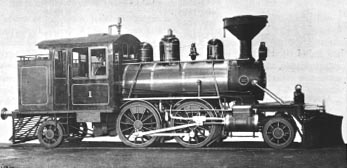
Under the Whyte notation for the classification of steam locomotives, 2-4-2 represents the wheel arrangement of two leading wheels on one axle, four powered and coupled driving wheels on two axles and two trailing wheels on one axle. The type is sometimes named Columbia after a Baldwin 2-4-2 locomotive was showcased at the 1893 World's Columbian Exposition held at Chicago, Illinois.
The wheel arrangement was widely used on passenger tank locomotives during the last three decades of the nineteenth and the first decade of the twentieth centuries. The vast majority of 2-4-2 locomotives were tank engines, designated 2-4-2T. The symmetrical wheel arrangement was well suited for a tank locomotive that is used to work in either direction.
When the leading and trailing wheels are in swivelling trucks, the equivalent UIC classification is 1'B1'.
While a number of 2-4-2 tender locomotives were built, larger tender locomotive types soon became dominant.
In 1899, the Walvis Bay Railway in the British territory of Walvis Bay, a Cape of Good Hope exclave in Deutsch-Südwest-Afrika (German South West Africa), placed a single tank locomotive in service. The engine, named Hope and built by Kerr, Stuart and Company, remained in service until 1904 when operations on the railway were suspended. The line was abandoned in 1905, partly as a result of being buried by a sandstorm.
A 2-4-2 tank locomotive, built by Baldwin Locomotive Works in 1899 and used on the private Raahe track in Finland, was later bought by the Finnish State Railways.
In 1877, when the New Zealand Railways needed new motive power, the road turned to the Rogers Locomotive Works who supplied eight 2-4-2 tender locomotives between 1877 and 1879 that were designated the "K" class. These were the first American-built locomotives in New Zealand and proved to be quite successful.
Three of these locomotives have been preserved. No. K88 Washington was used on the first through train between Christchurch and Dunedin in 1877. After fifty years of service, Washington was dumped in the Oreti River, Southland, as a flood protection measure. In 1974, the locomotive was exhumed from her watery grave and, over the next eight years, restored to full active service.
Hub AI
2-4-2 AI simulator
(@2-4-2_simulator)
2-4-2
Under the Whyte notation for the classification of steam locomotives, 2-4-2 represents the wheel arrangement of two leading wheels on one axle, four powered and coupled driving wheels on two axles and two trailing wheels on one axle. The type is sometimes named Columbia after a Baldwin 2-4-2 locomotive was showcased at the 1893 World's Columbian Exposition held at Chicago, Illinois.
The wheel arrangement was widely used on passenger tank locomotives during the last three decades of the nineteenth and the first decade of the twentieth centuries. The vast majority of 2-4-2 locomotives were tank engines, designated 2-4-2T. The symmetrical wheel arrangement was well suited for a tank locomotive that is used to work in either direction.
When the leading and trailing wheels are in swivelling trucks, the equivalent UIC classification is 1'B1'.
While a number of 2-4-2 tender locomotives were built, larger tender locomotive types soon became dominant.
In 1899, the Walvis Bay Railway in the British territory of Walvis Bay, a Cape of Good Hope exclave in Deutsch-Südwest-Afrika (German South West Africa), placed a single tank locomotive in service. The engine, named Hope and built by Kerr, Stuart and Company, remained in service until 1904 when operations on the railway were suspended. The line was abandoned in 1905, partly as a result of being buried by a sandstorm.
A 2-4-2 tank locomotive, built by Baldwin Locomotive Works in 1899 and used on the private Raahe track in Finland, was later bought by the Finnish State Railways.
In 1877, when the New Zealand Railways needed new motive power, the road turned to the Rogers Locomotive Works who supplied eight 2-4-2 tender locomotives between 1877 and 1879 that were designated the "K" class. These were the first American-built locomotives in New Zealand and proved to be quite successful.
Three of these locomotives have been preserved. No. K88 Washington was used on the first through train between Christchurch and Dunedin in 1877. After fifty years of service, Washington was dumped in the Oreti River, Southland, as a flood protection measure. In 1974, the locomotive was exhumed from her watery grave and, over the next eight years, restored to full active service.
Recent media