



Community hub
Recent from talks
Knowledge base stats:
Talk channels stats:
Members stats:
2007 Greek forest fires
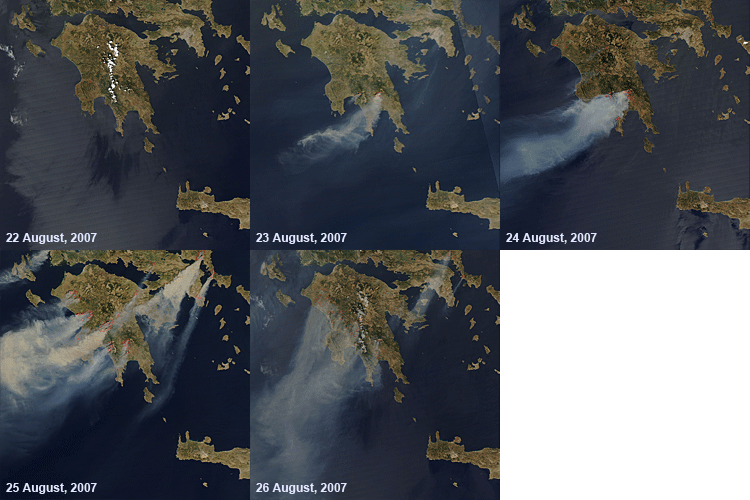
The 2007 Greek forest fires were a series of massive forest fires that broke out in several areas across Greece throughout the summer of 2007. The most destructive and lethal infernos broke out on 23 August, expanded rapidly and raged out of control until 27 August, until they were finally put out in early September. The fires mainly affected western and southern Peloponnese as well as southern Euboea. The death toll in August alone stood at 67 people. In total 85 people lost their lives because of the fires, including several fire fighters.
Some of these firestorms are believed to be the result of arson while others were merely the result of negligence. Hot temperatures, including three consecutive heat waves of over 40 °C (104 °F), and severe drought rendered the 2007 summer unprecedented in modern Greek history. From the end of June to early September, over 3,000 forest fires were recorded across the nation. Nine more people were killed in blazes in June and July.
A total of 2,700 square kilometers (670,000 acres) of forest, olive groves and farmland were destroyed in the fires, which was the worst fire season on record in the past 50 years. Of the total of 2,700 km2, 1,500 km2 (370,000 acres) were burnt forests in Southern Greece alone which meant that 4% of Greece's total forest area burnt in 2007 alone. Many buildings were also destroyed in the blaze. The fire destroyed 1,000 houses and 1,100 other buildings, and damaged hundreds more.
The first major fire of the summer of 2007 was started on 28 June 2007. It is perceived to have been started by either an exploding electrical pylon or by arsonists. Significant parts of the Parnitha National Park were destroyed, and in total, the fire burnt 15,723 acres (63.6 km2) of the core of the national forest in a matter of days. Overall, the mountain of Parnitha suffered a burnt area of 38,000 acres (153.8 km2), making it one of the worst recorded wildfires in Attica since the Penteli fire of July 1995.
The magnitude of the devastation was unforeseen. Environmental studies in Greece report that the Athenian microclimate will significantly change to warmer during the summer season, and flooding is now a very probable danger for the northern suburbs of the city. Mount Parnitha was considered the 'lungs' of Athens; following its considerable burning, both the city and local flora and fauna are expected to feel the consequences. Other affected areas included Pelion, Agia and Melivoia, Skourta, Dafni, and Pyli.
On 11 July 2007, another wildfire sparked at a garbage dump near Agia Paraskevi, Skiathos, and spread across the island. Residents and tourists were forced to evacuate to nearby Troulos, and returned after the fire was put out. More than 100 fires were reported by 15 July 2007, in such locations as Keratea outside of Athens, Peloponnese, and on the Aegean islands of Andros, Evia, Lesbos, and Samos, as well as Crete and the Ionian island of Kefalonia.
In Peloponnese around 20 July 2007, a fire which started from the mountains over the town of Aigio expanded rapidly towards Diakopto and Akrata, destroyed a large area of forests and cultivated land. In the same fire many villages were totally or partially burned, resulting in the loss of 230 houses and 10 churches; three people lost their lives. A 26-year-old farmer and a 77-year-old woman were arrested on suspicion of arson concerning the fires in Aigio and Diakopto. The farmer confessed and is currently held in prison.
Fires continued, on 17 August 2007 they started to burn on the outskirts of Athens. The fire started on Mt. Penteli began burning down towards the suburbs. More than sixty fire engines, nineteen planes and helicopters, and hundreds of firefighters as well as locals attempted to hold back the fire. Melisia, Vrilisia, and Penteli city were affected in the blaze that was put out once winds calmed down.
Hub AI
2007 Greek forest fires AI simulator
(@2007 Greek forest fires_simulator)
2007 Greek forest fires
The 2007 Greek forest fires were a series of massive forest fires that broke out in several areas across Greece throughout the summer of 2007. The most destructive and lethal infernos broke out on 23 August, expanded rapidly and raged out of control until 27 August, until they were finally put out in early September. The fires mainly affected western and southern Peloponnese as well as southern Euboea. The death toll in August alone stood at 67 people. In total 85 people lost their lives because of the fires, including several fire fighters.
Some of these firestorms are believed to be the result of arson while others were merely the result of negligence. Hot temperatures, including three consecutive heat waves of over 40 °C (104 °F), and severe drought rendered the 2007 summer unprecedented in modern Greek history. From the end of June to early September, over 3,000 forest fires were recorded across the nation. Nine more people were killed in blazes in June and July.
A total of 2,700 square kilometers (670,000 acres) of forest, olive groves and farmland were destroyed in the fires, which was the worst fire season on record in the past 50 years. Of the total of 2,700 km2, 1,500 km2 (370,000 acres) were burnt forests in Southern Greece alone which meant that 4% of Greece's total forest area burnt in 2007 alone. Many buildings were also destroyed in the blaze. The fire destroyed 1,000 houses and 1,100 other buildings, and damaged hundreds more.
The first major fire of the summer of 2007 was started on 28 June 2007. It is perceived to have been started by either an exploding electrical pylon or by arsonists. Significant parts of the Parnitha National Park were destroyed, and in total, the fire burnt 15,723 acres (63.6 km2) of the core of the national forest in a matter of days. Overall, the mountain of Parnitha suffered a burnt area of 38,000 acres (153.8 km2), making it one of the worst recorded wildfires in Attica since the Penteli fire of July 1995.
The magnitude of the devastation was unforeseen. Environmental studies in Greece report that the Athenian microclimate will significantly change to warmer during the summer season, and flooding is now a very probable danger for the northern suburbs of the city. Mount Parnitha was considered the 'lungs' of Athens; following its considerable burning, both the city and local flora and fauna are expected to feel the consequences. Other affected areas included Pelion, Agia and Melivoia, Skourta, Dafni, and Pyli.
On 11 July 2007, another wildfire sparked at a garbage dump near Agia Paraskevi, Skiathos, and spread across the island. Residents and tourists were forced to evacuate to nearby Troulos, and returned after the fire was put out. More than 100 fires were reported by 15 July 2007, in such locations as Keratea outside of Athens, Peloponnese, and on the Aegean islands of Andros, Evia, Lesbos, and Samos, as well as Crete and the Ionian island of Kefalonia.
In Peloponnese around 20 July 2007, a fire which started from the mountains over the town of Aigio expanded rapidly towards Diakopto and Akrata, destroyed a large area of forests and cultivated land. In the same fire many villages were totally or partially burned, resulting in the loss of 230 houses and 10 churches; three people lost their lives. A 26-year-old farmer and a 77-year-old woman were arrested on suspicion of arson concerning the fires in Aigio and Diakopto. The farmer confessed and is currently held in prison.
Fires continued, on 17 August 2007 they started to burn on the outskirts of Athens. The fire started on Mt. Penteli began burning down towards the suburbs. More than sixty fire engines, nineteen planes and helicopters, and hundreds of firefighters as well as locals attempted to hold back the fire. Melisia, Vrilisia, and Penteli city were affected in the blaze that was put out once winds calmed down.