


Community hub
Recent from talks
Contribute something
Nothing was collected or created yet.
Crete
View on Wikipedia
Crete (/kriːt/ KREET; Greek: Κρήτη, Modern: Kríti [ˈkriti], Ancient: Krḗtē [krɛ̌ːtεː]) is the largest and most populous of the Greek islands, the 88th largest island in the world, and the fifth largest island in the Mediterranean Sea, after Sicily, Sardinia, Cyprus, and Corsica. Crete is located approximately 100 km (62 mi) south of the Peloponnese, and about 300 km (190 mi) southwest of Anatolia. Crete has an area of 8,450 km2 (3,260 sq mi) and a coastline of 1,046 km (650 mi). It bounds the southern border of the Aegean Sea, with the Sea of Crete (or North Cretan Sea) to the north and the Libyan Sea (or South Cretan Sea) to the south. Crete covers 260 km from west to east but is narrow from north to south, spanning three degrees of longitude but only half a degree of latitude.
Key Information


Crete and its surrounding islands and islets form the Region of Crete (Greek: Περιφέρεια Κρήτης), which is the southernmost of the 13 top-level administrative units of Greece, and the fifth most populous of Greece's regions. Its capital and largest city is Heraklion, located on the island's north shore. As of 2021[update], the region had a population of 624,408.[4] The Dodecanese are located to the northeast of Crete, while the Cyclades are situated to the north, separated by the Sea of Crete.
Crete was the center of Europe's first advanced civilization, the Minoans, from 2700 to 1420 BC. The Minoan civilization was overrun by the Mycenaean civilization from mainland Greece. Crete was subsequently ruled by Rome, then successively by the Byzantine Empire, Andalusian Arabs, the Byzantine Empire again, the Venetian Republic, and the Ottoman Empire. In 1898 Crete, whose people had for some time wanted to join the Greek state, achieved independence from the Ottomans, formally becoming the Cretan State. Crete became part of Greece in December 1913. In Greek mythology, Crete is best known as the birthplace of the Greek god Zeus.
Crete is predominantly mountainous, characterized by a range that crosses the island from west to east. It includes Crete's highest point, Mount Ida, and the range of the White Mountains (Lefka Ori) with 30 summits above 2,000 metres (6,600 ft) in altitude and the Samaria Gorge, a World Biosphere Reserve. Crete forms a significant part of the economy and cultural heritage of Greece, while retaining its own local cultural traits (such as its own poetry and music). The Nikos Kazantzakis airport at Heraklion and the Daskalogiannis airport at Chania serve international travelers. The Minoan palace at Knossos is also located in Heraklion.[5]
Name
[edit]
| ||||||
| Keftiu in hieroglyphs | ||||||
|---|---|---|---|---|---|---|


The earliest references to the island of Crete come from texts from the Syrian city of Mari dating from the 18th century BC, where the island is referred to as Kaptara.[6] This is repeated later in Neo-Assyrian records and the Bible (Caphtor). It was known in ancient Egyptian as Keftiu or kftı͗w, strongly suggesting a similar Minoan name for the island.[7]
The current name Crete is first attested in the 15th century BC in Mycenaean Greek texts, written in Linear B, through the words ke-re-te 𐀐𐀩𐀳, *Krētes; later Greek: Κρῆτες [krɛː.tes], plural of Κρής [krɛːs])[8] and ke-re-si-jo 𐀐𐀩𐀯𐀍, *Krēsijos; later Greek: Κρήσιος [krέːsios],[9] 'Cretian').[10][11] In Ancient Greek, the name Crete (Κρήτη) first appears in Homer's Odyssey.[12] Its etymology is unknown. One proposal derives it from a hypothetical Luwian word *kursatta (compare kursawar 'island', kursattar 'cutting, sliver').[13] Another proposal suggests that it derives from the ancient Greek word "κραταιή" (krataie̅), meaning strong or powerful, the reasoning being that Crete was the strongest thalassocracy during ancient times.[14][15]
In Latin, the name of the island became Creta. The original Arabic name of Crete was Iqrīṭiš (Arabic: اقريطش < (τῆς) Κρήτης), but after the Emirate of Crete's establishment of its new capital at ربض الخندق Rabḍ al-Ḫandaq (modern Heraklion; Greek: Ηράκλειο, Irákleio), both the city and the island became known as Χάνδαξ (Chandax) or Χάνδακας (Chandakas), which gave Latin, Italian, and Venetian Candia, from which were derived French Candie and English Candy or Candia. Under Ottoman rule, in Ottoman Turkish, Crete was called Girit (كريد). In the Hebrew Bible, Crete is referred to as (כְּרֵתִים) "kretim".
Physical geography and climate
[edit]


.jpg)
Crete is the largest island in Greece and the fifth largest island in the Mediterranean Sea. It is located south of almost the rest of the country, in the southern part of the Aegean Sea separating the Aegean from the Libyan Sea.
Island morphology
[edit]The island has an elongated shape: it spans 260 km (160 mi) from east to west, is 60 km (37 mi) at its widest point, and narrows to as little as 12 km (7.5 mi) (close to Ierapetra). Crete covers an area of 8,336 km2 (3,219 sq mi), with a coastline of 1,046 km (650 mi); to the north, it broaches the Sea of Crete (Greek: Κρητικό Πέλαγος); to the south, the Libyan Sea (Greek: Λιβυκό Πέλαγος); in the west, the Myrtoan Sea, and toward the east the Carpathian Sea. It lies approximately 160 km (99 mi) south of the Greek mainland.
There are a number of peninsulas and gulfs on the north side of Crete, from west to east these include: Gramvousa peninsula, gulf of Kissamos, Rodopos peninsula, gulf of Chania, Akrotiri peninsula, Souda Bay, Apokoronas cape, gulf of Almiros, gulf of Heraklion, Aforesmenos cape, gulf of Mirabello, gulf of Sitia and the Sideros peninsula. On the south side of Crete is the gulf of Messaras and Cape Lithinon.
Mountains and valleys
[edit]Crete is mountainous, and its character is defined by a high mountain range crossing from west to east, formed by six different groups of mountains:
- The Idi Range (Psiloritis) 2,456 m (8,058 ft)
- The White Mountains or Lefka Ori 2,453 m (8,048 ft)
- The Dikti Mountains 2,148 m (7,047 ft)
- Kedros 1,777 m (5,830 ft)
- Thrypti 1,489 m (4,885 ft)
- Asterousia Mountains 1,231 m (4,039 ft)
These mountains lavish Crete with valleys, such as Amari valley, fertile plateaus, such as Lasithi plateau, Omalos and Nidha; caves, such as Gourgouthakas, Diktaion, and Idaion (the birthplace of the ancient Greek god Zeus); and a number of gorges.
The mountains have been seen as a key feature of the island's distinctiveness, especially since the time of Romantic travellers' writing. Contemporary Cretans distinguish between highlanders and lowlanders; the former often claim to reside in places affording a higher/better climatic and moral environment. In keeping with the legacy of Romantic authors, the mountains are seen as having determined their residents' 'resistance' to past invaders which relates to the oft-encountered idea that highlanders are 'purer' in terms of less intermarriages with occupiers.
For residents of mountainous areas, such as Sfakia in western Crete, the aridness and rockiness of the mountains is emphasised as an element of pride and is often compared to the alleged soft-soiled mountains of others parts of Greece or the world.[16]
Gorges, rivers and lakes
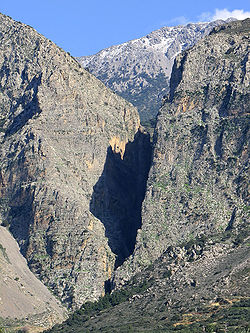
[edit]The island has a number of gorges, such as the Samariá Gorge, Imbros Gorge, Kourtaliotiko Gorge, Ha Gorge, Platania Gorge, the Gorge of the Dead (at Kato Zakros, Sitia) and Richtis Gorge and (Richtis) waterfall at Exo Mouliana in Sitia.[17][18][19][20]
The rivers of Crete include the Geropotamos River, the Koiliaris, the Anapodiaris, the Almiros, the Giofyros, the Keritis, and Megas Potamos. There are only two freshwater lakes in Crete: Lake Kournas and Lake Agia, which are both in Chania regional unit.[21] Lake Voulismeni at the coast, at Aghios Nikolaos, was formerly a freshwater lake but is now connected to the sea, in Lasithi.[22] Three artificial lakes created by dams also exist in Crete: the lake of Aposelemis Dam, the lake of Potamos Dam, and the lake of Mpramiana Dam.
-
-

-
 Aradaina Gorge
 -
 Venetian Bridge over Megalopotamos River


Surrounding islands
[edit]
A large number of islands, islets, and rocks hug the coast of Crete. Many are visited by tourists, some are only visited by archaeologists and biologists. Some are environmentally protected. A small sample of the islands includes:
- Gramvousa (Kissamos, Chania) the pirate island opposite the Balo lagoon
- Elafonisi (Chania), which commemorates a shipwreck and an Ottoman massacre
- Chrysi island (Ierapetra, Lasithi), which hosts the largest natural Juniperus macrocarpa forest in Europe
- Paximadia island (Agia Galini, Rethymno) where the god Apollo and the goddess Artemis were traditionally believed to be born
- The Venetian fort and leper colony at Spinalonga opposite the beach and shallow waters of Elounda (Agios Nikolaos, Lasithi)
- Dionysades islands which are in an environmentally protected region together with the Palm Beach Forest of Vai in the municipality of Sitia, Lasithi
Off the south coast, the island of Gavdos is located 26 nautical miles (48 km) south of Hora Sfakion and is the southernmost point of Europe.
Climate
[edit]Crete straddles two climatic zones, the Mediterranean and the semi-arid climate, mainly falling within the former. As such, the climate in Crete is primarily a hot-summer Mediterranean (Csa) climate while some areas in the south and east have a hot semi-arid climate (Köppen climate classification: BSh). The higher elevations fall into the cold-summer Mediterranean climate category (Csc),[23] while some of the mountain peaks (>2,000 meters) may feature a continental climate (Dfb or Dfc). The atmosphere can be quite humid, depending on the proximity to the sea, while winter is fairly mild. Snowfall is common on the mountains between November and April, but rare in most low-lying areas.

The south coast, including the Mesara Plain and Asterousia Mountains enjoy significantly more sunny days and, on average, higher temperatures throughout the year. There, date palms bear fruit, and swallows remain year-round. The fertile region around Ierapetra, on the southeastern corner of the island, has year-round agricultural production, with summer vegetable and fruit produced in greenhouses throughout the year.[24] Western Crete (Chania province) receives more rain and the soil there suffers more erosion compared to the Eastern part of Crete.[25]
Average annual temperatures reach up to 22.0 °C in Tris Ekklisies which is located in South Crete. Crete holds the record for the highest temperatures ever recorded in Europe during October, November, January and February among W.M.O. stations. [26] [27][28][29][30][31] According to the Hellenic National Meteorological Service, South Crete receives the most sunshine in Greece with more than 3,257 hours of sunshine per year.[32]
| Climate data for Heraklion 1955–2010 (HNMS) | |||||||||||||
|---|---|---|---|---|---|---|---|---|---|---|---|---|---|
| Month | Jan | Feb | Mar | Apr | May | Jun | Jul | Aug | Sep | Oct | Nov | Dec | Year |
| Record high °C (°F) | 29.9 (85.8) |
28.8 (83.8) |
34.0 (93.2) |
37.5 (99.5) |
38.0 (100.4) |
41.3 (106.3) |
43.6 (110.5) |
44.5 (112.1) |
39.5 (103.1) |
37.0 (98.6) |
32.8 (91.0) |
28.5 (83.3) |
44.5 (112.1) |
| Mean daily maximum °C (°F) | 15.3 (59.5) |
15.5 (59.9) |
17.0 (62.6) |
20.1 (68.2) |
23.6 (74.5) |
27.3 (81.1) |
28.9 (84.0) |
28.8 (83.8) |
26.6 (79.9) |
23.6 (74.5) |
20.2 (68.4) |
17.1 (62.8) |
22.0 (71.6) |
| Daily mean °C (°F) | 12.1 (53.8) |
12.2 (54.0) |
13.6 (56.5) |
16.6 (61.9) |
20.4 (68.7) |
24.5 (76.1) |
26.4 (79.5) |
26.3 (79.3) |
23.7 (74.7) |
20.3 (68.5) |
16.8 (62.2) |
13.8 (56.8) |
18.9 (66.0) |
| Mean daily minimum °C (°F) | 9.1 (48.4) |
8.9 (48.0) |
9.8 (49.6) |
12.0 (53.6) |
15.1 (59.2) |
19.2 (66.6) |
21.9 (71.4) |
22.0 (71.6) |
19.5 (67.1) |
16.7 (62.1) |
13.5 (56.3) |
10.9 (51.6) |
14.9 (58.8) |
| Record low °C (°F) | 0.0 (32.0) |
−0.8 (30.6) |
0.3 (32.5) |
4.2 (39.6) |
6.0 (42.8) |
12.2 (54.0) |
14.5 (58.1) |
16.6 (61.9) |
12.0 (53.6) |
8.7 (47.7) |
4.2 (39.6) |
2.4 (36.3) |
−0.8 (30.6) |
| Average rainfall mm (inches) | 91.0 (3.58) |
69.0 (2.72) |
53.4 (2.10) |
28.2 (1.11) |
13.4 (0.53) |
2.9 (0.11) |
0.8 (0.03) |
0.9 (0.04) |
16.7 (0.66) |
59.4 (2.34) |
59.6 (2.35) |
85.6 (3.37) |
480.9 (18.94) |
| Average rainy days | 16.0 | 13.6 | 11.4 | 7.6 | 4.6 | 1.3 | 0.3 | 0.5 | 2.8 | 7.5 | 10.6 | 15.2 | 91.4 |
| Average relative humidity (%) | 68.4 | 66.4 | 65.9 | 62.3 | 61.2 | 57.0 | 57.1 | 59.1 | 61.9 | 65.7 | 67.9 | 68.3 | 63.4 |
| Mean monthly sunshine hours | 119.9 | 132.3 | 181.5 | 234.8 | 298.5 | 356.2 | 368.3 | 343.5 | 275.8 | 206.9 | 145.5 | 115.4 | 2,778.6 |
| Source 1: HNMS[33][34] | |||||||||||||
| Source 2: meteo-climat (extremes)[35] | |||||||||||||
| Climate data for Tris Ekklisies 15 m a.s.l | |||||||||||||
|---|---|---|---|---|---|---|---|---|---|---|---|---|---|
| Month | Jan | Feb | Mar | Apr | May | Jun | Jul | Aug | Sep | Oct | Nov | Dec | Year |
| Record high °C (°F) | 21.5 (70.7) |
20.9 (69.6) |
25.6 (78.1) |
26.8 (80.2) |
32.3 (90.1) |
41.4 (106.5) |
42.1 (107.8) |
37.3 (99.1) |
36.8 (98.2) |
29.8 (85.6) |
27.8 (82.0) |
22.6 (72.7) |
42.1 (107.8) |
| Mean daily maximum °C (°F) | 18.1 (64.6) |
16.1 (61.0) |
19.4 (66.9) |
21.3 (70.3) |
24.9 (76.8) |
31.0 (87.8) |
34.3 (93.7) |
32.9 (91.2) |
30.3 (86.5) |
26.4 (79.5) |
22.4 (72.3) |
19.5 (67.1) |
24.7 (76.5) |
| Daily mean °C (°F) | 15.9 (60.6) |
13.8 (56.8) |
16.8 (62.2) |
18.6 (65.5) |
22.0 (71.6) |
27.7 (81.9) |
30.8 (87.4) |
29.8 (85.6) |
27.4 (81.3) |
23.8 (74.8) |
20.1 (68.2) |
17.3 (63.1) |
22.0 (71.6) |
| Mean daily minimum °C (°F) | 13.7 (56.7) |
11.4 (52.5) |
14.2 (57.6) |
16.0 (60.8) |
19.0 (66.2) |
24.4 (75.9) |
27.3 (81.1) |
26.7 (80.1) |
24.5 (76.1) |
21.3 (70.3) |
17.7 (63.9) |
15.1 (59.2) |
19.3 (66.7) |
| Record low °C (°F) | 5.6 (42.1) |
4.4 (39.9) |
9.6 (49.3) |
9.5 (49.1) |
14.3 (57.7) |
17.7 (63.9) |
22.9 (73.2) |
23.9 (75.0) |
18.8 (65.8) |
17.8 (64.0) |
11.9 (53.4) |
9.9 (49.8) |
4.4 (39.9) |
| Average rainfall mm (inches) | 64.7 (2.55) |
85.1 (3.35) |
30.6 (1.20) |
20.1 (0.79) |
17.1 (0.67) |
18.7 (0.74) |
1.1 (0.04) |
0.2 (0.01) |
29.7 (1.17) |
0.7 (0.03) |
78.1 (3.07) |
101.9 (4.01) |
448 (17.63) |
| Source: Cultural Association of Tris Ekklisies, CW (Dec 2022-Sep 2025) [36] | |||||||||||||
Human geography
[edit]Crete is the most populous island in Greece, with a population of over 600,000. Approximately 42% of residents live in the island's main cities and towns, while 45% reside in rural areas.[37]
-
 Venetian harbour in Chania
 -
 Dusk airview of the Old Harbour of Rethymno
 -
 View of the harbour in Heraklion
 -
 The old harbour in Agios Nikolaos


Administration
[edit]Crete Region
| |
|---|---|
 Logo flag | |
.svg) | |
| Coordinates: 35°13′N 24°55′E / 35.21°N 24.91°E | |
| Country |  Greece Greece |
| Established | 1912 |
| Capital | Heraklion |
| Regional units | |
| Government | |
| • Regional governor | Stavros Arnaoutakis (PASOK – Movement for Change) |
| Area | |
• Total | 8,335.88 km2 (3,218.50 sq mi) |
| Population (2021)[38] | |
• Total | 624,408 |
| • Density | 74.9061/km2 (194.006/sq mi) |
| GDP | |
| • Total | €8.913 billion (2021) |
| Time zone | UTC+2 (EET) |
| • Summer (DST) | UTC+3 (EEST) |
| ISO 3166 code | GR-M |
| Website | www |
Crete with its nearby islands form the Crete Region (Greek: Περιφέρεια Κρήτης, Periféria Krítis, [periˈferia ˈkritis]), one of the 13 regions of Greece which were established in the 1987 administrative reform.[40] Under the 2010 Kallikratis plan, the powers and authority of the regions were redefined and extended. The region is based at Heraklion and is divided into four regional units (pre-Kallikratis prefectures). From west to east these are: Chania, Rethymno, Heraklion, and Lasithi. These are further subdivided into 24 municipalities.
Since 1 January 2011, the regional governor is Stavros Arnaoutakis of the Panhellenic Socialist Movement. First elected in 2010, he was re-elected in 2014, 2019 and 2023.
Cities
[edit]Heraklion is the largest city and capital of Crete, holding more than a fourth of the island's population. Chania was the capital until 1971. The principal cities are:
- Heraklion (Iraklion or Candia) (144,422 inhabitants)[41]
- Chania (Haniá) (88,525 inhabitants)[41]
- Rethymno (34,300 inhabitants)[41]
- Ierapetra (23,707 inhabitants)
- Agios Nikolaos (20,679 inhabitants)
- Sitia (14,338 inhabitants)
-
 Venetian fortress in Heraklion
 -
 Chania cathedral
 -
 Rethymno Fortezza Mosque
 -
 Kazarma fortress at the top in Sitia


Demographics
[edit]According to official census data by the Hellenic Statistical Authority, the region's population has increased by 1,343 people between 2011 and 2021, experiencing a rise of 0.22%.[42] The island is home to 308,608 men and 315,800 women, accounting for 49.4% and 50.6% of the population respectively.
| Crete | 1981 | 1991 | 2001 | 2011 | 2021 |
|---|---|---|---|---|---|
| Population | 502,165 | 540,054 | 601,131 | 623,065 | 624,408 |
| Change | --- --- --- | +7.27% | +10.7% | +3.58% | +0.22% |
 | This graph was using the legacy Graph extension, which is no longer supported. It needs to be converted to the new Chart extension. |
The island is divided into four regional units, Heraklion, Rethymno, Chania, and Lasithi.
| Regional Unit | Population (2021) | Change between 2011 and 2021 (%) |
|---|---|---|
| Heraklion | 305,017 | -0.2% |
| Lasithi | 77,819 | +3.2% |
| Rethymno | 84,866 | -0.9% |
| Chania | 156,706 | +0.1% |
Economy
[edit]
The economy of Crete is predominantly based on services and tourism. However, agriculture also plays an important role and Crete is one of the few Greek islands that can support itself without a tourism industry.[43] The economy began to change visibly during the 1970s as tourism gained in importance. Although an emphasis remains on agriculture and stock breeding, because of the climate and terrain of the island, there has been a drop in manufacturing, and an observable expansion in its service industries (mainly tourism-related). All three sectors of the Cretan economy (agriculture/farming, processing-packaging, services), are directly connected and interdependent. The island has a per capita income much higher than the Greek average, whereas unemployment is at approximately 4%, one-sixth of that of the country overall.[citation needed][when?]
As in many regions of Greece, viticulture and olive groves are significant; oranges, citrons, avocadoes and bananas[44] are also cultivated. Dairy products are important to the local economy and there are a number of specialty cheeses such as mizithra, anthotyros, and kefalotyri. 20% of Greek wine is produced in Crete, mostly in the region of Peza.[45]
The Gross domestic product (GDP) of the region was €9.4 billion in 2018, accounting for 5.1% of Greek economic output. GDP per capita adjusted for purchasing power was €17,800 or 59% of the EU27 average in the same year. The GDP per employee was 68% of the EU average. Crete is the region in Greece with the fifth highest GDP per capita.[46]
Transport infrastructure
[edit]Airports
[edit]The island has three significant airports, Nikos Kazantzakis at Heraklion, the Daskalogiannis airport at Chania and the smaller Sitia airport. The first two serve international routes, acting as the main gateways to the island for travellers. Nikos Kazantzakis was Greece’s second-busiest airport through the year of 2024.[47] Work has begun plan to replace Heraklion airport with a new airport at Kasteli, where there is presently an air force base, and the new Kasteli Airport is due to open by 2027.
Ferries
[edit]The island is well served by ferries, mostly from Piraeus, by ferry companies such as Minoan Lines and ANEK Lines with links to the Cyclades and Dodecanese islands. Seajets also operates routes to Cyclades.
The main ports from west to east are at Kissamos (ferry link to Peloponnese), Souda (Chania), Rethymno, Heraklion (links to Cyclades), Agios Nikolaos and Sitia (link to Dodecanese).
Road network
[edit]
Most of Crete is served by the road network. A modern highway is currently being upgraded along the north coast connecting the four major cities (A90 motorway), the sections bypassing the main cities (Heraklion to Malia, Rethymno, Chania to Kolymvari) are at motorway standard, while the sections in between, and west to Kissamos and east to Sitia, should be completed by 2028. A link will also connect to the new Kasteli international airport .[48]
In addition, a European Union study has been devised to promote a modern highway to connect the northern and southern parts of the island via a tunnel. The study proposal includes a 15.7 km (9.8 mi) section of road between the villages of Agia Varvara and Agia Deka in central Crete. The new road section forms part of the route between Messara in the south and Crete's largest city Heraklion, which houses the island's biggest airport and ferry links with mainland Greece.
Railway
[edit]Also, during the 1930s there was a narrow-gauge industrial railway in Heraklion, from Giofyros in the west side of the city to the port. There are now no railway lines on Crete. The government is planning the construction of a line from Chania to Heraklion via Rethymno.[49][50]
Development
[edit]The construction sector in Crete responded well during the pandemic and has come out strong in the post-recession recovery period. Total construction spending recovered and is expected to peak a record high (approximately 8% higher than 2019 average levels) signalling consistent expansion in construction projects and real estate investments in Crete.[51] The evolution of the private sector in Crete is tightly linked with the demand for tourism-related investments. Moreover, the recovery of the tourism sector is expected to lead to further growth in housing prices and rental demand.
Newspapers have reported that the Ministry of Mercantile Marine is ready to support the agreement between Greece, South Korea, Dubai Ports World and China for the construction of a large international container port and free trade zone in southern Crete near Tympaki; the plan is to expropriate 850 ha (2,100 acres) of land. The port would handle two million containers per year, but the project has not been universally welcomed because of its environmental, economic and cultural impact.[52] As of January 2013, the project has still not been confirmed, although there is mounting pressure to approve it, arising from Greece's difficult economic situation.
There are plans for underwater cables going from mainland Greece to Israel and Egypt passing by Crete and Cyprus: EuroAfrica Interconnector and EuroAsia Interconnector.[53][54] They would connect Crete electrically with mainland Greece, ending energy isolation of Crete. At present Greece covers electricity cost differences for Crete of around €300 million per year.[55]
History
[edit]
.jpg)

In the later Neolithic and Bronze Age periods, under the Minoans, Crete had a highly developed, literate civilization. It has been ruled by various ancient Greek entities, the Roman Empire, the Byzantine Empire, the Emirate of Crete, the Republic of Venice and the Ottoman Empire. After a brief period of independence (1897–1913) under a provisional Cretan government, it joined the Kingdom of Greece. It was occupied by Nazi Germany during the Second World War.
Prehistory
[edit]Stone tools suggest that archaic humans may have visited Crete as early as 130,000 years ago, but there is no evidence of permanent settlement of the island until the Neolithic, around 7,000 BCE.[56] Settlements dating to the aceramic Neolithic in the 7th millennium BC, used cattle, sheep, goats, pigs and dogs as well as domesticated cereals and legumes; ancient Knossos was the site of one of these major Neolithic (then later Minoan) sites.[57] Other neolithic settlements include those at Kephala, Magasa, and Trapeza.
Minoan civilization
[edit]During the Bronze Age, Crete was the centre of the Minoan civilization, notable for its art, its writing systems such as Linear A, and for its massive building complexes including the palace at Knossos. Its economy benefited from a network of trade around much of the Mediterranean, and Minoan cultural influence extended to Cyprus, Canaan, and Egypt.
Mycenaean civilization
[edit]In 1420 BC, the Minoan civilization was subsumed by the Mycenaean civilization from mainland Greece. The oldest samples of writing in the Greek language, as identified by Michael Ventris, is the Linear B archive from Knossos, dated approximately to 1425–1375 BC.[58]
Archaic and Classical period
[edit]After the Bronze Age collapse, Crete was settled by new waves of Greeks from the mainland. A number of city states developed in the Archaic period. There was limited contact with mainland Greece, and Greek historiography shows little interest in Crete, so there are few literary references about the island or its people.
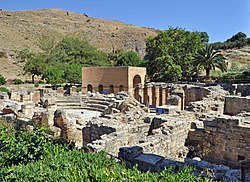
During the 6th to 4th centuries BC, Crete was comparatively free from warfare. The Gortyn code (5th century BC) is evidence for how codified civil law established a balance between aristocratic power and civil rights. In the late 4th century BC, the aristocratic order began to collapse due to endemic infighting among the elite, and Crete's economy was weakened by prolonged wars between city states. During the 3rd century BC, Gortyn, Kydonia (Chania), Lyttos and Polyrrhenia challenged the primacy of ancient Knossos.
While the cities continued to prey upon one another, they invited into their feuds mainland powers like Macedon and its rivals Rhodes and Ptolemaic Egypt. In 220 BC the island was tormented by a war between two opposing coalitions of cities. As a result, the Macedonian king Philip V gained hegemony over Crete which lasted to the end of the Cretan War (205–200 BC), when the Rhodians opposed the rise of Macedon and the Romans started to interfere in Cretan affairs. In the 2nd century BC Ierapytna (Ierapetra) gained supremacy on eastern Crete.
Roman rule
[edit]Crete was involved in the Mithridatic Wars, initially repelling an attack by Roman general Marcus Antonius Creticus in 71 BC. Nevertheless, a ferocious three-year campaign soon followed under Quintus Caecilius Metellus, equipped with three legions. Crete was conquered by Rome in 69 BC, earning for Metellus the title "Creticus". Gortyn was made capital of the island, and Crete became a Roman province, along with Cyrenaica that was called Creta et Cyrenaica. Archaeological remains suggest that Crete under Roman rule witnessed prosperity and increased connectivity with other parts of the Empire.[59] In the 2nd century AD, at least three cities in Crete (Lyttos, Gortyn, Hierapytna) joined the Panhellenion, a league of Greek cities founded by the emperor Hadrian. When Diocletian redivided the Empire, Crete was placed, along with Cyrene, under the diocese of Moesia, and later by Constantine I to the diocese of Macedonia.
Byzantine Empire – first period
[edit]
Crete was separated from Cyrenaica c. 297. It remained a province within the eastern half of the Roman Empire, usually referred to as the Eastern Roman (Byzantine) Empire after the establishment of a second capital in Constantinople by Constantine in 330. Crete was subjected to an attack by Vandals in 467, the great earthquakes of 365 and 415, a raid by Slavs in 623, Arab raids in 654 and the 670s, and again in the 8th century. In c. 732, the Emperor Leo III the Isaurian transferred the island from the jurisdiction of the Pope to that of the Patriarchate of Constantinople.[60]
Arab rule
[edit]
In the 820s, after 900 years as a Roman island, Crete was captured by Andalusian Muwallads led by Abu Hafs,[61] who established the Emirate of Crete. The Byzantines launched a campaign that took most of the island back in 842 and 843 under Theoktistos. Further Byzantine campaigns in 911 and 949 failed. In 960–61, Nikephoros Phokas' campaign restored Crete to the Byzantine Empire, after a century and a half of Arab control.
Byzantine Empire – second period
[edit]In 961, Nikephoros Phokas returned the island to Byzantine rule after expelling the Arabs.[62] Extensive efforts at conversion of the populace were undertaken, led by John Xenos and Nikon "the Metanoeite".[63][64] The reconquest of Crete was a major achievement for the Byzantines, as it restored Byzantine control over the Aegean littoral and diminished the threat of Saracen pirates, for which Crete had provided a base of operations.
In 1204, the Fourth Crusade seized and sacked the imperial capital of Constantinople. Crete was initially granted to leading Crusader Boniface of Montferrat[62] in the partition of spoils that followed. However, Boniface sold his claim to the Republic of Venice,[62] whose forces made up the majority of the Crusade. Venice's rival the Republic of Genoa immediately seized the island and it was not until 1212 that Venice secured Crete as a colony.
Venetian rule
[edit]
From 1212, during Venice's rule, which lasted more than four centuries, a Renaissance swept through the island as is evident from the artistic works dating to that period. Known as The Cretan School or Post-Byzantine Art, it is among the last flowerings of the artistic traditions of the fallen empire. This included the painter El Greco and the writers Nicholas Kalliakis (1645–1707), Georgios Kalafatis (professor) (c. 1652–1720), Andreas Musalus (c. 1665–1721) and Vitsentzos Kornaros.[65][66][67]

In total, about 10,000 Venetians are estimated to have moved to Crete during the first century of Venetian rule—by comparison, Venice itself had a population of c. 60,000 at this period.[68] The colonization wave of 1252 also resulted in the establishment of Canea (modern Chania), on the site of the long abandoned ancient city of Kydonia.[68]

Under the rule of the Catholic Venetians, the city of Candia (modern Heraklion) was reputed to be the best fortified city of the Eastern Mediterranean.[69] The three main forts were located at Gramvousa, Spinalonga, and Fortezza at Rethymnon. Other fortifications include the Kazarma fortress at Sitia and Frangokastello in Sfakia.

In 1492, Jews expelled from Spain settled on the island.[70] In 1574–77, Crete was under the rule of Giacomo Foscarini as Proveditor General, Sindace and Inquisitor. According to Starr's 1942 article, the rule of Giacomo Foscarini was a Dark Age for Jews and Greeks. Under his rule, non-Catholics had to pay high taxes with no allowances. In 1627, there were 800 Jews in the city of Candia, about seven percent of the city's population.[71] Marco Foscarini was the Doge of Venice during this time.
Ottoman rule
[edit]


The Ottomans conquered Crete (Girit Eyâleti) in 1669, after the siege of Candia with the last Venetian strongholds off Crete falling in the last Ottoman–Venetian War in 1715. Many Greek Cretans fled to other regions of the Republic of Venice after the Ottoman–Venetian Wars, some even prospering such as the family of Simone Stratigo (c. 1733 – c. 1824) who migrated to Dalmatia from Crete in 1669.[72]
Heraklion was surrounded by high walls and bastions and extended westward and southward by the 17th century. The most opulent area of the city was the northeastern quadrant where the elite were gathered. The city had received another name under the rule of the Ottomans, "the deserted city" following its destruction after the Siege of Candia.
Islamic presence on the island, aside from the interlude of the Arab occupation, was cemented by the Ottoman conquest. Most Cretan Muslims were local Greek converts who spoke Cretan Greek, but in the island's 19th-century political context they came to be viewed by the Christian population as Turks.[73][pages needed] Contemporary estimates vary, but in 1830, as much as 45% of the population of the island may have been Muslim.[74]
During the Russo-Turkish War (1768–1774), a revolt against Ottoman rule in Crete was started by Daskalogiannis, a shipowner from Sfakia who was promised support by the Russian navy which never arrived. Daskalogiannis eventually surrendered to the Ottoman authorities.[75][76] On 17 June 1771 Daskalogiannis was, in the full daylight of publicity, tortured, skinned alive and then beaten to death, an ordeal that he endured in complete silence.[77] Today, Chania International Airport is named after him.[78]
During the Greek War of Independence, Sultan Mahmud II granted rule over Crete to Egypt's de facto ruler Muhammad Ali Pasha in exchange for his military support. Crete was subsequently left out of the new Greek state established under the London Protocol of 1830.[79] Its administration by Muhammad Ali was confirmed in the Convention of Kütahya of 1833, but direct Ottoman rule was re-established by the Convention of London of 3 July 1840.[74]
The Cretan Revolt of 1866–1869 or Great Cretan Revolution (Greek: Κρητική Επανάσταση του 1866) was a three-year uprising against Ottoman rule, the third and largest in a series of revolts between the end of the Greek War of Independence in 1830 and the establishment of the independent Cretan State in 1898. A particular event which caused strong reactions among the liberal circles of western Europe was the Holocaust of Arkadi. The event occurred in November 1866, as a large Ottoman force besieged the Arkadi Monastery, which served as the headquarters of the rebellion.[80]
In addition to its 259 defenders, over 700 women and children had taken refuge in the monastery. After a few days of hard fighting, the Ottomans broke into the monastery. At that point, under orders from the hegumen (abbot) of the monastery, the Cretans blew up barrels of gunpowder, choosing to sacrifice themselves rather than surrender. The subsequent explosion resulted the death of most of the rebels and the women and children sheltered there.[81] Thirty-six insurgents had found refuge in the refectory, near the ammunitions. Discovered by the Ottomans, who forced the door, they were massacred.[81]
Cretan State and union with Greece
[edit]
Following the repeated uprisings in 1841, 1858, 1889, 1895 and 1897 by the Cretan people, who wanted to join Greece, the Great Powers decided to restore order and in February 1897 sent in troops. The island was subsequently garrisoned by troops from Great Britain, France, Italy and Russia; Germany and Austro-Hungary withdrawing from the occupation in early 1898. During this period Crete was governed through a committee of admirals from the remaining four Powers. In March 1898 the Powers decreed, with the reluctant consent of the Sultan, that the island would be granted autonomy under Ottoman suzerainty in the near future.[82]
In September 1898 the Candia massacre in Candia, modern Heraklion, left over 500 Cretan Christians and 14 British servicemen dead at the hands of Muslim irregulars. As a result, the Admirals ordered the expulsion of all Ottoman troops and administrators from the island, a move that was ultimately completed by early November. The decision to grant autonomy to the island was enforced and a High Commissioner, Prince George of Greece, appointed, arriving to take up his post in December 1898.[83] The flag of the Cretan State was chosen by the Powers, with the white star representing the Ottoman suzerainty over the island.

In 1905, disagreements between Prince George and minister Eleftherios Venizelos over the question of the enosis (union with Greece), such as the Prince's autocratic style of government, resulted in the Theriso revolt, one of the leaders being Eleftherios Venizelos. Prince George resigned as High Commissioner and was replaced by Alexandros Zaimis, a former Greek prime minister, in 1906. In 1908, taking advantage of domestic turmoil in Turkey as well as the timing of Zaimis's vacation away from the island, the Cretan deputies unilaterally declared union with Greece. With the outbreak of the First Balkan War, the Greek government declared that Crete was now Greek territory. This was not recognised internationally until 1 December 1913.[83]
Second World War
[edit]

During World War II, the island was the scene of the Battle of Crete in May 1941. The initial 11-day battle was bloody and left more than 11,000 soldiers and civilians killed or wounded. As a result of the fierce resistance from both Allied forces and civilian Cretan locals, the invasion force suffered heavy casualties, and Adolf Hitler forbade further large-scale paratroop operations for the rest of the war.
During the initial and subsequent occupation, German firing squads routinely executed male civilians in reprisal for the death of German soldiers; civilians were rounded up randomly in local villages for the mass killings, such as at the Massacre of Kondomari and the Viannos massacres. Two German generals were later tried and executed for their roles in the killing of 3,000 of the island's inhabitants.[84]
Following the collapse of fronts elsewhere in Europe, German forces evacuated most of Crete in October 1944 leaving an area including Chania under occupation. The following year the day after VE Day the remaining Germans under Generalmajor Hans-Georg Benthack surrendered at Knossos to British Major-General Colin Callander.[85]
Civil War
[edit]In the aftermath of the Dekemvriana in Athens, Cretan leftists were targeted by the right-wing paramilitary organization National Organization of Rethymno (EOR), which engaged in attacks in the villages of Koxare and Melampes, as well as Rethymno in January 1945. Those attacks did not escalate into a full-scale insurgency as they did in the Greek mainland and the Cretan ELAS did not surrender its weapons after the Treaty of Varkiza. An uneasy truce was maintained until 1947, with a series of arrests of notable communists in Chania and Heraklion. Encouraged by orders from the central organization in Athens, KKE launched an insurgency in Crete; marking the beginning of the Greek Civil War on the island. In eastern Crete the Democratic Army of Greece (DSE) struggled to establish its presence in Dikti and Psilorites. On 1 July 1947, the surviving 55 fighters of DSE were ambushed south of Psilorites, the few surviving members of the unit managed to join the rest of DSE in Lefka Ori.[86]
The Lefka Ori region in the west offered more favourable conditions for DSE's insurgency. In the summer of 1947 DSE raided and looted the Maleme Airport and motor depot at Chrysopigi. Its numbers swelled to approximately 300 fighters. The rise of DSE numbers compounded with crop failure on the island created serious logistical issues for the insurgents. The communists resorted to cattle rustling and crop confiscations which solved the problem only temporarily. In the autumn of 1947, the Greek government offered generous amnesty terms to Cretan DSE fighters and mountain bandits, many of whom opted to abandon armed struggle or defect to the nationalists. On 4 July 1948, government troops launched a large scale offensive on Samariá Gorge. Many DSE soldiers were killed in the fighting while the survivors broke into small armed bands. In October 1948, the secretary of the Cretan KKE Giorgos Tsitilos was killed in an ambush. By the following month only 34 DSE fighters remained active in Lefka Ori. The insurgency in Crete gradually withered away, with the last two hold outs surrendering in 1974, 25 years after the conclusion of the war in mainland Greece.[87]
Tourism
[edit]
Crete is one of the most popular holiday destinations in Greece. In 2023, Crete welcomed 6.3 million visitors, who stayed on average 5.4 days on the island, reflecting significant overtourism pressure on coastal infrastructure.[88] 15% of all arrivals in Greece come through the city of Heraklion (port and airport), while charter journeys to Heraklion make up about 20% of all charter flights in Greece.[89] The number of hotel beds on the island increased by 53% in the period between 1986 and 1991.
Today, the island's tourism infrastructure includes a wide range of accommodation; including large luxury hotels with their complete facilities, swimming pools, sports and recreation, smaller family-owned apartments, camping facilities and others. Visitors reach the island via two international airports in Heraklion and Chania and a smaller airport in Sitia (international charter and domestic flights started in May 2012)[90] or by boat to the main ports of Heraklion, Chania, Rethimno, Agios Nikolaos and Sitia.
Popular tourist attractions include the archaeological sites of the Minoan civilisation, the Venetian old city and port of Chania, the Venetian castle at Rethymno, the gorge of Samaria, the islands of Chrysi, Elafonisi, Gramvousa, Spinalonga and the Palm Beach of Vai, which is the largest natural palm forest in Europe.
Transportation
[edit]Crete has an extensive bus system with regular services across the north of the island and from north to south. There are two regional bus stations in Heraklion. Bus routes and timetables can be found on KTEL website.[91]
Holiday homes and immigration
[edit]Crete's mild climate attracts northern Europeans who want a holiday home or residence on the island. EU citizens have the right to freely buy property and reside with little formality.[92] In the cities of Heraklion and Chania, the average price per square metre of apartments ranges from €1,670 to €1,700.[93] A growing number of real estate companies cater mainly to British immigrants, followed by Dutch, German, Scandinavian and other European nationalities wishing to own a home in Crete. The British immigrants are concentrated in the western regional units of Chania and Rethymno and to a lesser extent in Heraklion and Lasithi.[49]
Archaeological sites and museums
[edit]The area has a large number of archaeological sites, including the Minoan sites of Knossos, Malia (not to be confused with the town of the same name), Zakros, Petras and Phaistos, the classical site of Gortys, and the diverse archaeology of the island of Koufonisi, which includes Minoan, Roman, and World War II era ruins (nb. due to conservation concerns, access to Koufonisi has been restricted for the last few years).
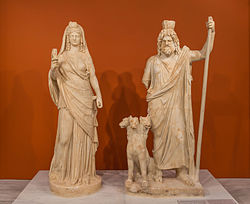
There are museums throughout Crete, most notably the Heraklion Archaeological Museum which displays most of the archaeological finds from the Minoan era.[94] Other notable museums include the Maritime Museum of Crete, the Archaeological Museum of Chania, and the WW2 museum in Platinias.[95]
Harmful effects
[edit]Helen Briassoulis, in a qualitative analysis, proposed in the Journal of Sustainable Tourism that Crete is affected by tourism applying pressure to it to develop at an unhealthy rate, and that informal, internal systems within the country are forced to adapt. According to her, these forces have strengthened in three stages: from the period from 1960 to 1970, 1970–1990, and 1990 to the present. During this first period, tourism was a largely positive force, pushing modern developments like running water and electricity onto the largely rural countryside. However, beginning in the second period and especially in the third period leading up to the present day, tourist companies became more pushy with deforestation and pollution of Crete's natural resources. The country is then pulled into an interesting parity, where these companies only upkeep those natural resources that are directly essential to their industry.[96]
-
 View of Gortyn
 -
 Archaeological site of Phaistos
 -
 Ruins of the Palace of Knossos
 -

-
 Archaeological Museum of Chania
 -

-
-
 Jars in Malia, Crete

.jpg)


_2.jpg)


Fauna and flora
[edit]Fauna
[edit]Crete is isolated from mainland Europe, Asia, and Africa, and this is reflected in the diversity of the fauna and flora. As a result, the fauna and flora of Crete have many clues to the evolution of species. There are no animals that are dangerous to humans on the island of Crete in contrast to other parts of Greece. Indeed, the ancient Greeks attributed the lack of large mammals such as bears, wolves, jackals, and venomous snakes, to the labour of Hercules (who took a live Cretan bull to the Peloponnese). Hercules wanted to honor the birthplace of Zeus by removing all "harmful" and "venomous" animals from Crete. Later, Cretans believed that the island was cleared of dangerous creatures by the Apostle Paul, who lived on the island of Crete for two years, with his exorcisms and blessings. The Natural History Museum of Crete, operates under the direction of the University of Crete and two aquariums – Aquaworld in Hersonissos and Cretaquarium in Gournes, display sea creatures common in Cretan waters.
Prehistoric fauna
[edit]Dwarf elephants, dwarf hippopotamus, dwarf mammoths, dwarf deer, and giant flightless owls were native to Pleistocene Crete.[97][98] Their ancestors could have reached the island in the time of the Messinian salinity crisis.
Mammals
[edit]Mammals of Crete include the vulnerable kri-kri, Capra aegagrus cretica that can be seen in the national park of the Samaria Gorge and on Thodorou,[99] Dia and Agioi Pantes (islets off the north coast), the Cretan wildcat and the Cretan spiny mouse.[100][101][102][103] Other terrestrial mammals include subspecies of the Cretan marten, the Cretan weasel, the Cretan badger, the Cretan wildcat,[104] the long-eared hedgehog, and the edible dormouse.[105]
The Cretan shrew, a type of white-toothed shrew is considered endemic to the island of Crete because this species of shrew is unknown elsewhere. It is a relic species of the Crocidura shrews of which fossils have been found that can be dated to the Pleistocene era. Today it can only be found in the highlands of Crete.[106] It is considered to be the only surviving remnant of the endemic species of the Pleistocene Mediterranean islands.[107]
Bat species include: Blasius's horseshoe bat, the lesser horseshoe bat, the greater horseshoe bat, the lesser mouse-eared bat, Geoffroy's bat, the whiskered bat, Kuhl's pipistrelle, the common pipistrelle, Savi's pipistrelle, the serotine bat, the long-eared bat, Schreibers' bat and the European free-tailed bat.[108]
-
 The kri-kri (the Cretan ibex) lives in protected natural parks at the gorge of Samaria and the island of Agios Theodoros.
 -
 Male Cretan ibex
 -
 Cretan Hound or Kritikos Lagonikos, one of Europe's oldest hunting dog breeds


Birds
[edit]Varieties of birds include eagles (can be seen in Lasithi), swallows (throughout Crete in the summer and year-round in the south of the island), pelicans (along the coast), and common cranes (including Gavdos and Gavdopoula). The Cretan mountains and gorges are refuges for the endangered lammergeier vulture. Bird species include: the golden eagle, Bonelli's eagle, the bearded vulture or lammergeier, the griffon vulture, Eleonora's falcon, peregrine falcon, lanner falcon, European kestrel, tawny owl, little owl, hooded crow, alpine chough, red-billed chough, and the Eurasian hoopoe.[109][110] The population of griffon vultures in Crete is the largest insular one of the species in the world and consists of the majority of the griffon vulture population in Greece.[111]
Reptiles and amphibians
[edit]Tortoises can be seen throughout the island. Snakes can be found hiding under rocks. Toads and frogs reveal themselves when it rains. Reptiles include the Aegean wall lizard, Balkan green lizard, common chameleon, ocellated skink, snake-eyed skink, Moorish gecko, Turkish gecko, Kotschy's gecko, spur-thighed tortoise, and the Caspian turtle.[108][112] There are four species of snake on the island and these are not dangerous to humans. The four species include the leopard snake (locally known as ochendra), the Balkan whip snake (locally called dendrogallia), the dice snake (called nerofido in Greek), and the only venomous snake is the nocturnal cat snake which has evolved to deliver a weak venom at the back of its mouth to paralyse geckos and small lizards, and is not dangerous to humans.[108][113]
Sea turtles include the green turtle and the loggerhead turtle which are both threatened species.[112] The loggerhead turtle nests and hatches on north-coast beaches around Rethymno and Chania, and south-coast beaches along the gulf of Mesara.[114] Amphibians include the European green toad, American bullfrog (introduced), European tree frog, and the Cretan marsh frog (endemic).[108][112][115]
Arthropods
[edit]Cicadas, known locally as tzitzikia, make a distinctive repetitive tzi tzi sound that becomes louder and more frequent on hot summer days. Butterfly species include the swallowtail butterfly.[108] There are several species of scorpion such as Euscorpius carpathicus whose venom is generally no more potent than a mosquito bite.
Crustaceans and molluscs
[edit]River crabs include the semi-terrestrial Potamon potamios crab.[108] Edible snails are widespread and can cluster in the hundreds waiting for rainfall to reinvigorate them.
Sealife
[edit]
Apart from terrestrial mammals, the seas around Crete are rich in large marine mammals. The endangered Mediterranean monk seal lives in almost all the coasts of the country. The area south of Crete, known as the Greek Abyss, hosts whales, sperm whales, dolphins and porpoises.[116] The Minoan frescoes depicting dolphins in Queen's Megaron at Knossos indicate that Minoans were well aware of and celebrated these creatures. Squid, octopus, sea turtles and hammerhead sharks live or traverse along the coast.
Some of the fish of the waters around Crete include: scorpion fish, dusky grouper, east Atlantic peacock wrasse, five-spotted wrasse, weever fish, common stingray, brown ray, Mediterranean black goby, pearly razorfish, star-gazer, painted comber, damselfish, and the flying gurnard.[117]
The Cretaquarium and the Aquaworld Aquarium, are two of the three aquariums in Greece. They are located in Gournes and Hersonissos respectively.[118][119]
Flora
[edit]The Minoans contributed to the deforestation of Crete. Further deforestation occurred in the 1600s "so that no more local supplies of firewood were available".[120]
Common wildflowers include: camomile, daisy, gladiolus, hyacinth, iris, poppy, cyclamen and tulip, among others.[121] There are more than 200 species of wild orchid on the island and this includes 14 varieties of Ophrys cretica.[122] Crete has a rich variety of indigenous herbs including common sage, rosemary, thyme, and oregano.[122][123] Rare herbs include the endemic Cretan dittany[122][123] and ironwort, Sideritis syriaca, known as malotira (μαλοτήρα). Varieties of cactus include the edible prickly pear. Common trees on the island include the chestnut, cypress, oak, olive tree, pine, plane, and tamarisk.[123] Trees tend to be taller to the west of the island where water is more abundant.
-
 Snake lily (Dracunculus vulgaris)
 -
 The Cretan bee-orchid Ophrys cretica


Environmentally protected areas
[edit]Environmentally protected areas include the island of Elafonisi on the coast of southwestern Crete, the palm forest of Vai in eastern Crete and the Dionysades (both in the municipality of Sitia, Lasithi). Vai has a palm beach and is the largest natural palm forest in Europe. The island of Chrysi, 15 kilometres (9 miles) south of Ierapetra, has the largest naturally-grown Juniperus macrocarpa forest in Europe. Samaria Gorge is a World Biosphere Reserve and Richtis Gorge is protected for its landscape diversity. Also, Sitia UNESCO Global Geopark, added in 2015 in UNESCO Geoparks, is located on the easternmost edge of Crete.
Mythology
[edit]
Crete has a strong association with ancient Greek gods but is also connected with the Minoan civilization. According to Greek mythology, the Diktaean Cave at Mount Dikti was the birthplace of the god Zeus. The Paximadia islands were the birthplace of the goddess Artemis and the god Apollo [citation needed]. Their mother, the goddess Leto, was worshipped at Phaistos. The goddess Athena bathed in Lake Voulismeni. Zeus launched a lightning bolt at a giant lizard that was threatening Crete. The lizard immediately turned to stone and became the lizard-shaped island of Dia, which can be seen from Knossos. The islets of Lefkai were the result of a musical contest between the Sirens and the Muses. The Muses were so anguished to have lost that they plucked the feathers from the wings of their rivals; the Sirens turned white and fell into the sea at Aptera ("featherless"), where they formed the islands in the bay that were called Lefkai (the islands of Souda and Leon).[124] Heracles, in one of his labors, took the Cretan bull to the Peloponnese. Europa and Zeus made love at Gortys and conceived the kings of Crete: Rhadamanthys, Sarpedon, and Minos.
The labyrinth of the Palace of Knossos was the setting for the myth of Theseus and the Minotaur in which the Minotaur was slain by Theseus. Icarus and Daedalus were captives of King Minos and crafted wings to escape. After his death, King Minos became a judge of the dead in Hades, while Rhadamanthys became the ruler of the Elysian fields.
Culture
[edit]Crete has its own distinctive Mantinades poetry. The island is known for its Mantinades-based music (typically performed with the Cretan lyra and the laouto) and has many indigenous dances, the most noted of which is the Pentozali. Since the 1980s and certainly in the 1990s onwards there has been a proliferation of cultural associations that teach dancing (in Western Crete where many focus on rizitiko singing). These associations often perform in official events but also become stages for people to meet and engage in traditional practices. The topic of tradition and the role of cultural associations in reviving it is often debated throughout Crete.[125]
Cretan authors have made important contributions to Greek literature throughout the modern period; major names include Vikentios Kornaros, creator of the 17th-century epic romance Erotokritos (Greek Ερωτόκριτος), and, in the 20th century, Nikos Kazantzakis. In the Renaissance, Crete was the home of the Cretan School of icon painting, which influenced El Greco and through him subsequent European painting.[126]
Cretans are proud of their island and customs, and men often don elements of traditional dress in everyday life: knee-high black riding boots (stivania), vráka breeches tucked into the boots at the knee, black shirt and black headdress consisting of a fishnet-weave kerchief worn wrapped around the head or draped on the shoulders (mantili / kefalomantilo). Men often grow large mustaches as a mark of pride, manhood and valiance.
Cretan society is known in Greece and internationally for family and clan vendettas which persist on the island to date.[127][128] Cretans also have a tradition of keeping firearms at home, stemming from the era of resistance against the Ottoman Empire. Nearly every rural household on Crete has at least one unregistered gun.[127] Guns are subject to strict regulation from the Greek government, and in recent years an effort to control firearms in Crete has been undertaken by the Greek police, but with limited success.
-
 Dancers from Sfakia
 -


Sports
[edit]Crete has many football clubs playing in the local leagues. During the 2011–12 season, OFI Crete, which plays at Theodoros Vardinogiannis Stadium (Iraklion), and Ergotelis F.C., which plays at the Pankritio Stadium (Iraklion) were both members of the Greek Superleague. During the 2012–13 season, OFI Crete, which plays at Theodoros Vardinogiannis Stadium (Iraklion), and Platanias F.C., which plays at the Perivolia Municipal Stadium, near Chania, are both members of the Greek Superleague.
Notable people
[edit]


Notable people from Crete include:
- Vitsentzos Kornaros, Renaissance author from Sitia, who lived in Heraklion (then Candia)
- Domenikos Theotokopoulos (El Greco), Renaissance artist, born in Heraklion
- Nikos Xilouris, famous composer and singer.
- Psarantonis, Cretan folk singer and Cretan lyra player and brother of Nikos Xilouris.
- Nikos Kazantzakis, author, born in Heraklion, 7 times suggested for the Nobel Prize
- Odysseas Elytis, poet, awarded the Nobel Prize in Literature in 1979, born in Heraklion[129]
- Eleftherios Venizelos, former Greek Prime Minister, born in Chania Prefecture
- Konstantinos Mitsotakis, nephew of Eleftherios Venizelos and father to Kyriakos Mitsotakis, the Prime Minister of Greece.
- Daskalogiannis, leader of the Orlov Revolt in Crete in 1770
- John Aniston (Giannis Anastasakis), Greek-American actor, father of Jennifer Aniston
- Zach Galifianakis paternal grandparents, Mike Galifianakis and Sophia Kastrinakis, were from Crete
- Georgios Chortatzis, Renaissance author
- Nana Mouskouri, singer, born in Chania
- Michalis Kourmoulis, leader of the Greek War of Independence from Messara.
- Eleni Daniilidou, tennis player, born in Chania
- Louis Tikas, Greek-American labor union leader
- Tess Fragoulis, Greek-Canadian writer, born in Heraklion
- Nick Dandolos, a.k.a. Nick the Greek, professional gambler and high roller
- Joseph Sifakis, a computer scientist, laureate of the 2007 Turing Award, born in Heraklion in 1946
- Constantinos Daskalakis, Associate Professor at MIT's Electrical Engineering and Computer Science department
- George Karniadakis, Professor of Applied Mathematics at Brown University; and Research Scientist at MIT
- George Psychoundakis, a shepherd, a war hero and an author
- Georgos Kalaitzakis, Greek professional basketball player for the Tigers Tübingen of the German Basketball Bundesliga is from Heraklion, Crete
See also
[edit]References
[edit]- ^ "CensusHub2". ec.europa.eu. Retrieved 22 March 2021.
- ^ "Census 2021 GR" (PDF) (Press release). Hellenic Statistical Authority. 19 July 2022. Archived (PDF) from the original on 19 July 2022. Retrieved 12 September 2022.
- ^ "Sub-national HDI – Area Database – Global Data Lab". hdi.globaldatalab.org. Retrieved 20 July 2021.
- ^ "Population on 1 January by NUTS 2 region". Statistics Eurostat. Archived from the original on 21 January 2021.
- ^ Ancient Crete Archived 30 May 2020 at the Wayback Machine Oxford Bibliographies Online: Classics
- ^ Stephanie Lynn Budin, The Ancient Greeks: An Introduction (New York: Oxford UP, 2004), 42.
- ^ O. Dickinson, The Aegean Bronze Age (Cambridge, UK: Cambridge UP, 1994), 241–244.
- ^ Found on the PY An 128 tablet.
- ^ Found on the PY Ta 641 and PY Ta 709 tablets.
- ^ "The Linear B word ke-re-si-ji". Palaeolexicon.
- ^ Κρής, Κρήσιος s.v. κρησίαι. Liddell, Henry George; Scott, Robert; A Greek–English Lexicon at the Perseus Project.
- ^ Book 14, line 199; Henry George Liddell, Robert Scott, A Greek–English Lexicon
- ^ Edwin L. Brown, "Linear A on Trojan Spindlewhorls, Luvian-Based ϜΑΝΑΞ at Cnossus", in Qui miscuit utile dulci: Festschrift Essays for Paul Lachlan MacKendrick, eds. Gareth Schmeling & Jon D. Mikalson (Wauconda, Ill.: Bolchazy-Carducci, 1998), 62.
- ^ "Τι σημαίνει το όνομα "Κρήτη" τελικά και γιατί ονομάστηκε έτσι το νησί μας;". Daynight.gr (in Greek). 8 December 2018. Archived from the original on 14 July 2021. Retrieved 14 July 2021.
- ^ Λελάκης, Γεώργιος (2008). Αιγαίο-ετυμολογίες νήσων (in Greek).
- ^ Kalantzis, Konstantinos (2019). Tradition in the Frame: Photography, Power, and Imagination in Sfakia, Crete. Indiana University Press. pp. 23–58. ISBN 978-0-253-03713-8. Archived from the original on 16 December 2019. Retrieved 2 October 2019.
- ^ "Gorge of the Dead". Cretanbeaches.com. Archived from the original on 25 April 2015. Retrieved 13 September 2012.
- ^ "Richtis gorge". Cretanbeaches.com. Archived from the original on 31 July 2012. Retrieved 13 September 2012.
- ^ "Richtis beach and gorge". Candia.wordpress.com. 20 April 2010. Retrieved 13 September 2012.
- ^ "Richtis gorge and waterfall". Worldreviewer.com. 25 February 2011. Archived from the original on 12 October 2018. Retrieved 13 September 2012.
- ^ Photos of Agia Lake Crete TOURnet.
- ^ Lake Voulismeni Archived 20 July 2011 at the Wayback Machine aghiosnikolaos.eu
- ^ "Latest Conditions in Xyloskalo, Chania, Crete Island". penteli.meteo.gr. Retrieved 18 June 2025.
- ^ Rackham, O; Moody, J (1996). The Making of the Cretan Landscape. Manchester University Press. ISBN 9780719036477.
- ^ Panagos, Panagos; Christos, Karydas; Cristiano, Ballabio; Ioannis, Gitas (2014). "Seasonal monitoring of soil erosion at regional scale: An application of the G2 model in Crete focusing on agricultural land uses". International Journal of Applied Earth Observation and Geoinformation. 27: 147–155. Bibcode:2014IJAEO..27..147P. doi:10.1016/j.jag.2013.09.012.
- ^ "WMO stations". Retrieved 17 October 2025.
- ^ "Meteo.gr: Πανευρωπαϊκό ρεκόρ θερμοκρασιών οι 35 βαθμοί στην Κρήτη το Σάββατο 04/11 - Μεγάλο πλήθος και διασπορά φαινομένων στη χώρα". Archived from the original on 5 November 2023.
- ^ "Greece and Cyprus weather records - Temperature and precipitation records in Greece".
- ^ "Meteo.gr: Τα δύο ακραία πρόσωπα του καιρού στην Ευρώπη το Σ/Κ 9-10 Ιανουαρίου 2021".
- ^ "32.1C February record Vryses NOA". National Observatory of Athens. Archived from the original on 23 February 2010. Retrieved 14 February 2024.
- ^ "NOA February 2010 climate bulletins" (PDF). National Observatory of Athens. Retrieved 14 February 2024.
- ^ "Climatic Atlas of Greece". Hellenic National Meteorological Service. Retrieved 4 August 2022.
- ^ "Climatic Data for selected stations in Greece: Heraklion (Crete)". Retrieved 17 September 2019.
- ^ "Climate Atlas of Greece (for sunshine 1977-2002)". HNMS. Retrieved 20 July 2021.
- ^ "STATION HERAKLION". meteo-climat. Retrieved 2 December 2018.
- ^ "Cultural Association of Tris Ekklisies, CW". Retrieved 17 October 2025.
- ^ Crete, p.44, by Victoria Kyriakopoulos.
- ^ "Demographic and social characteristics of the Resident Population of Greece according to the 2011 Population – Housing Census revision of 20/3/2014" (PDF). Hellenic Statistical Authority. 12 September 2014. Archived from the original (PDF) on 8 September 2015.
- ^ "Population on 1 January by age, sex and NUTS 2 region", www.ec.europa.eu
- ^ Π.Δ. 51/87 "Καθορισμός των Περιφερειών της Χώρας για το σχεδιασμό κ.λ.π. της Περιφερειακής Ανάπτυξης" (Determination of the Regions of the Country for the planning etc. of the development of the Region), ΦΕΚ A 26/06.03.1987
- ^ a b c 2011 Census
- ^ "Μόνιμος Πληθυσμός - ELSTAT". www.statistics.gr. Archived from the original on 30 March 2023. Retrieved 30 March 2023.
- ^ The rough guide to Crete, Introduction, p. ix by J. Fisher and G. Garvey.
- ^ Τζιάλλα, Χριστίνα (23 March 2018). "Μπανάνες Κρήτης |". Gastronomos.gr (in Greek). Retrieved 31 March 2025.
- ^ "Crete information". Crete.
- ^ "Regional GDP per capita ranged from 30% to 263% of the EU average in 2018". Eurostat.
- ^ "Heraklion Airport Leads Greece's 5% 2024 Summer Passenger Traffic Surge". Cretorama. Cretorama.com. 29 October 2024. Retrieved 13 July 2025.
- ^ "New road in Crete set to improve journey times and safety-Projects". ec.europa.eu. Retrieved 18 January 2018.
- ^ a b Rackham, O. & Moody, J., 1996. The Making of the Cretan Landscape, Manchester University Press,
- ^ ΤΟΠΙΟ: Αγνωστα Βιομηχανικά Μνημεία Ι: υπολείμματα του βιομηχανικού σιδηροδρόμου Ηρακλείου http://to-pio.blogspot.gr/2011/11/blog-post_17.html
- ^ Thomas, Stavros (20 January 2022). "Construction Activity in Crete - Key Trends And Prospects to 2022". ARENCOS. Retrieved 16 January 2023.
- ^ No Container Transshipment Hub in Timbaki Archived 23 January 2007 at the Wayback Machine. Retrieved 27 May 2007.
- ^ "EuroAsia Interconnector Project and Progress" (PDF). Archived from the original (PDF) on 16 February 2018. Retrieved 16 February 2018.
- ^ "EuroAfrica Interconnector". Archived from the original on 18 April 2019. Retrieved 18 April 2019.
- ^ "Η ηλεκτρική διασύνδεση EuroAsia Interconnector θα εξασφαλίσει ενεργειακά την Κρήτη". Cretalive. 7 February 2018. Retrieved 18 April 2019.
- ^ Day, Jo (2018), "Crete, Archaeology of", Encyclopedia of Global Archaeology, Cham: Springer International Publishing, pp. 1–18, doi:10.1007/978-3-319-51726-1_1434-2, ISBN 978-3-319-51726-1, retrieved 8 May 2023
- ^ C. Michael Hogan. 2007 Knossos fieldnotes The Modern Antiquarian
- ^ Shelmerdine, Cynthia. "Where Do We Go From Here? And How Can the Linear B Tablets Help Us Get There?" (PDF). Archived from the original (PDF) on 3 October 2011. Retrieved 27 March 2008.
- ^ Jane Francis and Anna Kouremenos (2016). Roman Crete: New Perspectives. Oxford: Oxbow. ISBN 978-1785700958.
- ^ Gregory & Kazhdan 1991, p. 546.
- ^ Reinhart Dozy, Histoire des Musulmans d'Espagne: jusqu'à la conquête de l'Andalousie par les Almoravides (French) pg. 711–1110, Leiden, 1861 & 1881, 2nd edition
- ^ a b c Panagiotakis 1987, p. XVI.
- ^ Gregory & Kazhdan 1991, pp. 545–546.
- ^ Treadgold 1997, p. 495.
- ^ Tiepolo, Maria Francesca; Tonetti, Eurigio (2002). I greci a Venezia. Istituto veneto di scienze. p. 201. ISBN 978-88-88143-07-1.
Cretese Nikolaos Kalliakis
- ^ Boehm, Eric H. (1995). Historical abstracts: Modern history abstracts, 1450–1914, Volume 46, Issues 3–4. American Bibliographical Center of ABC-Clio. p. 755. OCLC 701679973.
Between the 15th and 19th centuries the University of Padua attracted a great number of Greek students who wanted to study medicine. They came not only from Venetian dominions (where the percentage reaches 97% of the students of Italian universities) but also from Turkish-occupied territories of Greece. Several professors of the School of Medicine and Philosophy were Greeks, including Giovanni Cottunio, Niccolò Calliachi, Giorgio Calafatti...
- ^ Convegno internazionale nuove idee e nuova arte nell '700 italiano, Roma, 19–23 maggio 1975. Accademia nazionale dei Lincei. 1977. p. 429. OCLC 4666566.
Nicolò Duodo riuniva alcuni pensatori ai quali Andrea Musalo, oriundo greco, professore di matematica e dilettante di architettura chiariva le nuove idée nella storia dell'arte.
- ^ a b Detorakis, Theocharis E. (1986). Ιστορία της Κρήτης [History of Crete] (in Greek). Athens. p. 167. OCLC 715204595.
{{cite book}}: CS1 maint: location missing publisher (link) - ^ M. Greene. 2001. Ruling an island without a navy: A comparative view of Venetian and Ottoman Crete. Oriente moderno, 20(81), 193–207
- ^ A.J. Schoenfeld. 2007. Immigration and Assimilation in the Jewish Community of Late Venetian Crete (15th–17th centuries). Journal of Modern Greek Studies, 25(1), 1–15
- ^ Starr, J. (1942), Jewish Life in Crete Under the Rule of Venice, Proceedings of the American Academy for Jewish Research, Vol. 12, pp. 59–114.
- ^ Capra, Carlo; Peruta, Franco Della; Mazzocca, Fernando (2002). Napoleone e la repubblica italiana: 1802–1805 [Napoleon and the Italian Republic: 1802–1805] (in Italian). Milan: Skira. p. 200. ISBN 978-88-8491-415-6.
Simone Stratico, nato a Zara nel 1733 da famiglia originaria di Creta (abbandonata a seguito della conquista turca del 1669)
- ^ Tziovas, Dimitris (2003). Greece and the Balkans: Identities, Perceptions and Cultural Encounters Since the Enlightenment. London: Routledge. ISBN 978-0-7546-0998-8.
- ^ a b Yale, William (1958). "IX: Trouble in Crete and the Balkans". The Near East: A Modern History. Ann Arbor: University of Michigan Press. pp. 129–145. LCCN 58-62524 – via Internet Archive.
- ^ Detorakis, Theocharis (1988). "Η Τουρκοκρατία στην Κρήτη" [Turkish Rule in Crete]. In Panagiotakis, Nikolaos M. (ed.). Κρήτη: Ιστορία καί Πολιτισμός [Crete: History and Culture] (in Greek). Vol. II. Heraklion: Vikelea Municipial Library. pp. 333–436. ISBN 978-0-00-797002-5.
- ^ Kohn, George C., ed. (2006). Dictionary of Wars (3rd ed.). New York: Infobase. p. 155. ISBN 978-1-4381-2916-7. Archived from the original on 9 November 2013. Retrieved 28 November 2024 – via Scribd.
- ^ Papoutsakis, Niko (22 May 2001). "Daskalogiannis: Skinned Alive by the Turks". Stigmes Online. Archived from the original on 22 May 2001. Retrieved 28 November 2024.
- ^ Hatzipanagos, George. "Ioannis Daskalogiannis International Airport". Greek Airports. Hellenic Civil Aviation Authority. Archived from the original on 17 December 2010. Retrieved 28 December 2010.
- ^ Dodwell, Henry (1967). "VIII: Muhammad Ali's Government in Crete and Syria". The Founder of Modern Egypt: A Study of Muhammad Ali (2nd ed.). Cambridge University Press. pp. 242–258. ISBN 978-0-404-12036-8. LCCN 31-22265 – via Internet Archive.
- ^ Provatakis (1980), p. 66-68
- ^ a b Provatakis (1980), p. 75
- ^ Pinar Senisik, The Transformation of Ottoman Crete, Revolts, Politics and Identity in the Late Nineteenth century p. 165. I. B. Tauris, 2011.
- ^ a b Robert Holland and Diane Markides, The British and the Hellenes: Struggles for Mastery in the Eastern Mediterranean 1850–1960. p. 81. Oxford University Press, 2005.
- ^ "Some Noteworthy War Criminals" Archived 1 April 2012 at the Wayback Machine, Source: History of the United Nations War Crimes Commission and the Development of the Laws of War, United Nations War Crimes Commission. London: HMSO, 1948, p. 526, updated 29 January 2007 by Stuart Stein (University of the West of England), accessed 22 January 2010
- ^ Beevor, Antony (2005). Crete: The Battle and the Resistance. John Murray. p. 176. ISBN 978-0-7195-6831-2.
- ^ Margaritis 2006, pp. 441–447.
- ^ Margaritis 2006, pp. 447–452.
- ^ "The Undesired Impacts of Overtourism in the Island of Crete, Greece" (PDF). International Journal of Advanced Multidisciplinary Research and Studies (via MultiResearchJournal.com). CIHEAM‑MAICh & Technical University of Crete. 10 July 2024. Retrieved 13 July 2025.
- ^ "Archived copy". Archived from the original on 29 July 2020. Retrieved 1 April 2020.
{{cite web}}: CS1 maint: archived copy as title (link) - ^ "14/06/2011. ΞΕΚΙΝΟΥΝ ΟΙ ΠΤΗΣΕΙΣ CHARTER ΣΤΟ ΑΕΡΟΔΡΟΜΙΟ ΣΗΤΕΙΑΣ. | Νέα - Ανακοινώσεις | Ενημέρωση | Δήμος Σητείας". www.sitia.gr. Archived from the original on 1 October 2011.
- ^ "KTEL bus services".
- ^ On the Rights of Citizens of the Union, EC Directive 2004/58 EC (2004) EUR-Lex
- ^ "Buying a Property in Crete as a Foreigner". ARENCORES. 29 December 2020. Archived from the original on 5 March 2021. Retrieved 22 March 2021.
- ^ Archaeological sites and Museums in Crete ExploreCrete.com
- ^ AllinCrete (10 November 2018). "World War 2 Shelter of Platanias in Chania". AllinCrete Travel Guide for Crete. Retrieved 7 December 2024.
- ^ Briassoulis, Helen (1 September 2003). "Crete: Endowed by Nature, Privileged by Geography, Threatened by Tourism?". Journal of Sustainable Tourism. 11 (2–3): 97–115. Bibcode:2003JSusT..11...97B. doi:10.1080/09669580308667198. ISSN 0966-9582. S2CID 28002287.
- ^ Van der Geer, A.A.E., Dermitzakis, M., De Vos, J., 2006. Crete before the Cretans: the reign of dwarfs. Pharos 13, 121–132. Athens: Netherlands Institute.PDF
- ^ "Crete: 10 Fun Facts and Interesting Insights". 7 April 2019.
- ^ Αναρτήθηκε από admin. "ΤΟΠΙΟ: Θοδωρού, η άγνωστη νησίδα του Βενετικού ναυτικού οχυρού, των κρι-κρι και η απαγόρευση προσέγγισης". To-pio.blogspot.gr. Retrieved 26 March 2013.
- ^ Thodorou Islands off Platanias ExploreCrete.com
- ^ Cretan Ibex, by Alexandros Roniotis CretanBeaches.com
- ^ Cretan wildcat Archived 11 February 2011 at the Wayback Machine CretanBeaches.com
- ^ Cretan spiny mouse CretanBeaches.com
- ^ "Fauna and Flora of Crete". 13 February 2023.
- ^ Terrestrial mammals of Crete Archived 7 February 2011 at the Wayback Machine CretanBeaches.com
- ^ Atlas of terrestrial mammals of the Ionian and Aegean islands. De Gruyter. 30 October 2012. p. 43. ISBN 9783110254587.
- ^ Evolution of Island Mammals. Wiley. 14 February 2011. p. 35. ISBN 9781444391282.
- ^ a b c d e f Wildlife on Crete Archived 3 October 2023 at the Wayback Machine IntoCrete.com
- ^ Birds of Crete We-love-crete.com
- ^ Checklist and Guide to the Birds of Crete Archived 29 May 2013 at the Wayback Machine
- ^ Xirouchakis, Stavros M.; Mylonas, Moysis (December 2005). "Status and structure of the griffon vulture (Gyps fulvus) population in Crete". European Journal of Wildlife Research. 51 (4): 223–231. Bibcode:2005EJWR...51..223X. doi:10.1007/s10344-005-0101-4. S2CID 24900498.
- ^ a b c Native Reptiles of Crete at Aquaworld Aquaworld Aquarium.
- ^ The Snakes of Crete by John McClaren CreteGazette.com
- ^ Crete p. 69, by Victoria Kyriakopoulos
- ^ Dufresnes, C. (2019). Amphibians of Europe, North Africa and the Middle East: A Photographic Guide. Bloomsbury Publishing. ISBN 978-1-4729-4137-4.
- ^ Marine mammals of Crete Archived 7 February 2011 at the Wayback Machine CretanBeaches.com
- ^ Fish from Crete at Aquaworld Aquaworld Aquarium
- ^ Cretaquarium Archived 26 June 2011 at the Wayback Machine Cretaquarium.gr
- ^ Great Britons in Crete, John Bryce McLaren Archived 19 March 2011 at the Wayback Machine BritsinCrete.net
- ^ Sands, Roger (2005). Forestry in a Global Context. p. 27. ISBN 9780851990897. Retrieved 24 September 2019.
- ^ Fielding, J. and Turland, N. "Flowers of Crete", Royal Botanic Gardens, Kew, ISBN 978-1842460795, 2008
- ^ a b c Crete p.68 by Victoria Kyriakopoulos
- ^ a b c The Flora of Crete ExploreCrete.com
- ^ Caroline M. Galt, "A marble fragment at Mount Holyoke College from the Cretan city of Aptera", Art and Archaeology 6 (1920:150).
- ^ Kalantzis, Konstantinos (2019). Tradition in the Frame Photography, Power, and Imagination in Sfakia, Crete. Indiana University Press. pp. 153–178. ISBN 978-0-253-03713-8.
- ^ "Island's Culture". Active Crete. Retrieved 15 April 2024.
- ^ a b Brian Murphy: Vendetta Victims: People, A Village – Crete's 'Cycle Of Blood' Survives The Centuries at The Seattle Times, 14 January 1999.
- ^ Aris Tsantiropoulos: "Collective Memory and Blood Feud: The Case of Mountainous Crete" (PDF). Archived from the original (PDF) on 31 March 2012. (254 KB), Crimes and Misdemeanours 2/1 (2008), University of Crete.
- ^ Odysseas Elytis[permanent dead link] by Alexandros Roniotis, CretanBeaches.com.
General and cited sources
[edit]- . Encyclopædia Britannica. Vol. 7 (11th ed.). 1911. pp. 418–430.
- Francis, Jane and Anna Kouremenos (eds.) 2016. Roman Crete: New Perspectives. Oxford: Oxbow.
- Gregory, T. E.; Kazhdan, A. (1991). "Crete". In Kazhdan, Alexander (ed.). The Oxford Dictionary of Byzantium. Oxford and New York: Oxford University Press. ISBN 0-19-504652-8.
- Margaritis, Giorgos (2006). Ιστορία του ελληνικού εμφυλίου πολέμου 1946-1949 [History of the Greek Civil War 1946-1949] (in Greek). Vol. II. Athens: Vivliorama. ISBN 9608087139.
- Panagiotakis, Nikolaos M., ed. (1987). "Εισαγωγικό Σημείωμα ("Introduction")". Crete, History and Civilization (in Greek). Vol. I. Vikelea Library, Association of Regional Associations of Regional Municipalities. pp. XI–XX.
- Provatakis, Theocharis (1980). Monastery of Arkadi. Athens: Toubi's.
- Treadgold, Warren (1997). A History of the Byzantine State and Society. Stanford, California: Stanford University Press. ISBN 0-8047-2630-2.
External links
[edit] Definitions from Wiktionary
 Media from Commons
 News from Wikinews
 Quotations from Wikiquote
 Texts from Wikisource
 Textbooks from Wikibooks
 Resources from Wikiversity
 Travel information from Wikivoyage


- Official Website of Gavalochori Village, Crete (in English)
- Crete Locals comprehensive guide of Crete Island (in English)
- Natural History Museum of Crete at the University of Crete.
- Cretaquarium Thalassocosmos in Heraklion.
- Aquaworld Aquarium in Hersonissos.
- Ancient Crete Archived 30 May 2020 at the Wayback Machine at Oxford Bibliographies Online: Classics.
- Official Greek National Tourism Organisation website
- Interactive Virtual Tour of Crete
Administrative division of the Crete Region | ||
|---|---|---|
| Regional unit of Chania |  | |
| Regional unit of Heraklion | ||
| Regional unit of Lasithi | ||
| Regional unit of Rethymno | ||
| ||
| Regions | | |
|---|---|---|
| Autonomous regions | ||
| ||


| |||||||||||||||||||||||||
| |||||||||||||||||||||||||
| |||||||||||||||||||||||||
| |||||||||||||||||||||||||
| |||||||||||||||||||||||||
| |||||||||||||||||||||||||


| International | |
|---|---|
| National | |
| Geographic | |
| Other | |

Crete
View on GrokipediaCrete (Greek: Κρήτη, Kríti) is the largest island belonging to Greece, situated in the southern Aegean Sea and serving as a natural divider between the Aegean and Libyan Seas.[1] The island measures approximately 260 kilometers in length with an area of about 8,336 square kilometers.[2] As of 2020, its population stands at 636,504, primarily concentrated in urban centers like the capital, Heraklion.[2] Crete forms one of Greece's 13 administrative regions, encompassing four regional units: Chania, Rethymno, Heraklion, and Lasithi.[3] Historically, it is the cradle of the Minoan civilization, Europe's earliest advanced society, which thrived from roughly 3500 to 1100 BCE through sophisticated palace complexes, maritime trade, and cultural innovations.[4] Geographically diverse, Crete features rugged mountain ranges such as the White Mountains and Psiloritis, dramatic gorges, and extensive coastlines, supporting a economy dominated by tourism and agriculture, particularly olives, grapes, and citrus.[5]
Etymology
Name Origins and Evolution
The name Crete originates from the ancient Greek term Κρήτη (Krḗtē), first attested in the mid-2nd millennium BCE in Mycenaean Greek records inscribed in Linear B script as ke-re-te, denoting the island or its people (Kretes).[6] This form likely reflects an indigenous pre-Greek substrate word, possibly from a Luwian or Anatolian root such as kursatta (meaning "island" or "cut off"), though direct evidence remains elusive due to the undeciphered Minoan Linear A script, which predates these attestations by centuries.[7] Earlier non-Greek references, such as the Egyptian Keftiu (attested from the 18th Dynasty around 1500 BCE) and Hittite Katapa, appear to designate Crete or its Minoan inhabitants, suggesting phonetic continuity but no clarified etymological link.[8] Proposals linking the name to Greek κριτής (kritḗs, "judge"), evoking mythological figures like King Minos, or to Semitic roots implying "covenant" or "stronghold," lack empirical substantiation and stem from later interpretive traditions rather than linguistic reconstruction.[9] The name evolved minimally through antiquity, adapting to Latin as Creta by the Roman period (from the 1st century BCE), as seen in texts like those of Pliny the Elder, while retaining its core phonetic structure in Greek usage.[8] During the Byzantine era (4th–13th centuries CE), it persisted as Krḗtē, and under Arab rule (9th–10th centuries), it appeared as Iqrīṭiš, reflecting transliteration without semantic shift. Venetian domination (1212–1669 CE) introduced the exonym Candia (derived from the Arabic Qandak for Heraklion, the island's capital), which Europeans applied broadly to Crete until the 19th century, though locals continued using Krḗtē.[6] Ottoman administration (1669–1898) rendered it Girit in Turkish, yet post-independence in 1913 and full Greek integration by 1913, the Hellenic form Κρήτη (modern pronunciation Kríti) was standardized, emphasizing indigenous continuity over colonial variants.[8] This resilience underscores the name's deep-rooted association with the island's geography and early Aegean identity, unaltered by transient political nomenclature.Physical Geography
Island Morphology and Terrain
Crete measures approximately 260 kilometers in length along its east-west axis and varies in width from 12 to 60 kilometers, resulting in an elongated, narrow form that spans an area of about 8,303 square kilometers.[10] This morphology positions the island as the largest in Greece and fifth largest in the Mediterranean Sea, with a coastline exceeding 1,000 kilometers characterized by diverse coastal features including sandy beaches on the northern shore and more rugged cliffs to the south.[11] The island's terrain is predominantly mountainous, with elevations rising sharply from narrow coastal plains and semi-mountainous zones to peaks over 2,000 meters, reflecting tectonic uplift and erosion processes that have shaped its landscape over millions of years.[12] The terrain divides into three primary morphological zones: lowlands below 200 meters occupying limited flat areas suitable for agriculture, semi-mountainous regions between 200 and 400 meters featuring rolling hills, and a dominant mountainous zone above 400 meters covering the bulk of the island's interior.[12] Four principal mountain ranges traverse Crete parallel to its long axis: the White Mountains (Lefka Ori) in the west reaching up to 2,453 meters at Pachnes, the Ida Range (Psiloritis) centrally with Crete's highest peak at 2,456 meters, the Dikti Mountains in the east, and the Asterousia range in the southeast.[13] These ranges, composed largely of limestone, create a rugged topography interspersed with deep valleys, plateaus like the Lasithi and Omalos, and karst features including caves and sinkholes, which limit extensive flatlands to pockets such as the Mesara Plain in the south and the Chania Plain in the northwest.[14] Coastal morphology varies significantly due to differential erosion and sediment deposition, with the northern seaboard presenting gentler slopes and broader alluvial plains feeding into the Aegean, while the southern coast along the Libyan Sea features steeper descents and fewer harbors.[15] This asymmetry influences accessibility and settlement patterns, as the island's narrow width—often less than 30 kilometers across—constrains north-south connectivity, funneling travel through transverse valleys or mountain passes.[2] Overall, Crete's terrain embodies a compressed Mediterranean landscape of high relief, where tectonic folding and fluvial carving have produced a mosaic of micro-environments despite the island's modest scale.[16]Mountains, Gorges, and Hydrology
Crete features three principal mountain ranges: the Psiloritis (Ida) range in the center, reaching an elevation of 2,456 meters at Timios Stavros peak; the White Mountains (Lefka Ori) in the west, spanning the largest area with Pachnes peak at 2,453 meters and over 50 summits exceeding 2,000 meters; and the Dikti Mountains in the east, with Spathi peak at 2,148 meters.[17][18] These ranges, formed by tectonic uplift and limestone karstification, dominate the island's rugged terrain, covering much of its 8,336 square kilometers and influencing local microclimates through orographic precipitation.[19] The island hosts over 400 gorges, the highest density in Greece, carved by erosion through the limestone mountains over millennia. Samaria Gorge, the longest in Europe at 16 kilometers total length (12.8 kilometers within the narrow canyon), descends 1,236 meters from the White Mountains to the Libyan Sea, featuring steep walls up to 1,000 meters high and the endemic Cretan wild goat (kris krini). Other notable gorges include Imbros (8 kilometers, easier access) and Aradaina (wilder, with a bridge crossing). These formations result from fluvial downcutting in a karst landscape, active primarily during wet seasons.[20][21] Hydrology in Crete is dominated by karst aquifers due to the pervasive limestone bedrock, leading to limited surface water and reliance on groundwater for 65% of supply, with the remainder from seasonal springs and intermittent streams. Permanent rivers are scarce; examples include the Aposelemis (dammed for irrigation) and Megalopotamos, but most watercourses dry up in summer, reflecting a Mediterranean regime with wet winters (October–March) yielding average annual precipitation of 800–1,000 millimeters in mountains and dry summers exacerbating scarcity. This hydrogeology causes rapid infiltration and subterranean flow, challenging sustainable management amid rising tourism and agricultural demands.[22][23][24]Climate Patterns and Variability
Crete exhibits a Mediterranean climate characterized by hot, dry summers and mild, wet winters, classified under the Köppen system as Csa (hot-summer Mediterranean).[25] Annual mean temperatures range from 18.5°C in the western regions to 20°C in the southern areas, with coastal highs reaching 29–30°C in July and August, while winter lows average 9–10°C in January.[26] Precipitation is concentrated in the winter months, with November to February accounting for the majority of annual totals, peaking in December; summers are arid, receiving negligible rainfall.[27] Regional variations arise primarily from topographic influences, including the island's north-south mountain ranges that enhance orographic precipitation on windward slopes. Western Crete, exemplified by Chania, receives higher annual precipitation of approximately 853 mm, compared to 464 mm in eastern Heraklion, reflecting greater moisture capture from prevailing northerly winds interacting with the Lefka Ori and other western highlands.[28][29] Eastern and southern areas exhibit greater aridity due to rain shadows, exacerbating water scarcity in lowland plains like the Mesara.[30] Temporal variability is pronounced, with high interannual fluctuations in precipitation dominating over long-term trends in observed records. Seasonal extremes include prolonged summer droughts, which intensify water shortages, and episodic winter floods from intense, convective rainfall events that have increased in localized intensity despite overall stability in totals.[31][32] Historical data from Greek stations indicate no statistically significant precipitation trends over decades, but variability contributes to recurrent hydrological stresses, such as extended dry periods in the east affecting agriculture.[33][34]Human Geography
Administration and Governance
The Region of Crete (Περιφέρεια Κρήτης) is one of Greece's thirteen administrative regions and functions as a standalone decentralized administration, with its headquarters in Heraklion. Governance is led by an elected regional governor, who serves a five-year term alongside a regional council comprising 49 members responsible for policy-making in areas such as economic development, tourism, and infrastructure. The current governor, Stavros Arnaoutakis, was re-elected in the October 2023 regional elections.[35] The region is subdivided into four regional units—Chania, Rethymno, Heraklion, and Lasithi—each overseen by a deputy regional governor appointed by the governor to manage unit-specific affairs like local transport and environmental protection. These units encompass 24 municipalities in total, which form the primary tier of local self-government, handling services including waste management, primary education, and civil registries under the framework established by the 2010 Kallikratis administrative reform. That reform merged smaller communities into larger municipalities to streamline operations and reduce administrative overlap, resulting in Crete's current structure of 24 units from over 120 pre-reform entities.[36][3][37] Crete elects eight members to the Hellenic Parliament, distributed across the regional units (four from Heraklion, two from Chania, one from Rethymno, and one from Lasithi), reflecting its proportional representation in national governance. The region's authorities coordinate with central government ministries on devolved powers, including health and agriculture, while the decentralized administration's secretary-general, appointed by the national government, oversees coordination with state services.[38]Major Settlements and Urban Centers
Heraklion (Irákleio), the capital of the Crete Region and its largest urban center, recorded a municipal population of 179,301 in the 2021 census.[39] Located on the northern coast, it functions as the primary economic, administrative, and transport hub, featuring the island's busiest port and international airport.[40] Chania (Chaniá), capital of the Chania Regional Unit in western Crete, had 111,375 residents in its municipality as of 2021.[39] It serves as a key western port city with historical significance, including Ottoman and Venetian fortifications, and supports regional tourism and commerce.[3] Rethymno, the seat of the Rethymno Regional Unit, is the island's third-largest municipality with 57,219 inhabitants in 2021.[39] Positioned centrally on the north coast, it preserves extensive Venetian architecture and acts as a mid-island connection point for travel and trade.[3] Agios Nikolaos, capital of the Lasithi Regional Unit in eastern Crete, reported 27,787 municipal residents in 2021.[39] Known for its inland lake and coastal setting, it functions as the administrative and tourist gateway to the east, with supporting infrastructure for local agriculture and seasonal visitors.[3] Other notable urban centers include Ierapetra, the largest municipality in Lasithi with 27,338 people in 2021, serving as a greenhouse agriculture hub and southern port,[39] and Hersonissos, a tourism-focused settlement near Heraklion with 27,220 residents, drawing visitors to its beaches and nightlife.[39] These settlements, alongside the regional capitals, concentrate over half of Crete's urban population along the north shore, driven by historical maritime access and modern infrastructure.[39]Demographics and Population Trends
The population of the Crete Region was recorded at 624,410 in the 2021 census conducted by the Hellenic Statistical Authority (ELSTAT). This figure represents a marginal increase of 0.2% from the 623,065 residents enumerated in the 2011 census, reflecting relative stability amid Greece's broader national population decline. The regional population density stands at approximately 75 inhabitants per square kilometer, given Crete's land area of 8,336 square kilometers. Urban residents comprise 65.2% of the total, with the remainder in rural areas, concentrated primarily in the four regional units: Heraklion (286,000 residents), Chania (144,000), Rethymno (approximately 80,000), and Lasithi (around 75,000).[41] Population trends in Crete have shifted from modest growth in the early 2000s—driven by internal migration and tourism-related employment—to stagnation and recent decline, mirroring national patterns of low fertility and net emigration. Between 2001 and 2011, the island experienced an annual growth rate of about 0.47%, but post-2011 economic pressures, including the Greek debt crisis, contributed to outflows of younger workers to mainland Greece and abroad.[42] By 2024, estimates indicate a slight drop to around 622,491 residents, influenced by a negative natural increase (more deaths than births) and limited immigration.[43] Crete's total fertility rate of 1.57 children per woman in recent years exceeds the national average of approximately 1.34 but remains below replacement level (2.1), exacerbating aging demographics. The population is ethnically homogeneous, consisting predominantly of Greeks, with small communities of immigrants from Albania, other Balkan countries, and Asia comprising less than 5% of residents, primarily in urban centers for seasonal tourism or agriculture work.[44] The vast majority adhere to the Greek Orthodox Church. Age structure data align with Greece's overall profile: roughly 14% under 15 years, 63% aged 15-64, and 23% over 65, with a median age exceeding 45 years, resulting from extended life expectancy (around 82 years regionally) and subdued birth rates.[43] This aging trend poses challenges for labor supply, particularly in agriculture and services, though tourism sustains some youth retention compared to depopulating rural mainland areas.[45]Economy and Resource Utilization
The economy of Crete centers on tourism and agriculture, which form the primary pillars supporting the island's prosperity and contributing substantially to its gross regional domestic product. Tourism, in particular, drives seasonal employment and infrastructure development, while agriculture emphasizes export-oriented crops adapted to the Mediterranean climate. These sectors leverage the island's natural resources, including arable land and coastal appeal, though they face challenges from water scarcity and environmental pressures. Services overall, including trade and real estate, complement these mainstays, with limited industrial activity focused on food processing and construction.[46][47] Tourism generated 26% of Greece's total incoming tourism revenue in 2023, underscoring Crete's role as a leading destination within the national economy. In 2024, international air arrivals to the island exceeded 5 million, fueled by demand from markets like Germany, the United Kingdom, and France. This influx supports hotels, restaurants, and transport, with average visitor spending in Crete ranking highest among Greek regions at €767 per tourist in 2024. The sector's growth, up 60% in tourist numbers over the past six years, has boosted local incomes but intensified resource demands, including water for hospitality facilities.[48][49][50][51] Agriculture utilizes Crete's fertile plains and terraced hills for olive cultivation, producing nearly half of Greece's olive oil output, with approximately 72,000 tons yielded in 2019. The island accounts for over 10% of national wine production across 11 native varieties and seven protected designations of origin. Key exports include olive oil, grapes, citrus, and vegetables, with olives occupying about 44% of agricultural land. These activities rely heavily on irrigation amid variable rainfall, contributing to high water use in the sector. Food processing industries, such as olive oil mills and wineries, add value and support rural economies.[52][53][54][55] Resource utilization in Crete grapples with the water-energy nexus, where annual per capita water consumption reaches 763.9 cubic meters and electricity use stands at 4,793 kWh, elevated by tourism and irrigated farming. Agriculture and hospitality account for significant portions of water demand, strained by droughts exacerbated by climate variability; a new reservoir and irrigation project aims to mitigate these effects as of 2024. Energy production traditionally depends on thermoelectric plants, but renewable sources like solar and wind hold potential for over 90% penetration, with desalination efforts integrating green power to address shortages. These initiatives reflect efforts to balance economic growth with sustainable resource management amid high seasonal pressures.[56][57][58]Transportation Networks
Crete's transportation infrastructure relies primarily on roads, air travel, and maritime connections, reflecting its status as an island with rugged terrain and high tourism demand. The island lacks a railway system, as European Union transport regulations, including Regulation 1679/2024, exclude railway development on Crete from trans-European network priorities, citing geographic isolation, mountainous topography, and economic prioritization of road and sea links over rail feasibility.[59][60] The road network centers on the Greek National Road 90 (VOAK), a coastal highway spanning approximately 320 kilometers along the northern shore from Chania to Sitia, serving as part of the European route E75.[61] Ongoing upgrades to transform VOAK into the full A90 motorway, planned at 310 kilometers from Kissamos to Sitia with completion targeted for 2028, aim to enhance east-west connectivity and reduce travel times amid increasing traffic from tourism and local commerce.[61][62] The Northern Crete Highway (BOAK) project, including a $2.2 billion Chania-Heraklion section contracted in May 2025, addresses bottlenecks in the central corridor.[63] Secondary roads branch southward, but the network's density favors the north, with public bus services operated by KTEL companies providing intercity coverage between major hubs like Heraklion, Rethymno, and Chania, though southern routes are less frequent and terrain-dependent.[64][65] Air travel dominates rapid access, with Heraklion International Airport (HER) and Chania International Airport (CHQ) handling the bulk of passengers. In 2024, Heraklion processed over 4.6 million passengers during peak summer months, while Chania served 3.95 million annually, with both seeing increases into 2025 driven by seasonal charters from Europe.[66] Smaller facilities at Sitia and Kastelli support regional flights, bolstered by infrastructure expansions including a new central airport under development as part of Crete's 2025 boom.[67] Maritime networks link Crete to the Greek mainland and Cyclades via ferry ports at Heraklion, Chania, Rethymno, and Sitia, with up to 55 daily sailings in peak seasons primarily from Piraeus to Heraklion (9-10 hours) and shorter routes to Santorini.[68] Heraklion's port features dedicated passenger terminals and a capacity of 3,000 TEU for mixed cargo-ferry operations, facilitating both tourism and essential goods import.[69] Rethymno offers limited seasonal connections, mainly to Santorini, underscoring Heraklion's dominance in volume.[70]Natural Environment
Flora and Fauna Diversity
Crete's flora comprises approximately 1,647 vascular plant species and subspecies, representing a significant portion of Greece's Mediterranean biodiversity, with around 10% endemic to the island due to its prolonged geological isolation and topographic variation.[71] Among these, 223 endemic vascular taxa have been documented, concentrated in montane habitats such as the Lefka Ori range, where paleo-endemics and neo-endemics thrive amid chasms and limestone substrates.[72] Vegetation assemblages include phryganic shrublands dominated by Phlomis and Sarcopoterium, evergreen maquis with Quercus coccifera, and relictual pine forests of Pinus brutia on lower slopes, adapted to seasonal drought and herbivory pressures from livestock grazing.[73] Faunal diversity is marked by low vertebrate endemism but exceptional richness in invertebrates, with an estimated 1,000 endemic animal species, predominantly arthropods; spiders, for instance, exhibit 40% endemism.[74] Mammals number around 32 species in protected areas like the White Mountains, including the endemic Cretan ibex (Capra aegagrus creticus, or kri-kri), restricted to gorges such as Samaria, and the Cretan lesser white-toothed shrew (Crocidura suaveolens, with a Cretan subspecies).[75] Reptiles and amphibians total about 14 species combined, featuring endemics like the Cretan wall lizard (Podarcis tauricus subspecies) and snakes such as the endemic Dolicophis schmidti, while amphibians are limited to three non-endemic frogs adapted to intermittent wetlands.[75] Avian fauna includes over 400 species recorded, with roughly 100 breeding pairs of raptors and passerines in rugged terrains; notable residents encompass the endemic Cretan race of the Eurasian eagle-owl (Bubo bubo subspecies) and vultures like Gyps fulvus, though populations have declined from habitat fragmentation and poisoning.[76] Marine-adjacent habitats support diverse crustaceans and mollusks, but terrestrial endemism peaks in invertebrates, driven by insular evolution and minimal competition from large predators, underscoring Crete's status as a hotspot vulnerable to invasive species and climate shifts.[72]Prehistoric and Endemic Species
Crete's prehistoric fauna exemplifies insular dwarfism, a phenomenon observed in isolated island ecosystems where large continental mammals evolve reduced body sizes over generations due to limited resources and absence of predators. Fossil evidence from the Pleistocene epoch (approximately 2.58 million to 11,700 years ago) reveals a suite of dwarfed megafauna, including the Cretan dwarf mammoth (Mammuthus creticus), the smallest known mammoth species, which stood under 1 meter at the shoulder and weighed around 300-500 kg based on unearthed teeth and bones from sites like Chora Sfakion.[77][78] These remains, dated to the Middle Pleistocene (roughly 700,000-200,000 years ago), indicate colonization via lowered sea levels during glacial periods, followed by rapid evolutionary adaptation.[79] Complementing the mammoths were other dwarfed herbivores, such as the Cretan dwarf hippopotamus (Hippopotamus creutzburgi), which measured about 1 meter in length and lacked the aquatic adaptations of mainland kin, relying instead on terrestrial foraging amid Crete's rugged terrain. Fossils, including a recently reconstructed skull using 3D imaging from sites like Kolympos, date primarily to the Early to Middle Pleistocene (1.8 million-200,000 years ago), with some evidence suggesting persistence into the late Pleistocene before extinction likely triggered by climatic shifts and habitat fragmentation at the onset of the Holocene. Dwarf deer (Praemegaceros cretensis) and giant rodents also populated this insular assemblage, forming a depauperate food web without large carnivores, as confirmed by paleontological surveys yielding over 100 specimens across caves and coastal deposits.[80][81][82] Contemporary endemic species on Crete number over 1,000, predominantly invertebrates adapted to the island's karstic landscapes, maquis shrublands, and montane forests, reflecting millions of years of vicariance and allopatric speciation since Miocene tectonic isolation from mainland Greece. Vascular plants include 223 endemic taxa, such as Horstrissea dolichantha (a monotypic genus confined to gorges) and Petromarula pintaudii, thriving in oligotrophic soils with minimal competition from continental flora. Among vertebrates, the Cretan spiny mouse (Acomys minous) represents a relict mammal, endemic to southeastern Crete and characterized by stiff dorsal spines for defense against sparse predators. Invertebrate endemics dominate, with over 100 snail species in the genus Albinaria (e.g., A. idaea in high-altitude refugia) and specialized insects like the Cretan cicada (Cicada cretensis), whose distributions are tightly linked to endemic host plants.[72][83][74] These taxa persist due to Crete's topographic heterogeneity, which fosters microhabitats, though ongoing threats from habitat loss underscore their vulnerability despite legal protections.[73]Protected Areas and Conservation Efforts
Crete's protected areas are managed primarily through national parks, nature reserves, and the European Union's Natura 2000 network, which includes 53 sites covering approximately 30% of the island's land area.[84] These designations aim to safeguard habitats for endemic species amid pressures from tourism and development. Key management entities include the Natural Environment and Climate Change Agency (NECCA), which oversees units for western Crete (including Samaria National Park) and eastern Crete protected areas.[85] [86] The Samaria National Park, established in 1962, spans the Samaria Gorge and surrounding White Mountains (Lefka Ori), protecting biodiversity hotspots with strict visitor regulations to mitigate trail erosion and wildlife disturbance.[85] Other significant sites include the Psiloritis Natural Park in the Ida Mountains, Vai palm forest reserve, and Elafonisi Nature Reserve, which conserve coastal dunes and wetlands vital for loggerhead turtles (Caretta caretta) and the endemic Cretan ibex (Capra aegagrus creticus, or kri-kri).[87] [88] Marine protections, such as the 2021-designated Marine Protected Area at Plakias Bay, target posidonia seagrass meadows and fish stocks to enhance biodiversity.[89] Conservation initiatives emphasize endemic flora and fauna, with Crete hosting 223 endemic vascular plant taxa and ongoing projects for critically endangered species like Horstrissea dolinicola, restricted to specific dolines in central Crete.[72] [90] Efforts include reforestation for relic trees such as Zelkova abelicea and collaborative NGO monitoring to counter climate-induced threats to high-altitude endemics.[91] [92] These programs integrate ecotourism guidelines, habitat restoration, and enforcement against illegal collection, though challenges persist from overgrazing and invasive species.[88]Environmental Pressures and Sustainability
Crete faces significant environmental pressures primarily from water scarcity, intensified by seasonal tourism demands and climate-driven droughts. The island's water resources have been strained, with demand surging over 55% between 1985 and 2000 due to urbanization, agricultural expansion, and tourism growth.[22] In 2024, prolonged dry periods and reduced rainfall exacerbated shortages, pitting local residents against tourists for limited supplies, particularly in coastal areas reliant on desalination and groundwater.[93] [94] Climate change projections indicate further declines in precipitation and soil moisture, amplifying evaporation rates and crop water wastage during heatwaves associated with southerly winds.[95] Overtourism compounds these issues, generating excessive waste and overcrowding beaches while boosting peak-season water consumption for hotels and pools. Crete hosted record tourist numbers in recent summers, leading to environmental degradation from unmanaged solid waste and sewage, alongside habitat fragmentation in sensitive ecosystems.[96] [97] Wildfires, made more frequent and severe by drier conditions—conditions ten times likelier under current climate trends—pose additional risks, with rising temperatures projected to heighten fire danger across Mediterranean landscapes like Crete's.[98] [99] Sustainability responses include EU-backed renewable energy transitions, such as the Crete Valley project, which aims to create a decentralized system harnessing solar and wind to meet local demands and reduce fossil fuel imports.[100] [101] In 2025, initiatives like Eco Hellas's biogas plants began converting agricultural waste, greenhouse scraps, and organic refuse into renewable energy, addressing both waste management and energy needs while cutting methane emissions.[102] These efforts integrate water-energy-climate nexus strategies, promoting desalination powered by renewables and efficient irrigation to mitigate shortages, though implementation faces challenges from tourism seasonality and infrastructural lags.[103] Regional policies emphasize modular, low-carbon systems to foster resilience, with Crete joining the EU's Clean Energy for Islands initiative to lower costs and emissions.[104]History
Prehistoric Foundations
The earliest indications of human activity on Crete date to the Middle Paleolithic period, with lithic artifacts recovered from coastal sites such as Plakias in Rethymno prefecture. These tools, including quartzite hand-axes and flakes, have been dated through stratigraphic and paleoenvironmental analysis to approximately 140,000–130,000 years before present, suggesting that early hominins—possibly Neanderthals or Homo heidelbergensis—reached the island via sea voyages, as Crete has been separated from mainland Greece by at least 10 kilometers of water since the Messinian Salinity Crisis resolved around 5.3 million years ago.[105][106] However, the anthropogenic origin of these implements remains contested, with critics arguing that some may result from natural geological processes or post-depositional displacement, and no associated faunal remains or hearths confirm sustained occupation.[107] Substantial evidence for permanent human settlement emerges in the Neolithic period, beginning around 7000 BC with pre-ceramic (Aceramic Neolithic) phases at sites like Knossos in central Crete. Radiocarbon dating of bone collagen and charred seeds from Knossos indicates initial colonization by small groups practicing early farming, with domesticated sheep, goats, and cattle introduced via maritime migration—likely from Anatolia or the Aegean mainland—as no endemic wild progenitors existed on the island.[108][109] These settlers exploited coastal and lowland resources, evidenced by obsidian tools sourced from Melos (over 100 km away) and local chert, pointing to organized seafaring networks from the outset.[110] Population estimates for early Neolithic Crete suggest modest communities of 50–200 individuals per site, sustained by emmer wheat, barley, and legumes, with faunal assemblages showing a dominance of ovicaprids (80–90% of remains at Knossos).[107] By the Late Neolithic (ca. 5400–4400 BC), ceramic technologies appeared, alongside expanded settlement at sites including Phaistos, Gerani Cave, and coastal caves like Eileithyia, reflecting population growth and cultural continuity. Pottery styles, such as coarse incised wares, parallel those from the Cyclades and western Anatolia, supporting gene flow and exchange models over isolation.[110] Architectural evidence includes rectilinear houses with stone foundations and mud-brick superstructures at Knossos, accommodating up to 500 residents by the Final Neolithic (ca. 4400–3000 BC), when metallurgy—copper smelting—first appears, foreshadowing Bronze Age transitions.[108] These foundations laid the adaptive basis for Crete's later palatial societies, with empirical data emphasizing maritime agency in overcoming the island's biogeographic barriers.[109]Minoan Civilization and Collapse
The Minoan civilization emerged on Crete during the Early Bronze Age, with evidence of organized settlements dating to approximately 3000 BCE, evolving from local Neolithic farming communities into a complex society by around 2000 BCE characterized by urban centers, advanced pottery, and early trade networks across the Aegean and eastern Mediterranean.[111] This period saw the development of protopalatial structures, marking a shift to hierarchical organization with elite control over resources, as indicated by fortified hilltop sites and specialized crafts like stone vase production.[112] By the Middle Bronze Age (c. 2000–1700 BCE), Minoan society reached a peak of prosperity, evidenced by the construction of grand palaces that served as administrative, religious, and economic hubs, including Knossos, Phaistos, Malia, and Zakros.[113] Minoan palaces featured innovative architecture, such as multi-story buildings arranged around open central courtyards, light wells for illumination, advanced drainage systems, and extensive storage facilities (pithoi jars in magazines) for olive oil, wine, and grain, reflecting a centralized economy reliant on agriculture, metallurgy, and maritime trade in goods like metals, timber, and luxury items.[114] Knossos, the largest complex covering over 20,000 square meters, included ceremonial spaces with colonnaded halls and frescoed walls depicting naturalistic scenes of marine life, landscapes, and ritual activities, underscoring a sophisticated artistic tradition using vibrant pigments on plaster.[115] Cultural practices included the undeciphered Linear A script, employed from c. 1800 BCE for administrative records on clay tablets, likely a syllabic system for accounting rather than literature, with over 1,400 inscriptions found primarily in palatial contexts.[116] Iconography such as bull-leaping frescoes from Knossos—depicting acrobats vaulting over charging bulls—suggests ritual or athletic spectacles involving bulls, central to Minoan religious symbolism, though whether these represent actual practices or stylized ceremonies remains debated based on the consistency of motifs across seals, rhyta, and paintings.[117][118] The Neopalatial period (c. 1700–1450 BCE) represented the civilization's zenith, with rebuilt palaces after seismic events around 1700 BCE incorporating enhanced seismic-resistant designs like flexible timber framing and polythyra (multi-door partitions), alongside expanded trade evidenced by Minoan-style frescoes and pottery at sites like Tell el-Dab'a in Egypt.[114] Society appears to have been non-militarized, lacking fortified walls or widespread weaponry in archaeological assemblages, prioritizing naval prowess for commerce rather than conquest, as inferred from the absence of defensive architecture and the prevalence of merchant-oriented artifacts.[4] The Minoan collapse unfolded in phases, beginning with disruptions around 1450 BCE marked by destruction layers at major palaces, including fire damage and abandonment at Knossos, Phaistos, and Malia, followed by a shift to Mycenaean Greek administration using Linear B script.[119] Archaeological evidence, such as warrior burials, mainland-style pottery, and Linear B tablets recording Greek names and terms at Knossos from c. 1450–1370 BCE, indicates Mycenaean military takeover rather than natural catastrophe as the primary agent, with man-made destruction evident across sites and a subsequent depopulation reflected in reduced settlement sizes.[120][119] The Thera (Santorini) volcanic eruption c. 1600 BCE, while depositing ash on Crete and potentially causing tsunamis, did not precipitate immediate collapse, as palatial activity continued unabated for over a century afterward, with no correlating drop in Minoan exports or site occupations.[121][119] Final decline by c. 1100 BCE aligned with broader Late Bronze Age systemic failures, including trade disruptions and possible droughts, but Crete's integration into Mycenaean networks prolonged partial continuity until widespread invasions and economic fragmentation.[122][112]Mycenaean and Archaic Transitions
The Mycenaean Greeks from the mainland established hegemony over Crete after the catastrophic destructions of Minoan palace sites circa 1450 BC, marked by the shift to Linear B script—an adaptation of Linear A for recording Mycenaean Greek—at administrative centers like Knossos.[123] Linear B tablets from Knossos, primarily dated to the 14th and 13th centuries BC, document palace-based economies managing resources, labor, and religious offerings in Greek, with over 4,000 fragments attesting to continuity of elite control amid Mycenaean-style fortifications and chamber tombs appearing island-wide.[124] This phase, spanning roughly 1450–1200 BC, integrated local Minoan elements like fresco traditions into Mycenaean material culture, though archaeological evidence suggests uneven dominance, with eastern Crete showing less penetration.[125] The late 13th-century BC collapse of Mycenaean systems, triggered by factors including Dorian migrations, seismic activity, and disruptions in eastern Mediterranean trade networks, led to site abandonments at Knossos and elsewhere by circa 1200–1100 BC, ushering in the Dark Ages (c. 1100–800 BC).[126] Material record thins dramatically, featuring sub-Mycenaean pottery, cremation burials, and small villages with iron tools, indicating population decline, loss of writing, and decentralized tribal structures rather than palace hierarchies; continuity appears in cult practices at peak sanctuaries but without monumental scale.[125] From the 9th century BC, Crete transitioned into the Archaic period (c. 800–500 BC), with resurgence in pottery (Protogeometric to Geometric styles), overseas contacts via Phoenician trade, and the adaptation of the alphabet—adding vowels to Semitic consonants—facilitating literacy by c. 750 BC.[126] Independent city-states (poleis) coalesced around defensible sites, including Knossos, Gortyn, Lyttos, Cydonia, and eastern polities like Lato and Hierapytna, totaling perhaps 100 by the 7th century BC per Homeric tradition; these featured agora-like spaces, temples to Olympian gods, and institutions like syssitia (communal warrior meals) and heteries (age-class systems).[127] Governance emphasized oligarchic councils and early codes, exemplified by Gortyn's inscribed laws (codified c. 450 BC but Archaic in origin), regulating property, marriage, and slavery with empirical detail unmatched elsewhere initially.[125] Inter-polis conflicts persisted, fostering military prowess, while artistic advances in Daedalic sculpture—blocky, orientalizing figures—reflected eastern influences, positioning Crete as a vanguard in Greek state formation without unification.[126]Classical, Hellenistic, and Roman Eras
In the Classical period (c. 480–323 BCE), Crete was characterized by a constellation of independent city-states, or poleis, numbering around 40, which maintained autonomy amid frequent internecine conflicts. These poleis, including prominent ones like Gortyn, Lyttos, Knossos, and Hierapytna, developed distinct constitutions and social institutions, such as the syssitia—communal warrior mess halls akin to those in Sparta—that reinforced a martial ethos among the aristocracy.[128][127] Aristotle attributed to the Cretans the formulation of the earliest known city-state constitutions, emphasizing their influence on Greek political thought.[125] While Crete avoided direct involvement in major mainland Greek wars like the Persian or Peloponnesian conflicts, its poleis engaged in alliances and rivalries, such as Gortyn's dominance in the Messara plain through legal codes inscribed on stone, dating from the 5th century BCE.[129] The Hellenistic era (323–67 BCE) saw continuity in Crete's fragmented political landscape, with city-states pursuing independence through shifting alliances and endemic warfare, often fueled by mercenary economies and piracy. Knossos emerged as a leading power, clashing with coalitions of rivals like Lyttos and Hierapytna in protracted conflicts, including a major war in the late 3rd century BCE that involved Ptolemaic Egyptian intervention on Knossos's behalf.[130] Economic activity centered on agriculture, trade, and the export of archers as mercenaries, sustaining a degree of prosperity despite internal strife; however, Cretan harbors served as bases for pirates, drawing Roman ire.[130] Efforts at island-wide federation, such as the koinon or league of Cretan cities, proved ephemeral, undermined by mutual distrust, leaving Crete vulnerable to external powers by the mid-1st century BCE.[131] Roman conquest unfolded between 69 and 67 BCE, initiated by praetor Marcus Antonius and completed under Quintus Caecilius Metellus, who subdued resistant poleis after Cretan alliances with Cilician pirates provoked Senate authorization under the Lex Gabinia. Pompey the Great intervened in 67 BCE to eradicate piracy, securing Crete's submission and earning Metellus the cognomen Creticus for his campaigns.[131] The island was annexed as the senatorial province of Crete and Cyrenaica, with Gortyn designated capital due to its central location and infrastructure; under Augustus, Knossos was refounded as a Roman colony, fostering urban expansion and administrative stability.[132][133] Roman rule brought economic integration via grain exports and olive oil production, alongside infrastructure like roads and aqueducts, though the province remained secondary in imperial priorities, with local elites retaining influence through citizenship grants.[134] By the 1st century CE, Crete's cities thrived under Pax Romana, evidenced by monumental constructions in Gortyn, until Diocletian's reforms in 284–305 CE detached it as an independent province.[135]Byzantine and Arab Interludes
Following the division of the Roman Empire in 395 AD, Crete became part of the Eastern Roman (Byzantine) Empire, administered as a province within the thematic system, experiencing relative stability amid broader imperial challenges like invasions and iconoclasm.[136] The island served as a strategic outpost in the Aegean, with Gortyn as a key administrative center, though it faced occasional raids from Slavic and Arab forces in the 7th and 8th centuries.[133] Christian communities persisted, supported by monasteries and bishops, but the population declined due to plagues and economic stagnation.[129] In 824 (or possibly 827/828), a force of approximately 300-500 Andalusian Arabs, exiled from Umayyad Cordoba after a revolt, landed on Crete under the leadership of Abu Hafs Umar al-Iqritishi, quickly overpowering local Byzantine defenses weakened by internal strife.[137] They established the Emirate of Crete, an independent Islamic state with its capital at Chandax (modern Heraklion), which they fortified into a major stronghold.[138] The emirate's economy relied heavily on piracy and slave trading, launching raids that disrupted Byzantine shipping in the Aegean and Ionian Seas, capturing thousands and generating revenue through tribute and commerce with Egypt and Sicily.[139] Over time, Arab settlers intermingled with the local Greek population, leading to partial Islamization, though pockets of Christians endured under dhimmi status; the state maintained loose ties to Abbasid and Fatimid caliphates but operated autonomously under emirs like Shu'ayb ibn Umar.[137] [140] Byzantine emperors mounted several unsuccessful reconquest attempts in the 9th and 10th centuries, including expeditions under Michael III and Basil I, hampered by Arab naval superiority and internal revolts.[141] The turning point came in 960, when General Nikephoros Phokas assembled a fleet of over 200 dromons carrying 27,000-40,000 troops, landing near Chandax after securing initial victories at fortified sites like Gortyn.[142] The siege of Chandax lasted from September 960 to March 7, 961, involving sapping, artillery bombardment, and blockades that starved the defenders; upon capture, the city was sacked, with estimates of 150,000-200,000 casualties among the Muslim population, though these figures likely reflect Byzantine chroniclers' exaggeration for propaganda.[143] Phokas systematically subdued the island, executing or enslaving resistors and destroying mosques to reassert Orthodox dominance.[144] Crete's reintegration into the Byzantine Empire from 961 to 1204 marked a second Byzantine period of fortification and repopulation, with Phokas establishing it as a distinct theme governed from Chandax, now Herakleion.[145] Imperial resources rebuilt churches, monasteries like those at Toplou, and defenses against ongoing threats, while Slavic and Armenian settlers bolstered the population; agricultural recovery followed, but the island remained a frontier vulnerable to Norman and Seljuk pressures.[133] This era ended with the Fourth Crusade's fragmentation in 1204, when Genoa and Venice vied for control, though Byzantine loyalists briefly resisted.[145]Venetian Domination and Resistance
Following the sack of Constantinople during the Fourth Crusade in 1204, Boniface of Montferrat, who had been granted suzerainty over Crete, sold his rights to the island to the Republic of Venice for approximately 1,000 silver marks.[146] Venetian forces initiated the conquest in 1205, securing full control by 1212 after overcoming resistance from local Byzantine lords and Genoese competitors who had briefly established footholds.[147] The island, renamed the Kingdom of Candia or Duchy of Candia, became Venice's most important overseas colony, serving as a strategic naval base and trade hub in the Eastern Mediterranean.[148] Venetian administration imposed a feudal system with a duke appointed from Venice overseeing rectors and councils in major towns like Candia (Heraklion), Canea (Chania), and Retimo (Rethymno).[148] A rigid class hierarchy divided the population into Venetian nobles, who held large estates and privileges, and Greek serfs bound to the land under heavy taxation and corvée labor.[147] The economy centered on agriculture, including sugar plantations established by Venetians and worked by enslaved laborers primarily captured Christians, exporting wine, olive oil, sugar, and cheese, alongside shipbuilding and commerce, but exploitative policies—such as fixed low prices for local produce and confiscatory taxes—fostered widespread resentment among the Orthodox Greek majority.[148][149][150] Despite tensions, cultural exchange occurred, culminating in the Cretan Renaissance of the 15th–17th centuries, marked by the Cretan School of painting and vernacular literature like the epic Erotokritos.[148] Cretan resistance to Venetian domination manifested in at least 27 major revolts from the 13th to 16th centuries, driven by land expropriations, religious discrimination, and curtailment of local autonomies.[148] The first uprising erupted in 1211, led by the Argyropouloi (Agiostephanites) family against the seizure of church properties, but was swiftly suppressed with external reinforcements.[151] Subsequent revolts included those of the Skordilides and Melissinoi families in western Crete (1217–1236), which secured limited feudal privileges through treaties in 1219, 1223, and 1236; the Chortatzides brothers' rebellion in eastern Crete (1272–1278), crushed with reprisals; and the prolonged revolt of Alexios Kallergis (1282–1299), which forced the "Pax Alexii Callergi" treaty granting extensive rights to native nobles and stabilizing rule temporarily.[151] [147] Later insurrections, such as the Revolt of Saint Titus (1363–1366), sought full independence but failed amid Venetian military superiority and divisions among local leaders.[147] These uprisings, often led by prominent Greek families like the Kallergis and Chortatzis, highlighted the causal link between Venetian colonial extraction—rooted in maintaining economic outflows to the metropole—and persistent ethnic and class conflicts, though intermarriages and policy relaxations after the 16th century mitigated overt violence.[148]Ottoman Conquest and Rebellions
The Ottoman Empire launched its conquest of Crete, a key Venetian stronghold, in June 1645 during the Cretan War (1645–1669. Ottoman forces under Admiral Köse Ali Pasha landed near Chania with around 60,000 troops aboard approximately 400 ships, capturing the city after brief resistance on 22 August 1645.[152][153] Rethymno surrendered in 1646 following a short siege, leaving the fortified capital of Candia (modern Heraklion) as the primary Venetian bastion.[154] The siege of Candia commenced in May 1648 and endured for 21 years, one of the longest in military history, involving relentless Ottoman assaults, mining operations, and Venetian reinforcements bolstered by European allies including France and the Pope.[155][154] Despite fierce defense, Candia capitulated on 27 September 1669 under the command of Grand Vizier Köprülü Ahmed Fazıl Pasha, after Venetian commander Francesco Morosini negotiated surrender terms that allowed safe evacuation of survivors.[156] The prolonged conflict inflicted severe losses, with Ottoman casualties estimated at up to 118,000 troops, underscoring the strategic determination to secure the eastern Mediterranean despite the drain on imperial resources.[157] Crete was subsequently organized as the Eyalet of Crete, with Muslim settlers introduced to consolidate control, though the Christian population remained predominant and subject to discriminatory taxes like the kharaj and restrictions on arms and churches.[158] Post-conquest, Ottoman rule faced persistent Christian resistance fueled by economic burdens, forced conversions, and cultural suppression, manifesting in recurrent rebellions. In 1770, Sfakian leader Ioannis Vlachos, known as Daskalogiannis, a prosperous shipowner, initiated an uprising in western Crete's rugged mountains, coordinating with Russian agents amid the broader Orlov Revolt; he amassed arms and men but was betrayed by a rival, captured, and executed by flaying alive on 17 June 1771 in Chania.[159][160] The 1821 revolt aligned with the Greek War of Independence saw widespread Cretan participation, but Ottoman forces, reinforced by 5,000 Egyptian troops under Muhammad Ali's son Hasan, crushed it through massacres and deportations, executing thousands including Archbishop Gerasimos Pardalis.[158] Smaller uprisings erupted in 1833 and 1839–1841, driven by demands for tax relief and religious freedoms, but were quelled by Ottoman reprisals.[161][162] The Great Cretan Revolution (1866–1869) marked the most significant challenge, igniting on 29 August 1866 after petitions to Sultan Abdulaziz for autonomy were ignored; poorly equipped rebels, numbering in the thousands, confronted 15,000 Ottoman soldiers and 30 cannons, holding mountain strongholds and inflicting attrition through guerrilla tactics.[163][164] Pivotal events included the November 1866 defense of Arkadi Monastery, where 259 defenders and over 1,000 refugees detonated gunpowder stores, killing themselves and 600 attackers in a symbolic act of defiance.[163] Though suppressed by 1869 with massacres claiming up to 20,000 Christian lives, the revolt garnered European sympathy, pressuring the Porte toward concessions like the 1878 Halepa Pact granting limited self-governance, though enforcement remained inconsistent.[165] These insurrections highlighted the fragility of Ottoman control, rooted in the island's geographic isolation, martial traditions, and demographic imbalance favoring Orthodox Christians resistant to assimilation.Path to Independence and Union with Greece
The Cretan uprising of 1821 aligned with the broader Greek War of Independence against Ottoman rule, but Ottoman forces, reinforced by Egyptian troops under Ibrahim Pasha, suppressed the revolt by 1824 after fierce resistance that saw thousands of Cretan fighters killed or exiled.[166] Subsequent smaller revolts in 1841 and 1858 highlighted ongoing Christian discontent with Ottoman administration, including heavy taxation and religious discrimination, though these were quelled without achieving autonomy.[163] The Great Cretan Revolt of 1866–1869, involving over 20,000 insurgents, escalated demands for self-governance and union (enosis) with Greece, prompting Ottoman reprisals that destroyed villages and caused an estimated 20,000 Christian deaths; international sympathy, including from Britain and Russia, led to the Organic Law of 1868, granting limited administrative autonomy while maintaining nominal Ottoman suzerainty.[163] Following the Russo-Turkish War (1877–1878, the Congress of Berlin enforced the Halepa Pact of 1878, which expanded Cretan self-rule through a Christian-majority assembly, separate budget, and gendarmerie, though enforcement faltered amid ongoing Muslim-Christian clashes and Ottoman interference.[167] Tensions reignited in 1896 over a dispute regarding church elections, sparking the 1897 revolt that drew Greek military support, resulting in the brief Greco-Turkish War where Greece suffered defeats but European powers—Britain, France, Russia, and Italy—intervened to protect Christian populations from Ottoman massacres, deploying naval forces and expelling Turkish troops by 1898.[168] Crete was declared an autonomous state under Ottoman overlordship but international guarantee, with Prince George of Greece appointed High Commissioner on December 9, 1898, inaugurating a period of administrative reforms, economic modernization, and Muslim emigration that reduced the island's Muslim population from about 20% to under 1% by 1913.[168] The Theriso Revolt of 1905, led by Eleftherios Venizelos against perceived delays in enosis, pressured Prince George's administration and underscored Cretan resolve for full incorporation into Greece. In the wake of the Young Turk Revolution of 1908, the Cretan assembly unilaterally declared union with Greece on September 28, raising the Greek flag despite Ottoman and great power objections, though formal recognition was withheld amid Balkan instability.[169] The Balkan Wars (1912–1913) shifted dynamics as Greece's victories weakened Ottoman control; the Treaty of London (May 30, 1913) compelled the Ottoman Empire to renounce sovereignty over Crete, followed by the Treaty of Athens later that year confirming the transfer.[169] On December 1, 1913, Crete's formal union with Greece was consummated with the official raising of the Greek flag in Chania, integrating the island's institutions into the Greek state without further resistance.[169]World War II Occupation and Cretan Resistance
The German airborne invasion of Crete, Operation Mercury, began on 20 May 1941, targeting Allied positions with initial drops of around 3,000 paratroopers that expanded to a total assault force of approximately 22,000 German troops, facing some 40,000 British, Commonwealth, and Greek defenders.[170][171] Intense combat centered on securing airfields like Maleme, where German reinforcements turned the tide despite fierce Cretan civilian involvement using knives, axes, and farm tools to dispatch scattered paratroopers. By 1 June 1941, German forces controlled the island, but suffered over 3,000 dead and nearly 6,500 total casualties, losses severe enough to deter Adolf Hitler from future major paratroop operations. Allied casualties comprised about 4,000 killed and more than 11,000 captured, with roughly 18,000 evacuated by Royal Navy vessels from 28 May to 1 June.[170][171] Under Fortress Crete command, German occupation authorities imposed martial law, dividing the island into sectors with garrisons enforcing resource extraction and forced labor, while Italian forces handled peripheral areas until 1943. Reprisals for resistance or aid to evaders followed a directive to execute 100 Greek civilians per German killed, leading to systematic village razings and mass shootings; the Kondomari massacre on 2 June 1941 saw dozens of men shot after locals repelled paratroopers, and the 1943 Viannos operations killed over 500 in retaliation for partisan activity. Cretan civilian deaths from such reprisals numbered in the thousands, with estimates of around 6,000 directly attributable to retaliatory killings amid broader famine and bombings.[172][173][174] Cretan resistance transitioned from ad hoc civilian defense during the invasion to structured guerrilla warfare by andartes bands, who sheltered thousands of unevacuated Allied troops in mountains and caves, organizing escape routes via caiques to Egypt or submarines like HMS Thrasher in July 1941, which rescued about 100 evaders. Supported by British Special Operations Executive agents, fighters conducted airfield sabotage to disrupt Luftwaffe logistics and ambushes such as the Battle of Trahili, where Giorgos Petrakis's group killed 33 Germans at the cost of 7 partisans. A pinnacle operation was the February 1944 abduction of garrison commander General Heinrich Kreipe by Patrick Leigh Fermor and Cretan allies, who evaded patrols across 300 kilometers to a coastal pickup, boosting Allied morale and yielding intelligence on German dispositions.[175][176] These efforts immobilized several German divisions on Crete, preventing their redeployment to fronts like the Eastern or North African theaters, while providing vital signals intelligence that intercepted German communications and foreshadowed operations like the 1943 Dodecanese campaign. Resistance persisted until the German evacuation in autumn 1944 ahead of Allied advances, with Cretan forces capturing isolated garrisons in 1945; the insurgency's toll on occupiers, through attrition and denial of secure bases, compounded the invasion's earlier costs in eroding Wehrmacht effectiveness.[177][175]Post-War Reconstruction and Civil Strife
Following the German surrender on Crete on May 8, 1945, the island faced extensive devastation from the four-year occupation, including destroyed villages, infrastructure, and agricultural resources, with reprisals against resistance fighters leaving thousands dead and properties razed. Reconstruction began immediately using scavenged wartime materials, such as rifle barrels for fences, aircraft parts for roofs, and helmets repurposed as cooking vessels, reflecting the resource scarcity amid widespread poverty.[177] Crete's primarily agrarian economy, reliant on olives, grapes, and livestock, suffered crop failures and livestock losses estimated in the tens of thousands during the occupation, necessitating urgent rebuilding of irrigation systems, roads, and ports like those in Chania and Heraklion to restore trade.[178] Unlike the mainland, Crete largely escaped the full brunt of the Greek Civil War (1946–1949), where communist-led Democratic Army of Greece (DSE) guerrillas clashed with government forces, due to the island's strong anti-communist traditions forged in the non-communist-dominated resistance against the Axis. Communist efforts to establish footholds, particularly in eastern Crete, faltered amid local hostility and rapid suppression by national guard units, with no major battles or sustained guerrilla operations materializing.[179] This avoidance stemmed from the wartime alignment of many Cretan andartes (partisans) with British and royalist elements, viewing ELAS (the communist resistance arm) with suspicion for its opportunistic tactics during the occupation, leading to minimal DSE recruitment and swift loyalty to the post-war government.[178] Sporadic civil strife included arrests and executions of suspected leftists, but these were localized and did not escalate to widespread conflict, allowing reconstruction to proceed without the disruptions that plagued continental Greece. Economic recovery accelerated through U.S. aid under the Truman Doctrine (starting 1947) and Marshall Plan (1948–1952), which allocated Greece approximately $376 million in economic assistance and over $700 million total including military support, funding infrastructure repairs, agricultural modernization, and import of machinery that indirectly benefited Crete's export-oriented farming.[180] By 1950, Crete's relative stability enabled earlier agricultural rebound compared to war-torn regions, with olive oil production rising and initial tourism stirrings, though hyperinflation and rationing persisted until stabilization measures took hold.[179] The period's causal dynamics—wartime resistance fostering social cohesion against leftist insurgency—underpinned this divergence, prioritizing empirical recovery over ideological division.Cultural Legacy
Mythological Associations
In Greek mythology, Crete is prominently featured as the birthplace of Zeus, the chief deity of the Olympian pantheon. According to the myth, Rhea concealed her infant son Zeus from his father Cronos, who devoured his offspring to avert a prophesied overthrow, by hiding him in a cave on the island—traditionally identified as either the Dikteon Cave near the Lasithi Plateau or the Ideon Cave on Mount Ida.[181][182] There, Zeus was nursed by the nymphs and goat Amalthea, whose horn became the cornucopia symbolizing abundance, while the Kouretes—youthful warriors—clashed shields to mask the child's cries from Cronos.[183] This narrative underscores Crete's role as a sanctuary for divine infancy and the origin of Zeus's eventual dominion over the gods and Titans.[184] Crete also serves as the setting for the abduction of Europa by Zeus, who transformed into a white bull to carry the Phoenician princess across the sea to the island.[185] There, Europa bore Zeus three sons—Minos, Rhadamanthus, and Sarpedon—who became rulers and judges; Minos, in particular, established a powerful kingdom centered at Knossos, from which he dispensed justice even in the afterlife as one of the underworld's infernal judges.[186] The myth symbolizes the transfer of civilizing influences from the Near East to the Aegean, with Europa's name later applied to the continent.[187] The reign of King Minos gave rise to the tale of the Minotaur, a monstrous hybrid of man and bull born to Minos's wife Pasiphae after Poseidon cursed her for Minos's refusal to sacrifice a divinely sent white bull.[188] To contain the creature, Minos commissioned the architect Daedalus to construct an intricate labyrinth near Knossos, an inescapable maze that trapped the Minotaur and required periodic human sacrifices from Athens as tribute following Athens's defeat in war.[189] The Athenian hero Theseus volunteered for the third tribute, slaying the beast with aid from Minos's daughter Ariadne, who provided a thread to navigate the labyrinth; afterward, Theseus abandoned Ariadne on Naxos, leading to her marriage to Dionysus.[190] Daedalus and his son Icarus later escaped Crete's confines using waxen wings, though Icarus perished by flying too close to the sun.[186] These myths, preserved in sources like Apollodorus's Bibliotheca and Ovid's Metamorphoses, portray Crete as a nexus of hubris, divine retribution, and heroic trials, blending royal ambition with monstrous consequences.[188]Linguistic and Folklore Traditions
The Cretan dialect of Modern Greek, spoken primarily on the island of Crete, descends from the Hellenistic Koine Greek of the Byzantine period, incorporating archaic Doric elements that distinguish it from Standard Modern Greek.[191][192] It belongs to the southern group of Greek dialects, featuring phonological traits such as the retention of ancient aspirates in some forms and vowel shifts, alongside lexical borrowings from Venetian rule (1212–1669 CE), evident in intonation patterns for declaratives and polar questions that align more closely with Venetian than with mainland Greek varieties.[193] Ottoman Turkish influences (1669–1898 CE) introduced limited vocabulary, particularly in administrative and everyday terms, though these remain peripheral compared to the dialect's core Greek substrate.[194] Grammatical features include simplified verb conjugations and unique pronominal forms, such as the widespread use of "tsi" for "what" in interrogatives, reflecting regional evolution rather than external imposition.[195] Mutual intelligibility with Standard Greek is high but varies by region, with eastern Cretan showing more conservative traits and western varieties incorporating subtle substrate effects from prolonged foreign contacts.[194] Cretan folklore traditions emphasize oral poetry and song, preserved through communal performance rather than written codification, embodying historical memory and social values. Central to this is the mantinada, a 15-syllable rhyming couplet in Cretan dialect, often improvised spontaneously during feasts, weddings, or dances to convey wit, romance, or commentary on daily life.[196] These couplets, typically sung to the accompaniment of the Cretan lyra or laouto, draw from a shared repertoire accumulated over centuries, with themes rooted in resilience against foreign domination, as seen in verses referencing Venetian or Ottoman-era struggles.[197] Rizitika songs, originating from the rugged Sfakia region in western Crete, represent an older stratum of folklore, dating potentially to the Byzantine era and serving as vehicles for oral history of heroic deeds, battles, and migrations.[198] Performed in a recitative style by groups without instrumental support, they preserve narratives of resistance, such as those against Arab raids in the 9th century or later uprisings, functioning as a communal archive where singers adapt verses to contemporary events while maintaining metrical and thematic fidelity.[198] Proverbs and folk tales, often intertwined with these forms, emphasize themes of hospitality (filoxenia), honor, and fatalism, reflecting the island's insular geography and history of intermittent isolation.[199] These traditions persist in rural gatherings, though urbanization has prompted efforts to document them through recordings since the mid-20th century to counter erosion from standardized media.[198]Culinary and Daily Life Customs
Cretan cuisine centers on locally sourced ingredients emphasizing olive oil, wild greens, vegetables, legumes, and moderate amounts of fish, dairy, and meat, forming the basis of the traditional Mediterranean diet documented in the Seven Countries Study initiated in the 1950s, which observed low rates of coronary heart disease and cancer among mid-20th-century Cretan cohorts consuming 2-4 tablespoons of olive oil daily alongside whole-grain breads, beans, and plentiful fruits.[200][201] Key dishes include dakos, a barley rusk topped with tomatoes, olive oil, and feta; ladera, vegetables stewed in abundant olive oil with onions and herbs; and boiled wild greens (horta) dressed with olive oil, reflecting practices rooted in resource availability and seasonal foraging on the island's rugged terrain.[202] Seafood such as octopus, providing high selenium content (90 μg per 100 g), and lamb prepared as antikristo—slow-roasted on a spit—are staples, with red meat consumed sparingly compared to plant-based elements that supply antioxidants, fiber, vitamins C and E, and omega-3 fatty acids.[203][204] These culinary elements integrate deeply into daily life through family-oriented meals that prioritize communal sharing and hospitality (filoxenia), a custom where hosts offer unsolicited food and drink to guests as an expression of honor and reciprocity, often extending to strangers in rural villages.[205][206] Breakfast typically features bread with olive oil and honey or yogurt with local herbs, while midday and evening meals reinforce social bonds, with women historically preparing tsigaristo (stir-fried liver or meat) or cheese pies using mizithra from sheep's milk.[207] Coffee houses (kafenia) serve as hubs for leisurely conversations over Greek coffee or raki—a grape-based spirit distilled from pomace—fostering community ties amid a pace of life that values unhurried interactions over modern haste.[208] Religious and seasonal festivals amplify these customs via panigiria, village feasts honoring saints or harvests, where attendees partake in free communal meals of grilled lamb, wine, and kalitsounia (cheese-filled pastries), blending Orthodox rituals with pre-Christian elements like circle dances (pentozali).[209] Easter, the paramount observance, involves dyeing eggs red symbolizing Christ's blood, cracking them in games, and feasting on antikristo lamb after midnight services, with families gathering for multi-day celebrations that underscore resilience and kinship forged through historical adversities.[210] Other events, such as the Assumption on August 15 or product-specific fairs for olive oil and honey, feature tastings and music, maintaining traditions despite tourism's influence, though empirical data from dietary surveys affirm the persistence of these patterns in reducing chronic disease risks via high monounsaturated fat intake and low processed food reliance.[202][211]Arts, Literature, and Intellectual Contributions
The Minoan civilization, flourishing on Crete from approximately 3000 to 1100 BCE, produced distinctive art characterized by vibrant frescoes depicting natural scenes, ritual activities, and marine life, as seen in palace decorations at Knossos and Phaistos.[212] Pottery featured intricate painted motifs of stylized flora and fauna, while metalworking advanced with engraved gems and intricate jewelry, reflecting technical sophistication in bronze and gold.[4] No deciphered literature survives from this era, as the Linear A script remains untranslated, limiting insights into written intellectual traditions.[4] In the Archaic period, Crete contributed to early Greek philosophy through figures like Epimenides of Knossos or Phaistos, a 7th- or 6th-century BCE poet, seer, and thinker credited with purifying Athens of plague in 596 BCE via rituals and credited with the liar paradox stating "All Cretans are liars," which he himself embodied as a Cretan.[213] His legendary lifespan of over 150 years and ascetic practices underscore a blend of mysticism and proto-philosophical inquiry in Cretan intellectual life.[214] During the Venetian domination from 1212 to 1669 CE, Crete hosted a "Cretan Renaissance" in arts and letters, fusing Byzantine iconography with Western techniques, yielding a school of post-Byzantine painters.[215] Domenikos Theotokopoulos, known as El Greco, born in 1541 in Candia (modern Heraklion), trained in Cretan icon painting before departing for Venice in 1567, where he absorbed Titian's influence, later developing a mannerist style in Spain marked by elongated figures and dramatic lighting in works like The Burial of the Count of Orgaz (1586–1588).[216] Cretan literature thrived with vernacular works, including epic poetry that preserved local dialects and themes of resistance and romance. Traditional Cretan intellectual expression persists in mantinades, improvised 15-syllable rhyming couplets in the Cretan dialect, often performed as recitatives accompanying the lyra (a three-stringed bowed instrument) at social gatherings like weddings and festivals.[196] These folk poems, rooted in oral traditions dating to at least the Venetian era, encapsulate wit, love, and philosophical reflections on life, forming a core of Cretan musical-poetic heritage.[217] In the 20th century, Nikos Kazantzakis (1883–1957), born in Heraklion, elevated Cretan contributions to modern literature with philosophical novels like Zorba the Greek (1946) and The Last Temptation of Christ (1955), exploring existential themes of freedom and spirituality, drawing from his Cretan upbringing and studies under Henri Bergson in Paris (1907–1908).[218] Nominated for the Nobel Prize in Literature multiple times, his works, translated into over 40 languages, integrate Cretan folklore and landscape into broader humanistic inquiries.[219]Sports and Martial Traditions
Minoan Crete featured bull-leaping, known as taurokathapsia, as a central athletic and ritualistic pursuit, vividly illustrated in frescoes from the Knossos palace complex dated to circa 1450–1400 BCE. Participants—likely trained athletes—executed acrobatic vaults over the horns of charging bulls, grasping the animal's horns or back before somersaulting or dismounting, a feat demanding exceptional agility, strength, and coordination.[118][117] This activity, recurrent in seals, figurines, and rhyta across Minoan sites, intertwined sport with religious ceremonies, where bulls symbolized power and fertility; archaeological consensus holds it as a genuine practice rather than mere symbolism, evidenced by consistent iconographic details of bull postures and human anatomy.[220] Complementing these spectacles, Minoan athletic traditions encompassed boxing and wrestling, integral to religious feasts and communal rites, as inferred from fresco fragments and comparative Bronze Age evidence.[221] Contrary to mid-20th-century portrayals of Minoans as inherently pacific—stemming from Arthur Evans's interpretations emphasizing matriarchal harmony—recent analyses of weaponry, fortifications, and skeletal trauma reveal a society steeped in martial organization. Excavations at over 100 sites yield slings, swords, spears, and boar-tusk helmets indicative of systematic combat training and inter-group conflict, with Dr. Barry Molloy's 2013 synthesis of artifact distributions underscoring warfare's role in social structure and resource control.[222][223] Post-Minoan eras perpetuated Cretan martial prowess, particularly from the Archaic period onward, when islanders supplied elite mercenaries to mainland Greek forces, favoring light infantry tactics like archery and skirmishing over the phalanx formations dominant elsewhere.[224] This "Cretan way of war" emphasized mobility and individual skill, rooted in rugged terrain and historical self-reliance. Knife-fighting emerged as a enduring folk tradition, blending defensive techniques with cultural displays of honor, persisting into the 20th century through oral transmission and rural practices, as documented in ethnographic accounts of blade-based duels resolving disputes.[225] Such customs reflect causal links between Crete's insular geography—fostering autonomy and vendetta cycles—and a pragmatic emphasis on personal armament over state armies.Tourism and Modern Impacts
Infrastructure and Accessibility
Crete's primary access points are via air and sea, with two major international airports serving the island: Heraklion International Airport (Nikos Kazantzakis, HER) and Chania International Airport (Ioannis Daskalogiannis, CHQ). Heraklion Airport handled the majority of arrivals, supporting high tourism volumes, while a new Kastelli International Airport near Heraklion, at 60% completion as of July 2025, is slated to replace it by 2027 with a capacity for 15 million passengers annually and features including 19 gates.[226][227] Sea access relies on ferries from mainland ports like Piraeus to Heraklion and Chania, operated by companies such as Minoan Lines, with voyages taking 8-10 hours; these routes handle significant passenger and cargo traffic, though schedules are seasonal and weather-dependent.[228] Internal connectivity centers on the VOAK (Northern Road Axis of Crete, National Road 90), a 650 km highway along the north coast forming part of European routes E65 and E75, linking Kissamos in the west to Sitia in the east. A €1.75 billion upgrade project, initiated in 2025, aims to transform sections into a full motorway, enhancing safety and reducing travel times amid the island's mountainous terrain. Secondary roads in the south and interior are narrower and winding, limiting high-speed travel.[229][230] Public transport is provided by KTEL bus networks, which connect major cities like Heraklion, Rethymno, Chania, and smaller towns efficiently and affordably, with routes such as Heraklion to Chania taking about 3 hours; there is no railway system on the island. Car rentals are prevalent for flexibility, given buses' focus on urban and intercity links rather than rural areas. Accessibility for individuals with disabilities remains limited, with challenges in ferry facilities, rural roads, and sites despite ongoing improvements like beach ramps in Rethymno.[64][231][232]Economic Contributions and Growth Metrics
Crete's economy is predominantly service-oriented, with tourism and agriculture forming the core pillars, collectively accounting for over 50% of the island's gross domestic product. Tourism, leveraging the region's extensive coastline, historical sites, and Mediterranean climate, generates substantial revenue through visitor expenditures on accommodations, dining, and excursions, while agriculture focuses on high-value exports such as olive oil, citrus fruits, avocados, and greenhouse vegetables, supported by fertile plains like Messara. These sectors employ a significant portion of the workforce, with tourism peaking seasonally and agriculture providing year-round stability amid limited industrial development.[46][233] The island contributes more than 5% to Greece's national gross domestic product, underscoring its outsized role despite comprising about 6% of the country's land area and population of approximately 623,000 as of 2024. In 2023, tourism alone drove regional economic activity, with Crete ranking among the top contributors to national tourism revenue alongside Attica and the South Aegean islands; nationally, tourism accounted for 13% of GDP that year, bolstered by international arrivals and overnight stays that rebounded post-pandemic. Agricultural output, including Crete's share of Greece's olive oil production (which constitutes over 20% of EU totals), adds to export earnings, though vulnerability to climate variability and water scarcity poses risks.[234][235] Growth metrics reflect resilience tied to tourism recovery and national trends, with Greece's overall GDP expanding by 2.3% in both 2023 and 2024. Crete's gross domestic product per capita, adjusted for purchasing power standards, stood at 46.3% of the EU-27 average in recent assessments, below the national figure but indicative of tourism-led gains; the region's GDP per employee reached 68% of the EU average prior to recent updates. Unemployment declined to 10.8% in 2023 from 12.1% the prior year, aligning with national reductions and seasonal tourism hiring, though structural dependence on low-skill service jobs limits diversification.[236][236][237]| Metric | Value (2023 unless noted) | Source Notes |
|---|---|---|
| Unemployment Rate | 10.8% | Down from 12.1% in 2022; tourism seasonal effects. [236] |
| GDP per Capita (PPS % of EU avg.) | 46.3% | Below national average; services-driven. [236] |
| Tourism Share in National GDP Contribution | Key regional driver (13% national total) | Crete among top revenue generators. [235] |