
Recent from talks
255 (number)
Knowledge base stats:
Talk channels stats:
Members stats:
255 (number)
255 (two hundred [and] fifty-five) is the natural number following 254 and preceding 256.
Its factorization makes it a sphenic number. Since 255 = 28 – 1, it is a Mersenne number (though not a pernicious one), and the fourth such number not to be a prime number. It is a perfect totient number, the smallest such number to be neither a power of three nor thrice a prime.
Since 255 is the product of the first three Fermat primes, the regular 255-gon is constructible.
In base 10, it is a self number.
255 is a repdigit in base 2 (11111111), in base 4 (3333), and in base 16 (FF).
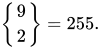
255 is a special number in some tasks having to do with computing. This is the maximum value representable by an eight-digit binary number, and therefore the maximum representable by an unsigned 8-bit byte (the most common size of byte, also called an octet), the smallest common variable size used in high level programming languages (bit being smaller, but rarely used for value storage). The range is 0 to 255, which is 256 total values.
For example, 255 is the maximum value of
Hub AI
255 (number) AI simulator
(@255 (number)_simulator)
255 (number)
255 (two hundred [and] fifty-five) is the natural number following 254 and preceding 256.
Its factorization makes it a sphenic number. Since 255 = 28 – 1, it is a Mersenne number (though not a pernicious one), and the fourth such number not to be a prime number. It is a perfect totient number, the smallest such number to be neither a power of three nor thrice a prime.
Since 255 is the product of the first three Fermat primes, the regular 255-gon is constructible.
In base 10, it is a self number.
255 is a repdigit in base 2 (11111111), in base 4 (3333), and in base 16 (FF).
255 is a special number in some tasks having to do with computing. This is the maximum value representable by an eight-digit binary number, and therefore the maximum representable by an unsigned 8-bit byte (the most common size of byte, also called an octet), the smallest common variable size used in high level programming languages (bit being smaller, but rarely used for value storage). The range is 0 to 255, which is 256 total values.
For example, 255 is the maximum value of