Recent from talks
Nothing was collected or created yet.
255 (number)
View on WikipediaThis article needs additional citations for verification. (January 2009) |
| ||||
|---|---|---|---|---|
| Cardinal | two hundred fifty-five | |||
| Ordinal | 255th (two hundred fifty-fifth) | |||
| Factorization | 3 × 5 × 17 | |||
| Divisors | 1, 3, 5, 15, 17, 51, 85, 255 | |||
| Greek numeral | ΣΝΕ´ | |||
| Roman numeral | CCLV, cclv | |||
| Binary | 111111112 | |||
| Ternary | 1001103 | |||
| Senary | 11036 | |||
| Octal | 3778 | |||
| Duodecimal | 19312 | |||
| Hexadecimal | FF16 | |||
255 (two hundred [and] fifty-five) is the natural number following 254 and preceding 256.
In mathematics
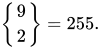
[edit]Its factorization makes it a sphenic number.[1] Since 255 = 28 – 1, it is a Mersenne number[2] (though not a pernicious one), and the fourth such number not to be a prime number. It is a perfect totient number,[3] the smallest such number to be neither a power of three nor thrice a prime.
Since 255 is the product of the first three Fermat primes, the regular 255-gon is constructible.[4]
In base 10, it is a self number. [5]
255 is a repdigit in base 2 (11111111), in base 4 (3333), and in base 16 (FF).
In computing
[edit]255 is a special number in some tasks having to do with computing. This is the maximum value representable by an eight-digit binary number, and therefore the maximum representable by an unsigned 8-bit byte (the most common size of byte, also called an octet), the smallest common variable size used in high level programming languages (bit being smaller, but rarely used for value storage). The range is 0 to 255, which is 256 total values.
For example, 255 is the maximum value of
- components in the 24-bit RGB color model, since each color channel is allotted eight bits;
- any dotted quad in an IPv4 address; and
- the alpha blending scale in Delphi (255 being 100% visible and 0 being fully transparent) and
- a DMX512 channel
The use of eight bits for storage in older video games has had the consequence of it appearing as a hard limit in many video games. For example, in the original The Legend of Zelda game, Link can carry a maximum of 255 rupees.[6] It was often used for numbers where casual gameplay would not cause anyone to exceed the number. However, in most situations it is reachable given enough time. This can cause many other peculiarities to appear when the number wraps back to 0, such as the infamous "kill screen" seen after clearing level 255 of Pac-Man.[7]
This number could be interpreted by a computer as −1 if a programmer is not careful about which 8-bit values are signed and unsigned, and the two's complement representation of −1 in a signed byte is equal to that of 255 in an unsigned byte.
References
[edit]- ^ Sloane, N. J. A. (ed.). "Sequence A007304 (Sphenic numbers: products of 3 distinct primes.)". The On-Line Encyclopedia of Integer Sequences. OEIS Foundation.
- ^ "PDF" (PDF). American Mathematical Society. Retrieved 12 March 2015.
- ^ Sloane, N. J. A. (ed.). "Sequence A082897 (perfect totient numbers)". The On-Line Encyclopedia of Integer Sequences. OEIS Foundation.
- ^ Sloane, N. J. A. (ed.). "Sequence 003401 (Numbers of edges of regular polygons constructible with ruler)". The On-Line Encyclopedia of Integer Sequences. OEIS Foundation.
- ^ Sloane, N. J. A. (ed.). "Sequence A0000700 (self number)". The On-Line Encyclopedia of Integer Sequences. OEIS Foundation.
- ^ Hoovler, Evan. "The History of Annoying Side-Quests in Videogames Archived 2010-04-10 at the Wayback Machine." GameSpy. 2009-12-04.
- ^ Clewett, James. "255 and Pac-Man". Numberphile. 2007-17-11.
255 (number)
View on GrokipediaMathematics
Arithmetic and number-theoretic properties
255 is the natural number following 254 and preceding 256.[6] It factors as the product , where 3, 5, and 17 are distinct primes.[6] The positive divisors of 255 are 1, 3, 5, 15, 17, 51, 85, and 255.[1] The sum of these divisors, denoted , equals 432.[1] As the product of three distinct primes, 255 is a sphenic number.[7] It is also a Mersenne number, specifically .[8] Since , 255 is a deficient number with deficiency .[1] 255 qualifies as a perfect totient number, the smallest such that is neither a power of 3 nor three times a prime.[9] This property holds because the sum of the iterated values of Euler's totient function applied successively to 255 equals 255:where and subsequent iterations follow the powers of 2 down to 1.[9] In base 10, 255 is a self number, meaning no integer satisfies (sum of digits of ) = 255.[10] 255 appears as a repdigit in several bases: in base 2 as , in base 4 as , and in base 16 as .[11] Its representation in base 8 is .[1]
Geometric significance
In geometry, the number 255 holds significance due to its role in the construction of regular polygons using straightedge and compass. A regular 255-gon is constructible because 255 factors as the product of the distinct Fermat primes 3, 5, and 17, satisfying the necessary condition for such constructions.[12] This allows for the precise division of the circle into 255 equal parts, each subtending a central angle of radians.[13] Fermat primes, denoted for nonnegative integers , are primes that enable the algebraic solvability of the minimal polynomials for the primitive nth roots of unity through quadratic extensions of the rationals. The known Fermat primes include , , and , among others, and a regular n-gon is constructible if and only if n is of the form times a product of distinct such primes.[14] For n = 255, the absence of a factor of 2 (equivalent to ) still permits construction, as the cyclotomic field has a degree over that is a power of 2, allowing iterative bisections and perpendiculars to yield the vertices.[12] Additionally, 255 appears in polyhedral theory as the fifth icosahedral number, a figurate number representing the total number of unit spheres that can be arranged in an icosahedral pyramid with n = 5 layers. The general formula for the nth icosahedral number is , which evaluates to 255 when n = 5.[15] This connection underscores 255's relevance to the symmetry and packing properties of the icosahedron, a Platonic solid with icosahedral rotational symmetry.Computing and technology
Digital representation
In computing, 255 serves as the maximum value for an unsigned 8-bit integer, calculated as , with its binary representation being 11111111_2, allowing for 256 distinct values from 0 to 255 within a single byte.[16][17] This structure forms the foundation of byte-based data storage in digital systems, where each bit contributes a power-of-two weight summing to the total value.[16] In signed 8-bit two's complement representation, the bit pattern 11111111_2 interprets as -1 rather than 255, derived by taking the positive value 1 (00000001_2), inverting its bits to obtain the one's complement (11111110_2), and adding 1 to yield 11111111_2.[18] This convention enables efficient arithmetic operations across positive and negative ranges (-128 to 127) without special sign-handling hardware.[18] The significance of 255 traces to early 8-bit architectures, such as the Intel 8080 microprocessor introduced in 1974, which used an 8-bit data bus and register set, establishing byte-sized processing as a standard for subsequent systems. In these environments, exceeding 255 in unsigned operations triggers overflow, where the value wraps around to 0 (e.g., 255 + 1 = 0), a behavior that supports modular arithmetic but requires careful management to avoid unintended results.[19] In low-level programming and hardware interfacing, 255 is commonly expressed in hexadecimal as FF_{16} and in octal as 377_8, facilitating compact notation for memory addresses, masks, and constants in assembly and C code.[20] For instance, FF_{16} is used to set all bits in a byte for full-scale operations like clearing or initializing registers.[20]Applications in networks and protocols
In IPv4 networking, the decimal value 255, equivalent to binary 11111111, is integral to addressing mechanisms, particularly for designating broadcast addresses within subnets. A broadcast address is formed by setting all host bits to 1, resulting in an address ending in .255 for many common configurations; for instance, on the subnet 192.168.1.0/24, the broadcast address 192.168.1.255 directs packets to all devices on that local network segment. This convention enables efficient one-to-many communication, such as in ARP requests or service discovery protocols.[21][22] The subnet mask 255.255.255.0, denoting a /24 prefix length, is a standard choice for local networks, allocating 256 addresses per subnet—specifically, 254 usable for hosts after reserving the network identifier (e.g., 192.168.1.0) and broadcast address. This mask extends the network portion of a Class C address into the third octet, supporting up to 65,536 such subnets while limiting each to a manageable size suitable for small-to-medium enterprise or home networks. Its prevalence stems from the need to conserve IPv4 address space in early Internet growth, though it can lead to rapid exhaustion in high-density environments with over 254 devices.[23][24] Within TCP/IP protocols, 255 defines the maximum value for the Time to Live (TTL) field in IP headers, capping the packet's lifespan at 255 hops to guard against infinite loops in routing. Each intermediate router decrements the TTL by at least one, discarding the packet and sending an ICMP Time Exceeded message if it reaches zero; initial TTLs are often set lower (e.g., 64 or 128) for efficiency, but 255 provides the protocol's upper limit. UDP, operating over IP, inherits this TTL constraint, with port numbers spanning 0 to 65535.[25] In the historical context of early networking, 255 featured prominently in classful addressing schemes adopted post-ARPANET, particularly for Class C networks (192.0.0.0 to 223.255.255.0), where the default mask 255.255.255.0 yielded broadcasts ending in .255 and supported 254 hosts per network. This design, formalized in the 1980s, facilitated the ARPANET's evolution into the Internet by enabling granular allocation of smaller address blocks, contrasting with larger Class A or B networks.[22][26] Security considerations arise from 255's role in broadcasts, as directed broadcast addresses (e.g., 192.168.1.255) can amplify denial-of-service attacks like the Smurf attack, where spoofed ICMP echo requests to such addresses provoke response floods from multiple hosts. To counter this, firewalls and routers often implement rules blocking inbound directed broadcasts, while limited broadcasts (255.255.255.255) are confined to local links. In /24 subnets, the 254-host limit also heightens address exhaustion risks, necessitating careful planning or migration to classless schemes like CIDR.Uses in graphics and media
In the RGB color model, which forms the basis for most digital displays and image processing, each primary color channel—red, green, and blue—is quantized using 8 bits, providing intensity values from 0 (minimum, or black) to 255 (maximum). This 8-bit depth per channel yields 256 possible levels, allowing for 16,777,216 distinct colors in a 24-bit truecolor image, such as (255, 255, 255) for pure white or (255, 0, 0) for pure red. The model is foundational in visual computing because it balances computational efficiency with perceptual color fidelity on standard hardware.[27] Common graphics formats like JPEG and PNG adopt this 8-bit channel structure for broad compatibility. JPEG images in RGB mode encode each channel with 8 bits (0-255), supporting efficient compression for photographs while preserving the full intensity range. PNG, designed for lossless storage, specifies 8 bits per sample for truecolor (RGB) and truecolor-alpha (RGBA) images, where channel values span 0 to 255; for grayscale PNGs, 255 denotes full white across 256 shades from black. This standardization ensures seamless rendering in media applications, from web browsers to video editors.[27][28] In entertainment media, particularly early video games constrained by 8-bit architectures, 255 often imposed practical limits that influenced design and led to iconic glitches. The original 1980 Pac-Man arcade game uses an 8-bit integer for its level counter, resulting in an overflow at level 256: the game misinterprets the value as 0, corrupting the fruit-drawing routine and splitting the screen with garbled tiles, rendering the board nearly impassable. Similarly, in the 1986 NES title The Legend of Zelda, the rupee inventory caps at 255—the maximum unsigned 8-bit value—forcing players to manage currency within this bound, a direct artifact of the system's memory constraints.[29][30] MIDI, the protocol for musical performance data, standardizes note velocity on a 7-bit scale (0-127) to denote strike force, but some extended implementations and conversion tools scale it to 8-bit ranges up to 255 for enhanced resolution in lighting or effects control, such as mapping MIDI velocity to DMX dimming channels. In audio media, 8-bit pulse-code modulation (PCM) formats, though uncommon today due to their limited dynamic range, represent unsigned samples from 0 (silence midpoint at 128) to 255 (peak amplitude), appearing in retro chiptune soundtracks or low-fidelity video game audio.[31][32]References
- https://en.wikibooks.org/wiki/Zelda_franchise_strategy_guide/Items/Rupee
