



Community hub
Recent from talks
Contribute something
Nothing was collected or created yet.
Fermat number
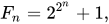
View on WikipediaIn mathematics, a Fermat number, named after Pierre de Fermat (1601–1665), the first known to have studied them, is a positive integer of the form: where n is a non-negative integer. The first few Fermat numbers are: 3, 5, 17, 257, 65537, 4294967297, 18446744073709551617, 340282366920938463463374607431768211457, ... (sequence A000215 in the OEIS).
Key Information

If 2k + 1 is prime and k > 0, then k itself must be a power of 2,[1] so 2k + 1 is a Fermat number; such primes are called Fermat primes. As of January 2025[update], the only known Fermat primes are F0 = 3, F1 = 5, F2 = 17, F3 = 257, and F4 = 65537 (sequence A019434 in the OEIS).
Basic properties
[edit]The Fermat numbers satisfy the following recurrence relations:


for n ≥ 1,


for n ≥ 2. Each of these relations can be proved by mathematical induction. From the second equation, we can deduce Goldbach's theorem (named after Christian Goldbach): no two Fermat numbers share a common integer factor greater than 1. To see this, suppose that 0 ≤ i < j and Fi and Fj have a common factor a > 1. Then a divides both

and Fj; hence a divides their difference, 2. Since a > 1, this forces a = 2. This is a contradiction, because each Fermat number is clearly odd. As a corollary, we obtain another proof of the infinitude of the prime numbers: for each Fn, choose a prime factor pn; then the sequence {pn} is an infinite sequence of distinct primes.
Further properties
[edit]- No Fermat prime can be expressed as the difference of two pth powers, where p is an odd prime.
- With the exception of F0 and F1, the last decimal digit of a Fermat number is 7.
- The sum of the reciprocals of all the Fermat numbers (sequence A051158 in the OEIS) is irrational. (Solomon W. Golomb, 1963)
Primality
[edit]Fermat numbers and Fermat primes were first studied by Pierre de Fermat, who conjectured that all Fermat numbers are prime. Indeed, the first five Fermat numbers F0, ..., F4 are easily shown to be prime. Fermat's conjecture was refuted by Leonhard Euler in 1732 when he showed, by dividing by 641 that

Euler proved that every factor of Fn must have the form k 2n+1 + 1 (later improved to k 2n+2 + 1 by Lucas) for n ≥ 2.
That 641 is a factor of F5 can be deduced, in hindsight, as follows: From the equalities 641 = 27 × 5 + 1 and 641 = 24 + 54. It follows from the first equality that 27 × 5 ≡ −1 (mod 641) and therefore (raising to the fourth power) that 228 × 54 ≡ 1 (mod 641). On the other hand, the second equality implies that 54 ≡ −24 (mod 641). These congruences imply that 232 ≡ −1 (mod 641).
Fermat was probably aware of the form of the factors later proved by Euler, so it seems curious that he failed to follow through on the straightforward calculation to find the factor.[2] One common explanation is that Fermat made a computational mistake.
There are no other known Fermat primes Fn with n > 4, but little is known about Fermat numbers for large n.[3] In fact, each of the following is an open problem:
- Is Fn composite for all n > 4?
- Are there infinitely many Fermat primes? (Eisenstein 1844[4])
- Are there infinitely many composite Fermat numbers?
- Does a Fermat number exist that is not square-free?
As of November 2025[update], it is known that Fn is composite for 5 ≤ n ≤ 32, although of these, complete factorizations of Fn are known only for 0 ≤ n ≤ 11, and there are no known prime factors for n = 20 and n = 24.[5] The largest Fermat number known to be composite is F18233954, and its prime factor 7 × 218233956 + 1 was discovered in October 2020.
Heuristic arguments
[edit]Heuristics suggest that F4 is the last Fermat prime.
The prime number theorem implies that a random integer in a suitable interval around N is prime with probability 1 / ln N. If one uses the heuristic that a Fermat number is prime with the same probability as a random integer of its size, and that F5, ..., F32 are composite, then the expected number of Fermat primes beyond F4 (or equivalently, beyond F32) should be

One may interpret this number as an upper bound for the probability that a Fermat prime beyond F4 exists.
This argument is not a rigorous proof. For one thing, it assumes that Fermat numbers behave "randomly", but the factors of Fermat numbers have special properties. Boklan and Conway published a more precise analysis suggesting that the probability that there is another Fermat prime is less than one in a billion.[6]
Anders Bjorn and Hans Riesel estimated the number of square factors of Fermat numbers from F5 onward as

in other words, there are unlikely to be any non-squarefree Fermat numbers, and in general square factors of are very rare for large n.[7]

Equivalent conditions
[edit]Let be the nth Fermat number. Pépin's test states that for n > 0,
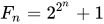
- is prime if and only if


The expression can be evaluated modulo by repeated squaring. This makes the test a fast polynomial-time algorithm. But Fermat numbers grow so rapidly that only a handful of them can be tested in a reasonable amount of time and space.

There are some tests for numbers of the form k 2m + 1, such as factors of Fermat numbers, for primality.
- Proth's theorem (1878). Let N = k 2m + 1 with odd k < 2m. If there is an integer a such that
- then is prime. Conversely, if the above congruence does not hold, and in addition
- (See Jacobi symbol)
- then is composite.



If N = Fn > 3, then the above Jacobi symbol is always equal to −1 for a = 3, and this special case of Proth's theorem is known as Pépin's test. Although Pépin's test and Proth's theorem have been implemented on computers to prove the compositeness of some Fermat numbers, neither test gives a specific nontrivial factor. In fact, no specific prime factors are known for n = 20 and 24.
Factorization
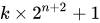
[edit]Because of Fermat numbers' size, it is difficult to factorize or even to check primality. Pépin's test gives a necessary and sufficient condition for primality of Fermat numbers, and can be implemented by modern computers. The elliptic curve method is a fast method for finding small prime divisors of numbers. Distributed computing project Fermatsearch has found some factors of Fermat numbers. Yves Gallot's proth.exe has been used to find factors of large Fermat numbers. Édouard Lucas, improving Euler's above-mentioned result, proved in 1878 that every factor of the Fermat number , with n at least 2, is of the form (see Proth number), where k is a positive integer. By itself, this makes it easy to prove the primality of the known Fermat primes.
Factorizations of the first 12 Fermat numbers are:
F0 = 21 + 1 = 3 is prime F1 = 22 + 1 = 5 is prime F2 = 24 + 1 = 17 is prime F3 = 28 + 1 = 257 is prime F4 = 216 + 1 = 65,537 is the largest known Fermat prime F5 = 232 + 1 = 4,294,967,297 = 641 × 6,700,417 (fully factored 1732[8]) F6 = 264 + 1 = 18,446,744,073,709,551,617 (20 digits) = 274,177 × 67,280,421,310,721 (14 digits) (fully factored 1855) F7 = 2128 + 1 = 340,282,366,920,938,463,463,374,607,431,768,211,457 (39 digits) = 59,649,589,127,497,217 (17 digits) × 5,704,689,200,685,129,054,721 (22 digits) (fully factored 1970) F8 = 2256 + 1 = 115,792,089,237,316,195,423,570,985,008,687,907,853,269,984,665,640,564,039,457,584,007,913,129,
639,937 (78 digits)= 1,238,926,361,552,897 (16 digits) ×
93,461,639,715,357,977,769,163,558,199,606,896,584,051,237,541,638,188,580,280,321 (62 digits) (fully factored 1980)F9 = 2512 + 1 = 13,407,807,929,942,597,099,574,024,998,205,846,127,479,365,820,592,393,377,723,561,443,721,764,0
30,073,546,976,801,874,298,166,903,427,690,031,858,186,486,050,853,753,882,811,946,569,946,433,6
49,006,084,097 (155 digits)= 2,424,833 × 7,455,602,825,647,884,208,337,395,736,200,454,918,783,366,342,657 (49 digits) ×
741,640,062,627,530,801,524,787,141,901,937,474,059,940,781,097,519,023,905,821,316,144,415,759,
504,705,008,092,818,711,693,940,737 (99 digits) (fully factored 1990)F10 = 21024 + 1 = 179,769,313,486,231,590,772,930...304,835,356,329,624,224,137,217 (309 digits) = 45,592,577 × 6,487,031,809 × 4,659,775,785,220,018,543,264,560,743,076,778,192,897 (40 digits) ×
130,439,874,405,488,189,727,484...806,217,820,753,127,014,424,577 (252 digits) (fully factored 1995)F11 = 22048 + 1 = 32,317,006,071,311,007,300,714,8...193,555,853,611,059,596,230,657 (617 digits) = 319,489 × 974,849 × 167,988,556,341,760,475,137 (21 digits) × 3,560,841,906,445,833,920,513 (22 digits) ×
173,462,447,179,147,555,430,258...491,382,441,723,306,598,834,177 (564 digits) (fully factored 1988)
As of January 2025[update], only F0 to F11 have been completely factored.[5] The distributed computing project Fermat Search is searching for new factors of Fermat numbers.[9] The set of all Fermat factors is A050922 (or, sorted, A023394) in OEIS.
The following factors of Fermat numbers were known before 1950 (since then, digital computers have helped find more factors):
| Year | Finder | Fermat number | Factor |
|---|---|---|---|
| 1732 | Euler | ||
| 1732 | Euler | (fully factored) | |
| 1855 | Clausen | ||
| 1855 | Clausen | (fully factored) | |
| 1877 | Pervushin | ||
| 1878 | Pervushin | ||
| 1886 | Seelhoff | ||
| 1899 | Cunningham | ||
| 1899 | Cunningham | ||
| 1903 | Western | ||
| 1903 | Western | ||
| 1903 | Western | ||
| 1903 | Western | ||
| 1903 | Cullen | ||
| 1906 | Morehead | ||
| 1925 | Kraitchik |


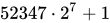

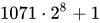



As of January 2025[update], 373 prime factors of Fermat numbers are known, and 328 Fermat numbers are known to be composite.[5] Several new Fermat factors are found each year.[10]
Pseudoprimes and Fermat numbers
[edit]Like composite numbers of the form 2p − 1, every composite Fermat number is a strong pseudoprime to base 2. This is because all strong pseudoprimes to base 2 are also Fermat pseudoprimes – i.e.,

for all Fermat numbers.[11]
In 1904, Cipolla showed that the product of at least two distinct prime or composite Fermat numbers will be a Fermat pseudoprime to base 2 if and only if .[12]



Other theorems about Fermat numbers
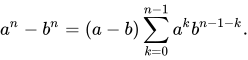
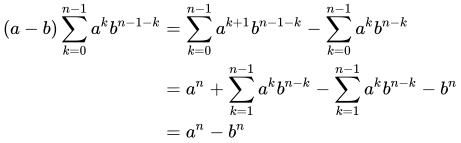
[edit]Lemma.—If n is a positive integer,
Theorem— If is an odd prime, then is a power of 2.


If is a positive integer but not a power of 2, it must have an odd prime factor , and we may write where .


By the preceding lemma, for positive integer ,


where means "evenly divides". Substituting , and and using that is odd,





and thus

Because , it follows that is not prime. Therefore, by contraposition must be a power of 2.

Theorem— A Fermat prime cannot be a Wieferich prime.
We show if is a Fermat prime (and hence by the above, m is a power of 2), then the congruence does not hold.


Since we may write . If the given congruence holds, then , and therefore




Hence , and therefore . This leads to , which is impossible since .

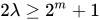


Theorem (Édouard Lucas)— Any prime divisor p of is of the form whenever n > 1.

Let Gp denote the group of non-zero integers modulo p under multiplication, which has order p − 1. Notice that 2 (strictly speaking, its image modulo p) has multiplicative order equal to in Gp (since is the square of which is −1 modulo Fn), so that, by Lagrange's theorem, p − 1 is divisible by and p has the form for some integer k, as Euler knew. Édouard Lucas went further. Since n > 1, the prime p above is congruent to 1 modulo 8. Hence (as was known to Carl Friedrich Gauss), 2 is a quadratic residue modulo p, that is, there is integer a such that Then the image of a has order in the group Gp and (using Lagrange's theorem again), p − 1 is divisible by and p has the form for some integer s.


In fact, it can be seen directly that 2 is a quadratic residue modulo p, since

Since an odd power of 2 is a quadratic residue modulo p, so is 2 itself.
A Fermat number cannot be a perfect number or part of a pair of amicable numbers. (Luca 2000)
The series of reciprocals of all prime divisors of Fermat numbers is convergent. (Křížek, Luca & Somer 2002)
If nn + 1 is prime and , there exists an integer m such that n = 22m. The equation nn + 1 = F(2m+m) holds in that case.[13][14]

Let the largest prime factor of the Fermat number Fn be P(Fn). Then,

Relationship to constructible polygons
[edit]
Carl Friedrich Gauss developed the theory of Gaussian periods in his Disquisitiones Arithmeticae and formulated a sufficient condition for the constructibility of regular polygons. Gauss stated that this condition was also necessary,[15] but never published a proof. Pierre Wantzel gave a full proof of necessity in 1837. The result is known as the Gauss–Wantzel theorem:
- An n-sided regular polygon can be constructed with compass and straightedge if and only if n is either a power of 2 or the product of a power of 2 and distinct Fermat primes: in other words, if and only if n is of the form n = 2k or n = 2kp1p2...ps, where k, s are nonnegative integers and the pi are distinct Fermat primes.
A positive integer n is of the above form if and only if its totient φ(n) is a power of 2.
Applications of Fermat numbers
[edit]Pseudorandom number generation
[edit]Fermat primes are particularly useful in generating pseudo-random sequences of numbers in the range 1, ..., N, where N is a power of 2. The most common method used is to take any seed value between 1 and P − 1, where P is a Fermat prime. Now multiply this by a number A, which is greater than the square root of P and is a primitive root modulo P (i.e., it is not a quadratic residue). Then take the result modulo P. The result is the new value for the RNG.

This is useful in computer science, since most data structures have members with 2X possible values. For example, a byte has 256 (28) possible values (0–255). Therefore, to fill a byte or bytes with random values, a random number generator that produces values 1–256 can be used, the byte taking the output value −1. Very large Fermat primes are of particular interest in data encryption for this reason. This method produces only pseudorandom values, as after P − 1 repetitions, the sequence repeats. A poorly chosen multiplier can result in the sequence repeating sooner than P − 1.
Generalized Fermat numbers
[edit]Numbers of the form with a, b any coprime integers, a > b > 0, are called generalized Fermat numbers. An odd prime p is a generalized Fermat number if and only if p is congruent to 1 (mod 4). (Here we consider only the case n > 0, so 3 = is not a counterexample.)


An example of a probable prime of this form is 200262144 + 119262144 (found by Kellen Shenton).[16]
By analogy with the ordinary Fermat numbers, it is common to write generalized Fermat numbers of the form as Fn(a). In this notation, for instance, the number 100,000,001 would be written as F3(10). In the following we shall restrict ourselves to primes of this form, , such primes are called "Fermat primes base a". Of course, these primes exist only if a is even.

If we require n > 0, then Landau's fourth problem asks if there are infinitely many generalized Fermat primes Fn(a).
Generalized Fermat primes of the form Fn(a)
[edit]Because of the ease of proving their primality, generalized Fermat primes have become in recent years a topic for research within the field of number theory. Many of the largest known primes today are generalized Fermat primes.
Generalized Fermat numbers can be prime only for even a, because if a is odd then every generalized Fermat number will be divisible by 2. The smallest prime number with is , or 3032 + 1. Besides, we can define "half generalized Fermat numbers" for an odd base, a half generalized Fermat number to base a (for odd a) is , and it is also to be expected that there will be only finitely many half generalized Fermat primes for each odd base.


In this list, the generalized Fermat numbers () to an even a are , for odd a, they are . If a is a perfect power with an odd exponent (sequence A070265 in the OEIS), then all generalized Fermat number can be algebraic factored, so they cannot be prime.


See[17][18] for even bases up to 1000, and[19] for odd bases. For the smallest number such that is prime, see (sequence A253242 in the OEIS).

| numbers such that is prime |
numbers such that is prime |
numbers such that is prime |
numbers such that is prime | ||||
|---|---|---|---|---|---|---|---|
| 2 | 0, 1, 2, 3, 4, ... | 18 | 0, ... | 34 | 2, ... | 50 | ... |
| 3 | 0, 1, 2, 4, 5, 6, ... | 19 | 1, ... | 35 | 1, 2, 6, ... | 51 | 1, 3, 6, ... |
| 4 | 0, 1, 2, 3, ... | 20 | 1, 2, ... | 36 | 0, 1, ... | 52 | 0, ... |
| 5 | 0, 1, 2, ... | 21 | 0, 2, 5, ... | 37 | 0, ... | 53 | 3, ... |
| 6 | 0, 1, 2, ... | 22 | 0, ... | 38 | ... | 54 | 1, 2, 5, ... |
| 7 | 2, ... | 23 | 2, ... | 39 | 1, 2, ... | 55 | ... |
| 8 | (none) | 24 | 1, 2, ... | 40 | 0, 1, ... | 56 | 1, 2, ... |
| 9 | 0, 1, 3, 4, 5, ... | 25 | 0, 1, ... | 41 | 4, ... | 57 | 0, 2, ... |
| 10 | 0, 1, ... | 26 | 1, ... | 42 | 0, ... | 58 | 0, ... |
| 11 | 1, 2, ... | 27 | (none) | 43 | 3, ... | 59 | 1, ... |
| 12 | 0, ... | 28 | 0, 2, ... | 44 | 4, ... | 60 | 0, ... |
| 13 | 0, 2, 3, ... | 29 | 1, 2, 4, ... | 45 | 0, 1, ... | 61 | 0, 1, 2, ... |
| 14 | 1, ... | 30 | 0, 5, ... | 46 | 0, 2, 9, ... | 62 | ... |
| 15 | 1, ... | 31 | ... | 47 | 3, ... | 63 | ... |
| 16 | 0, 1, 2, ... | 32 | (none) | 48 | 2, ... | 64 | (none) |
| 17 | 2, ... | 33 | 0, 3, ... | 49 | 1, ... | 65 | 1, 2, 5, ... |

For the smallest even base a such that is prime, see (sequence A056993 in the OEIS).
The generalized Fermat prime F14(71) is the largest known generalized Fermat prime in bases b ≤ 1000, it is proven prime by elliptic curve primality proving.[20]
| bases a such that is prime (only consider even a) | OEIS sequence | |
|---|---|---|
| 0 | 2, 4, 6, 10, 12, 16, 18, 22, 28, 30, 36, 40, 42, 46, 52, 58, 60, 66, 70, 72, 78, 82, 88, 96, 100, 102, 106, 108, 112, 126, 130, 136, 138, 148, 150, ... | A006093 |
| 1 | 2, 4, 6, 10, 14, 16, 20, 24, 26, 36, 40, 54, 56, 66, 74, 84, 90, 94, 110, 116, 120, 124, 126, 130, 134, 146, 150, 156, 160, 170, 176, 180, 184, ... | A005574 |
| 2 | 2, 4, 6, 16, 20, 24, 28, 34, 46, 48, 54, 56, 74, 80, 82, 88, 90, 106, 118, 132, 140, 142, 154, 160, 164, 174, 180, 194, 198, 204, 210, 220, 228, ... | A000068 |
| 3 | 2, 4, 118, 132, 140, 152, 208, 240, 242, 288, 290, 306, 378, 392, 426, 434, 442, 508, 510, 540, 542, 562, 596, 610, 664, 680, 682, 732, 782, ... | A006314 |
| 4 | 2, 44, 74, 76, 94, 156, 158, 176, 188, 198, 248, 288, 306, 318, 330, 348, 370, 382, 396, 452, 456, 470, 474, 476, 478, 560, 568, 598, 642, ... | A006313 |
| 5 | 30, 54, 96, 112, 114, 132, 156, 332, 342, 360, 376, 428, 430, 432, 448, 562, 588, 726, 738, 804, 850, 884, 1068, 1142, 1198, 1306, 1540, 1568, ... | A006315 |
| 6 | 102, 162, 274, 300, 412, 562, 592, 728, 1084, 1094, 1108, 1120, 1200, 1558, 1566, 1630, 1804, 1876, 2094, 2162, 2164, 2238, 2336, 2388, ... | A006316 |
| 7 | 120, 190, 234, 506, 532, 548, 960, 1738, 1786, 2884, 3000, 3420, 3476, 3658, 4258, 5788, 6080, 6562, 6750, 7692, 8296, 9108, 9356, 9582, ... | A056994 |
| 8 | 278, 614, 892, 898, 1348, 1494, 1574, 1938, 2116, 2122, 2278, 2762, 3434, 4094, 4204, 4728, 5712, 5744, 6066, 6508, 6930, 7022, 7332, ... | A056995 |
| 9 | 46, 1036, 1318, 1342, 2472, 2926, 3154, 3878, 4386, 4464, 4474, 4482, 4616, 4688, 5374, 5698, 5716, 5770, 6268, 6386, 6682, 7388, 7992, ... | A057465 |
| 10 | 824, 1476, 1632, 2462, 2484, 2520, 3064, 3402, 3820, 4026, 6640, 7026, 7158, 9070, 12202, 12548, 12994, 13042, 15358, 17646, 17670, ... | A057002 |
| 11 | 150, 2558, 4650, 4772, 11272, 13236, 15048, 23302, 26946, 29504, 31614, 33308, 35054, 36702, 37062, 39020, 39056, 43738, 44174, 45654, ... | A088361 |
| 12 | 1534, 7316, 17582, 18224, 28234, 34954, 41336, 48824, 51558, 51914, 57394, 61686, 62060, 89762, 96632, 98242, 100540, 101578, 109696, ... | A088362 |
| 13 | 30406, 71852, 85654, 111850, 126308, 134492, 144642, 147942, 150152, 165894, 176206, 180924, 201170, 212724, 222764, 225174, 241600, ... | A226528 |
| 14 | 67234, 101830, 114024, 133858, 162192, 165306, 210714, 216968, 229310, 232798, 422666, 426690, 449732, 462470, 468144, 498904, 506664, ... | A226529 |
| 15 | 70906, 167176, 204462, 249830, 321164, 330716, 332554, 429370, 499310, 524552, 553602, 743788, 825324, 831648, 855124, 999236, 1041870, 1074542, 1096382, 1113768, 1161054, 1167528, 1169486, 1171824, 1210354, 1217284, 1277444, 1519380, 1755378, 1909372, 1922592, 1986700, ... | A226530 |
| 16 | 48594, 108368, 141146, 189590, 255694, 291726, 292550, 357868, 440846, 544118, 549868, 671600, 843832, 857678, 1024390, 1057476, 1087540, 1266062, 1361846, 1374038, 1478036, 1483076, 1540550, 1828502, 1874512, 1927034, 1966374, ... | A251597 |
| 17 | 62722, 130816, 228188, 386892, 572186, 689186, 909548, 1063730, 1176694, 1361244, 1372930, 1560730, 1660830, 1717162, 1722230, 1766192, 1955556, 2194180, 2280466, 2639850, 3450080, 3615210, 3814944, 4085818, 4329134, 4893072, 4974408, ... | A253854 |
| 18 | 24518, 40734, 145310, 361658, 525094, 676754, 773620, 1415198, 1488256, 1615588, 1828858, 2042774, 2514168, 2611294, 2676404, 3060772, 3547726, 3596074, 3673932, 3853792, 3933508, 4246258, 4489246, ... | A244150 |
| 19 | 75898, 341112, 356926, 475856, 1880370, 2061748, 2312092, 2733014, 2788032, 2877652, 2985036, 3214654, 3638450, 4896418, 5897794, 6339004, 8630170, 9332124, 10913140, 11937916, 12693488, 12900356, ... | A243959 |
| 20 | 919444, 1059094, 1951734, 1963736, 3843236, ... | A321323 |
| 21 | 2524190, ... |
The smallest even base b such that Fn(b) = b2n + 1 (for given n = 0, 1, 2, ...) is prime are
- 2, 2, 2, 2, 2, 30, 102, 120, 278, 46, 824, 150, 1534, 30406, 67234, 70906, 48594, 62722, 24518, 75898, 919444, 2524190, ... (sequence A056993 in the OEIS)
The smallest odd base b such that Fn(b) = (b2n + 1)/2 (for given n = 0, 1, 2, ...) is prime (or probable prime) are
- 3, 3, 3, 9, 3, 3, 3, 113, 331, 513, 827, 799, 3291, 5041, 71, 220221, 23891, 11559, 187503, 35963, ... (sequence A275530 in the OEIS)
Conversely, the smallest k such that (2n)k + 1 (for given n) is prime are
- 1, 1, 1, 0, 1, 1, 2, 1, 1, 2, 1, 2, 2, 1, 1, 0, 4, 1, ... (The next term is unknown) (sequence A079706 in the OEIS) (also see (sequence A228101 in the OEIS) and (sequence A084712 in the OEIS))
A more elaborate theory can be used to predict the number of bases for which will be prime for fixed . The number of generalized Fermat primes can be roughly expected to halve as is increased by 1.
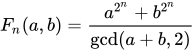
Generalized Fermat primes of the form Fn(a, b)
[edit]It is also possible to construct generalized Fermat primes of the form . As in the case where b=1, numbers of this form will always be divisible by 2 if a+b is even, but it is still possible to define generalized half-Fermat primes of this type. For the smallest prime of the form (for odd ), see also (sequence A111635 in the OEIS).


| numbers such that is prime[21][7] | ||
|---|---|---|
| 2 | 1 | 0, 1, 2, 3, 4, ... |
| 3 | 1 | 0, 1, 2, 4, 5, 6, ... |
| 3 | 2 | 0, 1, 2, ... |
| 4 | 1 | 0, 1, 2, 3, ... (equivalent to ) |
| 4 | 3 | 0, 2, 4, ... |
| 5 | 1 | 0, 1, 2, ... |
| 5 | 2 | 0, 1, 2, ... |
| 5 | 3 | 1, 2, 3, ... |
| 5 | 4 | 1, 2, ... |
| 6 | 1 | 0, 1, 2, ... |
| 6 | 5 | 0, 1, 3, 4, ... |
| 7 | 1 | 2, ... |
| 7 | 2 | 1, 2, ... |
| 7 | 3 | 0, 1, 8, ... |
| 7 | 4 | 0, 2, ... |
| 7 | 5 | 1, 4, |
| 7 | 6 | 0, 2, 4, ... |
| 8 | 1 | (none) |
| 8 | 3 | 0, 1, 2, ... |
| 8 | 5 | 0, 1, 2, |
| 8 | 7 | 1, 4, ... |
| 9 | 1 | 0, 1, 3, 4, 5, ... (equivalent to ) |
| 9 | 2 | 0, 2, ... |
| 9 | 4 | 0, 1, ... (equivalent to ) |
| 9 | 5 | 0, 1, 2, ... |
| 9 | 7 | 2, ... |
| 9 | 8 | 0, 2, 5, ... |
| 10 | 1 | 0, 1, ... |
| 10 | 3 | 0, 1, 3, ... |
| 10 | 7 | 0, 1, 2, ... |
| 10 | 9 | 0, 1, 2, ... |
| 11 | 1 | 1, 2, ... |
| 11 | 2 | 0, 2, ... |
| 11 | 3 | 0, 3, ... |
| 11 | 4 | 1, 2, ... |
| 11 | 5 | 1, ... |
| 11 | 6 | 0, 1, 2, ... |
| 11 | 7 | 2, 4, 5, ... |
| 11 | 8 | 0, 6, ... |
| 11 | 9 | 1, 2, ... |
| 11 | 10 | 5, ... |
| 12 | 1 | 0, ... |
| 12 | 5 | 0, 4, ... |
| 12 | 7 | 0, 1, 3, ... |
| 12 | 11 | 0, ... |



Largest known generalized Fermat primes
[edit]The following is a list of the ten largest known generalized Fermat primes.[22] The whole top-10 is discovered by participants in the PrimeGrid project.
| Rank | Prime number | Generalized Fermat notation | Number of digits | Discovery date | ref. |
|---|---|---|---|---|---|
| 1 | 25241902097152 + 1 | F21(2524190) | 13,426,224 | Oct 2025 | [23] |
| 2 | 4×511786358 + 1 | F1(2×55893179) | 8,238,312 | Oct 2024 | [24] |
| 3 | 38432361048576 + 1 | F20(3843236) | 6,904,556 | Dec 2024 | [25] |
| 4 | 19637361048576 + 1 | F20(1963736) | 6,598,776 | Sep 2022 | [26] |
| 5 | 19517341048576 + 1 | F20(1951734) | 6,595,985 | Aug 2022 | [27] |
| 6 | 10590941048576 + 1 | F20(1059094) | 6,317,602 | Nov 2018 | [28] |
| 7 | 9194441048576 + 1 | F20(919444) | 6,253,210 | Sep 2017 | [29] |
| 8 | 81×220498148 + 1 | F2(3×25124537) | 6,170,560 | Jun 2023 | [30] |
| 9 | 4×58431178 + 1 | F1(2×54215589) | 5,893,142 | Jan 2024 | [31] |
| 10 | 4×311279466 + 1 | F1(2×35639733) | 5,381,674 | Sep 2024 | [32] |
On the Prime Pages one can find the current top 20 generalized Fermat primes and the current top 100 generalized Fermat primes.
See also
[edit]- Constructible polygon: which regular polygons are constructible partially depends on Fermat primes.
- Double exponential function
- Lucas' theorem
- Mersenne prime
- Pierpont prime
- Primality test
- Proth's theorem
- Pseudoprime
- Sierpiński number
- Sylvester's sequence
Notes
[edit]- ^ For any positive odd number , where .
- ^ Křížek, Luca & Somer 2001, p. 38, Remark 4.15
- ^ Chris Caldwell, "Prime Links++: special forms" Archived 2013-12-24 at the Wayback Machine at The Prime Pages.
- ^ Ribenboim 1996, p. 88.
- ^ a b c Keller, Wilfrid (January 18, 2021), "Prime Factors of Fermat Numbers", ProthSearch.com, retrieved 20 June 2025
- ^ Boklan, Kent D.; Conway, John H. (2017). "Expect at most one billionth of a new Fermat Prime!". The Mathematical Intelligencer. 39 (1): 3–5. arXiv:1605.01371. doi:10.1007/s00283-016-9644-3. S2CID 119165671.
- ^ a b Björn, Anders; Riesel, Hans (1998). "Factors of generalized Fermat numbers". Mathematics of Computation. 67 (221): 441–446. doi:10.1090/S0025-5718-98-00891-6. ISSN 0025-5718.
- ^ Sandifer, Ed. "How Euler Did it" (PDF). MAA Online. Mathematical Association of America. Archived (PDF) from the original on 2022-10-09. Retrieved 2020-06-13.
- ^ ":: F E R M A T S E A R C H . O R G :: Home page". www.fermatsearch.org. Retrieved 7 April 2018.
- ^ "::FERMATSEARCH.ORG:: News". www.fermatsearch.org. Retrieved 7 April 2018.
- ^ Schroeder, M. R. (2006). Number theory in science and communication: with applications in cryptography, physics, digital information, computing, and self-similarity. Springer series in information sciences (4th ed.). Berlin ; New York: Springer. p. 216. ISBN 978-3-540-26596-2. OCLC 61430240.
- ^ Krizek, Michal; Luca, Florian; Somer, Lawrence (14 March 2013). 17 Lectures on Fermat Numbers: From Number Theory to Geometry. Springer Science & Business Media. ISBN 9780387218502. Retrieved 7 April 2018 – via Google Books.
- ^ Jeppe Stig Nielsen, "S(n) = n^n + 1".
- ^ Weisstein, Eric W. "Sierpiński Number of the First Kind". MathWorld.
- ^ Gauss, Carl Friedrich (1966). Disquisitiones arithmeticae. New Haven and London: Yale University Press. pp. 458–460. Retrieved 25 January 2023.
- ^ PRP Top Records, search for x^262144+y^262144, by Henri & Renaud Lifchitz.
- ^ "Generalized Fermat Primes". jeppesn.dk. Retrieved 7 April 2018.
- ^ "Generalized Fermat primes for bases up to 1030". noprimeleftbehind.net. Retrieved 7 April 2018.
- ^ "Generalized Fermat primes in odd bases". fermatquotient.com. Retrieved 7 April 2018.
- ^ The entry of the generalized Fermat prime F14(71) in the online factor database
- ^ "Original GFN factors". www.prothsearch.com.
- ^ Caldwell, Chris K. "The Top Twenty: Generalized Fermat". The Prime Pages. Retrieved 5 October 2024.
- ^ 25241902097152 + 1
- ^ 4×511786358 + 1
- ^ 38432361048576 + 1
- ^ 19637361048576 + 1
- ^ 19517341048576 + 1
- ^ 10590941048576 + 1
- ^ 9194441048576 + 1
- ^ 81×220498148 + 1
- ^ 4×58431178 + 1
- ^ 4×311279466 + 1


References
[edit]- Golomb, S. W. (January 1, 1963), "On the sum of the reciprocals of the Fermat numbers and related irrationalities", Canadian Journal of Mathematics, 15: 475–478, doi:10.4153/CJM-1963-051-0, S2CID 123138118
- Grytczuk, A.; Luca, F. & Wójtowicz, M. (2001), "Another note on the greatest prime factors of Fermat numbers", Southeast Asian Bulletin of Mathematics, 25 (1): 111–115, doi:10.1007/s10012-001-0111-4, S2CID 122332537
- Guy, Richard K. (2004), Unsolved Problems in Number Theory, Problem Books in Mathematics, vol. 1 (3rd ed.), New York: Springer Verlag, pp. A3, A12, B21, ISBN 978-0-387-20860-2
- Křížek, Michal; Luca, Florian & Somer, Lawrence (2001), 17 Lectures on Fermat Numbers: From Number Theory to Geometry, CMS books in mathematics, vol. 10, New York: Springer, ISBN 978-0-387-95332-8 - This book contains an extensive list of references.
- Křížek, Michal; Luca, Florian & Somer, Lawrence (2002), "On the convergence of series of reciprocals of primes related to the Fermat numbers", Journal of Number Theory, 97 (1): 95–112, doi:10.1006/jnth.2002.2782
- Luca, Florian (2000), "The anti-social Fermat number", American Mathematical Monthly, 107 (2): 171–173, doi:10.2307/2589441, JSTOR 2589441
- Ribenboim, Paulo (1996), The New Book of Prime Number Records (3rd ed.), New York: Springer, ISBN 978-0-387-94457-9
- Robinson, Raphael M. (1954), "Mersenne and Fermat Numbers", Proceedings of the American Mathematical Society, 5 (5): 842–846, doi:10.2307/2031878, JSTOR 2031878
- Yabuta, M. (2001), "A simple proof of Carmichael's theorem on primitive divisors" (PDF), Fibonacci Quarterly, 39 (5): 439–443, doi:10.1080/00150517.2001.12428701, archived (PDF) from the original on 2022-10-09
External links
[edit]- Chris Caldwell, The Prime Glossary: Fermat number at The Prime Pages.
- Luigi Morelli, History of Fermat Numbers
- John Cosgrave, Unification of Mersenne and Fermat Numbers
- Wilfrid Keller, Prime Factors of Fermat Numbers
- Weisstein, Eric W. "Fermat Number". MathWorld.
- Weisstein, Eric W. "Fermat Prime". MathWorld.
- Weisstein, Eric W. "Generalized Fermat Number". MathWorld.
- Yves Gallot, Generalized Fermat Prime Search
- Mark S. Manasse, Complete factorization of the ninth Fermat number (original announcement)
- Peyton Hayslette, Largest Known Generalized Fermat Prime Announcement
Classes of natural numbers | |||||||||||||||||||||||||
|---|---|---|---|---|---|---|---|---|---|---|---|---|---|---|---|---|---|---|---|---|---|---|---|---|---|
| |||||||||||||||||||||||||
| |||||||||||||||||||||||||
| |||||||||||||||||||||||||
| |||||||||||||||||||||||||
| |||||||||||||||||||||||||
| |||||||||||||||||||||||||
| |||||||||||||||||||||||||
| |||||||||||||||||||||||||
| |||||||||||||||||||||||||
| |||||||||||||||||||||||||

| International | |
|---|---|
| National | |

Fermat number
View on GrokipediaIntroduction
Definition
A Fermat number is defined as , where is a non-negative integer.[5] The first five Fermat numbers are , , , , and .[5] Pierre de Fermat introduced these numbers in a 1640 letter to Bernard Frénicle de Bessy while discussing methods for constructing perfect numbers.[6] In that correspondence, Fermat noted their form and suggested they might all be prime, though he provided no proof. Fermat numbers grow extremely rapidly in magnitude; for example, consists of exactly binary digits, reflecting the exponential tower in the exponent.[7]Historical Context
In 1640, Pierre de Fermat introduced the form of numbers now known as Fermat numbers in a letter to Bernard Frénicle de Bessy, conjecturing without proof that all such numbers are prime based on his verification of the first few cases.[8] This conjecture stemmed from Fermat's broader explorations in number theory, where he observed the primality of the initial instances and posited it as a general property.[7] Leonhard Euler verified the primality of the first five Fermat numbers, through , in 1732, but disproved Fermat's conjecture by factoring , demonstrating that is composite.[9] Euler's factorization relied on properties of factors of Fermat numbers, specifically identifying 641 as a divisor (of the form ) through systematic checking, and confirming the primality of the cofactor 6,700,417 by trial division up to its square root.[9] This discovery marked the first known composite Fermat number and shifted early interest from universal primality to the structure and factors of these numbers. It remains unknown whether there are any Fermat primes beyond the first five.[5] During the 19th century, interest in Fermat numbers persisted and culminated in Théophile Pépin's development of a primality test in 1877 specifically for Fermat numbers, providing a deterministic method using quadratic reciprocity to check if .[10] Pépin's test built on earlier ideas from Lucas and offered an efficient way to verify primality for larger Fermat numbers without full factorization. Meanwhile, factorization efforts advanced, with Édouard Lucas and others exploring algebraic properties, though progress on higher composites remained limited until computational tools emerged. In the 20th century, computational advances enabled further factorizations, such as Michael A. Morrison and John Brillhart's 1975 complete factorization of using the continued fraction method, revealing it as a product of five prime factors and highlighting the increasing difficulty of these tasks. This work exemplified the evolution of factoring algorithms tailored to Fermat numbers' special form. Ongoing distributed computing projects, like PrimeGrid, have continued this trend into the 21st century; for instance, in early 2025, PrimeGrid discovered a 2,397,178-digit prime factor of a high-index Fermat number, underscoring the scale of modern efforts to probe their compositeness.[11] Post-Euler, the focus shifted decisively from expecting all Fermat numbers to be prime toward investigating their composite nature, algebraic factorizations, and generalizations in number theory.[8]Mathematical Properties
Basic Algebraic Properties
Fermat numbers possess several fundamental algebraic properties that distinguish them from other sequences of integers. A key characteristic is their pairwise coprimality: for any distinct nonnegative integers and , . This property implies that no prime divisor of one Fermat number can divide another, ensuring that the prime factors of different Fermat numbers are entirely disjoint. The proof of this coprimality, originally established by Christian Goldbach in 1730, relies on showing that for , from which it follows that any common divisor of and (with ) must divide 2, but since all Fermat numbers are odd, the gcd is 1.[12] In binary representation, each Fermat number appears as a 1 followed by zeros followed by another 1. For example, (no zeros), (one zero), and (three zeros). This structure results in a binary length of exactly bits, with precisely two 1's and the remainder zeros, underscoring their sparse binary form.[7] This binary form directly connects Fermat numbers to powers of 2, as , revealing that they differ from a pure power of 2 by only 1 in the units place. This near-power-of-2 nature facilitates certain computational analyses but also contributes to their challenging factorization for larger .[13] The magnitude of Fermat numbers grows double-exponentially, making them extremely large even for modest . The number of decimal digits in is , highlighting their rapid increase; for instance, has 155 digits. This explosive growth poses significant obstacles for primality testing and factorization beyond small indices.[14]Recurrence and Product Formulas
Fermat numbers satisfy the fundamental product identity for every integer .[15] This relation, first established by Christian Goldbach in a 1730 letter to Leonhard Euler, arises from the geometric series factorization , since implies .[15] From the definition , a basic recurrence follows directly: . A more general recurrence relating arbitrary indices is , which generalizes the basic case by setting , so . These recurrences highlight the exponential growth and nested structure inherent to the sequence. The product identity has key consequences for the prime factors of Fermat numbers. Specifically, it implies that distinct Fermat numbers are pairwise coprime. To see this, suppose a prime divides both and with . Then divides , so divides some for ; in particular, since divides , but all Fermat numbers exceed 2 and are odd, cannot divide 2, leading to a contradiction unless no such exists.[15] Certain composite Fermat numbers admit special algebraic factorizations akin to Aurifeuillean identities, which exploit polynomial decompositions of forms like for specific exponents. These factorizations, while not applying universally to the sequence, provide explicit non-trivial decompositions for individual terms beyond the general product relations.Primality Status
Known Fermat Primes
The five known Fermat primes are , , , , and . These were verified as prime by Leonhard Euler in 1732 using trial division to check for divisors up to the square root of each number.[8] For through , the primality follows directly from their small values and absence of prime factors less than their square roots, which Euler confirmed via exhaustive checks. The case of , the largest known Fermat prime, required testing divisibility by all primes up to 251 (since ); Euler adapted methods akin to early primality tests, such as checking potential factors of the form , to establish its primality without finding any divisors.[16] No Fermat primes beyond are known as of 2025, with all for proven composite through direct factorization or discovery of nontrivial factors.[4] These results stem from extensive computational efforts, including the Cunningham project, which have ruled out primality for these cases via explicit factorizations for smaller and partial factorizations or primality certificates for larger ones up to .[17]Composite Fermat Numbers and Factorizations
The fifth Fermat number, , is the first known composite in the sequence and factors as , where both factors are prime; this factorization was discovered by Leonhard Euler in 1732.[8] Euler's result disproved Fermat's conjecture that all Fermat numbers are prime, and the factors conform to the general form expected for divisors of .[4] Subsequent Fermat numbers have also proven composite, with complete factorizations known up to . For instance, , both primes, factored by Clausen and Landry in 1855.[4] The seventh, , both primes, was factored using the continued fraction method by Michael Morrison and John Brillhart in 1970–1975.[4] factors into two primes (discovered by Richard Brent and John Pollard in 1980), into three primes (1903–1990), into four primes (1953–1995), and into five primes (1899–1988).[4] The following table summarizes the complete factorizations of through , highlighting the smallest prime factor for each:| Fermat Number | Smallest Prime Factor | Number of Prime Factors | Discovery Notes |
|---|---|---|---|
| 641 | 2 | Euler, 1732 | |
| 274,177 | 2 | Clausen/Landry, 1855 | |
| 59,649,589,127,497,217 | 2 | Morrison/Brillhart, 1970–1975 | |
| 1,238,926,361,552,897 | 2 | Brent/Pollard, 1980 | |
| 2,424,833 | 3 | Multiple, 1903–1990 | |
| 45,592,577 | 4 | Multiple, 1953–1995 | |
| 319,489 | 5 | Multiple, 1899–1988 |