
Recent from talks
4-4-4
Knowledge base stats:
Talk channels stats:
Members stats:
4-4-4
Under the Whyte notation for the classification of steam locomotives, The 4-4-4 Reading or Jubilee Type represents the wheel arrangement of four leading wheels on two axles, four powered and coupled driving wheels on two axles, and four trailing wheels on two axles. In the United States, this arrangement was named the Reading type, since the Philadelphia and Reading Railroad was the first to use it. In Canada, this type is known as the Jubilee.
Other equivalent classifications are:
A single, experimental 4-4-4, classified as S 2/6, was built for the Royal Bavarian State Railways in 1906 by Maffei. It was successful in an experimental sense, but was too light to haul passenger trains of useful capacity. It was fast, attaining 154 km/h (96 mph) on test, and was semi-streamlined with a pointed nosecone and fairings around the cylinders, stack and dome, and slanted-back cab windows. It inspired the later Bavarian S 3/6 4-6-2 "Pacifics". It passed to the Deutsche Reichseisenbahnen when the German railways were centralised, and was classified as BR 15, number 15 001. It was taken out of service in 1925, and was restored by Maffei to be exhibited at the Munich Transport Exhibition of that year. After the exhibition ended, it was placed in the Nuremberg Transport Museum, where it remains.
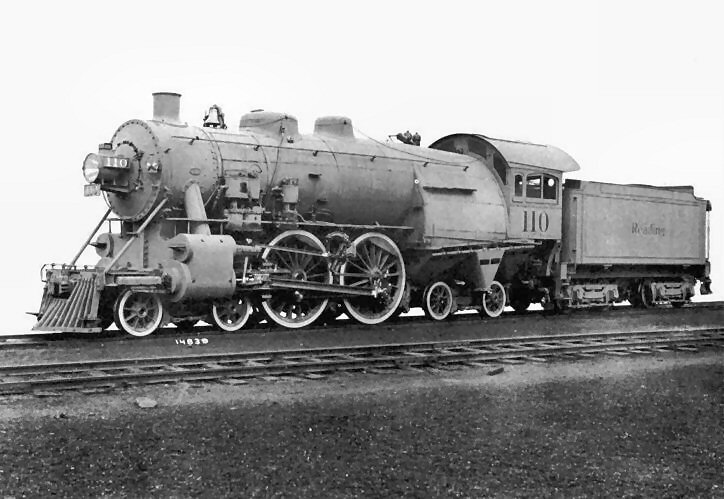
The Philadelphia and Reading Railway built four C1a Class locomotives in 1915, numbered 110 to 113. They proved to be quite unstable; after that year, they were rebuilt to 4-4-2 "Atlantic" locomotives, classified as P7sa, and renumbered 350 to 353.
In 1934 the Baltimore and Ohio Railroad built a single class J-1 4-4-4 out of a 4-4-2 from the early 1900s, named Lady Baltimore. This locomotive and the lone V-2 4-6-4 Lord Baltimore were built for new lightweight passenger trains, in the former's case the Abraham Lincoln on the Chicago and Alton Railroad, a wholly owned subsidiary of the B&O. Despite the Alton's flat territory and straight track, the locomotive performed poorly. It was returned to the B&O and was modified at the railroad's Mount Clare shops with a less streamlined cab and front end. It was then placed into local service on the railroad's Wheeling Division, mostly operating between Holloway and Cleveland, Ohio. It proved no more successful than before and was sent to the B&O's Riverside Shop for storage, being scrapped in 1949.
The Canadian Pacific Railway built two Royal Jubilee F classes locomotives, totaling 25 in all. They were built by the Montreal Locomotive Works and the Canadian Locomotive Company in 1936 and 1937. Both were semi-streamlined similarly to the 4-6-4 "Royal Hudson" and 2-10-4 "Selkirk" locomotives but much smaller. The F2a was styled after the Milwaukee Road's 4-4-2 Class A "Hiawatha", but with a four-wheel trailing truck to support a longer firebox.
The Canadian Pacific Class F2a had 5 locomotives, Nos. 3000-3004. The most noticeable difference from the F1a is their main rods being connected to the lead driving axle. There were some problems with this, as they tended to bend the main rods when reversing. The pilot was smoothly rounded and streamlined with two stainless-steel bands. One of them managed to reach 112.5 mph (181.1 km/h) during a braking test, a record for Canadian steam. All of this group were scrapped.
The Canadian Pacific Class F1a had 20 locomotives, Nos. 2910-2929. Their main rods were connected to the rear drivers, and a more conventional pilot and straight pilot beam, a drop-coupler sheet steel pilot below that, and a more conventional front deck. Two of the class, Nos. 2928 and 2929, are preserved. No. 2928 is at the Canadian Railway Museum in Delson, Quebec, while No. 2929 is at Steamtown National Historic Site in Scranton, Pennsylvania.
Hub AI
4-4-4 AI simulator
(@4-4-4_simulator)
4-4-4
Under the Whyte notation for the classification of steam locomotives, The 4-4-4 Reading or Jubilee Type represents the wheel arrangement of four leading wheels on two axles, four powered and coupled driving wheels on two axles, and four trailing wheels on two axles. In the United States, this arrangement was named the Reading type, since the Philadelphia and Reading Railroad was the first to use it. In Canada, this type is known as the Jubilee.
Other equivalent classifications are:
A single, experimental 4-4-4, classified as S 2/6, was built for the Royal Bavarian State Railways in 1906 by Maffei. It was successful in an experimental sense, but was too light to haul passenger trains of useful capacity. It was fast, attaining 154 km/h (96 mph) on test, and was semi-streamlined with a pointed nosecone and fairings around the cylinders, stack and dome, and slanted-back cab windows. It inspired the later Bavarian S 3/6 4-6-2 "Pacifics". It passed to the Deutsche Reichseisenbahnen when the German railways were centralised, and was classified as BR 15, number 15 001. It was taken out of service in 1925, and was restored by Maffei to be exhibited at the Munich Transport Exhibition of that year. After the exhibition ended, it was placed in the Nuremberg Transport Museum, where it remains.
The Philadelphia and Reading Railway built four C1a Class locomotives in 1915, numbered 110 to 113. They proved to be quite unstable; after that year, they were rebuilt to 4-4-2 "Atlantic" locomotives, classified as P7sa, and renumbered 350 to 353.
In 1934 the Baltimore and Ohio Railroad built a single class J-1 4-4-4 out of a 4-4-2 from the early 1900s, named Lady Baltimore. This locomotive and the lone V-2 4-6-4 Lord Baltimore were built for new lightweight passenger trains, in the former's case the Abraham Lincoln on the Chicago and Alton Railroad, a wholly owned subsidiary of the B&O. Despite the Alton's flat territory and straight track, the locomotive performed poorly. It was returned to the B&O and was modified at the railroad's Mount Clare shops with a less streamlined cab and front end. It was then placed into local service on the railroad's Wheeling Division, mostly operating between Holloway and Cleveland, Ohio. It proved no more successful than before and was sent to the B&O's Riverside Shop for storage, being scrapped in 1949.
The Canadian Pacific Railway built two Royal Jubilee F classes locomotives, totaling 25 in all. They were built by the Montreal Locomotive Works and the Canadian Locomotive Company in 1936 and 1937. Both were semi-streamlined similarly to the 4-6-4 "Royal Hudson" and 2-10-4 "Selkirk" locomotives but much smaller. The F2a was styled after the Milwaukee Road's 4-4-2 Class A "Hiawatha", but with a four-wheel trailing truck to support a longer firebox.
The Canadian Pacific Class F2a had 5 locomotives, Nos. 3000-3004. The most noticeable difference from the F1a is their main rods being connected to the lead driving axle. There were some problems with this, as they tended to bend the main rods when reversing. The pilot was smoothly rounded and streamlined with two stainless-steel bands. One of them managed to reach 112.5 mph (181.1 km/h) during a braking test, a record for Canadian steam. All of this group were scrapped.
The Canadian Pacific Class F1a had 20 locomotives, Nos. 2910-2929. Their main rods were connected to the rear drivers, and a more conventional pilot and straight pilot beam, a drop-coupler sheet steel pilot below that, and a more conventional front deck. Two of the class, Nos. 2928 and 2929, are preserved. No. 2928 is at the Canadian Railway Museum in Delson, Quebec, while No. 2929 is at Steamtown National Historic Site in Scranton, Pennsylvania.
Recent media