


Community hub
Recent from talks
Contribute something to knowledge base
Content stats: 0 posts, 0 articles, 1 media, 0 notes
Members stats: 0 subscribers, 0 contributors, 0 moderators, 0 supporters
Subscribers
Supporters
Contributors
Moderators
Hub AI
503rd Infantry Regiment (United States) AI simulator
(@503rd Infantry Regiment (United States)_simulator)
Hub AI
503rd Infantry Regiment (United States) AI simulator
(@503rd Infantry Regiment (United States)_simulator)
503rd Infantry Regiment (United States)
The 503rd Infantry Regiment, formerly the 503rd Parachute Infantry Regiment (503rd PIR) and the 503rd Airborne Infantry Regiment (503rd AIR), is an airborne infantry regiment of the United States Army. The regiment served as an independent regiment in the Pacific War during World War II; at Fort Campbell, Kentucky; in Okinawa, Japan; and in Germany. Regimental elements have been assigned to the 2nd Infantry Division, the 11th Airborne Division, the 24th Infantry Division, the 25th Infantry Division, the 82nd Airborne Division, the 101st Airborne Division, and the 173rd Airborne Brigade Combat Team. Regimental elements have participated in campaigns in the Vietnam War, Operation Enduring Freedom–Afghanistan, and Operation Iraqi Freedom. The regiment claims 15 Medal of Honor recipients: two from World War II, ten from Vietnam, and three from Afghanistan. A parent regiment under the U.S. Army Regimental System. The regiment's 1st and 2nd Battalions are active, assigned to the 173rd Airborne Brigade, based at Caserma Ederle, Vicenza, Italy. The 3rd and 4th Battalions as well as Companies E, F, G, H, and I have been inactived.
On 14 February 1942, just two months after the American entry into World War II, the 503rd Parachute Infantry Regiment was formed, under the command of Lieutenant Colonel William M. "Bud" Miley. The regiment's 1st and 2nd Battalions were formed at Fort Benning, Georgia, from the 503rd and 504th Parachute Battalions, respectively. In May 1942, the 503rd's 2nd Battalion was detached and sailed to Scotland, where it trained and would later take part in the Allied invasion of German-occupied North Africa in November 1942. This unit was later redesignated the 2nd Battalion, 509th Parachute Infantry. It would ultimately be the only battalion in its regiment, that existed in name only with no active regimental headquarters, and would later be redesignated the 509th Parachute Infantry Battalion in 1944.
The 3rd Battalion, 503rd Parachute Infantry was activated on 8 June 1942 at Fort Bragg, North Carolina, formed by elements of the 502nd Parachute Infantry; the Headquarters and Headquarters Company, 1st Battalion, 502nd, became Headquarters and Headquarters Company, 3rd Battalion, 503rd; Company A became Company G; Company B became Company H, and Company C became Company I. The regiment departed the United States in mid-October 1942 for Australia augmented by Company A, 504th Parachute Infantry, which had personally been selected by Major General Matthew Ridgway, the commander of the 82nd Airborne Division, as his best rifle company. Docking in the Panama Canal Zone on 1 November, the 503rd picked up the 501st Parachute Infantry Battalion (minus Company C), which had been undergoing jungle training. The 501st, as well as Company A, 504th, was redesignated as the 503rd's 2nd Battalion: Company A, 501st became Company E, 503rd; Company B, 501st became Company F, 503rd; and Company A, 504th became Company D, 503rd. In late 1942 and early 1943, there was confusion about unit designations in the 503rd, as some officers interpreted the 503rd was operating with two 2nd Battalions, one in Australia and one in Great Britain/North Africa. Unlike many other airborne units, which were deployed in the European Theater of Operations (ETO), the 503rd was the first airborne regiment to fight in the Pacific, and as an independent unit.
On 2 November 1942, the former 501st Parachute Battalion was inactivated on paper so that a new regiment (the 501st Parachute Infantry Regiment) with a lineal connection to its parent parachute battalion could be activated at Fort Benning.
The 503rd's first operation was an unopposed landing at Nadzab, in the Markham Valley, New Guinea, on 5 September 1943. Although the landings were unopposed, the troops were later attacked by enemy bombers from the air. The 503rd's deployment helped force the Japanese evacuation of a major military outpost at Lae. During their overland withdrawal, the third battalion of the 503rd had a major skirmish with the Japanese rear guard.
On 3–4 July 1944, 1st and 3rd Battalions of the 503rd were delivered by parachute to Kamiri Airfield on the island of Noemfoor off the coast of Dutch New Guinea, sustaining significant casualties from the jump. To reduce further casualties, the 2nd Battalion was delivered amphibiously. At the Battle of Noemfoor, the 503rd played a major role in the elimination of the Japanese garrison on that island. As a result of his heroic actions during the battle, paratrooper Sergeant Ray E. Eubanks was posthumously awarded the Medal of Honor. Airfields constructed on Noemfoor after its capture enabled the advance of Allied troops from New Guinea to the Philippines.
Following a non-combat landing on the island of Leyte in the Philippines, the 503rd Regimental Combat Team (RCT) made a major amphibious landing on Mindoro Island in the central Philippines on 15 December 1944. Originally, it was intended for the 503rd to jump on Mindoro, but due to inadequate airstrip facilities on Leyte, an airborne landing was not possible. During the Battle of Mindoro, the 503rd was subjected to intense air and naval actions, at one point being shelled for 25 minutes by a Japanese naval task force. One company of the 503rd RCT engaged in a fierce battle against a company-size Japanese force defending an enemy air raid warning station on the north end of the island. The success of the Mindoro operation enabled the United States Army Air Forces to construct and operate air strips and forward air bases to support later landings in the Philippines at Lingayen Gulf, Luzon. During combat in the Philippines, Lieutenant Colonel Joe S. Lawrie, former regimental S-3 and executive officer, and former 1st Battalion commander, succeeded to regimental command.
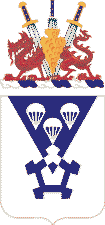
On 16 February 1945, the 503rd RCT jumped on Fortress Corregidor ("the Rock") to liberate that island from occupying Japanese forces. Braving intense fire, the paratroopers rushed forward and overcame the heavy blockhouse defenses, dropping explosives into embrasures to kill hidden Japanese gunners. For its successful capture of Corregidor, the unit was awarded a Presidential Unit Citation and received its nickname, "the Rock Regiment" from it. The regimental insignia was designed by Private First Class Thomas M. McNeill while recuperating from his injuries and dengue fever, hepatitis, and malaria on Mindoro Island, following the battle of Corregidor.
503rd Infantry Regiment (United States)
The 503rd Infantry Regiment, formerly the 503rd Parachute Infantry Regiment (503rd PIR) and the 503rd Airborne Infantry Regiment (503rd AIR), is an airborne infantry regiment of the United States Army. The regiment served as an independent regiment in the Pacific War during World War II; at Fort Campbell, Kentucky; in Okinawa, Japan; and in Germany. Regimental elements have been assigned to the 2nd Infantry Division, the 11th Airborne Division, the 24th Infantry Division, the 25th Infantry Division, the 82nd Airborne Division, the 101st Airborne Division, and the 173rd Airborne Brigade Combat Team. Regimental elements have participated in campaigns in the Vietnam War, Operation Enduring Freedom–Afghanistan, and Operation Iraqi Freedom. The regiment claims 15 Medal of Honor recipients: two from World War II, ten from Vietnam, and three from Afghanistan. A parent regiment under the U.S. Army Regimental System. The regiment's 1st and 2nd Battalions are active, assigned to the 173rd Airborne Brigade, based at Caserma Ederle, Vicenza, Italy. The 3rd and 4th Battalions as well as Companies E, F, G, H, and I have been inactived.
On 14 February 1942, just two months after the American entry into World War II, the 503rd Parachute Infantry Regiment was formed, under the command of Lieutenant Colonel William M. "Bud" Miley. The regiment's 1st and 2nd Battalions were formed at Fort Benning, Georgia, from the 503rd and 504th Parachute Battalions, respectively. In May 1942, the 503rd's 2nd Battalion was detached and sailed to Scotland, where it trained and would later take part in the Allied invasion of German-occupied North Africa in November 1942. This unit was later redesignated the 2nd Battalion, 509th Parachute Infantry. It would ultimately be the only battalion in its regiment, that existed in name only with no active regimental headquarters, and would later be redesignated the 509th Parachute Infantry Battalion in 1944.
The 3rd Battalion, 503rd Parachute Infantry was activated on 8 June 1942 at Fort Bragg, North Carolina, formed by elements of the 502nd Parachute Infantry; the Headquarters and Headquarters Company, 1st Battalion, 502nd, became Headquarters and Headquarters Company, 3rd Battalion, 503rd; Company A became Company G; Company B became Company H, and Company C became Company I. The regiment departed the United States in mid-October 1942 for Australia augmented by Company A, 504th Parachute Infantry, which had personally been selected by Major General Matthew Ridgway, the commander of the 82nd Airborne Division, as his best rifle company. Docking in the Panama Canal Zone on 1 November, the 503rd picked up the 501st Parachute Infantry Battalion (minus Company C), which had been undergoing jungle training. The 501st, as well as Company A, 504th, was redesignated as the 503rd's 2nd Battalion: Company A, 501st became Company E, 503rd; Company B, 501st became Company F, 503rd; and Company A, 504th became Company D, 503rd. In late 1942 and early 1943, there was confusion about unit designations in the 503rd, as some officers interpreted the 503rd was operating with two 2nd Battalions, one in Australia and one in Great Britain/North Africa. Unlike many other airborne units, which were deployed in the European Theater of Operations (ETO), the 503rd was the first airborne regiment to fight in the Pacific, and as an independent unit.
On 2 November 1942, the former 501st Parachute Battalion was inactivated on paper so that a new regiment (the 501st Parachute Infantry Regiment) with a lineal connection to its parent parachute battalion could be activated at Fort Benning.
The 503rd's first operation was an unopposed landing at Nadzab, in the Markham Valley, New Guinea, on 5 September 1943. Although the landings were unopposed, the troops were later attacked by enemy bombers from the air. The 503rd's deployment helped force the Japanese evacuation of a major military outpost at Lae. During their overland withdrawal, the third battalion of the 503rd had a major skirmish with the Japanese rear guard.
On 3–4 July 1944, 1st and 3rd Battalions of the 503rd were delivered by parachute to Kamiri Airfield on the island of Noemfoor off the coast of Dutch New Guinea, sustaining significant casualties from the jump. To reduce further casualties, the 2nd Battalion was delivered amphibiously. At the Battle of Noemfoor, the 503rd played a major role in the elimination of the Japanese garrison on that island. As a result of his heroic actions during the battle, paratrooper Sergeant Ray E. Eubanks was posthumously awarded the Medal of Honor. Airfields constructed on Noemfoor after its capture enabled the advance of Allied troops from New Guinea to the Philippines.
Following a non-combat landing on the island of Leyte in the Philippines, the 503rd Regimental Combat Team (RCT) made a major amphibious landing on Mindoro Island in the central Philippines on 15 December 1944. Originally, it was intended for the 503rd to jump on Mindoro, but due to inadequate airstrip facilities on Leyte, an airborne landing was not possible. During the Battle of Mindoro, the 503rd was subjected to intense air and naval actions, at one point being shelled for 25 minutes by a Japanese naval task force. One company of the 503rd RCT engaged in a fierce battle against a company-size Japanese force defending an enemy air raid warning station on the north end of the island. The success of the Mindoro operation enabled the United States Army Air Forces to construct and operate air strips and forward air bases to support later landings in the Philippines at Lingayen Gulf, Luzon. During combat in the Philippines, Lieutenant Colonel Joe S. Lawrie, former regimental S-3 and executive officer, and former 1st Battalion commander, succeeded to regimental command.
On 16 February 1945, the 503rd RCT jumped on Fortress Corregidor ("the Rock") to liberate that island from occupying Japanese forces. Braving intense fire, the paratroopers rushed forward and overcame the heavy blockhouse defenses, dropping explosives into embrasures to kill hidden Japanese gunners. For its successful capture of Corregidor, the unit was awarded a Presidential Unit Citation and received its nickname, "the Rock Regiment" from it. The regimental insignia was designed by Private First Class Thomas M. McNeill while recuperating from his injuries and dengue fever, hepatitis, and malaria on Mindoro Island, following the battle of Corregidor.
Recent media
Recent media