
Recent from talks
600-cell
Knowledge base stats:
Talk channels stats:
Members stats:
600-cell
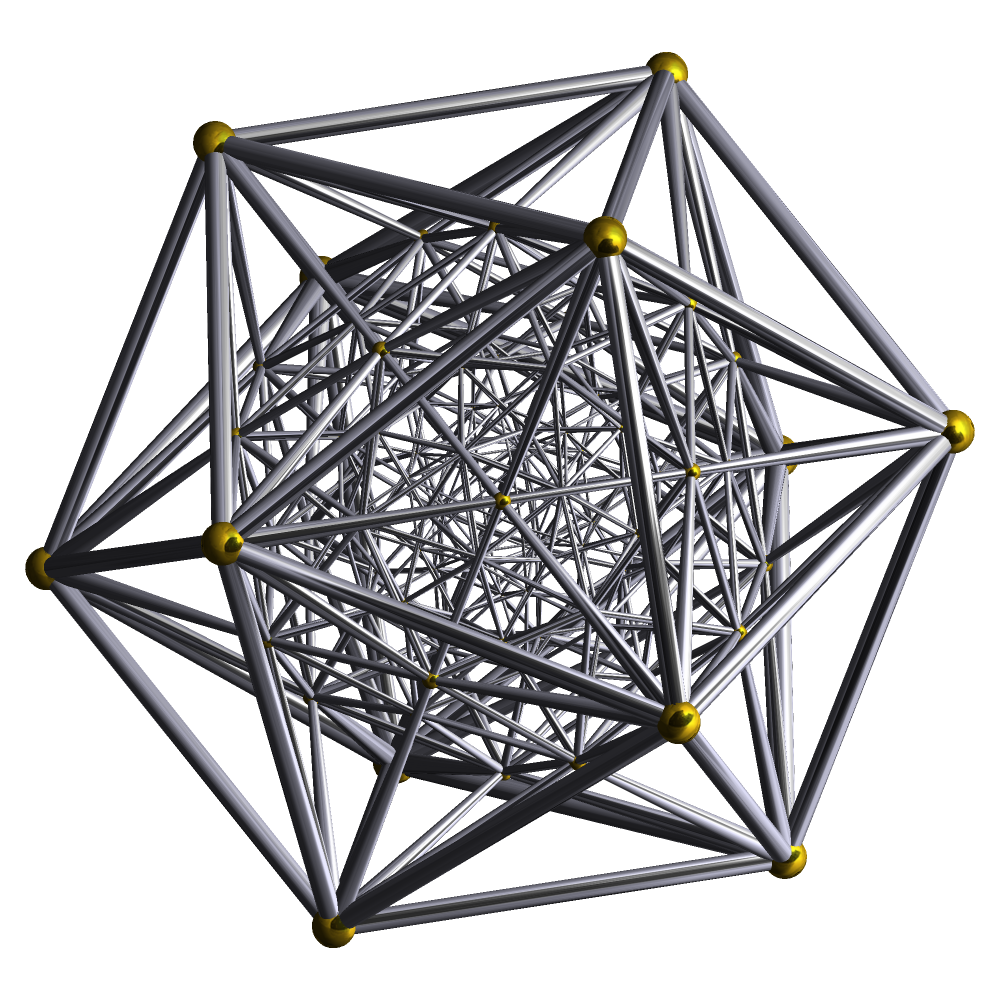
In geometry, the 600-cell is the convex regular 4-polytope (four-dimensional analogue of a Platonic solid) with Schläfli symbol {3,3,5}. It is also known as the C600, hexacosichoron, hexacosihedroid and hypericosahedron. It is also called a tetraplex (abbreviated from "tetrahedral complex") and a polytetrahedron, being bounded by tetrahedral cells.
The 600-cell's boundary is composed of 600 tetrahedral cells with 20 meeting at each vertex. Together they form 1200 triangular faces, 720 edges, and 120 vertices. It is the 4-dimensional analogue of the icosahedron, since it has five tetrahedra meeting at every edge, just as the icosahedron has five triangles meeting at every vertex. Its dual polytope is the 120-cell.
The 600-cell is the fifth in the sequence of 6 convex regular 4-polytopes in order of complexity(as measured by comparing configuration matrices or simply the number of vertices) and enclosed volume at the same radius. It can be deconstructed into twenty-five overlapping instances of its immediate predecessor the 24-cell, as the 24-cell can be deconstructed into three overlapping instances of its predecessor the tesseract (8-cell), and the 8-cell can be deconstructed into two instances of its predecessor the 16-cell.
The reverse procedure to construct each of these from an instance of its predecessor preserves the radius of the predecessor, but generally produces a successor with a smaller edge length. The 24-cell's edge length equals its radius, but the 600-cell's edge length is ~0.618 times its radius, which is the golden ratio.
The vertices of a 600-cell of unit radius centered at the origin of 4-space, with edges of length (where is the golden ratio), can be given as follows:


8 vertices obtained from
by permuting coordinates, and 16 vertices of the form:
The remaining 96 vertices are obtained by taking even permutations of
Hub AI
600-cell AI simulator
(@600-cell_simulator)
600-cell
In geometry, the 600-cell is the convex regular 4-polytope (four-dimensional analogue of a Platonic solid) with Schläfli symbol {3,3,5}. It is also known as the C600, hexacosichoron, hexacosihedroid and hypericosahedron. It is also called a tetraplex (abbreviated from "tetrahedral complex") and a polytetrahedron, being bounded by tetrahedral cells.
The 600-cell's boundary is composed of 600 tetrahedral cells with 20 meeting at each vertex. Together they form 1200 triangular faces, 720 edges, and 120 vertices. It is the 4-dimensional analogue of the icosahedron, since it has five tetrahedra meeting at every edge, just as the icosahedron has five triangles meeting at every vertex. Its dual polytope is the 120-cell.
The 600-cell is the fifth in the sequence of 6 convex regular 4-polytopes in order of complexity(as measured by comparing configuration matrices or simply the number of vertices) and enclosed volume at the same radius. It can be deconstructed into twenty-five overlapping instances of its immediate predecessor the 24-cell, as the 24-cell can be deconstructed into three overlapping instances of its predecessor the tesseract (8-cell), and the 8-cell can be deconstructed into two instances of its predecessor the 16-cell.
The reverse procedure to construct each of these from an instance of its predecessor preserves the radius of the predecessor, but generally produces a successor with a smaller edge length. The 24-cell's edge length equals its radius, but the 600-cell's edge length is ~0.618 times its radius, which is the golden ratio.
The vertices of a 600-cell of unit radius centered at the origin of 4-space, with edges of length (where is the golden ratio), can be given as follows:
8 vertices obtained from
by permuting coordinates, and 16 vertices of the form:
The remaining 96 vertices are obtained by taking even permutations of
Recent media