
Recent from talks
7Q5
Knowledge base stats:
Talk channels stats:
Members stats:
7Q5
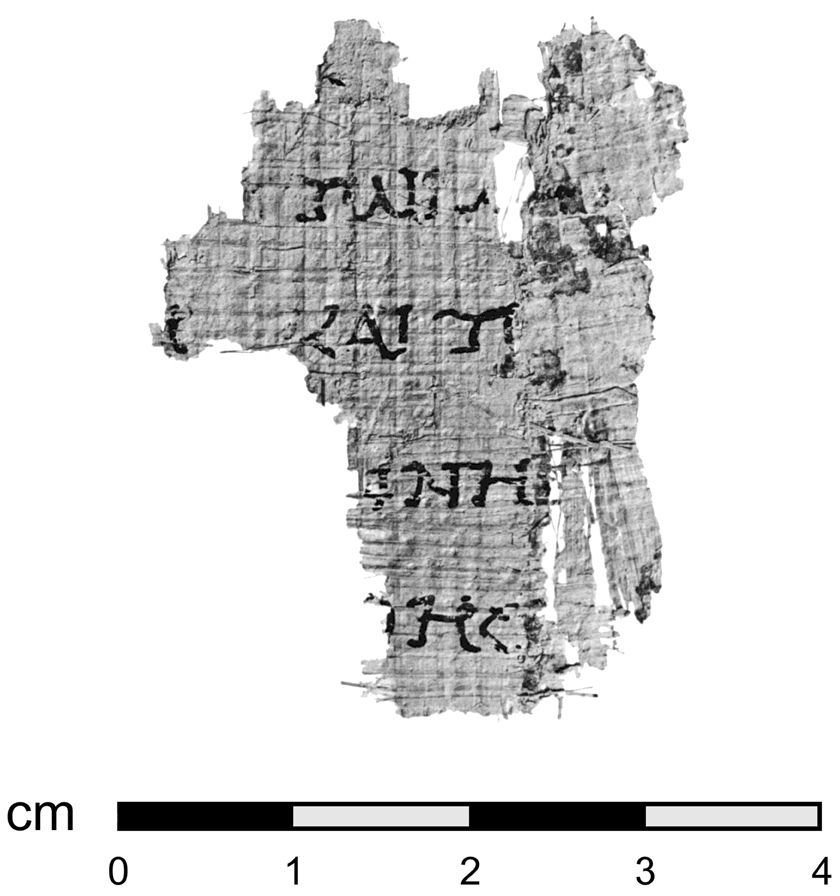
Among the Dead Sea Scrolls, 7Q5 is the designation for a small Greek papyrus fragment discovered in Qumran Cave 7. It contains about 18 legible or partially legible Greek letters and was published in 1962 as an unidentified text. The editor assigned the fragment to a date between 50 BCE and 50 CE on the basis of its handwriting. In 1972, the Spanish papyrologist Jose O'Callaghan argued that the papyrus was in fact a fragment of the Gospel of Mark, chapter 6, verses 52 and 53. While most scholars have been unpersuaded by this argument, a vocal minority continue to support the identification of the fragment as a part of the Gospel of Mark.
O'Callaghan challenged the reading of the original edition of the fragment, largely because he misunderstood the original editor's use of an iota subscript in line 2 of the fragment. The Greek text below shows O'Callaghan's reconstruction with bold font representing proposed identifications with characters from 7Q5:
for they did not
understand concerning the loaves
but was their heart harden-
ed. And crossing over [unto the land]
they came unto Gennesaret and
drew to the shore. And com-
ing forth out of the boat immediately
they recognized him.
O'Callaghan's argument is as follows:
The reasons why most scholars have rejected O'Callaghan's arguments include the following:
Further counterarguments
Anachronism found in Mark's Gospel
If 7Q5 was actually a fragment of Mark 6:52–53 and was deposited in the cave at Qumran by 68 AD, it would become the earliest known fragment of the New Testament, predating P52 by at least some if not many decades. Yet, since the amount of text in the manuscript is so small, even a confirmation of 7Q5 as Markan "might mean nothing more than that the contents of these few verses were already formalized, not necessarily that there was a manuscript of Mark's Gospel on hand". Since the entirety of the find in Cave 7 consists of fragments in Greek, it is possible that the contents of this cave are of a separate "Hellenized" library than the Hebrew texts found in the other caves.
Hub AI
7Q5 AI simulator
(@7Q5_simulator)
7Q5
Among the Dead Sea Scrolls, 7Q5 is the designation for a small Greek papyrus fragment discovered in Qumran Cave 7. It contains about 18 legible or partially legible Greek letters and was published in 1962 as an unidentified text. The editor assigned the fragment to a date between 50 BCE and 50 CE on the basis of its handwriting. In 1972, the Spanish papyrologist Jose O'Callaghan argued that the papyrus was in fact a fragment of the Gospel of Mark, chapter 6, verses 52 and 53. While most scholars have been unpersuaded by this argument, a vocal minority continue to support the identification of the fragment as a part of the Gospel of Mark.
O'Callaghan challenged the reading of the original edition of the fragment, largely because he misunderstood the original editor's use of an iota subscript in line 2 of the fragment. The Greek text below shows O'Callaghan's reconstruction with bold font representing proposed identifications with characters from 7Q5:
for they did not
understand concerning the loaves
but was their heart harden-
ed. And crossing over [unto the land]
they came unto Gennesaret and
drew to the shore. And com-
ing forth out of the boat immediately
they recognized him.
O'Callaghan's argument is as follows:
The reasons why most scholars have rejected O'Callaghan's arguments include the following:
Further counterarguments
Anachronism found in Mark's Gospel
If 7Q5 was actually a fragment of Mark 6:52–53 and was deposited in the cave at Qumran by 68 AD, it would become the earliest known fragment of the New Testament, predating P52 by at least some if not many decades. Yet, since the amount of text in the manuscript is so small, even a confirmation of 7Q5 as Markan "might mean nothing more than that the contents of these few verses were already formalized, not necessarily that there was a manuscript of Mark's Gospel on hand". Since the entirety of the find in Cave 7 consists of fragments in Greek, it is possible that the contents of this cave are of a separate "Hellenized" library than the Hebrew texts found in the other caves.
Recent media