
Recent from talks
8.8 cm Pak 43
Knowledge base stats:
Talk channels stats:
Members stats:
8.8 cm Pak 43
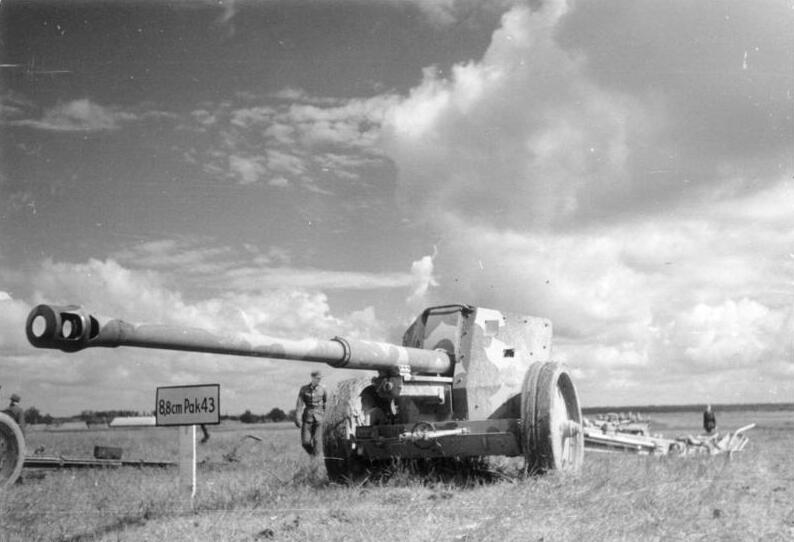
The Pak 43 (Panzerabwehrkanone 43 and Panzerjägerkanone 43) was a German 8.8 cm anti-tank gun developed by Krupp in competition with the Rheinmetall 8.8 cm Flak 41 anti-aircraft gun and used during World War II. The Pak 43 was the most powerful anti-tank gun of the Wehrmacht to see service in significant numbers, also serving in modified form as the 8.8 cm KwK 43 main gun on the Tiger II tank, the open-top Nashorn and fully enclosed, casemate-hulled Elefant and Jagdpanther tank destroyers.
The improved 8.8 cm gun was fitted with a semi-automatic vertical breech mechanism that greatly reduced recoil. It could also be fired electrically while on its wheels. It had a very flat trajectory out to 910 m (1,000 yd), making it easier for the gunner to hit targets at longer ranges as fewer corrections in elevation were needed. The gun had exceptional penetration and could defeat the frontal armour of any Allied tank to see service during the war at long range, even the Soviet IS-2 tanks and IS chassis-based tank destroyers. The gun's maximum firing range exceeded 15 km (9.3 mi).
KwK 43 and Pak 43s were initially manufactured with monobloc barrels but the extremely high muzzle velocity and operating pressures caused rapid barrel wear, resulting in a change to a two-piece barrel. This did not affect performance but made replacing a worn out barrel much faster and easier than before. A new PzGr.39/43 APCBC-HE projectile was designed, which, apart from the addition of much wider driving bands, was identical to the older 10.2 kg (22 lb) PzGr.39-1 APCBC-HE projectile used by the 8.8 cm KwK 36 and Pak 43 guns. The wider driving bands resulted in an increased weight to 10.4 kg (23 lb) for the PzGr.39/43. The older PzGr.39-1 was used for the KwK & Pak 43 before new PzGr.39/43 rounds came into use but only if the gun had fired no more than 500 rounds. Over this, the expected barrel wear combined with the narrow driving bands could lead to a loss of pressure. The new PzGr.39/43 could be fired without loss of pressure until the barrel was worn out, thus requiring no restriction.
PzGr.39-1 FES & Al all up weight: 10.2 kg (9.87 kg without fuse & bursting charge)
PzGr.39/43 FES & Al all up weight: 10.4 kg (10.06 kg without fuse & bursting charge)
The same 278-gram BdZ 5127 fuse and 59-gram Amatol bursting charge was used for PzGr.39-1 and PzGr.39/43 rounds, requiring armoured targets of 30 mm or thicker to ignite after penetration for maximum effect.
The main version of the Pak 43 was based on a highly effective cruciform mount, which offered a full 360 degree traverse and a much lower profile than the ubiquitous anti-aircraft 8.8 cm Flak 37. However the manufacture of this version was initially slow and costly, a situation that was made worse by the destruction of the carriage production line by Allied bombing.
As part of the design effort from Krupp to compete with the Flak 41, a barrel had been produced to prove the ballistics and design. This barrel design was developed, via an intermediate design known as the Gerät 42, to become the barrel used with Pak 43/41 design. When the Pak 43 was delayed, Krupp was asked to produce a weapon using this barrel using as many existing components as possible. This previous barrel design was then designated the Pak 41.
Hub AI
8.8 cm Pak 43 AI simulator
(@8.8 cm Pak 43_simulator)
8.8 cm Pak 43
The Pak 43 (Panzerabwehrkanone 43 and Panzerjägerkanone 43) was a German 8.8 cm anti-tank gun developed by Krupp in competition with the Rheinmetall 8.8 cm Flak 41 anti-aircraft gun and used during World War II. The Pak 43 was the most powerful anti-tank gun of the Wehrmacht to see service in significant numbers, also serving in modified form as the 8.8 cm KwK 43 main gun on the Tiger II tank, the open-top Nashorn and fully enclosed, casemate-hulled Elefant and Jagdpanther tank destroyers.
The improved 8.8 cm gun was fitted with a semi-automatic vertical breech mechanism that greatly reduced recoil. It could also be fired electrically while on its wheels. It had a very flat trajectory out to 910 m (1,000 yd), making it easier for the gunner to hit targets at longer ranges as fewer corrections in elevation were needed. The gun had exceptional penetration and could defeat the frontal armour of any Allied tank to see service during the war at long range, even the Soviet IS-2 tanks and IS chassis-based tank destroyers. The gun's maximum firing range exceeded 15 km (9.3 mi).
KwK 43 and Pak 43s were initially manufactured with monobloc barrels but the extremely high muzzle velocity and operating pressures caused rapid barrel wear, resulting in a change to a two-piece barrel. This did not affect performance but made replacing a worn out barrel much faster and easier than before. A new PzGr.39/43 APCBC-HE projectile was designed, which, apart from the addition of much wider driving bands, was identical to the older 10.2 kg (22 lb) PzGr.39-1 APCBC-HE projectile used by the 8.8 cm KwK 36 and Pak 43 guns. The wider driving bands resulted in an increased weight to 10.4 kg (23 lb) for the PzGr.39/43. The older PzGr.39-1 was used for the KwK & Pak 43 before new PzGr.39/43 rounds came into use but only if the gun had fired no more than 500 rounds. Over this, the expected barrel wear combined with the narrow driving bands could lead to a loss of pressure. The new PzGr.39/43 could be fired without loss of pressure until the barrel was worn out, thus requiring no restriction.
PzGr.39-1 FES & Al all up weight: 10.2 kg (9.87 kg without fuse & bursting charge)
PzGr.39/43 FES & Al all up weight: 10.4 kg (10.06 kg without fuse & bursting charge)
The same 278-gram BdZ 5127 fuse and 59-gram Amatol bursting charge was used for PzGr.39-1 and PzGr.39/43 rounds, requiring armoured targets of 30 mm or thicker to ignite after penetration for maximum effect.
The main version of the Pak 43 was based on a highly effective cruciform mount, which offered a full 360 degree traverse and a much lower profile than the ubiquitous anti-aircraft 8.8 cm Flak 37. However the manufacture of this version was initially slow and costly, a situation that was made worse by the destruction of the carriage production line by Allied bombing.
As part of the design effort from Krupp to compete with the Flak 41, a barrel had been produced to prove the ballistics and design. This barrel design was developed, via an intermediate design known as the Gerät 42, to become the barrel used with Pak 43/41 design. When the Pak 43 was delayed, Krupp was asked to produce a weapon using this barrel using as many existing components as possible. This previous barrel design was then designated the Pak 41.
Recent media