
Recent from talks
9K32 Strela-2
Knowledge base stats:
Talk channels stats:
Members stats:
9K32 Strela-2
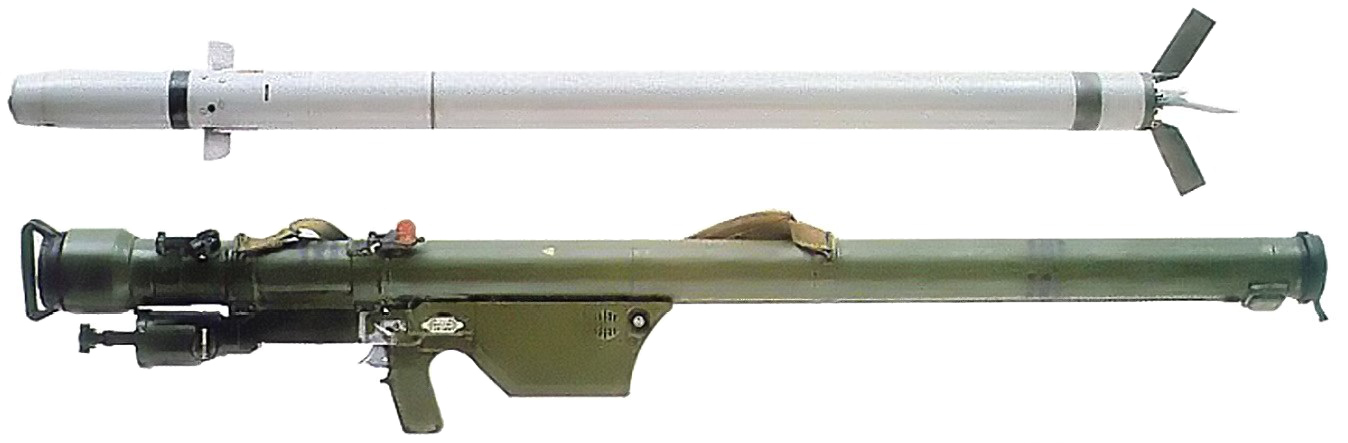
The 9K32 Strela-2 (Russian: Cтрела, lit. 'Arrow'; NATO reporting name SA-7 Grail) is a light-weight, shoulder-launched, surface-to-air missile or MANPADS system. It is designed to target aircraft at low altitudes with passive infrared-homing guidance and destroy them with a high-explosive warhead.
Broadly comparable in performance with the US Army FIM-43 Redeye, the Strela-2 was the first Soviet man-portable SAM – full-scale production began in 1970. While the Redeye and 9K32 Strela-2 were similar, the missiles were not identical.
The Strela-2 was a staple of the Cold War and was produced in huge numbers for the Soviet Union and their allies, as well as revolutionary movements. Though since surpassed by more modern systems, the Strela and its variants remain in service in many countries, and have seen use in nearly every regional conflict since 1972.
The end of World War II led to a major shift in Soviet defence policy. The advent of long range, high altitude, nuclear-armed American bombers, capable of penetrating Soviet airspace at heights and speeds unreachable and unmatchable by anti-aircraft guns and most interceptors, appeared to render every conventional weapon obsolete at a stroke. Numerous long-range, high-altitude SAM systems, such as the S-25 Berkut and S-75 Dvina, were rapidly developed and fielded to counter this large vulnerability. Due to the apparent obsolescence of conventional arms, however, relatively little development took place to field mobile battlefield air defences.
This direction was soon changed with the beginning of the Korean War. An entirely conventional conflict, it proved that nuclear weapons were not the be-all and end-all of warfare. In the face of a powerful and modern American air force, carrying non-nuclear payloads, the Soviet Union invested heavily in a multi-tier air defence system, consisting of several new mobile SAMs, to cover all altitude ranges and protect ground forces. The new doctrine listed five requirements:
Both Strela-1 and Strela-2 were initially intended to be man-portable systems. As the Strela-2 proved to be a considerably smaller and lighter package, however, the role of the Strela-1 was changed, becoming a heavier, vehicle-mounted system with increased range and performance to better support the ZSU-23-4 in the regimental air defense role.
As development began in the Turopov OKB (later changed to Kolomna), detailed information on the design of the US FIM-43 Redeye became available. While it was not a reverse-engineered copy, in many ways the Strela design borrowed heavily from the Redeye, which had started development a few years earlier.[citation needed] Due to the comparatively primitive Soviet technical base, development was protracted, and many problems arose, especially in designing a sufficiently small seeker head and rocket. Eventually, the designers settled for a simpler seeker head than that of the Redeye, allowing the initial version, the 9K32 "Strela-2" (US DoD designation SA-7A, missile round 9M32) to finally enter service in 1968, five years behind schedule. At the time, it was described by one expert as being "the premier Russian export line".
The initial variant suffered from numerous shortcomings: it could only engage targets flying at relatively slow airspeeds and low altitudes and then only from rear hemisphere, it suffered from poor guidance reliability (particularly in the presence of natural or man-made background IR radiation sources), and even when a hit was achieved, it often failed to destroy the target. Poor lethality was an issue especially when used against jet aircraft: the hottest part of the target was the nozzle behind the actual engine, which the missile therefore usually hit; but there its small warhead often failed to cause significant damage to the engine itself.
Hub AI
9K32 Strela-2 AI simulator
(@9K32 Strela-2_simulator)
9K32 Strela-2
The 9K32 Strela-2 (Russian: Cтрела, lit. 'Arrow'; NATO reporting name SA-7 Grail) is a light-weight, shoulder-launched, surface-to-air missile or MANPADS system. It is designed to target aircraft at low altitudes with passive infrared-homing guidance and destroy them with a high-explosive warhead.
Broadly comparable in performance with the US Army FIM-43 Redeye, the Strela-2 was the first Soviet man-portable SAM – full-scale production began in 1970. While the Redeye and 9K32 Strela-2 were similar, the missiles were not identical.
The Strela-2 was a staple of the Cold War and was produced in huge numbers for the Soviet Union and their allies, as well as revolutionary movements. Though since surpassed by more modern systems, the Strela and its variants remain in service in many countries, and have seen use in nearly every regional conflict since 1972.
The end of World War II led to a major shift in Soviet defence policy. The advent of long range, high altitude, nuclear-armed American bombers, capable of penetrating Soviet airspace at heights and speeds unreachable and unmatchable by anti-aircraft guns and most interceptors, appeared to render every conventional weapon obsolete at a stroke. Numerous long-range, high-altitude SAM systems, such as the S-25 Berkut and S-75 Dvina, were rapidly developed and fielded to counter this large vulnerability. Due to the apparent obsolescence of conventional arms, however, relatively little development took place to field mobile battlefield air defences.
This direction was soon changed with the beginning of the Korean War. An entirely conventional conflict, it proved that nuclear weapons were not the be-all and end-all of warfare. In the face of a powerful and modern American air force, carrying non-nuclear payloads, the Soviet Union invested heavily in a multi-tier air defence system, consisting of several new mobile SAMs, to cover all altitude ranges and protect ground forces. The new doctrine listed five requirements:
Both Strela-1 and Strela-2 were initially intended to be man-portable systems. As the Strela-2 proved to be a considerably smaller and lighter package, however, the role of the Strela-1 was changed, becoming a heavier, vehicle-mounted system with increased range and performance to better support the ZSU-23-4 in the regimental air defense role.
As development began in the Turopov OKB (later changed to Kolomna), detailed information on the design of the US FIM-43 Redeye became available. While it was not a reverse-engineered copy, in many ways the Strela design borrowed heavily from the Redeye, which had started development a few years earlier.[citation needed] Due to the comparatively primitive Soviet technical base, development was protracted, and many problems arose, especially in designing a sufficiently small seeker head and rocket. Eventually, the designers settled for a simpler seeker head than that of the Redeye, allowing the initial version, the 9K32 "Strela-2" (US DoD designation SA-7A, missile round 9M32) to finally enter service in 1968, five years behind schedule. At the time, it was described by one expert as being "the premier Russian export line".
The initial variant suffered from numerous shortcomings: it could only engage targets flying at relatively slow airspeeds and low altitudes and then only from rear hemisphere, it suffered from poor guidance reliability (particularly in the presence of natural or man-made background IR radiation sources), and even when a hit was achieved, it often failed to destroy the target. Poor lethality was an issue especially when used against jet aircraft: the hottest part of the target was the nozzle behind the actual engine, which the missile therefore usually hit; but there its small warhead often failed to cause significant damage to the engine itself.
Recent media