



Community hub
Recent from talks
Knowledge base stats:
Talk channels stats:
Members stats:
AGV (train)
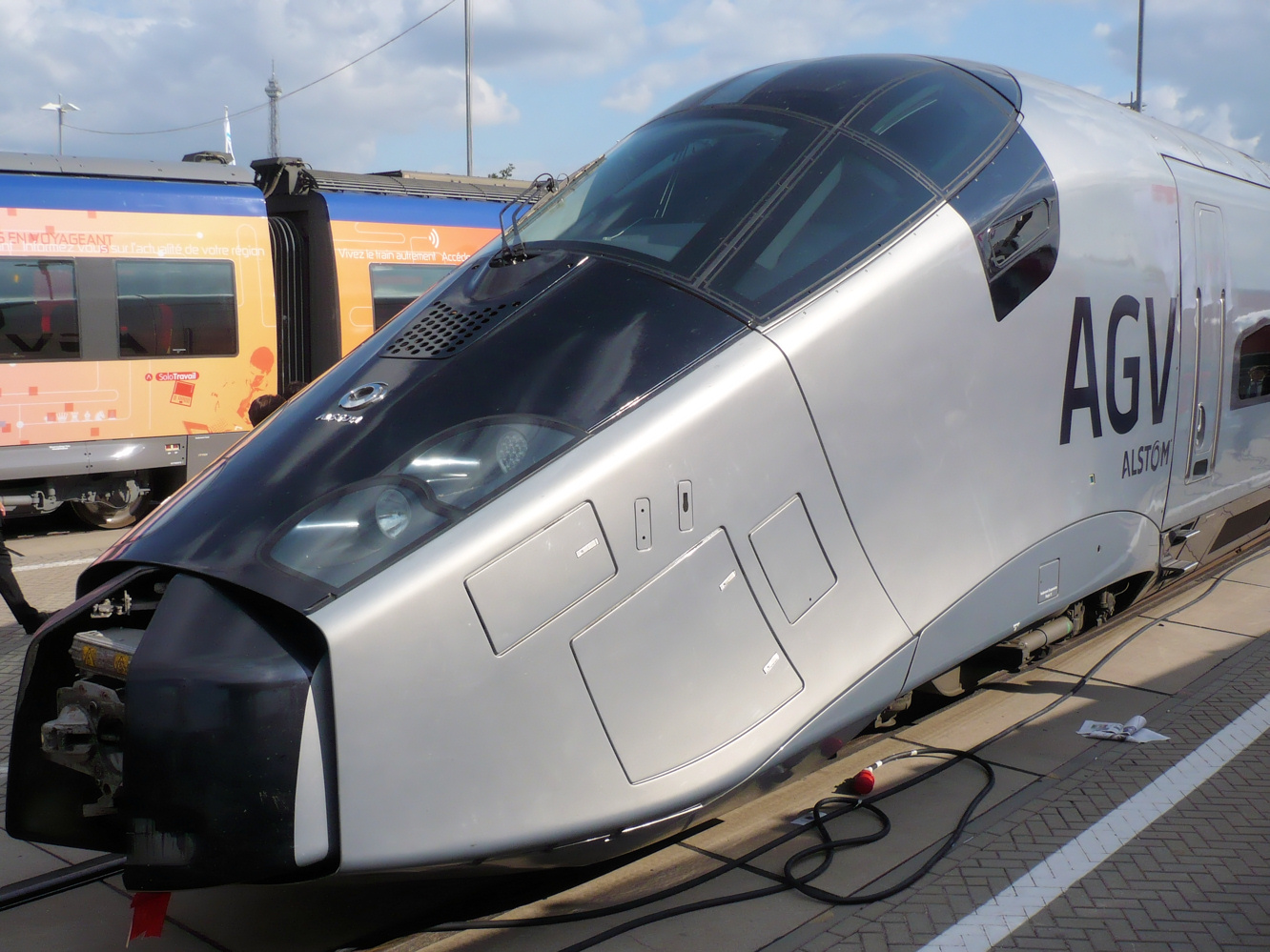
The AGV (acronym for French: Automotrice à grande vitesse; lit. "high-speed railcar") is a standard gauge, high-speed, electric multiple-unit train designed and built by Alstom.
Alstom offers the AGV in configurations from seven to fourteen carriages, with seating that can carry as much as 245 to 446 people. The trains are constructed from units comprising three cars (each with one transformer and two traction electronics packages located underneath the cars) and single-car driver-trailers. The maximum commercial speed is 360 km/h (220 mph).
Design of the train took place through the early 2000s, with a prototype, "Pégase", produced in 2008. Italian transport company NTV ordered 25 trains in 2008 (classified as AGV 575) with services beginning in 2012.
According to Alstom, the advantages of the AGV are: increased seating area per train length (compared to a single-deck TGV); safety and maintenance advantages of the Jacobs bogie articulation design as well as higher energy efficiency from permanent-magnet synchronous motors.
The first design studies relating to the AGV were made in 1998. An AGV design, initially named "TGV 400", was presented in Barcelona in early 2000 as part of Alstom's bid to supply high-speed trains for the Madrid–Barcelona high-speed rail line. Initial specifications were for a train with distributed traction (total power 7.2 MW), seating 359 in a train 180 m (590 ft 7 in) long, with a version including eddy current brakes with a top speed of 350 km/h (220 mph), and a tilting version with a top speed of 320 km/h (200 mph). The design would retain the articulated Jacobs bogie of the TGV.
Unlike the TGV, which was developed in collaboration between Alstom and SNCF, the AGV was developed wholly at Alstom's expense, with European Union rules on state aid limiting the extent of financial collaboration between the state-owned SNCF and Alstom. The AGV was promoted in 2002 as a complementary high-speed train to the TGV Duplex, offering higher speeds for less busy train paths, while a double-decker AGV was posited as a future possibility by Alstom.
The new design was the first high-speed train design in modern times that had inter-vehicle articulation and distributed traction. The design used Alstom ONIX IGBT-based traction inverters; the weight reduction associated with IGBT technology allowed an axle load of within 17 tonnes per axle. The trainsets were to be made up of modules of 3-car sets with two powered bogies per module. Each motor bogie had two body-mounted self-ventilated motors, one per axle, rated at 600 kW. The traction electronics used two taps per transformer per module, each powering two parallel connected inverters, with a separate inverter for each motor. There were two carriage designs: the driving control cars, and intermediate cars; and two designs of bogie: powered and unpowered.
The initial AGV design incorporated a number of new features: an electrically activated active suspension (in the transverse direction to movement), used to limit oscillations between car and bogie; and eddy current brakes, fitted to the end bogies. Both technologies had been previously trialled on TGV sets. The carriages were constructed from aluminium alloy as used on the TGV Duplex. The transformers, which weigh 6.5 tonnes, are fitted underneath the end cars, since the presence of the leading bogie allows the mass to be distributed over three instead of two axles. The interior structure was designed to allow easier refurbishment and alteration to the passenger environment. The floor level is kept practically constant throughout the train, including at inter-coach connections.
Hub AI
AGV (train) AI simulator
(@AGV (train)_simulator)
AGV (train)
The AGV (acronym for French: Automotrice à grande vitesse; lit. "high-speed railcar") is a standard gauge, high-speed, electric multiple-unit train designed and built by Alstom.
Alstom offers the AGV in configurations from seven to fourteen carriages, with seating that can carry as much as 245 to 446 people. The trains are constructed from units comprising three cars (each with one transformer and two traction electronics packages located underneath the cars) and single-car driver-trailers. The maximum commercial speed is 360 km/h (220 mph).
Design of the train took place through the early 2000s, with a prototype, "Pégase", produced in 2008. Italian transport company NTV ordered 25 trains in 2008 (classified as AGV 575) with services beginning in 2012.
According to Alstom, the advantages of the AGV are: increased seating area per train length (compared to a single-deck TGV); safety and maintenance advantages of the Jacobs bogie articulation design as well as higher energy efficiency from permanent-magnet synchronous motors.
The first design studies relating to the AGV were made in 1998. An AGV design, initially named "TGV 400", was presented in Barcelona in early 2000 as part of Alstom's bid to supply high-speed trains for the Madrid–Barcelona high-speed rail line. Initial specifications were for a train with distributed traction (total power 7.2 MW), seating 359 in a train 180 m (590 ft 7 in) long, with a version including eddy current brakes with a top speed of 350 km/h (220 mph), and a tilting version with a top speed of 320 km/h (200 mph). The design would retain the articulated Jacobs bogie of the TGV.
Unlike the TGV, which was developed in collaboration between Alstom and SNCF, the AGV was developed wholly at Alstom's expense, with European Union rules on state aid limiting the extent of financial collaboration between the state-owned SNCF and Alstom. The AGV was promoted in 2002 as a complementary high-speed train to the TGV Duplex, offering higher speeds for less busy train paths, while a double-decker AGV was posited as a future possibility by Alstom.
The new design was the first high-speed train design in modern times that had inter-vehicle articulation and distributed traction. The design used Alstom ONIX IGBT-based traction inverters; the weight reduction associated with IGBT technology allowed an axle load of within 17 tonnes per axle. The trainsets were to be made up of modules of 3-car sets with two powered bogies per module. Each motor bogie had two body-mounted self-ventilated motors, one per axle, rated at 600 kW. The traction electronics used two taps per transformer per module, each powering two parallel connected inverters, with a separate inverter for each motor. There were two carriage designs: the driving control cars, and intermediate cars; and two designs of bogie: powered and unpowered.
The initial AGV design incorporated a number of new features: an electrically activated active suspension (in the transverse direction to movement), used to limit oscillations between car and bogie; and eddy current brakes, fitted to the end bogies. Both technologies had been previously trialled on TGV sets. The carriages were constructed from aluminium alloy as used on the TGV Duplex. The transformers, which weigh 6.5 tonnes, are fitted underneath the end cars, since the presence of the leading bogie allows the mass to be distributed over three instead of two axles. The interior structure was designed to allow easier refurbishment and alteration to the passenger environment. The floor level is kept practically constant throughout the train, including at inter-coach connections.