Hubbry Logo
Insulated-gate bipolar transistorInsulated-gate bipolar transistorMain
Open search
Insulated-gate bipolar transistor
Community hub
Insulated-gate bipolar transistor
logo
8 pages, 0 posts
0 subscribers
Be the first to start a discussion here.
Insulated-gate bipolar transistor
from Wikipedia
Insulated-gate bipolar transistor
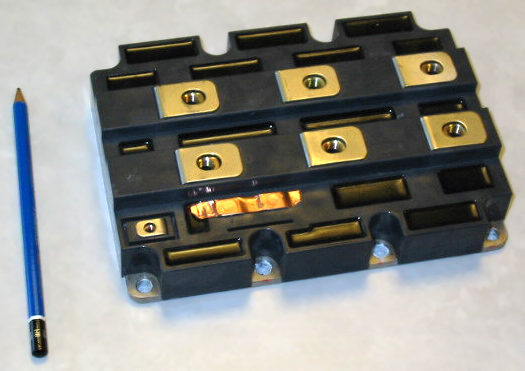
IGBT module (IGBTs and freewheeling diodes) with a rated current of 1200 A and a maximum voltage of 3300 V
Working principleSemiconductor
Inventor1959
Electronic symbol

IGBT schematic symbol

An insulated-gate bipolar transistor (IGBT) is a three-terminal power semiconductor device primarily forming an electronic switch. It was developed to combine high efficiency with fast switching. It consists of four alternating layers (NPNP)[1][2][3][4] that are controlled by a metal–oxide–semiconductor (MOS) gate structure.

Although the structure of the IGBT is topologically similar to a thyristor with a "MOS" gate (MOS-gate thyristor), the thyristor action is completely suppressed, and only the transistor action is permitted in the entire device operation range. It is used in switching power supplies in high-power applications: variable-frequency drives (VFDs) for motor control in trains, electric cars, variable-speed refrigerators and air conditioners, as well as lamp ballasts, arc-welding machines, photovoltaic and hybrid inverters, uninterruptible power supply systems (UPS), and induction stoves.

Since it is designed to turn on and off rapidly, the IGBT can synthesize complex waveforms with pulse-width modulation and low-pass filters, thus it is also used in switching amplifiers in sound systems and industrial control systems. In switching applications, modern devices feature pulse repetition rates well into the ultrasonic-range frequencies, which are at least ten times higher than audio frequencies handled by the device when used as an analog audio amplifier. As of 2010, the IGBT was the second most widely used power transistor, after the power MOSFET.[citation needed]

IGBT comparison table[5]
Device characteristic Power BJT Power MOSFET IGBT
Voltage rating High <1 kV High <1 kV Very high >1 kV
Current rating High <500 A Low <200 A High >500 A
Input drive Current ratio
hFE ~ 20–200
Voltage
VGS ~ 3–10 V
Voltage
VGE ~ 4–8 V
Input impedance Low High High
Output impedance Low Medium Low
Switching speed Slow (μs) Fast (ns) Medium
Cost Low Medium High

Device structure

[edit]
Cross-section of a typical IGBT showing internal connection of MOSFET and bipolar device

An IGBT cell is constructed similarly to an n-channel vertical-construction power MOSFET, except the n+ drain is replaced with a p+ collector layer, thus forming a vertical PNP bipolar junction transistor. This additional p+ region creates a cascade connection of a PNP bipolar junction transistor with the surface n-channel MOSFET. The whole structure comprises a four-layered NPNP.[1][2][3][4]

History

[edit]

The bipolar point-contact transistor was invented in December 1947[6] at the Bell Telephone Laboratories by John Bardeen and Walter Brattain under the direction of William Shockley. The junction version known as the bipolar junction transistor (BJT), invented by Shockley in 1948.[7] Later a similar thyristor was proposed by William Shockley in 1950 and developed in 1956 by power engineers at General Electric (GE). The metal–oxide–semiconductor field-effect transistor (MOSFET) was later invented at Bell Labs between 1959 and 1960.[8][9]

The basic IGBT mode of operation, where a pnp transistor is driven by a MOSFET, was first proposed by K. Yamagami and Y. Akagiri of Mitsubishi Electric in the Japanese patent S47-21739, which was filed in 1968.[10]

Static characteristic of an IGBT

In 1978 J. D. Plummer and B. Scharf patented a NPNP transistor device combining MOS and bipolar capabilities for power control and switching.[11][12] The development of the IGBT was characterised by an effort to completely suppress the thyristor operation, or the latch-up, in the four-layer device because the latch-up caused fatal device self-destruction. IGBTs had thus been established when the complete suppression of the latch-up of the parasitic thyristor was achieved. Later, Hans W. Becke and Carl F. Wheatley developed a similar device claiming non-latch-up. They patented the device in 1980, referring to it as "power MOSFET with an anode region" for which "no thyristor action occurs under any device operating conditions".[13][14]

A. Nakagawa et al. invented the device design concept of non-latch-up IGBTs in 1984.[15][16] The invention is characterised by the device design setting the device saturation current below the latch-up current, which triggers the parasitic thyristor. This invention achieved complete suppression of the parasitic thyristor action for the first time, because the maximal collector current was limited by the saturation current and never exceeded the latch-up current.

In the early development stage of the IGBT, research was aimed at increasing the latch-up current itself to suppress the latch-up of the parasitic thyristor. However, all these efforts failed because the IGBT could conduct an enormously large current. Successful suppression of latch-up became possible by constraining the maximal collector current to stay below the latch-up current, by controlling or reducing the saturation current of the inherent MOSFET. This was the breakthrough behind the non-latch-up IGBT, which in turn made "Becke’s device" possible.

The IGBT is characterised by its ability to simultaneously handle a high voltage and a large current. The product of the voltage and the current density that the IGBT can handle reached more than 5×10⁵ W/cm2,[17][18] which far exceeded the value, 2×10⁵ W/cm2, of existing power devices such as bipolar transistors and power MOSFETs. This is a consequence of the large safe operating area of the IGBT. The IGBT is the most rugged and the strongest power device yet developed, affording ease of use and so displacing bipolar transistors and even gate turn-off thyristors (GTOs). This excellent feature of the IGBT had suddenly emerged when the non-latch-up IGBT was established in 1984 by solving the problem of so-called "latch-up", which is the main cause of device destruction or device failure. Before that, the developed devices were very weak and were easily destroyed by "latch-up".

Practical devices

[edit]

Practical devices capable of operating over an extended current range were first reported by B. Jayant Baliga et al. in 1982.[19] The first experimental demonstration of a practical discrete vertical IGBT device was reported by Baliga at the IEEE International Electron Devices Meeting (IEDM) that year.[20][19] General Electric commercialized Baliga's IGBT device the same year.[21] Baliga was inducted into the National Inventors Hall of Fame for the invention of the IGBT.[22]

A similar paper was also submitted by J. P. Russel et al. to IEEE Electron Device Letter in 1982.[23] The applications for the device were initially regarded by the power electronics community to be severely restricted by its slow switching speed and latch-up of the parasitic thyristor structure inherent within the device. However, it was demonstrated by Baliga and also by A. M. Goodman et al. in 1983 that the switching speed could be adjusted over a broad range by using electron irradiation.[24][25] This was followed by demonstration of operation of the device at elevated temperatures by Baliga in 1985.[26] Successful efforts to suppress the latch-up of the parasitic thyristor and the scaling of the voltage rating of the devices at GE allowed the introduction of commercial devices in 1983,[27] which could be used for a wide variety of applications. The electrical characteristics of GE's device, IGT D94FQ/FR4, were reported in detail by Marvin W. Smith in the proceedings of PCI April 1984.[28] Smith showed in Fig. 12 of the proceedings that turn-off above 10 amperes for gate resistance of 5 kΩ and above 5 amperes for gate resistance of 1 kΩ was limited by switching safe operating area although IGT D94FQ/FR4 was able to conduct 40 amperes of collector current. Smith also stated that the switching safe operating area was limited by the latch-up of the parasitic thyristor.

Complete suppression of the parasitic thyristor action and the resultant non-latch-up IGBT operation for the entire device operation range was achieved by A. Nakagawa et al. in 1984.[15] The non-latch-up design concept was filed for US patents.[29] To test the lack of latch-up, the prototype 1200 V IGBTs were directly connected without any loads across a 600 V constant-voltage source and were switched on for 25 microseconds. The entire 600 V was dropped across the device, and a large short-circuit current flowed. The devices successfully withstood this severe condition. This was the first demonstration of so-called "short-circuit-withstanding-capability" in IGBTs. Non-latch-up IGBT operation was ensured, for the first time, for the entire device operation range.[18] In this sense, the non-latch-up IGBT proposed by Hans W. Becke and Carl F. Wheatley was realized by A. Nakagawa et al. in 1984. Products of non-latch-up IGBTs were first commercialized by Toshiba in 1985. This was the real birth of the present IGBT.

Once the non-latch-up capability was achieved in IGBTs, it was found that IGBTs exhibited very rugged and a very large safe operating area. It was demonstrated that the product of the operating current density and the collector voltage exceeded the theoretical limit of bipolar transistors, 2×10⁵ W/cm2 and reached 5×10⁵ W/cm2.[17][18]

The insulating material is typically made of solid polymers, which have issues with degradation. There are developments that use an ion gel to improve manufacturing and reduce the voltage required.[30]

The first-generation IGBTs of the 1980s and early 1990s were prone to failure through effects such as latchup (in which the device will not turn off as long as current is flowing) and secondary breakdown (in which a localized hotspot in the device goes into thermal runaway and burns the device out at high currents). Second-generation devices were much improved. The current third-generation IGBTs are even better, with speed rivaling power MOSFETs and excellent ruggedness and tolerance of overloads.[17] Extremely high pulse ratings of second- and third-generation devices also make them useful for generating large power pulses in areas including particle and plasma physics, where they are starting to supersede older devices such as thyratrons and triggered spark gaps. High pulse ratings and low prices on the surplus market also make them attractive to the high-voltage hobbyists for controlling large amounts of power to drive devices such as solid-state Tesla coils and coilguns.

Applications

[edit]

As of 2010, the IGBT is the second most widely used power transistor, after the power MOSFET. The IGBT accounts for 27% of the power transistor market, second only to the power MOSFET (53%), and ahead of the RF amplifier (11%) and bipolar junction transistor (9%).[31] The IGBT is widely used in consumer electronics, industrial technology, the energy sector, aerospace electronic devices, and transportation.

Advantages

[edit]

The IGBT combines the simple gate-drive characteristics of power MOSFETs with the high-current and low-saturation-voltage capability of bipolar transistors. The IGBT combines an isolated-gate FET for the control input and a bipolar power transistor as a switch in a single device. The IGBT is used in medium- to high-power applications like switched-mode power supplies, traction motor control and induction heating. Large IGBT modules typically consist of many devices in parallel and can have very high current-handling capabilities in the order of hundreds of amperes with blocking voltages of 6500 V. These IGBTs can control loads of hundreds of kilowatts.

Comparison with power MOSFETs

[edit]

An IGBT features a significantly lower forward voltage drop compared to a conventional MOSFET in higher blocking voltage rated devices, although MOSFETS exhibit much lower forward voltage at lower current densities due to the absence of a diode Vf in the IGBT's output BJT. As the blocking voltage rating of both MOSFET and IGBT devices increases, the depth of the n- drift region must increase and the doping must decrease, resulting in roughly square relationship decrease in forward conduction versus blocking voltage capability of the device. By injecting minority carriers (holes) from the collector p+ region into the n- drift region during forward conduction, the resistance of the n- drift region is considerably reduced. However, this resultant reduction in on-state forward voltage comes with several penalties:

  • The additional PN junction blocks reverse current flow. This means that unlike a MOSFET, IGBTs cannot conduct in the reverse direction. In bridge circuits, where reverse current flow is needed, an additional diode (called a freewheeling diode) is placed in anti-parallel with the IGBT to conduct current in the opposite direction. The penalty isn't overly severe because at higher voltages, where IGBT usage dominates, discrete diodes have a significantly higher performance than the body diode of a MOSFET.
  • The reverse bias rating of the N-drift region to collector P+ diode is usually only of tens of volts, so if the circuit application applies a reverse voltage to the IGBT, an additional series diode must be used.
  • The minority carriers injected into the N-drift region take time to enter and exit or recombine at turn-on and turn-off. This results in longer switching times, and hence higher switching loss [de] compared to a power MOSFET.
  • The on-state forward voltage drop in IGBTs behaves very differently from power MOSFETS. The MOSFET voltage drop can be modeled as a resistance, with the voltage drop proportional to current. By contrast, the IGBT has a diode-like voltage drop (typically of the order of 2V) increasing only with the log of the current. Additionally, MOSFET resistance is typically lower for smaller blocking voltages, so the choice between IGBTs and power MOSFETS will depend on both the blocking voltage and current involved in a particular application.

In general, high voltage, high current and lower frequencies favor the IGBT while low voltage, medium current and high switching frequencies are the domain of the MOSFET.

Modeling

[edit]

Circuits with IGBTs can be developed and modeled with various circuit simulating computer programs such as SPICE, Saber, and other programs. To simulate an IGBT circuit, the device (and other devices in the circuit) must have a model which predicts or simulates the device's response to various voltages and currents on their electrical terminals. For more precise simulations the effect of temperature on various parts of the IGBT may be included with the simulation. Two common methods of modeling are available: device physics-based model, equivalent circuits or macromodels. SPICE simulates IGBTs using a macromodel that combines an ensemble of components like FETs and BJTs in a Darlington configuration.[citation needed] An alternative physics-based model is the Hefner model, introduced by Allen Hefner of the National Institute of Standards and Technology. Hefner's model is fairly complex but has shown good results. Hefner's model is described in a 1988 paper and was later extended to a thermo-electrical model which include the IGBT's response to internal heating. This model has been added to a version of the Saber simulation software.[32]

IGBT failure mechanisms

[edit]

The failure mechanisms of IGBTs includes overstress (O) and wearout (wo) separately.

The wearout failures mainly include bias temperature instability (BTI), hot carrier injection (HCI), time-dependent dielectric breakdown (TDDB), electromigration (ECM), solder fatigue, material reconstruction, corrosion. The overstress failures mainly include electrostatic discharge (ESD), latch-up, avalanche, secondary breakdown, wire-bond liftoff and burnout.[33]

IGBT failure assessment

[edit]

Failure assessment of IGBTs is becoming a topic of interest for predictive maintenance in several applications where IGBTs are widely used such as transportation, telecommunication, and computers. It is particularly challenging given the difficult nature of the problem from a physical and a statistical point of view. Physics of failure are yet to be proven to generalize well to IGBTs, whereas data-driven models require high-quality data of IGBT failures that is often costly to obtain. Given these challenges, most state-of-the-art failure assessment models utilise hybrid approaches which combine physics-of-failure and data-driven models.[34][35]

IGBT modules

[edit]

See also

[edit]

References

[edit]

Further reading

[edit]
[edit]
Revisions and contributorsEdit on WikipediaRead on Wikipedia
from Grokipedia
The insulated-gate bipolar transistor (IGBT) is a three-terminal power device that integrates the insulated gate control of a with the high-current-handling capability of a , enabling efficient switching in medium- to high-power applications. It features a NPNP structure consisting of four alternating doped layers—N-P-N-P—with the gate insulated by an layer for voltage-driven operation, allowing low gate drive power while supporting collector-emitter voltages up to several kilovolts and currents exceeding hundreds of amperes. Invented around 1980 by at , the IGBT addressed limitations of earlier power devices by providing lower conduction losses than and simpler gate driving than BJTs, rapidly becoming the dominant switch for in the 1990s. In operation, when a positive gate voltage is applied (typically 10–20 V), the MOSFET section conducts to inject minority carriers into the drift region, turning on the internal BJT for low-voltage-drop forward conduction; removing the gate voltage blocks current flow, with reverse recovery managed to minimize switching losses. Key characteristics include a saturation voltage (V_CE(sat)) of 1.5–3 V, switching frequencies up to 20 kHz, and safe operating areas that support both DC and pulsed operation, though they are prone to in high-current scenarios if not properly designed. IGBTs offer significant advantages over pure MOSFETs in high-voltage scenarios due to their lower on-state resistance for reduced power dissipation, and over BJTs through voltage-controlled that eliminate base current needs, enabling easier paralleling and integration into modules. However, they exhibit higher switching losses than MOSFETs at very high frequencies and require careful thermal management to avoid second breakdown. Widely adopted since the early 2000s, IGBTs power over 50% of industrial motor drives, inverters, electric vehicles, and consumer appliances like air conditioners and equipment, with global market shipments exceeding billions of units annually and ongoing advancements in trench-gate designs improving efficiency by up to 20%.

Fundamentals

Device Structure

The insulated-gate bipolar transistor (IGBT) is a hybrid that integrates the gate-controlled input characteristics of a (MOSFET) with the high-current output capability of a (BJT). This combination enables voltage-controlled switching with low on-state losses suitable for medium- to high-power applications. The device is typically fabricated as an n-channel structure, where electrons serve as the primary charge carriers in the MOSFET section, though p-channel variants exist with reversed doping polarities for complementary circuit designs. In a cross-sectional view, the IGBT exhibits a vertical PNPN layered , resembling a wide-base PNP BJT driven by an integrated N-channel . The key layers, starting from the collector side, include a heavily doped p+ collector region for injection, a lightly doped n- drift region that supports voltage blocking, a p-body (or base) region forming the channel and junction, and an n+ source/emitter region for injection. Overlying the p-body and n+ source is a thin layer (typically 50-100 nm thick) topped by a polysilicon , which enables insulated gate control without base current. This structure supports limited reverse voltage blocking during reverse recovery processes but is primarily designed for forward conduction. IGBTs are classified into punch-through (PT) and non-punch-through (NPT) variants based on the design of the drift region and its interaction with the depletion layer during blocking. In PT-IGBTs, a thin n- drift region (optimized for reduced resistance) incorporates an n+ buffer layer between the drift and p+ collector to confine the depletion layer and prevent premature punch-through to the collector, enabling higher blocking voltages with lower on-state losses. NPT-IGBTs, in contrast, use a thicker n- drift region without a buffer, relying on symmetric doping for equal forward and reverse blocking capabilities and simpler fabrication using float-zone wafers, though at the cost of higher conduction losses. Doping profiles and dimensions vary significantly between high-voltage (e.g., >600 V) and low-voltage (<600 V) IGBTs to balance blocking capability, on-state resistance, and switching speed. For high-voltage devices, the n- drift region features low doping (typically 10^{13}-10^{14} cm^{-3}) and greater thickness (e.g., 80-120 \mu m for 1200 V ratings) to sustain the electric field without avalanche breakdown, while the p+ collector doping exceeds 10^{18} cm^{-3} for efficient carrier injection. Low-voltage IGBTs employ higher drift doping (10^{14}-10^{15} cm^{-3}) and thinner regions (e.g., 40-60 \mu m for 600 V) to minimize resistance, with optimized p-body doping (10^{16}-10^{17} cm^{-3}) to reduce latch-up risk. These parameters are tailored through epitaxial growth or ion implantation to achieve specific trade-offs in performance. The on-state collector-emitter voltage drop, V_{CE(sat)}, arises primarily from the forward-biased p-n junction at the collector and the modulated resistance of the drift region, approximated as: VCE(sat)VBE+ICRdriftV_{CE(sat)} \approx V_{BE} + I_C \cdot R_{drift} where V_{BE} is the base-emitter voltage of the equivalent PNP transistor (around 0.7-1.0 V) and R_{drift} represents the effective resistance of the conductivity-modulated n- drift region under high-level injection. This equation highlights the IGBT's low conduction loss compared to , as hole injection reduces R_{drift} significantly.

Operating Principle

The insulated-gate bipolar transistor (IGBT) operates as a hybrid device combining the high input impedance and fast switching of a with the low on-state conduction losses of a bipolar junction transistor. When a positive voltage exceeding the threshold (typically 4-6 V) is applied between the gate and emitter, it induces an n-type inversion layer in the p-body region under the gate oxide. This channel conducts electrons from the n+ emitter into the n- drift region, initiating the turn-on process. With a positive collector-emitter voltage applied, the forward-biased p+ collector-n- drift junction injects minority carrier holes into the drift region. These holes are transported across the base toward the p-body, providing base current to the equivalent parasitic NPN transistor formed by the n+ emitter, p-body, and n- drift layers. This amplifies the electron injection, leading to high-level carrier injection in the lightly doped n- region. The resulting conductivity modulation—where the injected electron-hole plasma increases the drift region's conductivity by orders of magnitude—dramatically lowers the on-state resistance and forward voltage drop (typically 2-3 V), enabling efficient conduction of high currents. The MOSFET channel current I_{MOS} provides the base current for the equivalent PNP transistor, resulting in the PNP collector current I_{C(PNP)} = \beta_{PNP} I_{MOS}, where \beta_{PNP} is the current gain of the PNP. The total forward conduction current is then I_C = I_{MOS} + I_{C(PNP)} = I_{MOS} (1 + \beta_{PNP}). During switching, turn-on begins with rapid gate charging, followed by a characteristic Miller plateau where the gate-emitter voltage remains nearly constant. This plateau occurs as the falling collector-emitter voltage charges the gate-collector capacitance, limiting gate current and slowing the voltage transition until the full on-state is reached. For turn-off, reducing the gate voltage below threshold pinches off the inversion channel, sweeping out majority carriers and initiating voltage rise. However, the stored minority carriers in the drift region cause a prolonged tail current, decaying exponentially due to recombination governed by the hole lifetime τh\tau_h. The tail phase duration depends on the minority carrier lifetime τh\tau_h in the drift region, contributing significantly to turn-off losses in high-voltage applications. A critical operational concern is latch-up, where excessive hole current flowing laterally through the p-body resistance generates a voltage drop sufficient to forward-bias the p-body-n+ emitter junction, triggering the parasitic four-layer thyristor structure and causing uncontrolled conduction. This can lead to device destruction and is prevented through design measures such as incorporating p+ diverter regions adjacent to the n+ emitter to shunt hole current away from the vulnerable junction, reducing the resistance and suppressing thyristor triggering. The safe operating area (SOA) delineates the permissible voltage-current loci for reliable operation. The forward-biased SOA (FBSOA) bounds DC or low-inductance conduction, limited by thermal runaway from avalanche-generated carriers and second breakdown effects at high currents. The reverse-biased SOA (RBSOA), relevant for inductive turn-off, is constrained by the open-base breakdown voltage of the equivalent PNP structure and the maximum voltage the device can block during current commutation without filamentation or hot-spot formation. These boundaries ensure the IGBT remains within thermal and electrical stress limits during dynamic operation.

Historical Development

Invention and Early Concepts

The insulated-gate bipolar transistor (IGBT) was conceived by B. Jayant Baliga at (GE) in 1979 as a hybrid power semiconductor device designed to merge the voltage-controlled gate drive simplicity of a metal-oxide-semiconductor field-effect transistor () with the low on-state voltage drop and high current-carrying capacity of a (BJT). This innovation addressed the growing need for efficient high-power switching in applications requiring voltages above 500 V and currents exceeding 100 A, where traditional devices fell short in performance trade-offs. Early concepts for the IGBT built upon the limitations of preceding power devices, particularly power Darlington transistors—which required substantial base current for drive and suffered from slow switching—and gate turn-off thyristors (GTOs), which demanded high gate power for turn-off and exhibited restricted commutation speeds due to their four-layer structure. Baliga's approach introduced a p-n-p-n structure with an insulated gate to enable conductivity modulation in the drift region, reducing on-state losses while maintaining MOSFET-like control, thereby overcoming the gate drive complexities of GTOs and the current-handling inefficiencies of Darlingtons. In 1979, Baliga developed the initial theoretical model, predicting the device's forward conduction behavior through coupled MOSFET channel current injection into a wide-base p-n-p transistor. Baliga filed the foundational patent for the IGBT on December 2, 1980 (U.S. Patent 4,969,028, issued November 6, 1990), describing a vertical structure with a p+ anode layer to suppress unwanted thyristor latch-up while achieving bipolar conduction. The device's introduction to the technical community came via Baliga's seminal 1982 paper, "The Insulated Gate Rectifier (IGR): A New High Voltage Power Switching Device," presented at the IEEE International Electron Devices Meeting (IEDM), which detailed the structure's operation and performance projections for blocking voltages up to 1000 V. Initial prototypes fabricated at GE around 1982–1983 encountered significant challenges, including latch-up of the inherent parasitic thyristor, which caused destructive uncontrolled conduction during high-current operation, and elevated on-state losses stemming from incomplete charge carrier injection in early silicon implementations. These issues were mitigated through design refinements, such as buffer layer optimization, leading to experimental verification of latch-up-free operation and reduced forward drop (approximately 2 V at 100 A/cm²) by 1983.

Commercialization and Milestones

The first commercial insulated-gate bipolar transistor (IGBT) was introduced by Toshiba in 1985, featuring non-latch-up characteristics and initial ratings of 600 V and around 50 A, which enabled reliable high-power switching and paved the way for adoption in applications like motor drives and inverters during the late 1980s. Fuji Electric followed with its commercialization in 1988, offering devices with improved reliability for industrial use, while Mitsubishi Electric entered the market in 1987, contributing to rapid proliferation among Japanese manufacturers. By the end of the decade, IGBTs had transitioned from prototypes to standard components in power electronics, replacing thyristors in many medium-voltage systems due to their superior controllability. Key technological milestones advanced IGBT performance in subsequent decades. In the mid-1990s, trench-gate structures were introduced commercially, reducing on-state losses by up to 20% compared to planar gates through better carrier distribution and enabling higher switching frequencies. The shift to field-stop (FS) IGBTs in the early 2000s further optimized efficiency, incorporating a lightly doped buffer layer to minimize tail current during turn-off, which lowered switching losses by 30-50% and supported applications in renewable energy converters. These innovations were driven by leading producers like , which acquired EUPEC in 2004 to bolster its IGBT portfolio, and , which refined FS designs for automotive traction systems. In recent years, IGBT commercialization has focused on hybrid integrations and manufacturing enhancements. From 2023 onward, hybrid modules combining silicon IGBTs with silicon carbide (SiC) diodes have gained traction, offering up to 50% reduction in conduction losses for electric vehicle inverters and industrial drives, as exemplified by Infineon's CoolSiC hybrid offerings. Laser annealing techniques, adopted in production lines by 2024, have improved manufacturing yields by 15-20% through precise activation of dopants in the field-stop layer without thermal damage to the wafer. ABB has played a pivotal role in scaling these hybrids for grid-tied systems, enhancing reliability in high-power modules. The IGBT market evolved from a niche segment in 1990s power supplies to dominating motor control applications by the 2000s, with global shipments exceeding billions of units annually. Driven by electrification trends, the market reached approximately USD 8 billion in 2025, fueled primarily by demand in electric vehicles and renewables, where IGBT modules account for over 40% of inverter costs. Major players such as Infineon, Mitsubishi Electric, and ABB continue to lead production, with combined market share surpassing 50%, through innovations like 8-inch wafer processing for cost reduction.

Comparisons with Other Devices

With Thyristors

Thyristors, such as silicon-controlled rectifiers (SCRs) and gate turn-off (GTO) thyristors, operate as latching devices that, once triggered into conduction via a gate pulse, remain on until the anode current drops below the holding current level or is forcibly commutated off using an external circuit to divert the current. In comparison, insulated-gate bipolar transistors (IGBTs) provide non-latching control, allowing turn-off simply by lowering the gate-emitter voltage below the threshold level, akin to MOSFET operation, which eliminates the need for complex commutation circuitry and enables precise, voltage-driven switching. This fundamental difference in turn-off mechanisms makes IGBTs more suitable for applications requiring frequent and rapid switching, while thyristors excel in sustained high-power conduction scenarios where latching behavior is advantageous. Regarding conduction characteristics, thyristors benefit from full conductivity modulation across their four-layer p-n-p-n structure, resulting in a low on-state voltage drop of approximately 1-2 V and minimal conduction losses, particularly at high currents where plasma density enhances carrier injection. IGBTs, with their four-layer PNPN structure combining MOSFET gating and bipolar conduction, achieve only partial conductivity modulation, leading to a higher on-state drop of 2-4 V and correspondingly greater conduction losses, though this is offset by improved overall efficiency in pulsed operations. Thyristors thus offer superior steady-state performance for very high-power, low-frequency applications, but their inherently slower switching speeds—due to the need for charge extraction during turn-off—incur higher switching losses compared to IGBTs, which balance conduction and switching trade-offs more effectively for medium- to high-frequency use. Gate drive requirements further distinguish the two devices: thyristors demand a high-current gate pulse, often 1-5 A for microseconds, to initiate triggering, necessitating robust drive circuits capable of delivering significant peak power. Conversely, IGBTs use a low-power voltage-based gate drive, typically operating between 3-20 V with currents in the milliampere range, allowing for simpler, more compact and energy-efficient control electronics similar to those for MOSFETs. This ease of gating contributes to the IGBT's advantages in integrated systems. In terms of power handling capabilities, thyristors support blocking voltages exceeding 10 kV per device and currents in the multi-megawatt range, often through series or parallel configurations in applications like high-voltage direct current (HVDC) transmission. IGBTs, while limited to single-device ratings up to 6.5 kV and module currents of 1-2 kA, provide sufficient capacity for most industrial and traction needs without extensive stacking. Historically, the adoption of IGBTs marked a significant shift in power electronics, particularly replacing GTO thyristors in electric traction systems by the 1990s, as the IGBT's simpler gate control reduced the need for bulky snubbers and commutation aids, improving system reliability, size, and efficiency in variable-speed drives.

With Power MOSFETs

Power MOSFETs rely on unipolar conduction, where current flow is carried exclusively by majority carriers (electrons in n-channel devices), enabling low on-resistance at low to medium voltages without the complications of minority carrier storage. In contrast, IGBTs utilize bipolar conduction involving both electrons and holes, which conductivity modulates the drift region to achieve significantly lower on-resistance for blocking voltages exceeding 200 V, though this introduces tail current losses during turn-off as stored minority carriers recombine slowly. Regarding breakdown voltage, power MOSFETs are economically constrained to ratings around 1 kV due to the quadratic increase in on-resistance with voltage in their unipolar structure, necessitating larger die sizes for higher voltages. IGBTs, benefiting from bipolar modulation, incorporate a thicker n- drift region to support breakdown voltages up to 6.5 kV or more while maintaining manageable on-state losses, making them suitable for medium- to high-voltage power systems. Switching performance differs markedly, with MOSFETs achieving turn-on and turn-off times in the nanosecond range owing to their purely majority-carrier operation, resulting in low switching losses (typically <1 mJ for E_off in comparable devices). IGBTs, however, exhibit slower switching in the microsecond range due to minority carrier storage, leading to higher turn-off energy losses of approximately 10-100 mJ from the tail current phase, which limits their use in high-frequency applications but suits lower-frequency power conversion. In terms of cost and ruggedness, IGBTs offer lower manufacturing costs for high-power modules because their bipolar design allows efficient handling of large currents and voltages with smaller die areas compared to unipolar at equivalent ratings. While IGBTs are more vulnerable to avalanche breakdown from stored charge effects, they demonstrate superior short-circuit ruggedness, withstanding fault currents for up to 10 μs before failure, providing a safety margin in industrial drives. Application boundaries typically favor MOSFETs for low-voltage scenarios below 500 V and currents under 100 A, where their fast switching and low losses excel in efficient, high-frequency circuits like switched-mode power supplies. Conversely, IGBTs dominate in higher-power domains above 600 V and 50 A, such as motor drives and inverters, where their conduction efficiency outweighs switching penalties at moderate frequencies.

Performance Characteristics

Advantages

The insulated-gate bipolar transistor (IGBT) excels in high-power applications due to its ability to handle elevated voltages and currents while maintaining low gate drive requirements. Modern IGBT modules can achieve blocking voltages up to 6.5 kV and continuous current ratings exceeding 1200 A, enabling robust performance in demanding scenarios without excessive complexity in the drive circuitry. Additionally, the gate drive power consumption remains below 1 W per device at typical switching frequencies of 1-20 kHz, facilitated by the voltage-controlled MOS gate structure that requires minimal charging current compared to current-driven alternatives. A key benefit lies in the IGBT's low conduction losses during on-state operation, characterized by a collector-emitter saturation voltage (V_CE(sat)) typically ranging from 2 to 4 V at high currents (e.g., 600-1200 A), which outperforms for applications above 600 V where MOSFET on-resistance scaling becomes inefficient. This results in reduced power dissipation, with conduction loss calculated as P_cond = V_CE(sat) × I_C, providing a favorable trade-off for medium- to high-voltage systems. The IGBT's positive temperature coefficient of on-state voltage (approximately 5-10 mV/°C) enhances reliability in paralleled configurations, as hotter devices experience increased V_CE(sat), promoting automatic current sharing and preventing thermal runaway—a common issue in devices with negative coefficients. This inherent protection simplifies module design and improves fault tolerance without additional balancing circuits. In pulse-width modulation (PWM) schemes, IGBTs balance switching and conduction losses effectively, achieving overall inverter efficiencies exceeding 95% at full load in three-phase systems operating at 1-10 kHz. This efficiency stems from optimized tail current control in turn-off transients, minimizing energy dissipation while supporting high-power density. As silicon-based devices, IGBTs offer cost-effectiveness, generally less expensive than equivalent counterparts for many industrial applications below 10 kW, due to mature fabrication processes and larger market volumes.

Limitations

One significant limitation of insulated-gate bipolar transistors (IGBTs) arises from their switching losses, primarily during turn-off, where the tail current phenomenon—stemming from the device's bipolar conduction mechanism—prolongs the collector current decay, leading to elevated energy dissipation. Typical combined turn-on and turn-off energies (E_on + E_off) range from 50 to 500 mJ for high-power modules under standard operating conditions, such as 1200 V and 100-600 A ratings. This contributes to overall power losses that restrict practical switching frequencies to below 20 kHz in most applications, beyond which thermal management becomes challenging without advanced cooling. IGBTs exhibit strong temperature dependence in their gate-emitter threshold voltage (V_GE(th)), which has a negative temperature coefficient of approximately -10 to -20 mV/°C, causing the device to turn on more readily at elevated temperatures. Above 125°C, this reduction in V_GE(th) increases the device's current gain, elevating short-circuit currents and thereby heightening the risk of thermal runaway during fault conditions. In low-voltage IGBT designs (typically below 600 V), latch-up susceptibility is a notable drawback due to the parasitic thyristor structure inherent to the device's p-n-p-n configuration, which can trigger uncontrolled conduction if the hole current exceeds critical levels. This issue is particularly pronounced in planar or trench-gate layouts with higher gain, often necessitating integrated diverter structures, such as p+ regions, to shunt excess minority carriers and prevent regenerative feedback. Fast switching in IGBTs generates significant electromagnetic interference (EMI) through high dv/dt rates, commonly reaching ~10 kV/μs during voltage transitions, which induces common-mode currents in parasitic capacitances and associated cabling. This noise propagation complicates compliance with EMI standards in dense power electronics systems, often requiring additional filtering components to mitigate conducted and radiated emissions. A emerging competitive pressure on IGBTs is the superior performance of silicon carbide (SiC) MOSFETs in high-voltage applications exceeding 1200 V, particularly in electric vehicle (EV) inverters, where SiC devices offer lower switching losses and higher efficiency, leading to reduced IGBT market share in this segment post-2023. Market analyses project SiC MOSFET demand in EVs to grow tenfold from 2023 to 2035, driven by these efficiency gains in 800 V architectures.

Applications

Industrial and Power Conversion

Insulated-gate bipolar transistors (IGBTs) play a central role in variable frequency drives (VFDs) for industrial motors, enabling precise control of motor speed from 0% to 100% of the rated value by varying the output frequency and voltage. These drives are commonly applied to AC induction motors in manufacturing, pumping, and conveyor systems, supporting power ratings from 1 HP to over 1000 HP to meet diverse industrial demands for energy efficiency and process optimization. In uninterruptible power supply (UPS) systems and industrial welding machines, IGBTs facilitate reliable power conversion at levels ranging from 50 kW to 500 kW, utilizing pulse-width modulation (PWM) techniques to generate stable AC outputs with minimal harmonics. For UPS applications, parallel-connected IGBT inverters ensure high-capacity three-phase operation, providing seamless backup power during outages. In welding equipment, IGBT-based converters employ hard-switching PWM controls in topologies like the two-transistor forward to deliver consistent arc stability and high-duty-cycle performance. Since the 1990s, IGBTs have progressively replaced gate turn-off (GTO) thyristors in railway traction inverters across Europe, particularly in 3 kV DC systems, due to their faster switching capabilities—up to 17 kHz—and full controllability, which enhance efficiency and reduce system size in electric multiple units (EMUs). This transition has supported higher performance in urban and intercity rail applications by enabling advanced PWM strategies for smoother acceleration and regenerative braking. In utility-scale applications, IGBTs are integral to high-voltage direct current (HVDC) converters and flexible AC transmission systems (FACTS) devices, operating at megawatt scales to stabilize power grids by controlling voltage, reactive power, and fault currents. Voltage-source converter (VSC)-based HVDC systems using press-pack IGBTs provide bidirectional power flow and black-start capabilities, while FACTS implementations like static compensators improve grid reliability in interconnected networks up to 250 MW per module. High-power IGBT-based drives are deployed for pumps and compressors in oil and gas processing, offering robust torque control and harmonic mitigation for loads exceeding 20 MW.

Emerging in Renewables and EVs

Insulated-gate bipolar transistors (IGBTs) play a pivotal role in electric vehicle (EV) power electronics, particularly in on-board chargers and traction inverters that enable efficient energy conversion and motor control. In 800V battery systems adopted by leading manufacturers such as Tesla and BYD, 1200V-rated IGBTs are deployed to manage high-power demands exceeding 300kW, supporting faster charging and improved driving range while maintaining system reliability under dynamic loads. These devices facilitate bidirectional power flow in on-board chargers, crucial for vehicle-to-grid (V2G) integration in smart grids as of 2025, where EVs act as distributed energy resources to stabilize grid fluctuations during peak demand. In renewable energy systems, IGBTs are integral to solar inverters, encompassing both string inverters for smaller arrays and central inverters handling 1-5MW capacities, as well as wind turbine converters that optimize variable power output for grid compatibility. Advanced 2300 V IGBT modules for 1500 V systems allow for larger solar panel strings and reduced system complexity, enhancing overall efficiency in utility-scale installations. For instance, collaborations like Infineon with Goldwind have integrated IGBT-based converters in wind systems since 2007, promoting compact designs and grid-friendly operation amid the push for higher renewable penetration. Emerging trends from 2023-2025 highlight hybrid SiC-IGBT solutions in EV traction inverters, blending silicon carbide's low switching losses for light loads with IGBTs' cost-effectiveness at high currents, yielding efficiency improvements over pure IGBT setups and nearing full-SiC performance. This innovation drives a 12.1% compound annual growth rate in the automotive hybrid IGBT market, projected to expand from $1.14 billion in 2025 to $3.57 billion by 2035, fueled by EV adoption and demands for enhanced power density. Additionally, IGBTs enable seamless grid integration in battery energy storage systems (BESS), where they manage power conversion in bidirectional setups to store excess renewable output and dispatch it during deficits, supporting smart grid resilience. As of 2025, while full SiC adoption grows in premium EVs for higher efficiency, hybrid IGBT-SiC approaches continue to bridge cost and performance in mainstream applications. A key challenge in these high-density EV applications is thermal management of IGBTs within compact battery packs, where heat generation from switching can exceed 150°C, risking performance degradation and reliability issues. Advanced solutions, including double-sided cooling and optimized packaging like Infineon's HybridPACK, mitigate these by improving heat dissipation and enabling operation at elevated power densities without compromising lifespan.

Modeling and Analysis

Electrical and Thermal Modeling

The Hefner model represents a foundational physics-based approach for simulating the electrical behavior of insulated-gate bipolar transistors (IGBTs), utilizing an equivalent circuit that integrates a for gate-driven channel formation and a PNP bipolar junction transistor for high-current conduction through the drift region. This model employs ambipolar transport equations to capture charge carrier dynamics in the lightly doped n- base, enabling accurate prediction of steady-state current-voltage characteristics and transient switching waveforms. The transconductance parameter, defined as gm=ICVGEg_m = \frac{\partial I_C}{\partial V_{GE}}, quantifies the sensitivity of collector current ICI_C to gate-emitter voltage VGEV_{GE}, reflecting the MOSFET's influence on overall device gain. Thermal modeling complements electrical analysis by addressing heat generation and dissipation in IGBTs, with the junction-to-case thermal resistance RθJCR_{\theta JC} serving as a key parameter to estimate temperature rise from junction to external case under steady-state conditions. Total power loss PP is primarily composed of conduction losses ICVCEI_C V_{CE} during on-state operation and switching losses f(Eon+Eoff)f (E_{on} + E_{off}), where ff denotes switching frequency, EonE_{on} and EoffE_{off} are turn-on and turn-off energies, respectively; these losses drive junction temperature TJT_J via TJ=TC+PRθJCT_J = T_C + P R_{\theta JC}, with TCT_C as case temperature. Such models are essential for preventing thermal runaway in power electronics applications. Parameter extraction for these models relies on manufacturer datasheets, where the PNP bipolar amplification factor α\alpha is derived from forward conduction curves by analyzing the ratio of hole current injection to total current, and the high-level carrier lifetime τ\tau is obtained from tail current decay in turn-off waveforms or open-circuit voltage decay measurements. These values allow calibration of the Hefner model's bipolar section without extensive device fabrication data, ensuring simulation fidelity to real-device performance. For instance, α\alpha typically ranges from 0.9 to 0.99 for modern IGBTs, while τ\tau varies with doping and influences switching speed. Coupled electro-thermal simulations integrate electrical and thermal domains to account for self-heating effects, where elevated junction temperatures increase on-state voltage drop VCE(sat)V_{CE(sat)} by approximately 2 mV/°C, thereby amplifying conduction losses and potentially shifting operating points in circuits. This feedback is modeled by making device parameters like mobility and lifetime temperature-dependent, often using finite-difference or finite-element methods to solve coupled Poisson, drift-diffusion, and heat equations iteratively. Such approaches reveal how thermal crosstalk in multi-chip modules exacerbates uneven current sharing. Recent developments in 2024 include 3D electrothermal finite-element modeling of IGBT power modules to analyze degradation mechanisms such as wire bonding failures and their impact on temperature distribution, with validation against experimental measurements during conduction and switching operations for improved reliability assessment. These models provide insights into thermal management in power modules.

Simulation Techniques

Simulation techniques for insulated-gate bipolar transistors (IGBTs) enable the prediction of device behavior in power electronics circuits, ranging from circuit-level to system-level analyses. These methods integrate established models, such as the Hefner model, into simulation environments to evaluate switching dynamics, losses, and safe operating areas (SOA) without physical prototyping. Circuit-level simulations often employ SPICE-compatible subcircuit models to represent IGBTs in tools like and PSpice. These models, typically provided by manufacturers, approximate the IGBT as a combination of MOSFET and bipolar components to capture on-state voltage drop, switching transients, and tail current effects. For instance, Infineon's IGBT models are distributed as .lib files that integrate seamlessly with LTspice and PSpice, allowing users to simulate inverter circuits with minimal setup by importing subcircuits and associating them with custom symbols. A simplified SPICE macromodel based on equivalent circuits further reduces complexity for preliminary designs, focusing on key parameters like gate threshold and collector-emitter saturation voltage. Device-level physics simulations utilize finite element analysis (FEA) through technology computer-aided design (TCAD) tools like Synopsys Sentaurus to model intricate phenomena such as ambipolar diffusion in the drift region. Sentaurus solves coupled drift-diffusion equations across the IGBT structure, enabling detailed examination of carrier transport, lattice heating, and electric field distributions during high-voltage operation. This approach is particularly valuable for optimizing buffer layers to mitigate punch-through effects, where ambipolar diffusion coefficients are calibrated against measured carrier lifetimes. Automated parameter extraction workflows in Sentaurus TCAD benchmark finite element models against experimental data, ensuring accuracy for advanced IGBT variants like field-stop types. At the system level, MATLAB/Simulink facilitates inverter simulations incorporating IGBTs with parasitic elements like stray inductances and capacitances. The Simulink IGBT block models the device as a resistor-inductor-voltage source in series with a controlled switch, supporting average or detailed switching behaviors for efficiency mapping in three-phase converters. Parasitics are included via coupled inductors and capacitors to predict electromagnetic interference and voltage overshoots in motor drives. This environment allows co-simulation of power electronics with control algorithms, such as space vector modulation, to assess overall system performance under varying loads. Recent advancements leverage artificial intelligence (AI) for enhanced parameter fitting in IGBT simulations, particularly in 2023 studies on machine learning for thermal and electrical estimation. Bayesian-optimized complete ensemble empirical mode decomposition with adaptive noise (BO-CEEMDAN) extracts fault features from IGBT signals, feeding into neural architectures like Performer-KAN for predictive modeling, improving accuracy over traditional curve-fitting by 15-20% in junction temperature forecasts. For electric vehicle (EV) powertrains, co-simulation frameworks integrate high-fidelity IGBT models from tools like Saber with vehicle dynamics in , enabling holistic analysis of traction inverters under real-world cycles like WLTP. These AI-driven methods reduce computational overhead in parameter optimization, with convolutional neural networks processing gate voltage waveforms to detect multi-parameter degradation in EV modules. Validation of these simulation techniques involves comparing outputs against dynamic tests to predict SOA, ensuring models accurately forecast short-circuit withstand times and overcurrent limits. Automated test setups measure IGBT terminal characteristics under pulsed conditions, correlating simulated waveforms with oscilloscope-captured data for turn-off energy and SOA boundaries. Physics-based models validated this way achieve errors below 10% in SOA prediction for SPT-IGBTs, confirming robustness for fault-tolerant designs.

Reliability and Failure

Failure Mechanisms

One prominent failure mechanism in insulated-gate bipolar transistors (IGBTs) is single-event burnout (SEB) induced by cosmic rays, where high-energy particles from cosmic radiation penetrate the device and generate charge carriers that trigger avalanche breakdown, leading to thermal runaway and catastrophic destruction. This phenomenon is particularly prevalent in high-voltage IGBTs (>1 kV) operating in off-state blocking conditions, with susceptibility increasing in environments with elevated cosmic ray flux, like high altitudes or space, and can occur even in terrestrial applications at blocking voltages above 1 kV. Another common degradation mode arises from bond-wire lift-off due to thermal cycling, where repeated temperature fluctuations cause fatigue in the aluminum or copper bond wires connecting the chip to the module leads. This fatigue stems from thermo-mechanical stress induced by coefficient of thermal expansion (CTE) mismatches between the wire, chip metallization, and substrate, leading to cracking at the heel of the bond and eventual lift-off after approximately 10^4 cycles under typical power cycling conditions. As lift-off progresses, it increases electrical resistance and thermal impedance, accelerating localized heating and potentially causing solder joint fatigue or chip cracking. Gate oxide breakdown represents a critical electrical failure in IGBTs, primarily driven by time-dependent dielectric breakdown (TDDB) when the gate voltage exceeds the maximum rated value (V_Gmax), typically around ±20 V for silicon-based devices. Under overvoltage stress, accelerated electron injection into the oxide layer creates defects and percolation paths, drastically reducing lifetime; for instance, operation above V_Gmax can shorten TDDB lifetime by orders of magnitude due to enhanced Fowler-Nordheim tunneling. This mechanism is exacerbated by high temperatures or electrostatic discharge, resulting in permanent shorting of the gate to the channel or emitter. Latch-up failure occurs when the parasitic thyristor inherent in the IGBT structure is triggered, forming a low-impedance regenerative feedback loop between the p-n-p-n layers that sustains high current flow even after gate signal removal. This is often initiated by excessive collector current exceeding 10 times the rated value during short-circuit or overcurrent events, combined with high dI/dt, which forward-biases the parasitic elements and leads to thermal destruction if not interrupted promptly. Modern IGBT designs mitigate latch-up by optimizing lifetime control and buffer layers to limit the gain of the parasitic transistors, but vulnerabilities persist under fault conditions. In recent hybrid IGBT modules combining silicon and silicon carbide (SiC) components, delamination has emerged as a failure mode due to CTE mismatch between the dissimilar materials during thermal cycling. Studies from 2024-2025 highlight that this mismatch induces shear stresses at interfaces, such as between SiC diodes and Si IGBT chips or within packaging adhesives, promoting void formation and delamination after extended operation, which compromises electrical connectivity and thermal management. Finite element analysis in these works demonstrates that optimizing interconnect materials can reduce stress concentrations, but the issue remains a reliability challenge for high-power SiC-hybrid applications.

Assessment and Mitigation

Assessment of IGBT health relies on non-invasive monitoring techniques to detect early signs of degradation without interrupting operation. One primary method involves on-state voltage monitoring, where an increase in the collector-emitter saturation voltage, V_CE(sat), serves as a key indicator of degradation; for instance, a rise exceeding 10% from baseline values often signals bond-wire lift-off or solder joint fatigue. This parameter is measured during low-current conduction phases to minimize power loss impact, enabling real-time health evaluation in power converters. Thermal imaging techniques provide visual mapping of surface temperatures across IGBT modules, helping identify hotspots that correlate with internal degradation. By capturing infrared emissions, these methods estimate junction temperatures indirectly, often combined with calibration against known operating conditions to achieve accuracies within 5°C. Complementing this, junction temperature estimation via I-V characteristics analyzes the forward voltage drop under controlled bias currents, as the on-state voltage varies predictably with temperature—typically decreasing by 2-3 mV/°C for silicon-based —allowing inference of thermal stress without direct sensors. Accelerated life testing, such as highly accelerated life tests (HALT) or power cycling, simulates years of operation in compressed timeframes to predict reliability. In HALT protocols, modules undergo thermal excursions up to 150°C for durations equivalent to 1000 hours of normal use, revealing failure thresholds through statistical analysis of cycle counts to end-of-life criteria like 20% increase in thermal resistance. Mitigation strategies focus on circuit-level designs to reduce stress factors contributing to degradation. Soft-switching topologies, including zero-voltage switching (ZVS) and zero-current switching (ZCS), minimize switching losses and electromagnetic interference by ensuring the IGBT turns on/off at zero voltage or current, thereby limiting dV/dt rates to below 1000 V/μs in high-power applications. Additionally, RC snubbers—capacitor-resistor networks connected across the device—dampen voltage transients, suppressing dV/dt spikes and overvoltages during turn-off, which can extend module lifespan by up to 50% in inductive loads. Recent advancements incorporate artificial intelligence for proactive fault prediction in electric vehicle (EV) modules. AI models, such as Performer-KAN trained on sensor data including gate voltage, current, and temperature, have shown high prognostic accuracy (R² ≈ 0.98) for IGBT health monitoring in EV applications, supporting predictive maintenance as of 2025. These data-driven approaches integrate with onboard diagnostics to optimize operation and prevent cascading faults in high-reliability automotive systems.

Manufacturing and Modules

Fabrication Processes

The fabrication of insulated-gate bipolar transistors (IGBTs) commences with wafer processing on n-type silicon substrates, typically employing a double-diffusion technique to selectively form the p-body region and n+ source regions adjacent to it, enabling the MOSFET-like input structure. This process involves sequential ion implantation of p-type and n-type dopants followed by high-temperature diffusion to achieve the required junction depths, with doping concentrations in the p-body around 10^17 cm^{-3} to support channel formation. Subsequent to diffusion, thermal oxidation is performed to grow a gate dielectric layer of silicon dioxide (SiO_2) with a thickness of 50-100 nm, which insulates the polysilicon gate electrode while allowing inversion channel formation under applied gate bias. The n- drift region, critical for voltage blocking, is formed differently depending on the IGBT type: punch-through (PT) structures utilize epitaxial growth of a lightly doped n-type layer (typically 10-50 μm thick with resistivity 50-200 Ω·cm) on a heavily doped n+ buffer substrate to precisely control the field-stop layer and minimize on-state losses. In contrast, non-punch-through (NPT) IGBTs rely on a uniformly doped n- drift region in the substrate, where carrier lifetime is controlled via fast neutron irradiation to introduce recombination centers, reducing tail current during turn-off and improving switching speed by up to 30-50% in 600 V devices. Backside processing follows frontside completion and wafer thinning (to 50-250 μm depending on voltage rating), involving ion implantation of p+ s (e.g., boron at doses of 10^15 cm^{-2}) to form the collector layer, followed by annealing. Traditional furnace annealing is increasingly complemented by laser annealing techniques, which use pulsed UV or green lasers (e.g., 308 nm excimer or 532 nm Nd:YAG) for millisecond-scale heating, achieving uniform deep (>2 μm) with minimal thermal budget and reduced , as demonstrated in advancements for 1200-1700 V IGBTs. This method significantly improves and uniformity compared to conventional processes, supporting thinner wafers without warpage. Final steps include passivation with silicon nitride or oxide layers to protect the active areas from moisture and ions, followed by metallization using sputtered or electroplated aluminum (Al) or films (1-5 μm thick) for gate, emitter, and collector interconnects, where Cu offers lower resistivity (1.7 μΩ·cm vs. 2.8 μΩ·cm for Al) but requires barrier layers to prevent . Yield in IGBT production on 200 mm wafers is influenced by defect density, targeted below 1 cm^{-2} for light point defects (LPDs) and 10^3 cm^{-2} for defects to achieve >90% die yield in high-volume fabs, with emerging adoption of 300 mm wafers and AI-optimized defect inspection enhancing scalability as of 2025. Recent developments incorporate (SiC) epitaxial layers (e.g., 10-20 μm n-type on 4H-SiC substrates) in hybrid Si/SiC IGBT configurations to enhance efficiency in inverters by combining Si drift regions with SiC diodes for reduced reverse recovery losses.

IGBT Modules and Packaging

IGBT modules integrate multiple individual IGBT dies and associated freewheeling s into compact assemblies suitable for high-power applications, typically configured in half-bridge or six-pack topologies to form the building blocks of inverters and converters. Half-bridge configurations pair one IGBT and one diode for upper and lower arms, while six-pack arrangements combine three half-bridges for three-phase systems, enabling ratings such as 1200 A and 1700 V. Two primary construction approaches dominate: -bonded modules, which use wire bonds and layers to attach dies to substrates, offering cost-effective assembly for medium-power uses; and press-pack modules, which employ mechanical pressure via springs or clamps to contact dies directly, avoiding for enhanced reliability in high-voltage scenarios exceeding 3 kV. Thermal management in IGBT modules is critical to dissipate from densely packed dies, often incorporating a baseplate made of for its high thermal conductivity (around 180-200 W/m·K) and low coefficient of matching . Thermal interface materials (TIMs), such as thermal greases or phase-change pads, fill gaps between the substrate and baseplate or heatsink to minimize , typically achieving values below 1 K·cm²/W. For high-power operation, liquid cooling via cold plates enables junction-to-ambient thermal resistance (R_θJA) under 0.1 K/W, supporting sustained currents over 1000 A while keeping junction temperatures below 150°C. Recent packaging trends emphasize advanced materials and designs for efficiency and durability, particularly in (EV) traction systems. Silicon nitride (Si3N4) substrates provide superior mechanical strength and thermal cycling resistance compared to traditional alumina, with exceeding 700 MPa, enabling thinner profiles for double-sided cooling. In 2025, press-pack IGBT modules have gained traction in EVs due to their fail-short mechanism and ability to withstand over 10^5 on/off cycles without bond-wire fatigue, facilitating series stacking for voltages up to 6.5 kV and improving system reliability in demanding automotive environments. Electrically, modern IGBT modules incorporate low-inductance busbars to minimize parasitic effects during fast switching, with laminated designs achieving stray inductance below 5 nH to reduce voltage overshoot and . Integrated gate drivers and sensors, such as NTC thermistors for real-time temperature monitoring and current sensors for , are embedded directly into the module housing, simplifying and enabling plug-and-play operation in topologies like 2-level inverters. Qualification of IGBT modules adheres to standards, particularly JESD22-A122 for tests, which simulate operational thermal stresses to ensure endurance up to 10^6 cycles under accelerated conditions, verifying robustness against solder joint fatigue and wire bond lift-off.

References

Add your contribution
Related Hubs
User Avatar
No comments yet.