



Community hub
Recent from talks
Knowledge base stats:
Talk channels stats:
Members stats:
Institutional Act Number Five
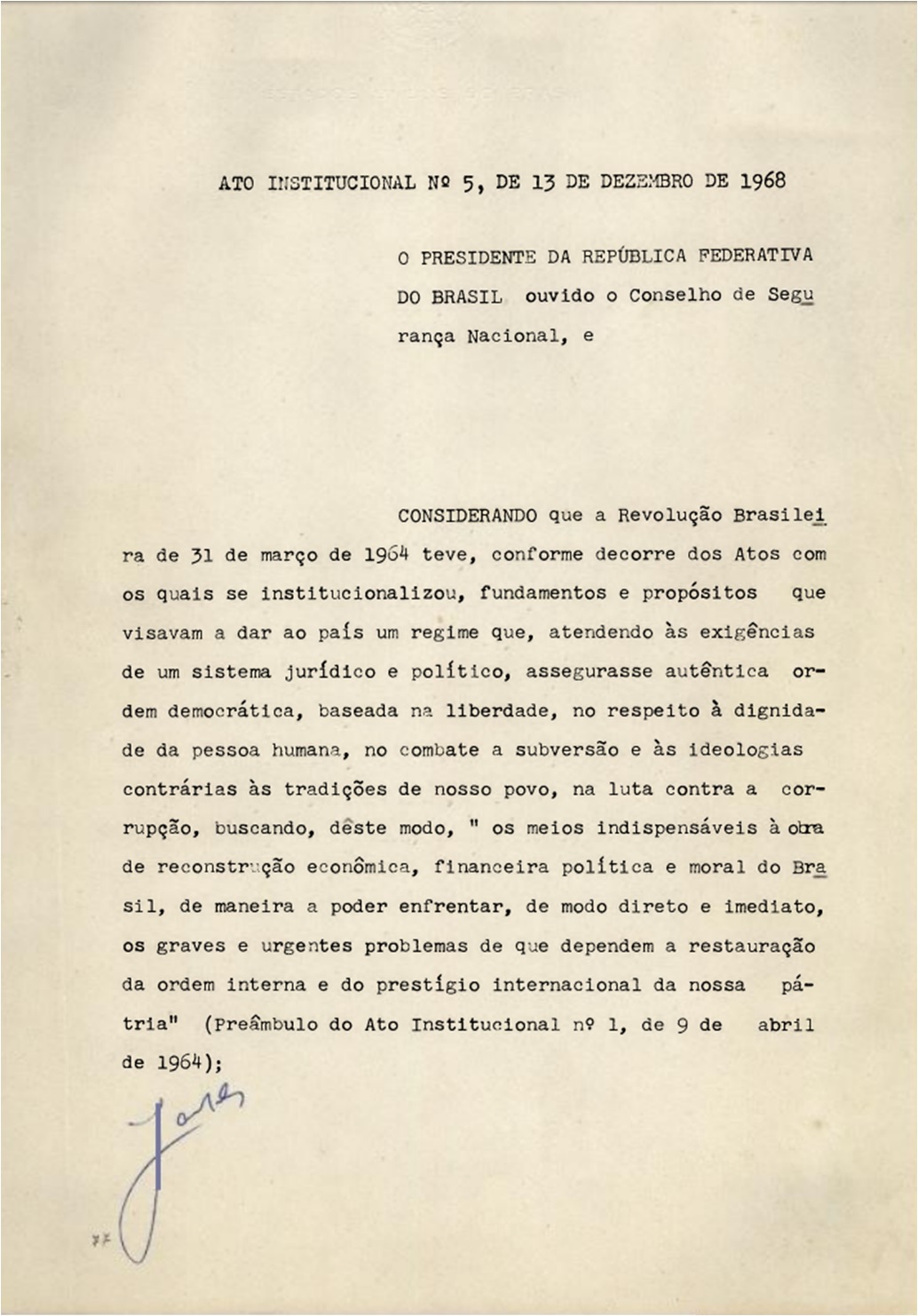
The Institutional Act Number Five (Portuguese: Ato Institucional Número Cinco), commonly known as AI-5, was the fifth of seventeen extra-legal Institutional Acts issued by the military dictatorship in the years following the 1964 Brazilian coup d'état.
The AI-5 suspended most civil rights, including habeas corpus, and allowed the removal from office of opposition politicians, and federal interventions in municipalities and states. It enabled institutionalization of arbitrary detention, torture, and extrajudicial killing by the regime. It was issued by President Artur da Costa e Silva on December 13, 1968.
Institutional Acts were not subject to judicial review, and superseded both the previous 1946 constitution and the 1967 constitution enacted by the regime. By suspending habeas corpus, the AI-5 enabled human rights abuses by the regime.
Sometimes called o golpe dentro do golpe ('the coup within the coup'), the AI-5 was the most impactful of all Institutional Acts.
Written by Minister of Justice Luís Antônio da Gama e Silva, it was a response to reactions against the regime, such as a demonstration by over fifty thousand people in Rio de Janeiro protesting the murder of student Edson Luís de Lima Souto by a member of the state Military Police, the March of the One Hundred Thousand, and the denial by the Chamber of Deputies of authorization to prosecute Congressman Márcio Moreira Alves, who had called Brazilians to boycott the 7 September Independence Day celebrations. It also aimed to consolidate the ambitions of a hardline faction within the regime which was unwilling to relinquish power in the foreseeable future.
A classified meeting held in December 1968 by the military regime's cabinet discussing the introduction of AI-5, discussing legalised torture, etc., was recorded; the recording only came to light decades later. João Pedro Bim made a documentary film, A Portas Fechadas (Behind Closed Doors), in 2023 contrasting propaganda newsreels of the time with the recording to reveal the covert machinations of the dictatorship.
The immediate consequences of the AI-5 were:
The AI-5 did not silence a group of Senators from ARENA, the political party created to give support for the dictatorship. Under the leadership of Daniel Krieger, the following Senators signed a disagreement message addressed to the president: Gilberto Marinho, Miltom Campos, Carvalho Pinto, Eurico Resende, Manoel Villaça, Wilson Gonçalves, Aloisio de Carvalho Filho, Antonio Carlos Konder Reis, Ney Braga, Mem de Sá, Rui Palmeira, Teotônio Vilela, José Cândido Ferraz, Leandro Maciel, Vitorino Freire, Arnon de Melo, Clodomir Milet, José Guiomard, Valdemar Alcântara and Júlio Leite.
Hub AI
Institutional Act Number Five AI simulator
(@Institutional Act Number Five_simulator)
Institutional Act Number Five
The Institutional Act Number Five (Portuguese: Ato Institucional Número Cinco), commonly known as AI-5, was the fifth of seventeen extra-legal Institutional Acts issued by the military dictatorship in the years following the 1964 Brazilian coup d'état.
The AI-5 suspended most civil rights, including habeas corpus, and allowed the removal from office of opposition politicians, and federal interventions in municipalities and states. It enabled institutionalization of arbitrary detention, torture, and extrajudicial killing by the regime. It was issued by President Artur da Costa e Silva on December 13, 1968.
Institutional Acts were not subject to judicial review, and superseded both the previous 1946 constitution and the 1967 constitution enacted by the regime. By suspending habeas corpus, the AI-5 enabled human rights abuses by the regime.
Sometimes called o golpe dentro do golpe ('the coup within the coup'), the AI-5 was the most impactful of all Institutional Acts.
Written by Minister of Justice Luís Antônio da Gama e Silva, it was a response to reactions against the regime, such as a demonstration by over fifty thousand people in Rio de Janeiro protesting the murder of student Edson Luís de Lima Souto by a member of the state Military Police, the March of the One Hundred Thousand, and the denial by the Chamber of Deputies of authorization to prosecute Congressman Márcio Moreira Alves, who had called Brazilians to boycott the 7 September Independence Day celebrations. It also aimed to consolidate the ambitions of a hardline faction within the regime which was unwilling to relinquish power in the foreseeable future.
A classified meeting held in December 1968 by the military regime's cabinet discussing the introduction of AI-5, discussing legalised torture, etc., was recorded; the recording only came to light decades later. João Pedro Bim made a documentary film, A Portas Fechadas (Behind Closed Doors), in 2023 contrasting propaganda newsreels of the time with the recording to reveal the covert machinations of the dictatorship.
The immediate consequences of the AI-5 were:
The AI-5 did not silence a group of Senators from ARENA, the political party created to give support for the dictatorship. Under the leadership of Daniel Krieger, the following Senators signed a disagreement message addressed to the president: Gilberto Marinho, Miltom Campos, Carvalho Pinto, Eurico Resende, Manoel Villaça, Wilson Gonçalves, Aloisio de Carvalho Filho, Antonio Carlos Konder Reis, Ney Braga, Mem de Sá, Rui Palmeira, Teotônio Vilela, José Cândido Ferraz, Leandro Maciel, Vitorino Freire, Arnon de Melo, Clodomir Milet, José Guiomard, Valdemar Alcântara and Júlio Leite.