



Community hub
Recent from talks
Knowledge base stats:
Talk channels stats:
Members stats:
AK-74
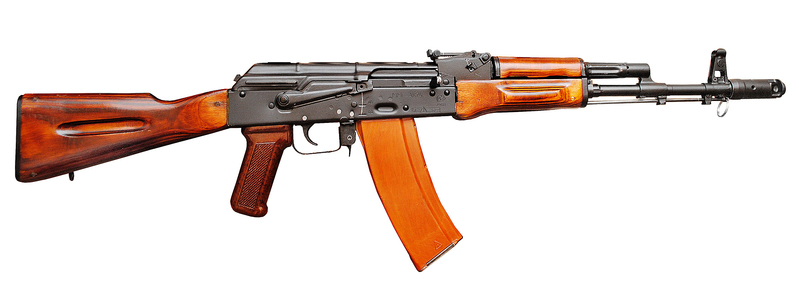
The AK-74 (Russian: Автомат Калашникова образца 1974 года, tr. Avtomat Kalashnikova obraztsa 1974 goda, lit. 'Kalashnikov assault rifle model 1974') is an assault rifle designed by small arms designer Mikhail Kalashnikov in 1974 as a successor to the AKM. While primarily associated with the Soviet Union, it has been used by many countries since the 1970s. It is chambered for the 5.45×39mm cartridge, which replaced the 7.62×39mm cartridge of Kalashnikov's earlier automatic weapons for the Soviet Armed Forces.
The rifle first saw service with Soviet forces in the Soviet–Afghan War from 1979. The head of the Afghan bureau of the Inter-Services Intelligence (ISI), the intelligence agency of Pakistan, claimed that the American Central Intelligence Agency (CIA) paid $5,000 for the first AK-74 captured by the Afghan mujahideen during the war.
As of 2021[update], most countries of the former Soviet Union use the rifle. Licensed copies were produced in Bulgaria (AK-74, AKS-74 and AKS-74U), and in the former East Germany (MPi-AK-74N, MPi-AKS-74N, MPi-AKS-74NK).
The AK-74 was designed by А. D. Kryakushin's group under the design supervision of Mikhail Kalashnikov. It is an adaptation of the 7.62×39mm AKM assault rifle and features several important design improvements. These improvements were primarily the result of converting the rifle to the intermediate-calibre high velocity 5.45×39mm cartridge. In fact, some early models are reported to have been converted AKMs, re-barreled to 5.45×39mm. Compared with the preceding AKM, the AK-74 has better effective firing range, accuracy (a main development goal), and reliability. About 50% of the parts in the AK-74 and AKM are the same (including pins, springs and screws).
The rifle's operation during firing and reloading is identical to that of the AKM. After ignition of the cartridge primer and propellant, rapidly expanding propellant gases are diverted into the gas cylinder above the barrel through a vent near the muzzle. The build-up of gases inside the gas cylinder drives the long-stroke piston and bolt carrier rearward and a cam guide machined into the underside of the bolt carrier along with an ejector spur on the bolt carrier rail guide, rotates the bolt approximately 35° and unlocks it from the barrel extension via a camming pin on the bolt. The moving assembly has about 5.5 mm (0.2 in) of free travel which creates a delay between the initial recoil impulse of the piston and the bolt unlocking sequence, allowing gas pressures to drop to a safe level before the seal between the chamber and the bolt is broken. Like previous Kalashnikov-pattern rifles, the AK-74 does not have a gas valve; excess gases are ventilated through a series of radial ports in the gas cylinder. Since the Kalashnikov operating system offers no primary extraction upon bolt rotation, the 5.45×39mm AK-74 bolt has a larger extractor claw than the 7.62×39mm AKM for increased extraction reliability. Other minor modifications were made to the bolt and carrier assembly.[citation needed]
The rifle received a new barrel with a chrome-lined bore and 4 right-hand grooves at a 200 mm (1:7.87 in) or 37 calibers rifling twist rate. The front sight base and gas block were redesigned. The gas block contains a gas channel that is installed at a 90° angle in relation to the bore axis to reduce bullet shear at the port hole. A pair of support brackets are cast into the gas block assembly and are used to attach a BG-15c or GP-25 underslung 40 mm grenade launcher. Like the AK-47 and AKM, the muzzle is threaded for the installation of various muzzle devices such as the standard muzzle brake or a blank-firing adaptor, while a spring-loaded detent pin held in the front sight post prevents them from unscrewing while firing. However the muzzle threads have been relocated to the front sight base for both easier and more economic replacement in case of thread damage. The distinctive standard-issue muzzle brake features a large expansion chamber, two symmetrical vertical cuts at the forward end of the brake and three non symmetrical positioned vent holes to counteract muzzle rise and climb as well as lateral shift to the right much like the AKM's offset muzzle brake. A flat plate near the end of the brake produces a forward thrust when emerging exhaust gases strike its surface, greatly reducing recoil. The muzzle brake prevents backblast from reaching the firer, although it is reported to be harsh on bystanders as the muzzle gases are dispersed to the sides. The standard-issue AK-74 muzzle brake has been subtly revised several times since the 1970s.
The AK-74 uses an adjustable notched rear tangent iron sight calibrated in 100 m (109 yd) increments from 100 to 1,000 m (109 to 1,094 yd). The front sight is a post adjustable for elevation in the field. Horizontal adjustment requires a special drift tool and is done by the armoury before issue or if the need arises by an armourer after issue. The sight line elements are approximately 48.5 mm (1.9 in) over the bore axis. The "point-blank range" battle zero setting "П" standing for постоянная (constant/consistent/permanent) the 5.45×39mm AK-74 rear tangent sight element corresponds to a 400 m (437 yd) zero, compared with the 300 m (328 yd) zero for 7.62×39mm AKs. For the AK-74 combined with the 7N6 or 7N10 service cartridges the 400 m battle zero setting point-blank range limits the apparent "bullet rise" within approximately −5 to +38 cm (−2.0 to 15.0 in) under the line of sight. At the corresponding 440 m (481 yd) maximum point-blank range the bullet will have dropped to approximately −21 cm (−8.3 in) relative to the line of sight. Soldiers are instructed to fire at any target within this range by simply placing the sights on the center of mass (the belt buckle, according to Russian and former Soviet doctrine) of the enemy target. Any errors in range estimation are tactically irrelevant, as a well-aimed shot will hit the torso of the enemy soldier.
While most Russian and CIS armed forces use the AK-74 in its basic configuration with iron sights, many magnified and non-magnified optical sights are available for designated marksmen and other special purpose troops in their respective militaries.
Hub AI
AK-74 AI simulator
(@AK-74_simulator)
AK-74
The AK-74 (Russian: Автомат Калашникова образца 1974 года, tr. Avtomat Kalashnikova obraztsa 1974 goda, lit. 'Kalashnikov assault rifle model 1974') is an assault rifle designed by small arms designer Mikhail Kalashnikov in 1974 as a successor to the AKM. While primarily associated with the Soviet Union, it has been used by many countries since the 1970s. It is chambered for the 5.45×39mm cartridge, which replaced the 7.62×39mm cartridge of Kalashnikov's earlier automatic weapons for the Soviet Armed Forces.
The rifle first saw service with Soviet forces in the Soviet–Afghan War from 1979. The head of the Afghan bureau of the Inter-Services Intelligence (ISI), the intelligence agency of Pakistan, claimed that the American Central Intelligence Agency (CIA) paid $5,000 for the first AK-74 captured by the Afghan mujahideen during the war.
As of 2021[update], most countries of the former Soviet Union use the rifle. Licensed copies were produced in Bulgaria (AK-74, AKS-74 and AKS-74U), and in the former East Germany (MPi-AK-74N, MPi-AKS-74N, MPi-AKS-74NK).
The AK-74 was designed by А. D. Kryakushin's group under the design supervision of Mikhail Kalashnikov. It is an adaptation of the 7.62×39mm AKM assault rifle and features several important design improvements. These improvements were primarily the result of converting the rifle to the intermediate-calibre high velocity 5.45×39mm cartridge. In fact, some early models are reported to have been converted AKMs, re-barreled to 5.45×39mm. Compared with the preceding AKM, the AK-74 has better effective firing range, accuracy (a main development goal), and reliability. About 50% of the parts in the AK-74 and AKM are the same (including pins, springs and screws).
The rifle's operation during firing and reloading is identical to that of the AKM. After ignition of the cartridge primer and propellant, rapidly expanding propellant gases are diverted into the gas cylinder above the barrel through a vent near the muzzle. The build-up of gases inside the gas cylinder drives the long-stroke piston and bolt carrier rearward and a cam guide machined into the underside of the bolt carrier along with an ejector spur on the bolt carrier rail guide, rotates the bolt approximately 35° and unlocks it from the barrel extension via a camming pin on the bolt. The moving assembly has about 5.5 mm (0.2 in) of free travel which creates a delay between the initial recoil impulse of the piston and the bolt unlocking sequence, allowing gas pressures to drop to a safe level before the seal between the chamber and the bolt is broken. Like previous Kalashnikov-pattern rifles, the AK-74 does not have a gas valve; excess gases are ventilated through a series of radial ports in the gas cylinder. Since the Kalashnikov operating system offers no primary extraction upon bolt rotation, the 5.45×39mm AK-74 bolt has a larger extractor claw than the 7.62×39mm AKM for increased extraction reliability. Other minor modifications were made to the bolt and carrier assembly.[citation needed]
The rifle received a new barrel with a chrome-lined bore and 4 right-hand grooves at a 200 mm (1:7.87 in) or 37 calibers rifling twist rate. The front sight base and gas block were redesigned. The gas block contains a gas channel that is installed at a 90° angle in relation to the bore axis to reduce bullet shear at the port hole. A pair of support brackets are cast into the gas block assembly and are used to attach a BG-15c or GP-25 underslung 40 mm grenade launcher. Like the AK-47 and AKM, the muzzle is threaded for the installation of various muzzle devices such as the standard muzzle brake or a blank-firing adaptor, while a spring-loaded detent pin held in the front sight post prevents them from unscrewing while firing. However the muzzle threads have been relocated to the front sight base for both easier and more economic replacement in case of thread damage. The distinctive standard-issue muzzle brake features a large expansion chamber, two symmetrical vertical cuts at the forward end of the brake and three non symmetrical positioned vent holes to counteract muzzle rise and climb as well as lateral shift to the right much like the AKM's offset muzzle brake. A flat plate near the end of the brake produces a forward thrust when emerging exhaust gases strike its surface, greatly reducing recoil. The muzzle brake prevents backblast from reaching the firer, although it is reported to be harsh on bystanders as the muzzle gases are dispersed to the sides. The standard-issue AK-74 muzzle brake has been subtly revised several times since the 1970s.
The AK-74 uses an adjustable notched rear tangent iron sight calibrated in 100 m (109 yd) increments from 100 to 1,000 m (109 to 1,094 yd). The front sight is a post adjustable for elevation in the field. Horizontal adjustment requires a special drift tool and is done by the armoury before issue or if the need arises by an armourer after issue. The sight line elements are approximately 48.5 mm (1.9 in) over the bore axis. The "point-blank range" battle zero setting "П" standing for постоянная (constant/consistent/permanent) the 5.45×39mm AK-74 rear tangent sight element corresponds to a 400 m (437 yd) zero, compared with the 300 m (328 yd) zero for 7.62×39mm AKs. For the AK-74 combined with the 7N6 or 7N10 service cartridges the 400 m battle zero setting point-blank range limits the apparent "bullet rise" within approximately −5 to +38 cm (−2.0 to 15.0 in) under the line of sight. At the corresponding 440 m (481 yd) maximum point-blank range the bullet will have dropped to approximately −21 cm (−8.3 in) relative to the line of sight. Soldiers are instructed to fire at any target within this range by simply placing the sights on the center of mass (the belt buckle, according to Russian and former Soviet doctrine) of the enemy target. Any errors in range estimation are tactically irrelevant, as a well-aimed shot will hit the torso of the enemy soldier.
While most Russian and CIS armed forces use the AK-74 in its basic configuration with iron sights, many magnified and non-magnified optical sights are available for designated marksmen and other special purpose troops in their respective militaries.