Hubbry Logo
AN/ARC-5AN/ARC-5Main
Open search
AN/ARC-5
Community hub
AN/ARC-5
logo
8 pages, 0 posts
0 subscribers
Be the first to start a discussion here.
AN/ARC-5
AN/ARC-5
from Wikipedia

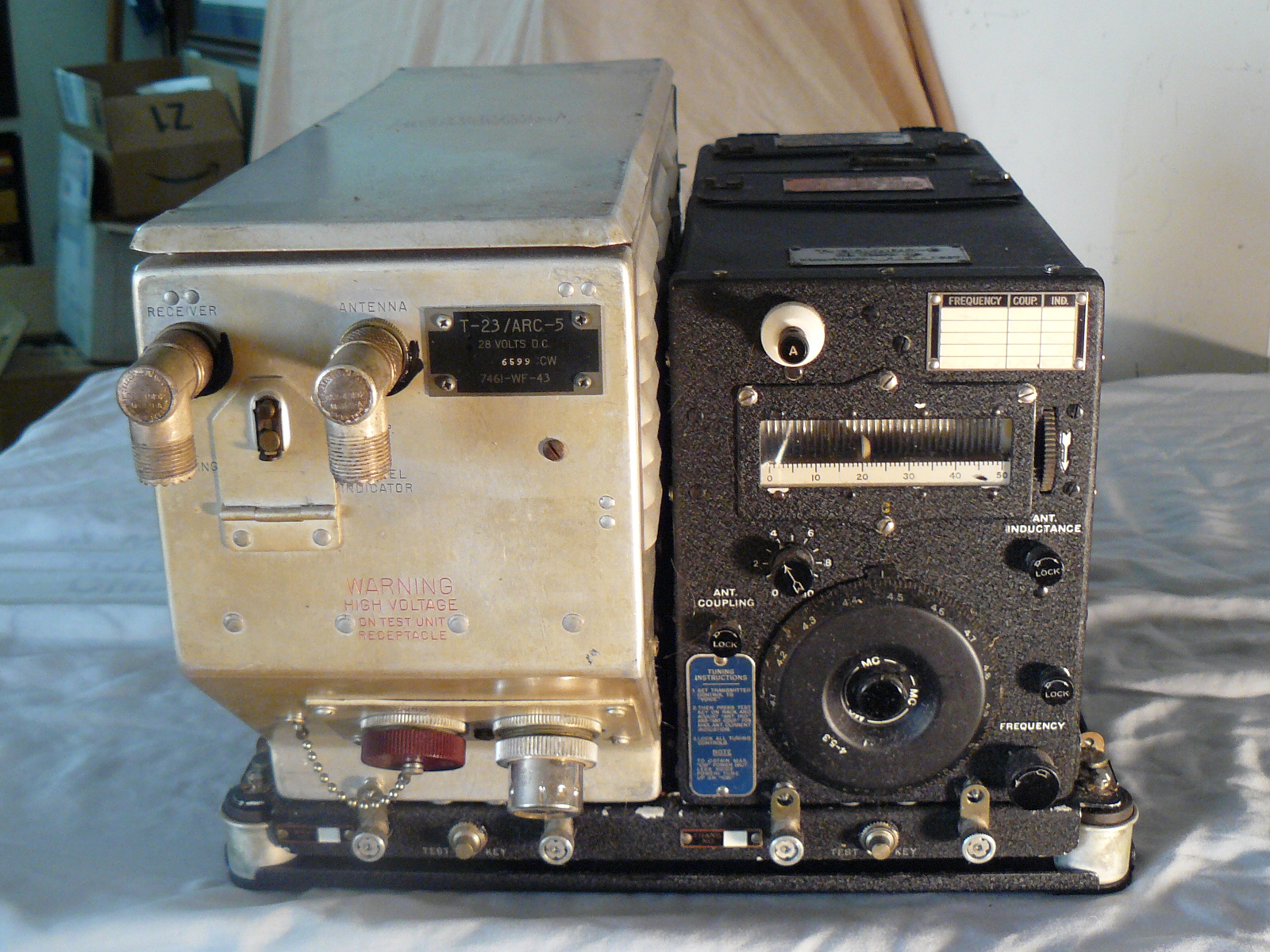
VHF transmitter T-23/ARC-5 and HF transmitter T-20/ARC-5 on rack MT-71/ARC-5.

The AN/ARC-5 Command Radio Set is a series of radio receivers, transmitters, and accessories carried aboard U.S. Navy aircraft during World War II and for some years afterward. It is described as "a complete multi-channel radio transmitting and receiving set providing communication and navigation facilities for aircraft. The LF-MF-HF components are designed to transmit and receive voice, tone-modulated, and continuous wave (cw) signals."[1]: 1  Its flexible design provided AM radiotelephone voice communication and Modulated continuous wave (MCW) and Continuous wave (CW) Morse code modes, all of which are typical capabilities in other Navy aircraft communication sets of the period. It was an improvement of the Navy's ARA/ATA command set. Similar units designated SCR-274-N were used in U.S. Army aircraft. The Army set is based on the ARA/ATA, not the later AN/ARC-5. The ARA/ATA and SCR-274-N series are informally referred to as "ARC-5", despite small differences that render all three series incompatible. Like the AN/ARC-5, the ARA/ATA and SCR-274-N had AM voice communication and two-way MCW and CW Morse code capability.[1]

In accordance with the Joint Electronics Type Designation System (JETDS), the "AN/ARC-5" designation represents the 5th design of an Army-Navy airborne electronic device for radio communications equipment. The JETDS system also now is used to name all Department of Defense electronic systems.

History

[edit]

The AN/ARC-5 command set was used by the US Navy from the latter part of World War II into the post-war era. It was fitted in many different aircraft types for communication between aircraft, navigation, and communication back to base. Units were available that covered much of the MF, HF, and VHF spectrum. Despite the use of octal base vacuum tubes, they were compact, rugged and light weight. Many became surplus after the war and were often converted for amateur radio use. The term 'ARC-5', while correctly applied to the AN/ARC-5 series, has also come to be a generic, though incorrect, term for the ARA/ATA and SCR-274-N command set units, including those designed by the Aircraft Radio Corporation in the late 1930s.[2]

The antecedent of the AN/ARC-5 system was the U.S. Navy's ARA/ATA system, initially deployed in 1940. The designations ARA and ATA are a pre-World War II Navy equipment nomenclature. The major units of the ARA are five receivers covering 0.19 to 9.1 MHz (1,577.86 to 32.94 m), each unit with its own dynamotor power supply. The major units of the ATA are five transmitters covering 2.1 to 9.1 MHz (142.76 to 32.94 m), using a common transmitter dynamotor/screen modulator unit. Most units were made by the Aircraft Radio Corporation (USN manufacturer's code CBY). Many units were also made by Stromberg-Carlson (USN manufacturer's code CCT).

To equip US Army Air Corps planes, the US Army adopted in 1941 a reduced set of radios from the ARA/ATA range. Designated SCR-274-N, these Army radios were electrically almost identical to their ARA/ATA counterparts, except for receiver output and modulator sidetone audio transformer output impedance. Structurally and in appearance, they were virtually identical except for most later units being left unpainted aluminum in contrast to the black wrinkle finish of the Navy sets. The designation SCR-274-N is a pre-World War II Army equipment nomenclature. The Army never acquired the ARA 1.5 to 3 MHz (199.86 to 99.93 m) receiver, nor the ATA 2.1 to 3.0 MHz (142.76 to 99.93 m) transmitter. Initially, it did not acquire the 3.0 to 4.0 MHz (99.93 to 74.95 m) transmitter, nor the 0.52 to 1.5 MHz (576.52 to 199.86 m) receiver, but the need to communicate on the common civil airfield frequency of 3.105 MHz (96.55 m) plus the anticipated USAAF use of the AN/ARR-1 homing adapter (see below) compelled adding these units to the SCR-274-N. Early Army units were made by Aircraft Radio Corporation, but the vast majority was made by Western Electric, plus a few by Colonial Radio and others.

In late 1943, the U.S. Navy fielded an improved and more flexible set of its ARA/ATA radios under the new Joint Army-Navy (JAN) nomenclature of AN/ARC-5. Structurally and in appearance, the AN/ARC-5 series is almost identical to the former units but both receivers and transmitters are somewhat different electrically. A receiver and transmitter were added that provide four-channel crystal-controlled VHF-AM operation, along with a rarely encountered set of transmitters that provide coverage of 0.5 to 2.1 MHz (599.58 to 142.76 m).

The main units of both the Navy and the Army systems were usually installed in three-receiver racks and two-transmitter racks. Units not in service could be stored on board the aircraft, just as one would store tuning units of other types of radio equipment.

Specifications

[edit]

The following is a table of ARA/ATA, SCR-274-N, and AN/ARC-5 major components that could comprise a typical three-receiver, two-transmitter installation, with other configurations also being possible. In addition, several miscellaneous components are listed. A blank in the component ID column indicates that no equivalent unit existed for that system. A.R.C. refers to Aircraft Radio Corporation.[3]: 3 

MHz ARA-ATA SCR-274-N AN/ARC-5
Navigation Receiver (Beacon Band) 0.19 - 0.55 CBY-46129 BC-453-(*) R-23(†)/ARC-5
Navigation Receiver (Broadcast Band) 0.52 - 1.5 CBY-46145 BC-946-(*) R-24/ARC-5
Communication Receiver 1.5 - 3.0 CBY-46104[a] R-25/ARC-5
Communication Receiver 3.0 - 6.0 CBY-46105[b] BC-454-(*) R-26/ARC-5
Communication Receiver 6.0 - 9.1 CBY-46106[c] BC-455-(*) R-27/ARC-5
Communication Receiver - Four Channel 100 - 156 R-28/ARC-5
Communication Receiver - Continuously Tunable 100 - 125 R-112/ARC-5
Communication Receiver - Continuously Tunable 125 - 156 R-113/ARC-5
Special Use Transmitter 0.5 - 0.8 T-15/ARC-5
Special Use Transmitter 0.8 - 1.3 T-16/ARC-5
Special Use Transmitter 1.3 - 2.1 T-17/ARC-5
Communication Transmitter 2.1 - 3.0 CBY-52232 T-18/ARC-5
Communication Transmitter 3.0 - 4.0 CBY-52208 BC-696-A T-19/ARC-5
Communication Transmitter 4.0 - 5.3 CBY-52209 BC-457-A T-20/ARC-5
Communication Transmitter 5.3 - 7.0 CBY-52210 BC-458-A T-21/ARC-5
Communication Transmitter 7.0 - 9.1 CBY-52211 BC-459-A T-22/ARC-5
Communication Transmitter - Four Channel 100 - 156 T-23/ARC-5
Communication Transmitter - Continuously Tunable 100 - 125 T-89/ARC-5
Communication Transmitter - Continuously Tunable 125 - 156 T-90/ARC-5
Communication Transmitter - Four Channel 100 - 146 T-126/ARC-5
Transmitter Modulator CBY-50083 BC-456-(*) MD-7/ARC-5
Transmitter Modulator Mount CBY-50084 FT-225-A MT-76/ARC-5
MF/HF Antenna Relay CBY-29125 BC-442-(‡) RE-2/ARC-5
MF/HF Antenna Relay Mount CBY-29126 FT-229-A MT-77/ARC-5
Receiver Adapter, ILS (AN/ARN-9) Audio MX-19/ARC-5
Receiver Adapter, ZB (AN/ARR-1) Power CBY-62036 FT-310-A MX-20/ARC-5
Receiver Adapter, Remote Control Blank CBY-49107[d] FT-230-A MX-21/ARC-5
Receiver Local Tuning Knob A.R.C. 6743 MC-237 A.R.C. 6743
Receiver Adapter, Local Control Panel CBY-23154[e] FT-260-A C-24/ARC-5
Nav. Receiver ANT-LOOP Remote Control C-25/ARC-5
Single Tunable Receiver Control Box CBY-23261 BC-473-A C-26/ARC-5
Single Lock-Tuned Receiver Control Box C-27/ARC-5
Single Tunable Receiver Control Mount A.R.C. 7053 FT-235-A MT-4/ARR-2
Three-Receiver Remote Control Box CBY-23251 BC-450-A C-38A/ARC-5
Three-Receiver Remote Control Mount A.R.C. 7054 FT-222-A MT-98/ARC-5
Four-Transmitter Remote Control Box CBY-23243 BC-451-A C-30(†)/ARC-5
Four-Transmitter Remote Control Mount A.R.C. 7083 FT-228-A MT-80/ARC-5
Three-Receiver Rack CBY-46149 FT-220-A MT-65/ARC-5
Three-Receiver Rack Mount CBY-46150 FT-221-A MT-64/ARC-5
Two-Transmitter Rack CBY-52212 FT-226-A MT-71/ARC-5
Two-Transmitter Rack Mount CBY-52213 FT-227-A MT-70/ARC-5
Audio Jack Box J-22/ARC-5
Audio Jack Box Mount MT-78/ARC-5
Receiver Dynamotor CBY-21531[f] DM-32-A DY-2(†)/ARR-2
Transmitter Dynamotor CBY-21626 DM-33-A DY-8/ARC-5
Receiver Remote Tuning Shaft A.R.C. 6151 MC-215-A A.R.C. 6151
Tuning Shaft Right Angle A.R.C. 6357 MC-211-A MX-22/ARR-2
Homing Adapter 234 - 258 ZB-series R-1/ARR-1 R-1/ARR-1
Homing Receiver 234 - 258 R-4(†)/ARR-2

Notes:

(*) A (basic model) or B (1st revision). (†) No letter (basic model) or A (revision). (‡) A (basic model) or AM (field modified to remove vacuum capacitor).

LF/MF/HF receivers all use an almost identical 6-tube superhet design: r.f. amplifier (12SK7), converter (12K8), two i.f. stages (two 12SK7's(4), or 12SK7/12SF7(5)), diode detector/BFO (12SR7), and one audio stage (12A6). Transmitters use four tubes: 1626 oscillator, two 1625 finals, and 1629 magic-eye tuning. The latter allows a check of the dial calibration by giving a visual indication, viewable by raising a small cover, when the oscillator's frequency matches that of an internal crystal.
(4)ARA and SCR-274-N. (5)AN/ARC-5.

Compatibility between systems

[edit]

Audio frequency receiver output and modulator sidetone impedance for the ARA/ATA and the AN/ARC-5 is 300 to 600 ohms. In the SCR-274-N "-A" version, the receiver and modulator impedance is 4000 ohms, while "-B" and later version units have a 250 ohm tap on the AF transformers which can be connected.

ARA/ATA units and equivalent SCR-274-N units are interchangeable between systems, aside from audio impedance differences. However, AN/ARC-5 units generally are not interchangeable with the units of the earlier systems.

In contrast to ARA and SCR-274-N receivers, all AN/ARC-5 receivers have automatic volume control and a modified tube complement. The AN/ARC-5 navigation receivers have terminals and a switch to connect a DU-series direction finding loop to the receiver, and have a special audio line for an MX-19/ARC-5 adapter to allow the receiver to serve as an LF/MF localizer for the Navy's short-lived AN/ARN-9 Air-Track (related to ZA, ZAX) instrument landing system. These two capabilities were rarely if ever utilized. Otherwise, equivalent receivers of all three systems can interchange as a unit.

Few transmitter components of the AN/ARC-5 are interchangeable with ATA or SCR-274-N equivalent units. Mechanically, the transmitter rear power connector is slightly different, so inserting the wrong transmitter in a rack can damage either the rack or the transmitter power connector. Electrically, AN/ARC-5 transmitters use high-level final amplifier plate modulation, and the output tank circuit is shunt high voltage fed. The two earlier systems use less effective screen modulation, and the output circuit is series high voltage fed. The only electrical components of the AN/ARC-5 transmitter system that are interchangeable with the earlier systems are the dynamotor and the antenna relay.

Unlike earlier systems, none of the AN/ARC-5 control boxes have audio jacks for the microphone, headphone, or key. A separate jack box is used instead. AN/ARC-5 transmitter control boxes contain no Morse key.

Homing adaptors and VHF

[edit]

The broadcast band receiver in all of these command sets is intended to host a homing adapter for the Navy ZB/YE homing system. The homing adapter demodulates a signal near 246 MHz (1.22 m) that is modulated with a broadcast band carrier. The output is sent to the broadcast band receiver tuned to the modulating frequency to further demodulate the carrier for voice messages or for a Morse code letter indicating to the pilot his bearing from the homing transmitter. All broadcast band receivers came with a power adapter to supply power to the homing adapter. The adapter under the Navy nomenclature system is the ZB-series. The identical unit under JAN nomenclature is the AN/ARR-1. This system was used by both the Navy extensively and the Army much less so. To put the system into operation on the aircraft, the beacon band receiver would be replaced in the rack by the broadcast band receiver. The antenna post is connected to the output of the homing adapter, and a power cable is connected from the homing adapter to the broadcast band receiver. The normal control that had been used for the beacon band receiver also serves this homing system without further reconfiguration.

Western Electric developed the AN/ARR-2, an all-in-one homing receiver that replaced the broadcast band receiver and external homing adapter and had other enhancements as well. The R-4A/ARR-2 uses the same dynamotor as the AN/ARC-5 sets, fits in the same racks, and can be controlled by special AN/ARC-5 control boxes. The AN/ARR-2 replaced the earlier R-24/ARC-5 and R-1/ARR-1 combo in AN/ARC-5 installations.

Western Electric developed a four-channel crystal-controlled VHF-AM receiver and transmitter for the U.S. Army's SCR-274-N system. The Army did not adopt these VHF components to any extent because of the move to a common British/American VHF capability in the form of the Bendix SCR-522 VHF-AM set. That remained Army policy until the arrival of the AN/ARC-3. The Navy adopted modified versions of the Western Electric units as the R-28/ARC-5 receiver and T-23/ARC-5 transmitter. The T-126/ARC-5 is a late variant of the T-23 which allowed the four channels to be grouped in a 100 to 146 MHz (3.00 to 2.05 m) tuning range, smaller than the T-23's.

Typical configuration

[edit]
SCR-274N Command Radio

A typical installation of ARA/ATA or SCR-274-N sets would consist of a 3 to 6 MHz (99.93 to 49.97 m), a 190 to 550 kHz (1,577.86 to 545.08 m), and a 6 to 9.1 MHz (49.97 to 32.94 m) receiver in a three-unit rack. Any two transmitters covering the desired frequency ranges would be in the transmitter rack. The two transmitters would be fixed-tuned before take-off, with the pilot able to select the desired transmitter and control the mode (Voice, MCW, CW) at the transmitter control box. The receivers were tuned at the pilot's control box by electrical cables and long mechanical tuning shafts, allowing remote control of power, mode, frequency, and volume.

AN/ARC-5 set composition and control differed markedly from the earlier systems. Three-unit receiver racks were still predominant, but the receiver line-up was quite different. One receiver would usually be a R-4A homing receiver, another the VHF R-28/ARC-5, and the last an MF/HF communication receiver. The transmitter rack would hold a VHF T-23/ARC-5 and an MF/HF transmitter corresponding to the MF/HF receiver. Frequency-stabilized versions of the AN/ARC-5 communications receivers usually have a yellow circle-S stamped on the front panel. Such receivers were not remotely tuned by the pilot, but were instead lock-tuned to the associated transmitter's frequency before take-off. AN/ARC-5 navigation receivers are not so stabilized, and if installed in the rack a control that allows remote tuning is required.

Because of these characteristics, AN/ARC-5 close equivalents to the control boxes of the ARA/ATA and SCR-274-N are rare or never existed. The most common AN/ARC-5 receiver remote control box is the C-38/ARC-5, which allows control only of audio volume of the VHF and MF/HF receivers. No power, mode, or frequency controls are present. The C-38 also has controls for the R-4A homing receiver. A common AN/ARC-5 transmitter control box C-30A/ARC-5 has controls for selecting the MF/HF transmitter or the VHF transmitter, and a switch to select the channel for both the VHF transmitter and receiver. Mode controls are normally set for voice and covered.

The typical AN/ARC-5 three-receiver, two-transmitter installation reflects system capabilities that are quite sophisticated compared to the earlier systems, allowing VHF homing, four channel VHF-AM communications, and one channel MF/HF-AM communications. All unnecessary controls have been eliminated to simplify operation of this more capable system.

Aircraft Radio Corporation, along with Stromberg-Carlson, made most AN/ARC-5 units except for the Western Electric VHF units.

Legacy

[edit]

The AN/ARC-5 certainly represents the climax development of the pre-war MF/HF command set. But its VHF AN/ARC-5 set and the AN/ARR-2 homing adapter presaged a move toward higher frequencies. During World War II, the Navy began a slow movement toward VHF-AM for command functions in theaters where it made sense, beginning with the Western Electric WE-233A commercial airline set which was later re-designated the AN/ARC-4. By 1943 they began deploying their own AN/ARC-1 ten-channel VHF-AM set in increasing numbers, but hedged their bets with the AN/ARC-5 VHF sets in certain aircraft. This experimentation even caused them to contract for and officially nomenclature a continuously tunable AN/ARC-5 VHF capability from Aircraft Radio Corporation for evaluation purposes, shown in the above chart, but by that time (latter part of 1944) channelized equipment became the preferred technology to reduce aircrew "fiddling" with controls, so it was not pursued beyond the evaluation quantities. By late war, the discovery of "ducting" in the lower VHF band (that allowed Japanese tactical radio intercepts over long distances under certain conditions) drove development of the AN/ARC-12 (UHF version of the AN/ARC-1) and AN/ARC-27 sets in currently-used UHF-AM military aircraft band. However, it is important to understand that this gradual movement to VHF was not accomplished overnight, and there were still pockets of documented HF command set employment through war's end, especially in smaller aircraft.

In terms of longevity, the AN/ARR-2 continued into service well into the 1950s, and the beacon band R-23A/ARC-5 receiver was still to be found in some older US Navy aircraft as late as the 1970s.

Amateur radio use

[edit]
Two war-surplus command set receivers series modified for amateur radio use by replacing the front connector with a small control panel

After World War II, surplus HF receivers and transmitters of the AN/ARC-5 family were extensively used in amateur radio stations. According to CQ magazine publisher Wayne Green, they first appeared for public purchase in March 1947, with thousands eventually becoming available, making them "by far the most popular surplus item to appear on the market." Green's magazine alone published some 47 articles on converting command sets to amateur use over the following 10 years, reprinting them in a compendium in 1957.[3]: pp. 3–5  Interest has continued into the 21st century.[4]

Other users

[edit]

The T-16 and T-17 transmitters which operated in the standard broadcast band were very hard to find on the surplus market but were used by some as low power "pirate" AM stations with the addition of a modulation transformer in the B+ line and a suitable audio amplifier which was a 50 watt PA, guitar, or 'HI-FI home entertainment amplifier. The tuning system would allow the rig to be loaded into almost any kind of vertical or dipole antenna for neighborhood and beyond AM broadcasting. The on air fidelity of the unit was very good. One T-17 was used on 1580 by three different operators at three different locations in the Chicago suburbs as a pirate station in the 1960s with the local FCC office raiding each station at its location. The last raided operator repurposed the ARC5 as a driver for an ultrasonic nebulizer.

[edit]

See also

[edit]

References

[edit]

Further reading

[edit]
[edit]
Revisions and contributorsEdit on WikipediaRead on Wikipedia
from Grokipedia
The AN/ARC-5 is a modular series of low- to high-frequency (LF/HF) radio command sets developed for aircraft communication and navigation, consisting of interchangeable transmitters, receivers, control units, and associated accessories that cover frequencies from approximately 190 kHz to 9.1 MHz. Designed primarily for the U.S. Navy, the system features dedicated units such as transmitters T-15 through T-22 for voice and CW transmission, and receivers R-23 through R-27 for superheterodyne reception across low-frequency (LF) to high-frequency bands. It includes control boxes like the C-39 for remote tuning and modulators such as the MD-7 for amplitude modulation, all mounted in shock-resistant racks for aviation environments. Originating from designs by the Aircraft Radio Corporation in the mid-1930s, the AN/ARC-5 evolved as an improved successor to earlier systems like the Army's SCR-274N and the Navy's ARA/ATA series, incorporating more compact, vibration-resistant components and simplified tuning mechanisms to meet wartime demands. Production ramped up in the early 1940s, with the sets entering widespread service in the latter half of World War II aboard bombers, fighters, and patrol aircraft for air-to-air coordination, ground liaison, and direction-finding operations. Notable variants include stabilized receivers (e.g., R-25S, R-26S, R-27S) with temperature-compensated oscillators for fixed-frequency reliability in harsh conditions, marked by a yellow "S" insignia. Post-war, the AN/ARC-5 saw continued use in civilian aviation and military surplus applications, including early VHF extensions (e.g., T-23/R-28 sets operating 100-156 MHz). Its rugged design and broad adaptability made it a staple in vintage radio restoration and amateur operations, with components like the R-23A range receiver remaining in service into the 1960s.

Development and History

Origins and Predecessors

The AN/ARC-5 radio system originated from designs by the Aircraft Radio Corporation in the mid-1930s and emerged amid the rapid expansion of U.S. military aviation during World War II, driven by the need for standardized, modular high-frequency (HF) command radios that could support reliable, interchangeable communications across diverse aircraft platforms. Its primary predecessors were the U.S. Navy's ARA/ATA command set, introduced in 1940 as a multi-channel HF system for naval aircraft featuring rack-mounted components, and the nearly identical SCR-274N adopted by the U.S. Army Air Corps shortly after May 1940 for similar short-range operations in Army aircraft. These systems addressed early wartime communication demands but relied on separate Army and Navy designations, leading to procurement inefficiencies and interoperability challenges. A pivotal influence was the establishment of the Joint Army-Navy (JAN) nomenclature system on February 16, 1943, which aimed to replace fragmented equipment designations with unified ones to streamline joint military operations and production. Additionally, initial Western Electric prototypes in 1942, including the VHF-capable T-23/ARC-5 transmitter and R-28/ARC-5 receiver, provided modular design precedents that shaped the series' flexibility. The AN/ARC-5 was formalized in early 1943 as an enhanced iteration of the ARA/ATA and SCR-274N, incorporating JAN standardization to better meet the escalating demands of WWII aviation communications.

Introduction and WWII Production

The AN/ARC-5 command radio set was formally designated in 1943 under the newly adopted Joint Army-Navy (JAN) nomenclature system, which unified disparate Army and Navy equipment designations to streamline wartime procurement and interoperability. As a direct successor to the earlier SCR-274N system, it standardized airborne radio communications for both services, building on the SCR-274N's modular design while incorporating refinements for broader frequency coverage and reliability in combat environments. This transition marked a pivotal shift toward integrated military electronics, with the AN/ARC-5 encompassing a suite of receivers, transmitters, and control units optimized for aircraft operations. Production of the AN/ARC-5 scaled rapidly from initial 1943 prototypes, driven by urgent wartime demands, and was handled by key contractors including the Aircraft Radio Corporation (primary designer), Stromberg-Carlson, Western Electric, and Foote, Pierson & Company. These efforts involved subcontracting for high-volume output, with early runs focusing on Navy needs before broader Army Air Forces adoption, contributing to a total series production exceeding 1.45 million sets when including predecessors and variants, making it one of the most prolifically produced military radio systems of the era. Although initial deployments missed the early Pacific Theater campaigns following the 1941 Pearl Harbor attack, the AN/ARC-5 achieved standard status by mid-1943, rapidly integrating into frontline aircraft such as the Navy's Grumman F6F Hellcat fighter and the Army Air Forces' Boeing B-29 Superfortress bomber for essential voice and command functions. This timely rollout enhanced tactical coordination in carrier-based and long-range bombing operations, supplanting older systems amid escalating air warfare. Wartime production encountered significant challenges, including supply chain disruptions from shortages of critical vacuum tubes and electronic components, which strained manufacturing timelines despite prioritized military contracts. These bottlenecks, exacerbated by global material rationing, necessitated innovative subcontracting and quality controls to maintain output for the Allied war effort.

Design and Components

Core Receivers and Transmitters

The core of the AN/ARC-5 aircraft radio system consists of modular superheterodyne receivers and transmitters optimized for high-frequency communication in aviation environments, with each unit designed for seamless integration into aircraft racks. The receiver lineup emphasizes crystal-controlled local oscillators for frequency stability, enabling precise spot tuning on fixed channels without frequent readjustments. Key models include the R-26/ARC-5, covering 3 to 6 MHz, and similar units like the R-25/ARC-5 (1.5 to 3 MHz) and R-27/ARC-5 (6 to 9.1 MHz), which incorporate an RF amplification stage to enhance signal capture in noisy airborne conditions. These receivers support standard voice and continuous wave (CW) modes, facilitating both amplitude-modulated speech and Morse code operations essential for WWII-era military communications. The transmitter components are similarly modular, powered by individual dynamotors that convert 28 V DC aircraft supply to the high voltages needed for operation, ensuring reliability without reliance on external power sources. Representative models encompass the T-19/ARC-5 (3 to 4 MHz) and T-20/ARC-5 (4 to 5.3 MHz), delivering variable power outputs of 10 W for voice modulation and up to 50 W for CW in lower bands, with higher-band units like the T-22/ARC-5 (7 to 9.1 MHz) following comparable specifications. This dynamotor integration minimizes weight and complexity, making the system suitable for installation in fighters, bombers, and patrol aircraft. A hallmark of the AN/ARC-5 design is its emphasis on interchangeability and ease of maintenance, with receivers and transmitters built to standard dimensions for mounting in dedicated aircraft racks such as the MT-75 series, allowing quick swaps of units within the same frequency band during field repairs. Overall, the system provides comprehensive band coverage across low- to high-frequency ranges, with the core units forming a 5-band HF framework extensible to 10 bands when incorporating VHF modules like the R-28/ARC-5 receiver.

Control and Mounting Units

The control and mounting units of the AN/ARC-5 radio set provided critical support for integrating the core receivers and transmitters into aircraft, handling operator interfaces, power conversion, and physical securing while ensuring reliability in demanding aviation environments. These components were designed for modularity, allowing flexible configurations across different aircraft power systems and mission requirements. Key control units included the C-24/ARC-5 and C-25/ARC-5, which managed band switching and antenna/loop selection for single or multiple receivers, enabling efficient frequency changes without direct access to the remote-mounted units. The C-27/ARC-5 served as a stabilized receiver control box, restricting full tuning access to prevent inadvertent adjustments during flight; it featured a yellow "S" marking on the audio switch for "stabilized" mode, limiting operations to RF gain and on/off functions for enhanced safety. The C-30/ARC-5 functioned as the primary transmitter control unit, offering switches for operating mode, band selection, and power level to facilitate voice or CW transmission. Power supplies relied on dynamotors for voltage conversion from aircraft DC systems to the high-voltage DC needed for vacuum tube operation in the receivers and transmitters. The DY-1/ARR-2 dynamotor was designed for 12 VDC input aircraft, outputting 250 VDC at approximately 85 mA to power receiver filaments and plates. The DY-2/ARR-2 variant supported 28 VDC inputs, providing comparable high-voltage DC output for similar low-power applications in the receiver chain, ensuring compatibility with standard WWII-era aircraft electrical systems. Mounting hardware emphasized ruggedness and ease of maintenance, with the MT-5/ARR-2 serving as a shock-absorbing base for a single receiver and the MT-7/ARR-2 as a rack tray for secure assembly of one or more units. These mounts incorporated quick-release latches and connectors, permitting in-flight or ground swaps of components to minimize downtime. A typical AN/ARC-5 configuration, including one to three receivers, dynamotors, and controls but excluding full transmitter and cabling, weighed 50 to 70 pounds, varying by the number of installed units. For carrier-based aircraft, these units often received specialized waterproofing treatments to protect against salt spray and humidity during naval operations. Antenna couplers, such as the AT-7, were integrated to optimize transmitter matching to aircraft antennas, enhancing signal efficiency across bands.

Technical Specifications

Frequency Bands and Coverage

The AN/ARC-5 radio system is structured around discrete frequency bands in the medium-frequency (MF) to high-frequency (HF) range to facilitate reliable aircraft communications. The transmitters provide coverage from 0.5 to 9.1 MHz, including three MF bands via T-15 (0.5–0.8 MHz), T-16 (0.8–1.3 MHz), and T-17 (1.3–2.1 MHz), plus five HF bands via T-18 (2.1–3.0 MHz), T-19 (3.0–4.0 MHz), T-20 (4.0–5.3 MHz), T-21 (5.3–7.0 MHz), and T-22 (7.0–9.1 MHz). The receivers extend from 0.19 to 9.1 MHz, with two lower-frequency navigation bands via R-23 (0.19–0.55 MHz) and R-24 (0.52–1.5 MHz), plus three primary HF communication bands via R-25 (1.5–3.0 MHz), R-26 (3.0–6.0 MHz), and R-27 (6.0–9.1 MHz). Continuous coverage within each band is achieved through manual adjustment of variable capacitors in the tuning circuits, allowing for precise frequency selection across the range without gaps. Tuning in the AN/ARC-5 relies on a crystal oscillator to generate the local injection signal for the superheterodyne receiver, ensuring stable operation, while the transmitter uses similar crystal-controlled master oscillators for frequency accuracy. Band selection is performed manually via dedicated control boxes (such as the C-27/ARC-5), which switch between the plug-in receiver and transmitter units mounted in the equipment rack, prioritizing simplicity and ruggedness for airborne use without the complexity of a variable frequency oscillator (VFO). This design choice enhances reliability in harsh aviation environments, where mechanical simplicity reduces failure points during flight. The frequency coverage of the AN/ARC-5 was specifically tailored for long-range HF skywave propagation, enabling beyond-line-of-sight communications critical for naval aviation command and control over oceanic distances. Early designs omitted VHF bands due to their inherent line-of-sight limitations, which were unsuitable for extended-range operations in aircraft far from bases or ships. Specific frequency allocations in the AN/ARC-5 align with established military HF channels, supporting amplitude modulation (AM) for voice and continuous wave (CW) for Morse code, with typical channel spacing of 6 kHz for AM.

Power and Performance Characteristics

The AN/ARC-5 radio set draws power from the standard 28 V DC aircraft bus, utilizing dynamotors to generate the required high voltages for receiver and transmitter circuits. Individual dynamotors supply high voltage to the receivers, while a dedicated dynamotor mounted on the transmitter rack provides power for transmission functions. During transmission, the total current draw reaches 15-20 A, with specific measurements indicating 8.8 A for CW emission and lower standby consumption around 2.5 A. Performance metrics of the AN/ARC-5 emphasize its suitability for voice and CW communications in airborne environments. Receiver sensitivity achieves approximately -100 dBm, enabling detection of weak signals in the designated frequency bands. The transmitter delivers 10-50 W peak envelope power (PEP) in AM mode, with documented maximum outputs of 15 W carrier per transmitter under 28 V DC input, varying by band. Selectivity is provided by a 6-10 kHz bandwidth, tailored for AM voice channels while rejecting adjacent interference. Reliability features ensure operation under harsh aircraft conditions, including vibration-proof construction rated up to 5 G to withstand turbulence and maneuvers. The system operates across a temperature range of -40°C to +55°C, with components designed for altitudes up to 40,000 feet. These attributes stem from ruggedized vacuum-tube architecture and military specifications for aviation use. Despite its robustness, the AN/ARC-5 exhibits limitations in high-noise environments, where aircraft-generated interference and static can degrade reception. It lacks built-in diversity reception, relying on a single antenna path without automatic switching to mitigate fading or multipath effects.

Installation and Operation

Typical Aircraft Configurations

The AN/ARC-5 command radio set was installed in various U.S. Navy aircraft during World War II, with configurations adapted to the size, role, and operational environment of the platform. In single-engine fighters like the F4U Corsair, a streamlined setup typically included select HF transmitters (e.g., T-15 through T-22) and receivers (e.g., R-24 through R-27) for MF/HF coverage, mounted in compact racks behind the pilot to minimize electromagnetic interference from the engine. These installations prioritized space efficiency and quick access, often using 2-4 unit racks for essential voice and CW communications during carrier operations. Larger multi-engine bombers employed more extensive configurations with 6-8 or more units, including multiple transmitters and receivers racked in the fuselage or bomb bay areas, often with remote control boxes like the C-29/ARC-5 for operation from the navigator's or radio operator's station. This allowed for coordinated long-range HF communications in patrol and anti-submarine roles, with dynamotors like the DY-8/ARC-5 providing power conversion from the aircraft's 28-volt DC system. Inter-unit cabling routed power, control signals, and audio through junction boxes such as the J-17/ARC-5, ensuring reliable connections in the confined aircraft environment. Antenna integration featured coaxial cables like RG-8/U for VHF elements, while HF sections connected to trailing wire antennas deployed from fuselage reels in larger aircraft for extended range. Whip or dipole antennas were common for fixed HF installations, with the system designed to share antenna relays like the RE-2/ARC-5 across components. Configurations varied between carrier-based and land-based variants to address vibration and space constraints; carrier fighters used shock-mounted racks like the MT-62 series for durability during catapult launches and arrested landings, whereas land-based scouts often featured minimal 4-unit setups for reconnaissance, contrasting with full 10+ unit arrays in heavy bombers for comprehensive command functions. Integration with IFF systems, such as the AN/MPX-2, allowed shared antenna usage without compromising radio performance. Operation involved remote tuning via control units like the C-39/ARC-5, with power from the 28-volt DC aircraft supply via dynamotors.

Compatibility with Other Systems

The AN/ARC-5 command radio set demonstrated significant interoperability with U.S. Army Air Forces equipment, particularly through its close relation to the SCR-274N system, which served as its Army counterpart. Receivers such as the R-26/ARC-5 (3-6 MHz) were electrically and mechanically interchangeable with the BC-454/SCR-274N, sharing identical frequency bands, tuning mechanisms, and plug configurations for seamless integration in mixed-service aircraft or joint operations. Similarly, the BC-348 receiver, widely used in Army sets like the SCR-274N, could interface with AN/ARC-5 transmitters via standard audio plugs and shared intermediate frequency stages, enabling voice and CW protocols without modification. The VHF components of the AN/ARC-5, including the R-28/ARC-5 receiver and T-23/ARC-5 transmitter operating in the 100-156 MHz band, overlapped with the SCR-522's 100-156 MHz coverage, allowing direct compatibility for short-range air-to-air and air-to-ground communications in combined Army-Navy formations. For ground and naval integration, the AN/ARC-5 linked effectively with shipboard and shore-based systems through frequency overlap in HF and VHF bands. The TBY radio set (equivalent to SCR-610), a Navy VHF trainer operating at 100-156 MHz, shared channels with the AN/ARC-5 VHF units, facilitating command net coordination during carrier operations or amphibious landings. Likewise, the shore-based AN/ARC-8 medium liaison set covered 2-10 MHz in HF, aligning with the AN/ARC-5's core HF receivers (e.g., R-27/ARC-5 at 6-9 MHz), which supported AM voice and CW modes for long-range air-to-ground links in joint theater networks. Junction boxes like the J-17/ARC-5 distributed power and control signals across mixed Army-Navy racks, accommodating plugs from both services to enable protocol alignment for voice modulation and CW keying without adapters in standard installations. Despite these strengths, the AN/ARC-5 faced limitations in joint operations with Allied forces, particularly early British systems. Band mismatches arose with British HF equipment like the T1154 transmitter (1.5-5 MHz), which had partial overlap but required precise frequency coordination to avoid interference in shared theaters, as U.S. sets emphasized broader 2-18 MHz coverage. VHF compatibility with British TR.1140 sets (38-45 MHz initially, later aligned to 100-156 MHz) demanded channel reprogramming for joint air operations, highlighting the need for interoperability protocols in multinational commands. These challenges were mitigated through theater-specific netting plans but underscored the AN/ARC-5's design focus on U.S. unilateral use.

Accessories and Enhancements

Homing Adaptors

The homing adaptors for the AN/ARC-5 radio set were essential direction-finding accessories that enabled aircraft navigation by detecting and orienting toward radio beacons, particularly in low-visibility conditions. The primary device was the AN/ARR-1 homing adaptor (Navy ZB-series), which featured a loop antenna and was part of the top-secret YE-ZB "Hayrake" system. It integrated with the R-24/ARC-5 receiver by receiving VHF signals in the 234-258 MHz range from ship- or ground-based transmitters, demodulating them, and feeding the audio output to the R-24 tuned to a medium-frequency subcarrier (500-1500 kHz) for bearing determination via the loop. This integration allowed the R-24's capabilities to be extended for VHF homing applications, with the adaptor connecting via the receiver's dedicated loop input terminal and power supplied by the MX-20/ARC-5 adapter. Operation of the AN/ARR-1 relied on the null-peak method, where pilots rotated the loop antenna to identify the direction of minimum (null) or maximum (peak) signal strength from the beacon. This technique was especially valuable for beacon homing during adverse weather or night operations, allowing aircraft to home in on ground or ship-based transmitters over long distances where visual references were unavailable. The adaptor was typically mounted externally on the aircraft fuselage or tail for optimal signal reception, with control handled through the C-38/ARC-5 control box, which included switches for antenna selection and volume adjustment. During World War II, these homing adaptors played a critical role in carrier aircraft returns and search-and-rescue missions, enhancing operational safety and effectiveness in the Pacific theater.

VHF and Additional Modules

The VHF components of the AN/ARC-5 system provided short-range amplitude-modulated voice communication capabilities in the very high frequency band, augmenting the core high-frequency equipment for tactical aircraft operations. The R-28/ARC-5 receiver covered 100-156 MHz across four crystal-controlled channels, enabling reception of liaison signals with an intermediate frequency of 6.9 MHz and utilizing ten vacuum tubes for amplification and frequency conversion. This receiver, weighing 14.5 pounds, featured a 300-ohm output impedance that could be adapted to 4000 ohms using an equalizer for compatibility with aircraft interphone systems. Complementing the receiver, the T-23/ARC-5 transmitter operated in the same 100-156 MHz range and four channels, delivering 6-10 watts of carrier power into a 50-ohm antenna for AM voice transmission. It employed four vacuum tubes, including a 1625 oscillator and 832A power amplifier, and required plate and screen modulation via the separate MD-7/ARC-5 modulator unit, which included a dynamotor for power conversion. The transmitter weighed 12.3 pounds and drew up to 9.8 amperes at 28 volts DC during transmission. Additional modules enhanced VHF functionality, including the C-39/ARC-5 auxiliary control box, which facilitated channel selection and microphone switching without integrated audio amplification. For interference rejection and signal optimization, components like the BC-9424 equalizer matched impedances and reduced noise in the receiver output circuit. Channel crystals, such as DC-30 units, were user-replaceable to align with specific operational frequencies, typically preset for military liaison bands. These VHF extensions were inherently limited to line-of-sight propagation due to the frequencies involved, restricting range to visual horizons in aircraft applications. The addition of the full VHF receiver-transmitter suite, including controls and modulator, increased installation weight by approximately 25-30 pounds, impacting aircraft payload considerations. Post-1945, surplus AN/ARC-5 VHF units were adapted for civilian and amateur radio use through crystal retuning and power supply modifications, extending their service in non-military communications.

Military and Post-War Use

WWII Operational Roles

The AN/ARC-5 command radio set served as a cornerstone for command and control in U.S. Navy carrier strike operations during World War II, particularly in the Pacific Theater starting from mid-1943, where it enabled real-time coordination between aircraft squadrons and surface vessels such as destroyers through its high-frequency (HF) transmission capabilities. It supported carrier-based offensives, such as those in the Gilbert and Marshall Islands campaigns, by providing essential voice communications for directing air wings during long-range strikes against Japanese naval forces. In the Pacific Theater, the AN/ARC-5 demonstrated notable reliability when installed in various Navy fighter and patrol aircraft, allowing squadron leaders to maintain formation integrity and relay tactical updates over extended missions. However, operators encountered challenges with signal propagation fading, especially beyond 500 miles, which could disrupt communications in vast oceanic environments and required careful frequency management to mitigate. Key enhancements, such as remote tuning mechanisms accessible to pilots via control boxes like the C-38/ARC-5, allowed in-flight adjustments without diverting attention from combat duties, improving operational efficiency in dynamic scenarios. Additionally, the AN/ARC-5 integrated with radar systems, including homing receivers like the AN/ARR-2, to facilitate combined operations where radio direction-finding supported vectoring aircraft toward targets or carriers during night or adverse weather conditions. Overall, the AN/ARC-5's versatility enabled around-the-clock communications across naval task forces, significantly enhancing coordination and contributing to the success of major carrier battles by minimizing disruptions from miscommunication.

Legacy Applications

Following World War II, surplus AN/ARC-5 equipment was retained in U.S. military reserves and saw continued service through the Korean War era (1950-1953), with components integrated into aircraft communications systems. Later adaptations appeared in some Cold War trainer and reserve aircraft, providing multi-channel HF and VHF capabilities for training missions. The AN/ARC-5 gained widespread popularity among amateur radio operators due to its robust design and coverage of HF bands from 80 to 10 meters. In the 1950s, detailed conversion guides published in QST magazine and the ARRL Handbook enabled hams to modify receivers like the R-23 and transmitters such as the T-22 for legal amateur band operation, including frequency retuning and power supply adjustments for 117 VAC civilian use. These adaptations emphasized the set's modular nature, allowing simple coil swaps to align with ham allocations while retaining original AM/CW modulation. Amateur radio enthusiasts formed dedicated groups to restore and operate AN/ARC-5 units for vintage events and historical reenactments, focusing on receivers like the R-23/ARC-5 for its sensitivity in the 3-6 MHz range. Restoration efforts often involve recapping wax-paper capacitors and rewiring dynamotors, preserving the equipment's vacuum-tube architecture for authentic QSOs on legacy frequencies. Post-war, the VHF variants of the AN/ARC-5 found immediate civilian applications in the newly allocated 108-136 MHz band for air traffic control and general aviation, bridging military surplus to peacetime infrastructure. Equipment also supported auxiliary roles in organizations like Civil Air Patrol for emergency communications and maritime auxiliaries for short-range HF links. By the 1960s, the AN/ARC-5 was largely replaced by solid-state radios offering greater reliability and reduced size, rendering the tube-based sets obsolete for active military and commercial duty. As of 2025, surplus units remain accessible at amateur radio swap meets (hamfests), where collectors acquire them for restoration projects, though operational use is confined to historical demonstrations due to parts scarcity and regulatory shifts toward digital modes. Today, examples are preserved in aviation museums, such as the National Naval Aviation Museum.

References

Add your contribution
Related Hubs
User Avatar
No comments yet.