



Community hub
Recent from talks
Knowledge base stats:
Talk channels stats:
Members stats:
Amplitude modulation
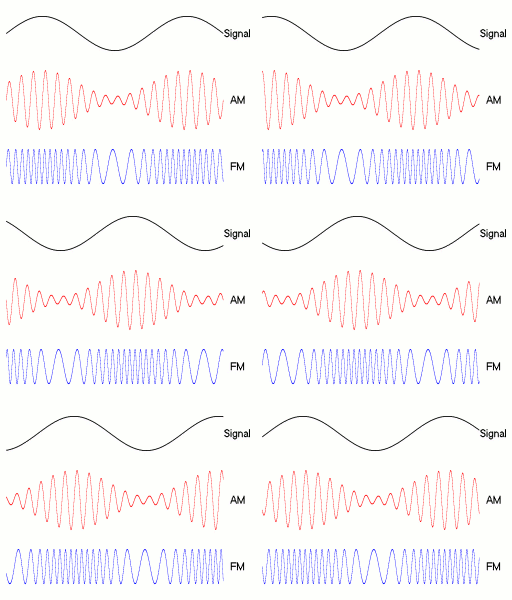
Amplitude modulation (AM) is a signal modulation technique used in electronic communication, most commonly for transmitting messages with a radio wave. In amplitude modulation, the instantaneous amplitude of the wave is varied in proportion to that of the message signal, such as an audio signal. This technique contrasts with angle modulation, in which either the frequency of the carrier wave is varied, as in frequency modulation, or its phase, as in phase modulation.
AM was the earliest modulation method used for transmitting audio in radio broadcasting. It was developed during the first quarter of the 20th century beginning with Roberto Landell de Moura and Reginald Fessenden's radiotelephone experiments in 1900. This original form of AM is sometimes called double-sideband amplitude modulation (DSBAM), because the standard method produces sidebands on either side of the carrier frequency. Single-sideband modulation uses bandpass filters to eliminate one of the sidebands and possibly the carrier signal, which improves the ratio of message power to total transmission power, reduces power handling requirements of line repeaters, and permits better bandwidth utilization of the transmission medium.
AM remains in use in many forms of communication in addition to AM broadcasting: shortwave radio, amateur radio, two-way radios, VHF aircraft radio, citizens band radio, and in computer modems in the form of quadrature amplitude modulation (QAM).
In electronics and telecommunications, modulation is the variation of a property of a continuous wave carrier signal according to an information-bearing signal, such as an audio signal which represents sound, or a video signal which represents images. In this sense, the carrier wave, which has a much higher frequency than the message signal, carries the information. At the receiving station, the message signal is extracted from the modulated carrier by demodulation.
In general form, a modulation process of a sinusoidal carrier wave may be described by the following equation:
A(t) represents the time-varying amplitude of the sinusoidal carrier wave and the cosine-term is the carrier at its angular frequency , and the instantaneous phase deviation . This description directly provides the two major groups of modulation, amplitude modulation and angle modulation. In angle modulation, the term A(t) is constant and the second term of the equation has a functional relationship to the modulating message signal. Angle modulation provides two methods of modulation, frequency modulation and phase modulation.


In amplitude modulation, the angle term is held constant and the first term, A(t), of the equation has a functional relationship to the modulating message signal.
The modulating message signal may be analog in nature, or it may be a digital signal, in which case the technique is generally called amplitude-shift keying.
Hub AI
Amplitude modulation AI simulator
(@Amplitude modulation_simulator)
Amplitude modulation
Amplitude modulation (AM) is a signal modulation technique used in electronic communication, most commonly for transmitting messages with a radio wave. In amplitude modulation, the instantaneous amplitude of the wave is varied in proportion to that of the message signal, such as an audio signal. This technique contrasts with angle modulation, in which either the frequency of the carrier wave is varied, as in frequency modulation, or its phase, as in phase modulation.
AM was the earliest modulation method used for transmitting audio in radio broadcasting. It was developed during the first quarter of the 20th century beginning with Roberto Landell de Moura and Reginald Fessenden's radiotelephone experiments in 1900. This original form of AM is sometimes called double-sideband amplitude modulation (DSBAM), because the standard method produces sidebands on either side of the carrier frequency. Single-sideband modulation uses bandpass filters to eliminate one of the sidebands and possibly the carrier signal, which improves the ratio of message power to total transmission power, reduces power handling requirements of line repeaters, and permits better bandwidth utilization of the transmission medium.
AM remains in use in many forms of communication in addition to AM broadcasting: shortwave radio, amateur radio, two-way radios, VHF aircraft radio, citizens band radio, and in computer modems in the form of quadrature amplitude modulation (QAM).
In electronics and telecommunications, modulation is the variation of a property of a continuous wave carrier signal according to an information-bearing signal, such as an audio signal which represents sound, or a video signal which represents images. In this sense, the carrier wave, which has a much higher frequency than the message signal, carries the information. At the receiving station, the message signal is extracted from the modulated carrier by demodulation.
In general form, a modulation process of a sinusoidal carrier wave may be described by the following equation:
A(t) represents the time-varying amplitude of the sinusoidal carrier wave and the cosine-term is the carrier at its angular frequency , and the instantaneous phase deviation . This description directly provides the two major groups of modulation, amplitude modulation and angle modulation. In angle modulation, the term A(t) is constant and the second term of the equation has a functional relationship to the modulating message signal. Angle modulation provides two methods of modulation, frequency modulation and phase modulation.
In amplitude modulation, the angle term is held constant and the first term, A(t), of the equation has a functional relationship to the modulating message signal.
The modulating message signal may be analog in nature, or it may be a digital signal, in which case the technique is generally called amplitude-shift keying.