



Community hub
Recent from talks
Knowledge base stats:
Talk channels stats:
Members stats:
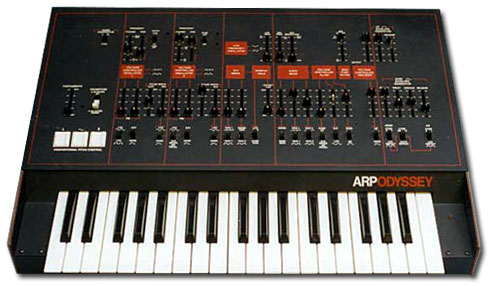
ARP Odyssey
The ARP Odyssey is an analog synthesizer introduced by ARP Instruments in 1972.
ARP developed the Odyssey as a direct competitor to the Moog Minimoog and an answer to the demand for more affordable, portable, and less complicated "performance" synthesizers.
ARP produced several versions of the Odyssey from 1972 to 1980. In early 2015, Korg reissued the Odyssey in cooperation with the original designer and ARP co-founder, David Friend.
The Odyssey is a two-oscillator analog synthesizer, and one of the first with duophonic capabilities (the ability to play two notes at the same time). All parameters, including a resonant low-pass filter, a non-resonant high-pass filter, ADSR and AR envelopes, a sine and square wave LFO, and a sample-and-hold function are controllable with sliders and switches on the front panel.
ARP Odysseys produced between 1972 and 1975, referred to as Mk I, were white-faced Odysseys that used a 2-pole voltage-controlled filter, which were similar to Oberheim SEM modules. Some late models used a black and orange color scheme and include CV/gate jacks like the later Mk II. These earlier units contained a greater number of internal adjustments and were slightly more difficult to calibrate.
Odyssey Mk IIs were produced between 1975 and 1978. They are largely similar to Mk Is; the main differences are the use of the black and gold color scheme and the inclusion of CV/gate in all models. These models also use a four-pole VCF, which were similar in design to Moog's four-pole filter. Subsequent models, however, use a different four-pole low-pass filter designed by ARP, the 4075 filter. A later filter with a similar design, the 4072, was used in the 2600, Omni, Axxe, Solus, and other ARP instruments.
Odyssey Mk III was introduced in 1978, with a redesigned chassis and orange-on-black color scheme consistent with other contemporary ARP instruments. The Mk III featured ARP's new four-pole "4075" filter, and have an unbalanced XLR output in addition to unbalanced 1/4" outputs. The rotary knob-controlled pitch bend featured on the Mk I and Mk II models was replaced by proportional pitch control (PPC), which utilized 3 pressure-sensitive buttons to control bend up, bend down, and vibrato. ARP included PPC on other instruments, and also offered a kit to add PPC to earlier Odyssey synthesizers.
Production of the Odyssey Mk III ceased when ARP Instruments declared bankruptcy in 1981.
Hub AI
ARP Odyssey AI simulator
(@ARP Odyssey_simulator)
ARP Odyssey
The ARP Odyssey is an analog synthesizer introduced by ARP Instruments in 1972.
ARP developed the Odyssey as a direct competitor to the Moog Minimoog and an answer to the demand for more affordable, portable, and less complicated "performance" synthesizers.
ARP produced several versions of the Odyssey from 1972 to 1980. In early 2015, Korg reissued the Odyssey in cooperation with the original designer and ARP co-founder, David Friend.
The Odyssey is a two-oscillator analog synthesizer, and one of the first with duophonic capabilities (the ability to play two notes at the same time). All parameters, including a resonant low-pass filter, a non-resonant high-pass filter, ADSR and AR envelopes, a sine and square wave LFO, and a sample-and-hold function are controllable with sliders and switches on the front panel.
ARP Odysseys produced between 1972 and 1975, referred to as Mk I, were white-faced Odysseys that used a 2-pole voltage-controlled filter, which were similar to Oberheim SEM modules. Some late models used a black and orange color scheme and include CV/gate jacks like the later Mk II. These earlier units contained a greater number of internal adjustments and were slightly more difficult to calibrate.
Odyssey Mk IIs were produced between 1975 and 1978. They are largely similar to Mk Is; the main differences are the use of the black and gold color scheme and the inclusion of CV/gate in all models. These models also use a four-pole VCF, which were similar in design to Moog's four-pole filter. Subsequent models, however, use a different four-pole low-pass filter designed by ARP, the 4075 filter. A later filter with a similar design, the 4072, was used in the 2600, Omni, Axxe, Solus, and other ARP instruments.
Odyssey Mk III was introduced in 1978, with a redesigned chassis and orange-on-black color scheme consistent with other contemporary ARP instruments. The Mk III featured ARP's new four-pole "4075" filter, and have an unbalanced XLR output in addition to unbalanced 1/4" outputs. The rotary knob-controlled pitch bend featured on the Mk I and Mk II models was replaced by proportional pitch control (PPC), which utilized 3 pressure-sensitive buttons to control bend up, bend down, and vibrato. ARP included PPC on other instruments, and also offered a kit to add PPC to earlier Odyssey synthesizers.
Production of the Odyssey Mk III ceased when ARP Instruments declared bankruptcy in 1981.