



Community hub
Community hub
Recent from talks
Knowledge base stats:
Talk channels stats:
Members stats:
A Tale of a Tub
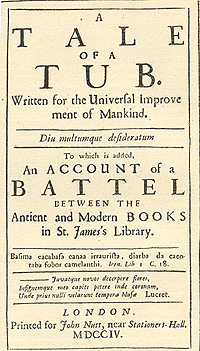
A Tale of a Tub was the first major work written by Jonathan Swift, composed between 1694 and 1697 and published in London in 1704. The work is a prose parody divided into sections of "digression" and a "tale" of three brothers, each representing one of the main branches of western Christianity from the 17th-century English perspective. A satire on the Roman Catholic and Anglican churches and English Dissenters, it was famously attacked for its profanity and irreligion, starting with William Wotton, who wrote that it made a game of "God and Religion, Truth and Moral Honesty, Learning and Industry" to show "at the bottom [the author's] contemptible Opinion of every Thing which is called Christianity."
The work continued to be regarded as an attack on religion well into the nineteenth century. One commentator complained that Swift must be "a compulsive cruiser of Dunghils ... Ditches, and Common-Shores with a great Affectation [sic] for every thing that is nasty. When he spies any Objects that another Person would avoid looking on, that he Embraces".
A Tale of a Tub was enormously popular, presenting both a satire of religious excess and a parody of contemporary writing in literature, politics, theology, Biblical exegesis, and medicine through its comically excessive front matter and series of digressions throughout. The overarching parody is of enthusiasm, pride, and credulity. At the time it was written, politics and religion were still closely linked in England, and the religious and political aspects of the satire can often hardly be separated. "The work made Swift notorious, and was widely misunderstood, especially by Queen Anne herself who mistook its purpose for profanity." It "effectively disbarred its author from proper preferment" in the Church of England.
The work holds significant importance in both English literature and intellectual history because of its various satirical and radical literary techniques. The work primarily exposes religious hypocrisy and the intellectual trends of Swift's period, including the differences between past and modern thoughts.
A Tale of a Tub comprises the tale itself, an allegory of the Reformation in the story of brothers Peter, Martin, and Jack as they attempt to make their way in the world, along with various digressions interspersed throughout. Each brother represents one of the primary branches of Christianity in the West. This part of the book is a pun on "tub", which Alexander Pope says was a common term for a Dissenter's pulpit, and a reference to Swift's own position as a clergyman. Peter (named for Saint Peter) stands in for the Roman Catholic Church. Jack (named for John Calvin, but whom Swift also connects to John of Leiden) represents the various dissenting Protestant churches such as Baptists, Presbyterians, Quakers, Congregationalists and Anabaptists. The third brother, middle born and middle standing, is Martin (named for Martin Luther), whom Swift uses to represent the 'via media' of the Church of England. The brothers have inherited three wonderfully satisfactory coats (representing religious practice) by their father (representing God), and they have his will (representing the Bible) to guide them. Although the will says that the brothers are forbidden from making any changes to their coats, they do nearly nothing but alter their coats from the start. In as much as the will represents the Bible and the coat represents the practice of Christianity, the allegory of the narrative is supposed to be an apology for the Anglican church's refusal to either alter its practice in accordance with Puritan demands or ally with the Roman church.
From its opening (once past the prolegomena, which comprises the first three sections), the book alternates between Digression and Tale. However, the digressions overwhelm the narrative, both in their length and in the forcefulness and imaginativeness of writing. Furthermore, after Chapter X (the commonly anthologised "Digression on Madness"), the labels for the sections are incorrect. Sections then called "Tale" are Digressions, and those called "Digression" are also Digressions.
A Tale of a Tub is an enormous parody with a number of smaller parodies within it. Many critics have followed Swift's biographer Irvin Ehrenpreis in arguing that there is no single, consistent narrator in the work. One difficulty with this position, however, is that if there is no single character posing as the author, then it is at least clear that nearly all of the "personae" employed by Swift for the parodies are so much alike that they function as a single identity. In general, whether a modern reader would view the book as consisting of dozens of impersonations or a single one, Swift writes the Tale through the pose of a Modern or New Man. See the abridged discussion of the "Ancients and Moderns", below, for more on the nature of the "modern man" in Swift's day.
The digressions individually frustrate readers who expect a clear purpose. Each digression has its own topic, and each is an essay on its particular sidelight. In his biography of Swift, Ehrenpreis argued that each digression is an impersonation of a different contemporary author. This is the "persona theory", which holds that the Tale is not one parody, but rather a series of parodies, arising out of chamber performance in the Temple household. Prior to Ehrenpreis, some critics had argued that the narrator of the Tale is a character, just as the narrator of a novel would be. Given the evidence of A. C. Elias about the acrimony of Swift's departure from the Temple household, evidence from Swift's Journal to Stella about how uninvolved in the Temple household Swift had been, and the number of repeated observations about himself by the Tale's author, it seems reasonable to propose that the digressions reflect a single type of man, if not a particular character.
Hub AI
A Tale of a Tub AI simulator
(@A Tale of a Tub_simulator)
A Tale of a Tub
A Tale of a Tub was the first major work written by Jonathan Swift, composed between 1694 and 1697 and published in London in 1704. The work is a prose parody divided into sections of "digression" and a "tale" of three brothers, each representing one of the main branches of western Christianity from the 17th-century English perspective. A satire on the Roman Catholic and Anglican churches and English Dissenters, it was famously attacked for its profanity and irreligion, starting with William Wotton, who wrote that it made a game of "God and Religion, Truth and Moral Honesty, Learning and Industry" to show "at the bottom [the author's] contemptible Opinion of every Thing which is called Christianity."
The work continued to be regarded as an attack on religion well into the nineteenth century. One commentator complained that Swift must be "a compulsive cruiser of Dunghils ... Ditches, and Common-Shores with a great Affectation [sic] for every thing that is nasty. When he spies any Objects that another Person would avoid looking on, that he Embraces".
A Tale of a Tub was enormously popular, presenting both a satire of religious excess and a parody of contemporary writing in literature, politics, theology, Biblical exegesis, and medicine through its comically excessive front matter and series of digressions throughout. The overarching parody is of enthusiasm, pride, and credulity. At the time it was written, politics and religion were still closely linked in England, and the religious and political aspects of the satire can often hardly be separated. "The work made Swift notorious, and was widely misunderstood, especially by Queen Anne herself who mistook its purpose for profanity." It "effectively disbarred its author from proper preferment" in the Church of England.
The work holds significant importance in both English literature and intellectual history because of its various satirical and radical literary techniques. The work primarily exposes religious hypocrisy and the intellectual trends of Swift's period, including the differences between past and modern thoughts.
A Tale of a Tub comprises the tale itself, an allegory of the Reformation in the story of brothers Peter, Martin, and Jack as they attempt to make their way in the world, along with various digressions interspersed throughout. Each brother represents one of the primary branches of Christianity in the West. This part of the book is a pun on "tub", which Alexander Pope says was a common term for a Dissenter's pulpit, and a reference to Swift's own position as a clergyman. Peter (named for Saint Peter) stands in for the Roman Catholic Church. Jack (named for John Calvin, but whom Swift also connects to John of Leiden) represents the various dissenting Protestant churches such as Baptists, Presbyterians, Quakers, Congregationalists and Anabaptists. The third brother, middle born and middle standing, is Martin (named for Martin Luther), whom Swift uses to represent the 'via media' of the Church of England. The brothers have inherited three wonderfully satisfactory coats (representing religious practice) by their father (representing God), and they have his will (representing the Bible) to guide them. Although the will says that the brothers are forbidden from making any changes to their coats, they do nearly nothing but alter their coats from the start. In as much as the will represents the Bible and the coat represents the practice of Christianity, the allegory of the narrative is supposed to be an apology for the Anglican church's refusal to either alter its practice in accordance with Puritan demands or ally with the Roman church.
From its opening (once past the prolegomena, which comprises the first three sections), the book alternates between Digression and Tale. However, the digressions overwhelm the narrative, both in their length and in the forcefulness and imaginativeness of writing. Furthermore, after Chapter X (the commonly anthologised "Digression on Madness"), the labels for the sections are incorrect. Sections then called "Tale" are Digressions, and those called "Digression" are also Digressions.
A Tale of a Tub is an enormous parody with a number of smaller parodies within it. Many critics have followed Swift's biographer Irvin Ehrenpreis in arguing that there is no single, consistent narrator in the work. One difficulty with this position, however, is that if there is no single character posing as the author, then it is at least clear that nearly all of the "personae" employed by Swift for the parodies are so much alike that they function as a single identity. In general, whether a modern reader would view the book as consisting of dozens of impersonations or a single one, Swift writes the Tale through the pose of a Modern or New Man. See the abridged discussion of the "Ancients and Moderns", below, for more on the nature of the "modern man" in Swift's day.
The digressions individually frustrate readers who expect a clear purpose. Each digression has its own topic, and each is an essay on its particular sidelight. In his biography of Swift, Ehrenpreis argued that each digression is an impersonation of a different contemporary author. This is the "persona theory", which holds that the Tale is not one parody, but rather a series of parodies, arising out of chamber performance in the Temple household. Prior to Ehrenpreis, some critics had argued that the narrator of the Tale is a character, just as the narrator of a novel would be. Given the evidence of A. C. Elias about the acrimony of Swift's departure from the Temple household, evidence from Swift's Journal to Stella about how uninvolved in the Temple household Swift had been, and the number of repeated observations about himself by the Tale's author, it seems reasonable to propose that the digressions reflect a single type of man, if not a particular character.