



Community hub
Community hub
Recent from talks
Knowledge base stats:
Talk channels stats:
Members stats:
ABBA
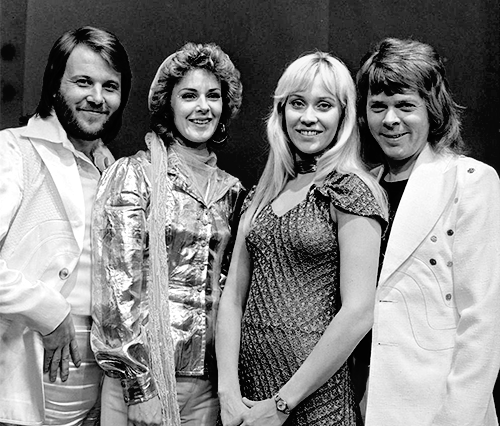
ABBA (/ˈæbə/ ⓘ AB-ə [ˈâbːa]) were a Swedish pop group formed in Stockholm in 1972 by Agnetha Fältskog, Björn Ulvaeus, Benny Andersson, and Anni-Frid Lyngstad. They are among the most renowned and commercially successful musical groups in history.
In 1974, ABBA won the Eurovision Song Contest for Sweden with their song "Waterloo". In 2005, 'Waterloo" was chosen as the best song in the competition's history during its 50th anniversary celebration. During their peak, ABBA comprised two married couples: Fältskog and Ulvaeus, and Lyngstad and Andersson. As their fame grew, their personal lives suffered, leading to the dissolution of both marriages. These relationship changes were reflected in the group's later music, which featured darker and more introspective lyrics. After ABBA disbanded in December 1982, Andersson and Ulvaeus continued their success writing music for stage, musicals, and movies, while Fältskog and Lyngstad pursued solo careers. Ten years after the group's breakup, the compilation ABBA Gold was released and became a worldwide best-seller. In 1999, ABBA's music was adapted into Mamma Mia!, a stage musical that toured globally. As of October 2024, it remains one of the ten longest-running productions on Broadway (closed in 2015) and the West End (still running). A film of the same name, released in 2008, became the highest-grossing film in the United Kingdom that year. A sequel, Mamma Mia! Here We Go Again, was released in 2018.
ABBA have sold an estimated 150 million records worldwide, making them one of the best-selling acts in the history of popular music. The group are ranked as the third best-selling singles artist in the United Kingdom, with a total of 11.3 million singles sold as of November 3, 2012. In May 2023, ABBA received the BRIT Billion Award, which honours artists who have surpassed one billion UK streams in their careers. They were the first group from a non-English-speaking country to achieve consistent success on the charts in English-speaking countries, including the United Kingdom, Australia, the United States, the Republic of Ireland, Canada, New Zealand, and South Africa. ABBA is recognised as the best-selling Swedish band of all time and the best-selling band originating from continental Europe. The group achieved eight consecutive number-one albums in the UK and also enjoyed significant success in Latin America, recording a collection of their hit songs in Spanish. ABBA was inducted into the Vocal Group Hall of Fame in 2002 and the Rock and Roll Hall of Fame in 2010, becoming the first recording artists to receive this honor from outside an Anglophone country. In 2015, their song "Dancing Queen" was inducted into the Recording Academy's Grammy Hall of Fame. In 2024, the United States Library of Congress included the album Arrival (1976) in the National Recording Registry, recognising it as a work "worthy of preservation for all time based on its cultural, historical, or aesthetic importance in the nation's recorded sound heritage".
In 2016, the group reunited and started working on a digital avatar concert tour. Newly recorded songs were announced in 2018. Voyage, their first new album in 40 years, was released on 5 November 2021, to positive critical reviews and strong sales. ABBA Voyage, a concert residency featuring ABBA as virtual avatars, opened in May 2022 in London.
Agnetha Fältskog (born 5 April 1950 in Jönköping, Sweden) sang with a local dance band headed by Bernt Enghardt, who sent a demo recording of their music to Karl-Gerhard Lundkvist. The demo tape featured a song written and sung by Fältskog: "Jag var så kär" ("I Was So in Love"). Lundkvist was impressed by her voice and believed she had the potential to become a star; he sought her out and arranged her to travel to Stockholm to record two of her own compositions. As a result, at the age of 18, Fältskog achieved a number-one single in Sweden with a self-written song, which subsequently sold over 80,000 copies. She was soon noticed by critics and songwriters as a talented singer/songwriter of schlager-style songs. Along with her own compositions, she recorded covers of foreign hits and performed them on tours in Swedish folkparks. She achieved a number of successful singles on the Swedish charts, the majority of which were her own compositions. Between 1968 and 1971, Fältskog released four solo studio albums.
Björn Ulvaeus (born 25 April 1945 in Gothenburg, Sweden) also began his musical career at the age of 18, as a singer and guitarist, when he fronted the Hootenanny Singers, a popular Swedish folk-skiffle group. Ulvaeus began composing English-language songs for his group and concurrently pursued a brief solo career. The Hootenanny Singers and Benny Andersson's Hep Stars sometimes crossed paths while touring. In June 1966, Ulvaeus and Andersson decided to write a song together. Their first attempt was "Isn't It Easy to Say", a song that was later recorded by the Hep Stars. Stig Anderson was the manager of the Hootenanny Singers and founder of the Polar Music label. He saw potential in the collaboration and encouraged them to write more. The two also began playing occasionally with the other's band on stage and on records, although it was not until 1969 that the pair wrote and produced some of their first hit songs: "Ljuva sextital" ("Sweet Sixties"), recorded by Brita Borg, and the Hep Stars' 1969 hit "Speleman" ("Fiddler").
Benny Andersson (born 16 December 1946 in Stockholm, Sweden) became, at age 18, a member of a popular Swedish pop-rock group, the Hep Stars, that performed, among other things, covers of international hits. The Hep Stars were known as "the Swedish Beatles". They also set up Hep House, their equivalent of Apple Corps. Andersson played the keyboard and eventually started writing original songs for his band, many of which became major hits, including "No Response", which reached number three on the charts in 1965, "Sunny Girl", "Wedding", and "Consolation", all of which reached number one in 1966. Andersson also had a fruitful songwriting collaboration with Lasse Berghagen, with whom he wrote his first Svensktoppen entry, "Sagan om lilla Sofie" ("The Tale of Little Sophie"), in 1968.
Andersson wrote and submitted the song "Hej, Clown" for Melodifestivalen 1969, the national festival to select the Swedish entry to the Eurovision Song Contest. The song tied for first place, but re-voting relegated Andersson's song to second place. On that occasion Andersson briefly met his future spouse, singer Anni-Frid Lyngstad, who also participated in the contest. A week later, they met again during a concert tour in southern Sweden, and soon became a couple. As their respective bands began to break up during 1969, Andersson and Ulvaeus teamed up and recorded their first collaborative album in 1970, called Lycka ("Happiness"), which included original songs sung by both musicians. Their partners were often present in the recording studio and sometimes added backing vocals; Fältskog co-wrote one of the songs. Ulvaeus still occasionally recorded and performed with the Hootenanny Singers until the middle of 1974, and Andersson took part in producing their records.
Hub AI
ABBA AI simulator
(@ABBA_simulator)
ABBA
ABBA (/ˈæbə/ ⓘ AB-ə [ˈâbːa]) were a Swedish pop group formed in Stockholm in 1972 by Agnetha Fältskog, Björn Ulvaeus, Benny Andersson, and Anni-Frid Lyngstad. They are among the most renowned and commercially successful musical groups in history.
In 1974, ABBA won the Eurovision Song Contest for Sweden with their song "Waterloo". In 2005, 'Waterloo" was chosen as the best song in the competition's history during its 50th anniversary celebration. During their peak, ABBA comprised two married couples: Fältskog and Ulvaeus, and Lyngstad and Andersson. As their fame grew, their personal lives suffered, leading to the dissolution of both marriages. These relationship changes were reflected in the group's later music, which featured darker and more introspective lyrics. After ABBA disbanded in December 1982, Andersson and Ulvaeus continued their success writing music for stage, musicals, and movies, while Fältskog and Lyngstad pursued solo careers. Ten years after the group's breakup, the compilation ABBA Gold was released and became a worldwide best-seller. In 1999, ABBA's music was adapted into Mamma Mia!, a stage musical that toured globally. As of October 2024, it remains one of the ten longest-running productions on Broadway (closed in 2015) and the West End (still running). A film of the same name, released in 2008, became the highest-grossing film in the United Kingdom that year. A sequel, Mamma Mia! Here We Go Again, was released in 2018.
ABBA have sold an estimated 150 million records worldwide, making them one of the best-selling acts in the history of popular music. The group are ranked as the third best-selling singles artist in the United Kingdom, with a total of 11.3 million singles sold as of November 3, 2012. In May 2023, ABBA received the BRIT Billion Award, which honours artists who have surpassed one billion UK streams in their careers. They were the first group from a non-English-speaking country to achieve consistent success on the charts in English-speaking countries, including the United Kingdom, Australia, the United States, the Republic of Ireland, Canada, New Zealand, and South Africa. ABBA is recognised as the best-selling Swedish band of all time and the best-selling band originating from continental Europe. The group achieved eight consecutive number-one albums in the UK and also enjoyed significant success in Latin America, recording a collection of their hit songs in Spanish. ABBA was inducted into the Vocal Group Hall of Fame in 2002 and the Rock and Roll Hall of Fame in 2010, becoming the first recording artists to receive this honor from outside an Anglophone country. In 2015, their song "Dancing Queen" was inducted into the Recording Academy's Grammy Hall of Fame. In 2024, the United States Library of Congress included the album Arrival (1976) in the National Recording Registry, recognising it as a work "worthy of preservation for all time based on its cultural, historical, or aesthetic importance in the nation's recorded sound heritage".
In 2016, the group reunited and started working on a digital avatar concert tour. Newly recorded songs were announced in 2018. Voyage, their first new album in 40 years, was released on 5 November 2021, to positive critical reviews and strong sales. ABBA Voyage, a concert residency featuring ABBA as virtual avatars, opened in May 2022 in London.
Agnetha Fältskog (born 5 April 1950 in Jönköping, Sweden) sang with a local dance band headed by Bernt Enghardt, who sent a demo recording of their music to Karl-Gerhard Lundkvist. The demo tape featured a song written and sung by Fältskog: "Jag var så kär" ("I Was So in Love"). Lundkvist was impressed by her voice and believed she had the potential to become a star; he sought her out and arranged her to travel to Stockholm to record two of her own compositions. As a result, at the age of 18, Fältskog achieved a number-one single in Sweden with a self-written song, which subsequently sold over 80,000 copies. She was soon noticed by critics and songwriters as a talented singer/songwriter of schlager-style songs. Along with her own compositions, she recorded covers of foreign hits and performed them on tours in Swedish folkparks. She achieved a number of successful singles on the Swedish charts, the majority of which were her own compositions. Between 1968 and 1971, Fältskog released four solo studio albums.
Björn Ulvaeus (born 25 April 1945 in Gothenburg, Sweden) also began his musical career at the age of 18, as a singer and guitarist, when he fronted the Hootenanny Singers, a popular Swedish folk-skiffle group. Ulvaeus began composing English-language songs for his group and concurrently pursued a brief solo career. The Hootenanny Singers and Benny Andersson's Hep Stars sometimes crossed paths while touring. In June 1966, Ulvaeus and Andersson decided to write a song together. Their first attempt was "Isn't It Easy to Say", a song that was later recorded by the Hep Stars. Stig Anderson was the manager of the Hootenanny Singers and founder of the Polar Music label. He saw potential in the collaboration and encouraged them to write more. The two also began playing occasionally with the other's band on stage and on records, although it was not until 1969 that the pair wrote and produced some of their first hit songs: "Ljuva sextital" ("Sweet Sixties"), recorded by Brita Borg, and the Hep Stars' 1969 hit "Speleman" ("Fiddler").
Benny Andersson (born 16 December 1946 in Stockholm, Sweden) became, at age 18, a member of a popular Swedish pop-rock group, the Hep Stars, that performed, among other things, covers of international hits. The Hep Stars were known as "the Swedish Beatles". They also set up Hep House, their equivalent of Apple Corps. Andersson played the keyboard and eventually started writing original songs for his band, many of which became major hits, including "No Response", which reached number three on the charts in 1965, "Sunny Girl", "Wedding", and "Consolation", all of which reached number one in 1966. Andersson also had a fruitful songwriting collaboration with Lasse Berghagen, with whom he wrote his first Svensktoppen entry, "Sagan om lilla Sofie" ("The Tale of Little Sophie"), in 1968.
Andersson wrote and submitted the song "Hej, Clown" for Melodifestivalen 1969, the national festival to select the Swedish entry to the Eurovision Song Contest. The song tied for first place, but re-voting relegated Andersson's song to second place. On that occasion Andersson briefly met his future spouse, singer Anni-Frid Lyngstad, who also participated in the contest. A week later, they met again during a concert tour in southern Sweden, and soon became a couple. As their respective bands began to break up during 1969, Andersson and Ulvaeus teamed up and recorded their first collaborative album in 1970, called Lycka ("Happiness"), which included original songs sung by both musicians. Their partners were often present in the recording studio and sometimes added backing vocals; Fältskog co-wrote one of the songs. Ulvaeus still occasionally recorded and performed with the Hootenanny Singers until the middle of 1974, and Andersson took part in producing their records.