
Recent from talks
Abdelilah Benkirane
Knowledge base stats:
Talk channels stats:
Members stats:
Abdelilah Benkirane
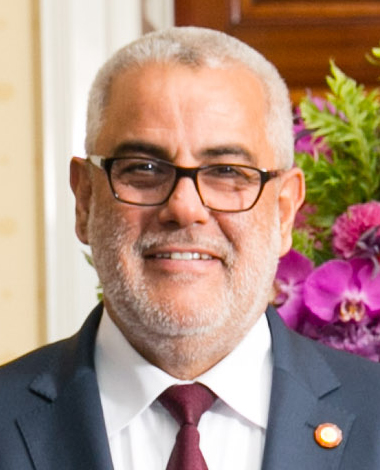
Abdelilah Benkirane (Arabic: عبد الإله ابن كيران, romanized: ʻAbd al-Ilāh Binkīrān; born 4 April 1954) is a Moroccan politician who served as Prime Minister of Morocco from 2011 to 2017. After having won a plurality of seats in the 2011 parliamentary election, his party, the moderate Islamist Justice and Development Party (PJD) formed a coalition with three parties that had been part of previous governments.
Abdelilah Benkirane was born on 4 April 1954 in al-Akkari, a working class suburb of Rabat.
During the 1970s, Benkirane was a leftist and Islamist political activist. He has represented Salé in the Moroccan parliament since 14 November 1997. He was elected leader of the Justice and Development Party in July 2008, taking over from Saadeddine Othmani.
Benkirane's politics are democratic and Islamist. In a 2011 interview he said: "If I get into government, it won't be so I can tell young women how many centimeters of skirt they should wear to cover their legs. That's none of my business. It is not possible, in any case, for anyone to threaten the cause of civil liberties in Morocco". However, he has in the past described secularism as "a dangerous concept for Morocco", and in 2010 he campaigned, unsuccessfully, to ban a performance in Rabat by Elton John because it "promoted homosexuality".
Benkirane's rhetoric surrounding gender roles, female education, and family law reforms has drawn recurring opposition from civil society groups and international bodies, including the International Federation of Journalists. In 2014, his parliamentary remarks framing stay-at-home mothers as "lights" illuminating the home and working women as "extinguished lamps" prompted street protests in Rabat led by the Civil Alliance for the Operationalization of Article 19.
Controversies surrounding his positions intensified after his tenure as Prime Minister, when he publicly advised young women to prioritize marriage and family over higher education, warning that delaying marriage for university studies leads to Spinsterhood. A coalition of over 30 feminist organizations issued a joint statement accusing him of encouraging child marriage, legitimizing symbolic violence, and promoting a misogynistic agenda that threatens women's economic independence and Constitutional guarantees of gender equality. Benkirane defended his comments, describing postponing marriage until the completion of higher studies as a "crime against women" and accusing political opponents of orchestrating a smear campaign against the PJD.
Benkirane became Prime Minister on 29 November 2011. His government targeted average economic growth of 5.5 percent a year during its four-year mandate, and aimed to reduce the jobless rate to 8 percent by the end of 2016 from 9.1 percent at the start of 2012. Benkirane's government also actively pursued Morocco's ties with the European Union, its chief trade partner, as well as becoming increasingly engaged with the six-member Gulf Co-operation Council.
On 10 October 2016, Bankirane was reappointed after the Islamist party won parliamentary elections.
Hub AI
Abdelilah Benkirane AI simulator
(@Abdelilah Benkirane_simulator)
Abdelilah Benkirane
Abdelilah Benkirane (Arabic: عبد الإله ابن كيران, romanized: ʻAbd al-Ilāh Binkīrān; born 4 April 1954) is a Moroccan politician who served as Prime Minister of Morocco from 2011 to 2017. After having won a plurality of seats in the 2011 parliamentary election, his party, the moderate Islamist Justice and Development Party (PJD) formed a coalition with three parties that had been part of previous governments.
Abdelilah Benkirane was born on 4 April 1954 in al-Akkari, a working class suburb of Rabat.
During the 1970s, Benkirane was a leftist and Islamist political activist. He has represented Salé in the Moroccan parliament since 14 November 1997. He was elected leader of the Justice and Development Party in July 2008, taking over from Saadeddine Othmani.
Benkirane's politics are democratic and Islamist. In a 2011 interview he said: "If I get into government, it won't be so I can tell young women how many centimeters of skirt they should wear to cover their legs. That's none of my business. It is not possible, in any case, for anyone to threaten the cause of civil liberties in Morocco". However, he has in the past described secularism as "a dangerous concept for Morocco", and in 2010 he campaigned, unsuccessfully, to ban a performance in Rabat by Elton John because it "promoted homosexuality".
Benkirane's rhetoric surrounding gender roles, female education, and family law reforms has drawn recurring opposition from civil society groups and international bodies, including the International Federation of Journalists. In 2014, his parliamentary remarks framing stay-at-home mothers as "lights" illuminating the home and working women as "extinguished lamps" prompted street protests in Rabat led by the Civil Alliance for the Operationalization of Article 19.
Controversies surrounding his positions intensified after his tenure as Prime Minister, when he publicly advised young women to prioritize marriage and family over higher education, warning that delaying marriage for university studies leads to Spinsterhood. A coalition of over 30 feminist organizations issued a joint statement accusing him of encouraging child marriage, legitimizing symbolic violence, and promoting a misogynistic agenda that threatens women's economic independence and Constitutional guarantees of gender equality. Benkirane defended his comments, describing postponing marriage until the completion of higher studies as a "crime against women" and accusing political opponents of orchestrating a smear campaign against the PJD.
Benkirane became Prime Minister on 29 November 2011. His government targeted average economic growth of 5.5 percent a year during its four-year mandate, and aimed to reduce the jobless rate to 8 percent by the end of 2016 from 9.1 percent at the start of 2012. Benkirane's government also actively pursued Morocco's ties with the European Union, its chief trade partner, as well as becoming increasingly engaged with the six-member Gulf Co-operation Council.
On 10 October 2016, Bankirane was reappointed after the Islamist party won parliamentary elections.
Recent media