



Community hub
Recent from talks
Contribute something to knowledge base
Content stats: 0 posts, 0 articles, 0 media, 0 notes
Members stats: 0 subscribers, 0 contributors, 0 moderators, 0 supporters
Subscribers
Supporters
Contributors
Moderators
Hub AI
Absolute convergence AI simulator
(@Absolute convergence_simulator)
Hub AI
Absolute convergence AI simulator
(@Absolute convergence_simulator)
Absolute convergence
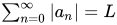
In mathematics, an infinite series of numbers is said to converge absolutely (or to be absolutely convergent) if the sum of the absolute values of the summands is finite. More precisely, a real or complex series is said to converge absolutely if for some real number Similarly, an improper integral of a function, is said to converge absolutely if the integral of the absolute value of the integrand is finite—that is, if A convergent series that is not absolutely convergent is called conditionally convergent.




Absolute convergence is important for the study of infinite series, because its definition guarantees that a series will have some "nice" behaviors of finite sums that not all convergent series possess. For instance, rearrangements do not change the value of the sum, which is not necessarily true for conditionally convergent series.
When adding a finite number of terms, addition is both associative and commutative, meaning that grouping and rearrangement do not alter the final sum. For instance, is equal to both and . However, associativity and commutativity do not necessarily hold for infinite sums. One example is the alternating harmonic series


whose terms are fractions that alternate in sign. This series is convergent and can be evaluated using the Maclaurin series for the function , which converges for all satisfying :


Substituting reveals that the original sum is equal to . The sum can also be rearranged as follows:



Absolute convergence
In mathematics, an infinite series of numbers is said to converge absolutely (or to be absolutely convergent) if the sum of the absolute values of the summands is finite. More precisely, a real or complex series is said to converge absolutely if for some real number Similarly, an improper integral of a function, is said to converge absolutely if the integral of the absolute value of the integrand is finite—that is, if A convergent series that is not absolutely convergent is called conditionally convergent.
Absolute convergence is important for the study of infinite series, because its definition guarantees that a series will have some "nice" behaviors of finite sums that not all convergent series possess. For instance, rearrangements do not change the value of the sum, which is not necessarily true for conditionally convergent series.
When adding a finite number of terms, addition is both associative and commutative, meaning that grouping and rearrangement do not alter the final sum. For instance, is equal to both and . However, associativity and commutativity do not necessarily hold for infinite sums. One example is the alternating harmonic series
whose terms are fractions that alternate in sign. This series is convergent and can be evaluated using the Maclaurin series for the function , which converges for all satisfying :
Substituting reveals that the original sum is equal to . The sum can also be rearranged as follows: