Hubbry Logo
search
logo

Absolute convergence

logo
Community Hub0 Subscribers
Read side by side
from Wikipedia

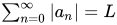
In mathematics, an infinite series of numbers is said to converge absolutely (or to be absolutely convergent) if the sum of the absolute values of the summands is finite. More precisely, a real or complex series is said to converge absolutely if for some real number Similarly, an improper integral of a function, is said to converge absolutely if the integral of the absolute value of the integrand is finite—that is, if A convergent series that is not absolutely convergent is called conditionally convergent.

Absolute convergence is important for the study of infinite series, because its definition guarantees that a series will have some "nice" behaviors of finite sums that not all convergent series possess. For instance, rearrangements do not change the value of the sum, which is not necessarily true for conditionally convergent series.

Background

[edit]

When adding a finite number of terms, addition is both associative and commutative, meaning that grouping and rearrangement do not alter the final sum. For instance, is equal to both and . However, associativity and commutativity do not necessarily hold for infinite sums. One example is the alternating harmonic series

whose terms are fractions that alternate in sign. This series is convergent and can be evaluated using the Maclaurin series for the function , which converges for all satisfying :

Substituting reveals that the original sum is equal to . The sum can also be rearranged as follows:

In this rearrangement, the reciprocal of each odd number is grouped with the reciprocal of twice its value, while the reciprocals of every multiple of 4 are evaluated separately. However, evaluating the terms inside the parentheses yields

or half the original series. The violation of the associativity and commutativity of addition reveals that the alternating harmonic series is conditionally convergent. Indeed, the sum of the absolute values of each term is , or the divergent harmonic series. According to the Riemann series theorem, any conditionally convergent series can be permuted so that its sum is any finite real number or so that it diverges. When an absolutely convergent series is rearranged, its sum is always preserved.

Definition for real and complex numbers

[edit]

A sum of real numbers or complex numbers is absolutely convergent if the sum of the absolute values of the terms converges.

Sums of more general elements

[edit]

The same definition can be used for series whose terms are not numbers but rather elements of an arbitrary abelian topological group. In that case, instead of using the absolute value, the definition requires the group to have a norm, which is a positive real-valued function on an abelian group (written additively, with identity element 0) such that:

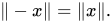
  1. The norm of the identity element of is zero:
  2. For every implies
  3. For every
  4. For every

In this case, the function induces the structure of a metric space (a type of topology) on

Then, a -valued series is absolutely convergent if

In particular, these statements apply using the norm (absolute value) in the space of real numbers or complex numbers.

In topological vector spaces

[edit]

If is a topological vector space (TVS) and is a (possibly uncountable) family in then this family is absolutely summable if[1]

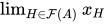
  1. is summable in (that is, if the limit of the net converges in where is the directed set of all finite subsets of directed by inclusion and ), and
  2. for every continuous seminorm on the family is summable in

If is a normable space and if is an absolutely summable family in then necessarily all but a countable collection of 's are 0.

Absolutely summable families play an important role in the theory of nuclear spaces.

Relation to convergence

[edit]

If is complete with respect to the metric then every absolutely convergent series is convergent. The proof is the same as for complex-valued series: use the completeness to derive the Cauchy criterion for convergence—a series is convergent if and only if its tails can be made arbitrarily small in norm—and apply the triangle inequality.

In particular, for series with values in any Banach space, absolute convergence implies convergence. The converse is also true: if absolute convergence implies convergence in a normed space, then the space is a Banach space.

If a series is convergent but not absolutely convergent, it is called conditionally convergent. An example of a conditionally convergent series is the alternating harmonic series. Many standard tests for divergence and convergence, most notably including the ratio test and the root test, demonstrate absolute convergence. This is because a power series is absolutely convergent on the interior of its disk of convergence.[a]

Proof that any absolutely convergent series of complex numbers is convergent

[edit]

Suppose that is convergent. Then equivalently, is convergent, which implies that and converge by termwise comparison of non-negative terms. It suffices to show that the convergence of these series implies the convergence of and for then, the convergence of would follow, by the definition of the convergence of complex-valued series.

The preceding discussion shows that we need only prove that convergence of implies the convergence of

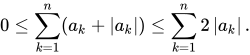
Let be convergent. Since we have Since is convergent, is a bounded monotonic sequence of partial sums, and must also converge. Noting that is the difference of convergent series, we conclude that it too is a convergent series, as desired.

Alternative proof using the Cauchy criterion and triangle inequality

[edit]

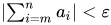
By applying the Cauchy criterion for the convergence of a complex series, we can also prove this fact as a simple implication of the triangle inequality.[2] By the Cauchy criterion, converges if and only if for any there exists such that for any But the triangle inequality implies that so that for any which is exactly the Cauchy criterion for

Proof that any absolutely convergent series in a Banach space is convergent

[edit]

The above result can be easily generalized to every Banach space Let be an absolutely convergent series in As is a Cauchy sequence of real numbers, for any and large enough natural numbers it holds:

By the triangle inequality for the norm ǁ⋅ǁ, one immediately gets: which means that is a Cauchy sequence in hence the series is convergent in [3]

Rearrangements and unconditional convergence

[edit]

Real and complex numbers

[edit]

When a series of real or complex numbers is absolutely convergent, any rearrangement or reordering of that series' terms will still converge to the same value. This fact is one reason absolutely convergent series are useful: showing a series is absolutely convergent allows terms to be paired or rearranged in convenient ways without changing the sum's value.

The Riemann rearrangement theorem shows that the converse is also true: every real or complex-valued series whose terms cannot be reordered to give a different value is absolutely convergent.

Series with coefficients in more general space

[edit]

The term unconditional convergence is used to refer to a series where any rearrangement of its terms still converges to the same value. For any series with values in a normed abelian group , as long as is complete, every series which converges absolutely also converges unconditionally.

Stated more formally:

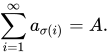
Theorem Let be a normed abelian group. Suppose If is any permutation, then
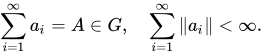
For series with more general coefficients, the converse is more complicated. As stated in the previous section, for real-valued and complex-valued series, unconditional convergence always implies absolute convergence. However, in the more general case of a series with values in any normed abelian group , the converse does not always hold: there can exist series which are not absolutely convergent, yet unconditionally convergent.

For example, in the Banach space, one series which is unconditionally convergent but not absolutely convergent is:

where is an orthonormal basis. A theorem of A. Dvoretzky and C. A. Rogers asserts that every infinite-dimensional Banach space has an unconditionally convergent series that is not absolutely convergent.[4]

Proof of the theorem

[edit]

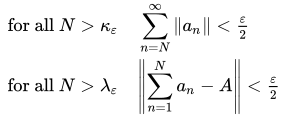
For any we can choose some such that:

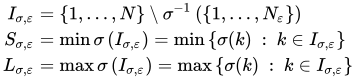
Let where so that is the smallest natural number such that the list includes all of the terms (and possibly others).


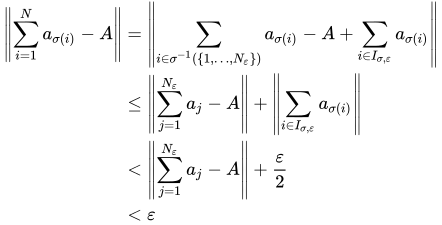
Finally for any integer let so that and thus

This shows that that is:

Q.E.D.

Products of series

[edit]

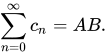
The Cauchy product of two series converges to the product of the sums if at least one of the series converges absolutely. That is, suppose that

The Cauchy product is defined as the sum of terms where:

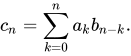
If either the or sum converges absolutely then

Absolute convergence over sets

[edit]

A generalization of the absolute convergence of a series, is the absolute convergence of a sum of a function over a set. We can first consider a countable set and a function We will give a definition below of the sum of over written as

First note that because no particular enumeration (or "indexing") of has yet been specified, the series cannot be understood by the more basic definition of a series. In fact, for certain examples of and the sum of over may not be defined at all, since some indexing may produce a conditionally convergent series.

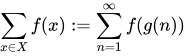
Therefore we define only in the case where there exists some bijection such that is absolutely convergent. Note that here, "absolutely convergent" uses the more basic definition, applied to an indexed series. In this case, the value of the sum of over [5] is defined by

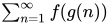
Note that because the series is absolutely convergent, then every rearrangement is identical to a different choice of bijection Since all of these sums have the same value, then the sum of over is well-defined.

Even more generally we may define the sum of over when is uncountable. But first we define what it means for the sum to be convergent.

Let be any set, countable or uncountable, and a function. We say that the sum of over converges absolutely if


There is a theorem which states that, if the sum of over is absolutely convergent, then takes non-zero values on a set that is at most countable. Therefore, the following is a consistent definition of the sum of over when the sum is absolutely convergent.
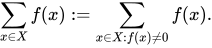
Note that the final series uses the definition of a series over a countable set.

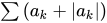
Some authors define an iterated sum to be absolutely convergent if the iterated series [6] This is in fact equivalent to the absolute convergence of That is to say, if the sum of over converges absolutely, as defined above, then the iterated sum converges absolutely, and vice versa.


Absolute convergence of integrals

[edit]

The integral of a real or complex-valued function is said to converge absolutely if One also says that is absolutely integrable. The issue of absolute integrability is intricate and depends on whether the Riemann, Lebesgue, or Kurzweil-Henstock (gauge) integral is considered; for the Riemann integral, it also depends on whether we only consider integrability in its proper sense ( and both bounded), or permit the more general case of improper integrals.


As a standard property of the Riemann integral, when is a bounded interval, every continuous function is bounded and (Riemann) integrable, and since continuous implies continuous, every continuous function is absolutely integrable. In fact, since is Riemann integrable on if is (properly) integrable and is continuous, it follows that is properly Riemann integrable if is. However, this implication does not hold in the case of improper integrals. For instance, the function is improperly Riemann integrable on its unbounded domain, but it is not absolutely integrable: Indeed, more generally, given any series one can consider the associated step function defined by Then converges absolutely, converges conditionally or diverges according to the corresponding behavior of

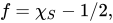
The situation is different for the Lebesgue integral, which does not handle bounded and unbounded domains of integration separately (see below). The fact that the integral of is unbounded in the examples above implies that is also not integrable in the Lebesgue sense. In fact, in the Lebesgue theory of integration, given that is measurable, is (Lebesgue) integrable if and only if is (Lebesgue) integrable. However, the hypothesis that is measurable is crucial; it is not generally true that absolutely integrable functions on are integrable (simply because they may fail to be measurable): let be a nonmeasurable subset and consider where is the characteristic function of Then is not Lebesgue measurable and thus not integrable, but is a constant function and clearly integrable.

On the other hand, a function may be Kurzweil-Henstock integrable (gauge integrable) while is not. This includes the case of improperly Riemann integrable functions.

In a general sense, on any measure space the Lebesgue integral of a real-valued function is defined in terms of its positive and negative parts, so the facts:

  1. integrable implies integrable
  2. measurable, integrable implies integrable

are essentially built into the definition of the Lebesgue integral. In particular, applying the theory to the counting measure on a set one recovers the notion of unordered summation of series developed by Moore–Smith using (what are now called) nets. When is the set of natural numbers, Lebesgue integrability, unordered summability and absolute convergence all coincide.

Finally, all of the above holds for integrals with values in a Banach space. The definition of a Banach-valued Riemann integral is an evident modification of the usual one. For the Lebesgue integral one needs to circumvent the decomposition into positive and negative parts with Daniell's more functional analytic approach, obtaining the Bochner integral.

See also

[edit]

Notes

[edit]

References

[edit]
Revisions and contributorsEdit on WikipediaRead on Wikipedia
from Grokipedia
In mathematics, particularly in the field of real and complex analysis, absolute convergence refers to a strong form of convergence for an infinite series n=1an\sum_{n=1}^\infty a_n, where the series formed by the absolute values of its terms, n=1an\sum_{n=1}^\infty |a_n|, also converges.[1][2][3] This property ensures that the original series converges, since the partial sums of an\sum a_n are bounded in absolute value by the partial sums of the convergent positive-term series an\sum |a_n|, allowing the application of tests like the comparison test for convergence.[1][3] A key advantage of absolute convergence is that the sum of the series is independent of the order in which the terms are rearranged, unlike conditionally convergent series where such rearrangements can alter the sum arbitrarily.[2][1] Additionally, the product of two absolutely convergent series is itself absolutely convergent, providing a useful closure property in series manipulations.[2] In contrast, a series that converges but whose absolute-value series diverges is termed conditionally convergent, highlighting the role of term cancellations in achieving convergence without absolute boundedness.[1][3]

Basic Concepts

Definition for series of real and complex numbers

In the context of infinite series with real terms, a series n=1an\sum_{n=1}^\infty a_n, where anRa_n \in \mathbb{R}, is said to converge absolutely if the series of absolute values n=1an\sum_{n=1}^\infty |a_n| converges.[1] This condition is equivalent to n=1an<\sum_{n=1}^\infty |a_n| < \infty.[4] Absolute convergence ensures that the original series converges, though the converse does not always hold.[5] A classic example is the pp-series n=11np\sum_{n=1}^\infty \frac{1}{n^p}, which converges absolutely if p>1p > 1 and diverges if p1p \leq 1.[6] For instance, the harmonic series n=11n\sum_{n=1}^\infty \frac{1}{n} (where p=1p=1) diverges, so it does not converge absolutely.[7] In contrast, n=11n2\sum_{n=1}^\infty \frac{1}{n^2} (where p=2>1p=2 > 1) converges absolutely.[6] The alternating harmonic series n=1(1)n+1n\sum_{n=1}^\infty \frac{(-1)^{n+1}}{n} converges but not absolutely, illustrating conditional convergence.[8] For series with complex terms, n=1zn\sum_{n=1}^\infty z_n where znCz_n \in \mathbb{C}, absolute convergence is defined analogously: the series converges absolutely if n=1zn\sum_{n=1}^\infty |z_n| converges, with zn|z_n| denoting the modulus.[9] The modulus of a complex number z=x+iyz = x + iy, with x,yRx, y \in \mathbb{R} and i=1i = \sqrt{-1}, is given by z=x2+y2|z| = \sqrt{x^2 + y^2}.[10] This definition aligns with the real case, as absolute convergence of zn\sum z_n holds if and only if the series of the real parts Re(zn)\sum \operatorname{Re}(z_n) and imaginary parts Im(zn)\sum \operatorname{Im}(z_n) both converge absolutely.[11]

Historical development

The concept of absolute convergence emerged in the early 19th century as mathematicians sought to rigorize the study of infinite series. Augustin-Louis Cauchy played a pivotal role with his 1821 textbook Cours d'analyse de l'Académie Royale des Sciences, where he defined convergence for series and required that the absolute values of sums of subsequent terms remain bounded by arbitrarily small limits as the number of terms increases. This criterion effectively anticipated absolute convergence by ensuring stability regardless of minor variations in order, though Cauchy did not yet employ the modern terminology.[12] A key insight into the limitations of ordinary convergence came from Peter Gustav Lejeune Dirichlet in 1829, during his investigations into the convergence of Fourier series. Dirichlet observed that certain convergent series could have their sums altered by rearranging terms, revealing the phenomenon of conditional convergence and the necessity of absolute convergence for order-independent results.[13] In the 1850s, Bernhard Riemann advanced this distinction, particularly through his work around 1852 on trigonometric series. Riemann recognized conditional convergence in alternating series like the harmonic series and proved that such series could be rearranged to yield any desired real sum, formalizing the contrast with absolutely convergent series that resist such manipulation.[14] Mid-19th-century efforts by Karl Weierstrass and Dirichlet further solidified the theory, emphasizing absolute convergence for rigorous handling of infinite series in contexts like Fourier analysis. Weierstrass, through his lectures and publications in the 1860s and 1870s, developed convergence tests that relied on absolute summability to guarantee uniform convergence, enhancing the applicability of series expansions.[15] Twentieth-century developments integrated absolute convergence into functional analysis, with Stefan Banach's contributions in the 1920s marking a significant extension. In his 1922 dissertation Théorie des opérations linéaires, Banach demonstrated that in complete normed linear spaces—termed Banach spaces—absolute convergence in the norm implies ordinary convergence, broadening the concept to infinite-dimensional settings.[16]

Convergence Properties

Relation to ordinary convergence

Ordinary convergence of an infinite series an\sum a_n refers to the convergence of its partial sums to a finite limit, without regard to the signs of the terms. In contrast, absolute convergence requires that the series an\sum |a_n| converges. A series that converges ordinarily but not absolutely is said to converge conditionally.[17] When all terms ana_n are nonnegative, absolute convergence is equivalent to ordinary convergence, as an=an|a_n| = a_n in this case. Absolute convergence implies ordinary convergence for any series, but the converse does not hold. For instance, the alternating harmonic series n=1(1)n+1n\sum_{n=1}^\infty \frac{(-1)^{n+1}}{n} converges ordinarily to ln2\ln 2, yet the series of absolute values n=11n\sum_{n=1}^\infty \frac{1}{n} diverges, demonstrating conditional convergence.[17][18] In the context of series of functions, the Weierstrass M-test provides a criterion linking absolute convergence to uniform convergence: if fn(x)Mn|f_n(x)| \leq M_n for all xx in a set and Mn\sum M_n converges, then fn(x)\sum f_n(x) converges absolutely and uniformly on that set.[19]

Proofs for numbers and Banach spaces

For a series n=1an\sum_{n=1}^\infty a_n of real numbers, absolute convergence means n=1an<\sum_{n=1}^\infty |a_n| < \infty. The partial sums sn=k=1naks_n = \sum_{k=1}^n a_k satisfy, for m>nm > n,
smsn=k=n+1makk=n+1mak, |s_m - s_n| = \left| \sum_{k=n+1}^m a_k \right| \leq \sum_{k=n+1}^m |a_k|,
by the triangle inequality. Since ak\sum |a_k| converges, the tail k=n+1mak0\sum_{k=n+1}^m |a_k| \to 0 as m,nm, n \to \infty, so {sn}\{s_n\} is a Cauchy sequence in R\mathbb{R}, which is complete, and thus converges.[20] The generalization to Banach spaces is addressed in the dedicated subsection below.

Proof for Complex Numbers

Consider a series k=1ak\sum_{k=1}^\infty a_k of complex numbers where akCa_k \in \mathbb{C}. The partial sums are defined as sn=k=1naks_n = \sum_{k=1}^n a_k. The series converges if the sequence {sn}\{s_n\} is Cauchy, meaning that for every ϵ>0\epsilon > 0, there exists NNN \in \mathbb{N} such that smsn<ϵ|s_m - s_n| < \epsilon for all m>n>Nm > n > N.[9] Assume the series is absolutely convergent, so k=1ak<\sum_{k=1}^\infty |a_k| < \infty. Then, for m>nm > n,
smsn=k=n+1makk=n+1mak, |s_m - s_n| = \left| \sum_{k=n+1}^m a_k \right| \leq \sum_{k=n+1}^m |a_k|,
by the triangle inequality for the modulus in C\mathbb{C}. Since ak\sum |a_k| converges, its partial sums form a Cauchy sequence, so k=n+1mak0\sum_{k=n+1}^m |a_k| \to 0 as m,nm, n \to \infty. Thus, {sn}\{s_n\} is Cauchy and converges in C\mathbb{C}, which is complete.[9] An alternative proof decomposes into real and imaginary parts. Let ak=uk+ivka_k = u_k + i v_k with uk,vkRu_k, v_k \in \mathbb{R}. Then ukak|u_k| \leq |a_k| and vkak|v_k| \leq |a_k|, so uk\sum |u_k| and vk\sum |v_k| converge by the comparison test. For the real series uk\sum u_k, note that 0uk+uk2uk0 \leq u_k + |u_k| \leq 2 |u_k|, so (uk+uk)\sum (u_k + |u_k|) converges, implying uk=(uk+uk)uk\sum u_k = \sum (u_k + |u_k|) - \sum |u_k| converges as a difference of convergent series. Similarly for vk\sum v_k. Hence, ak=uk+ivk\sum a_k = \sum u_k + i \sum v_k converges.[9]

Generalization to Banach Spaces

In a Banach space (X,)(X, \|\cdot\|), which is a complete normed vector space, absolute convergence of n=1xn\sum_{n=1}^\infty x_n means n=1xn<\sum_{n=1}^\infty \|x_n\| < \infty. The partial sums sn=k=1nxks_n = \sum_{k=1}^n x_k satisfy, for m>nm > n,
smsn=k=n+1mxkk=n+1mxk, \|s_m - s_n\| = \left\| \sum_{k=n+1}^m x_k \right\| \leq \sum_{k=n+1}^m \|x_k\|,
by the triangle inequality for the norm. Since xk\sum \|x_k\| converges in R\mathbb{R}, the tail k=n+1mxk0\sum_{k=n+1}^m \|x_k\| \to 0 as m,nm, n \to \infty, so {sn}\{s_n\} is Cauchy in XX. By completeness of XX, {sn}\{s_n\} converges to some sXs \in X, and thus xn\sum x_n converges.[21]

Sum of Absolutely Convergent Series

Let n=1an\sum_{n=1}^\infty a_n and n=1bn\sum_{n=1}^\infty b_n be two series of complex numbers that converge absolutely. Then the series n=1(an+bn)\sum_{n=1}^\infty (a_n + b_n) converges absolutely to n=1an+n=1bn\sum_{n=1}^\infty a_n + \sum_{n=1}^\infty b_n.[22] Proof: Since an\sum |a_n| and bn\sum |b_n| converge, (an+bn)=an+bn<\sum (|a_n| + |b_n|) = \sum |a_n| + \sum |b_n| < \infty. By the triangle inequality, an+bnan+bn|a_n + b_n| \leq |a_n| + |b_n| for each nn, so an+bn(an+bn)<\sum |a_n + b_n| \leq \sum (|a_n| + |b_n|) < \infty by the comparison test. Thus, (an+bn)\sum (a_n + b_n) converges absolutely. For the equality of sums, let s=n=1ans = \sum_{n=1}^\infty a_n, t=n=1bnt = \sum_{n=1}^\infty b_n, and let sN=n=1Nans_N = \sum_{n=1}^N a_n, tN=n=1Nbnt_N = \sum_{n=1}^N b_n, uN=n=1N(an+bn)=sN+tNu_N = \sum_{n=1}^N (a_n + b_n) = s_N + t_N. As NN \to \infty, sNss_N \to s and tNtt_N \to t, so uNs+tu_N \to s + t. Therefore, n=1(an+bn)=s+t\sum_{n=1}^\infty (a_n + b_n) = s + t.[22]

Generalizations to Vector Spaces

Absolute convergence in normed spaces

In a normed vector space (X,)(X, \|\cdot\|), a series n=1xn\sum_{n=1}^\infty x_n with xnXx_n \in X is said to converge absolutely if the scalar series n=1xn\sum_{n=1}^\infty \|x_n\| converges (to a finite real number).[23] This definition generalizes the notion from real or complex numbers by replacing the absolute value with the vector space norm, which induces a metric on XX.[24] Absolute convergence has key implications for the behavior of the series. Specifically, if xn<\sum \|x_n\| < \infty, then the partial sums sm=n=1mxns_m = \sum_{n=1}^m x_n form a Cauchy sequence in the norm of XX, because for m>km > k, smskn=k+1mxn0\|s_m - s_k\| \leq \sum_{n=k+1}^m \|x_n\| \to 0 as k,mk, m \to \infty.[24] In complete normed spaces (Banach spaces), this Cauchy property ensures that the series converges to some limit in XX. Moreover, a normed space XX is complete if and only if every absolutely convergent series in XX converges.[25] A representative example occurs in the Banach spaces p\ell^p for 1<p<1 < p < \infty, consisting of sequences (an)(a_n) with anp<\sum |a_n|^p < \infty under the pp-norm. Consider the coordinate series anen\sum a_n e_n, where ene_n are the standard basis vectors (with 1 in the nnth position and 0 elsewhere). This series converges in p\ell^p if and only if (an)p(a_n) \in \ell^p, but it converges absolutely if and only if (an)1(a_n) \in \ell^1, since anenp=an\|a_n e_n\|_p = |a_n| and an<\sum |a_n| < \infty.[23] Thus, absolute convergence in p\ell^p corresponds to membership of the coefficient sequence in 1\ell^1. In finite-dimensional normed spaces, the concept aligns closely with that for series of real or complex numbers, as all norms are equivalent and the space is complete, but the definition applies vector norms to the terms.[24]

In topological vector spaces

In locally convex topological vector spaces, the notion of absolute convergence for a series xn\sum x_n, where xnx_n belong to the space XX, is defined in terms of the topology rather than a single norm. A series converges absolutely if, for every continuous seminorm pp on XX, the numerical series p(xn)\sum p(x_n) converges (to a finite value). Equivalently, the series converges absolutely if f(xn)<\sum |f(x_n)| < \infty for every continuous linear functional ff on XX. This generalization captures the idea that the terms become "small" in a uniform way across the topology, without requiring a norm.[26][27] In such spaces, the topology is generated by a family of continuous seminorms {pα}αA\{p_\alpha\}_{\alpha \in A}. Here, the series xn\sum x_n is absolutely convergent if and only if pα(xn)<\sum p_\alpha(x_n) < \infty for every αA\alpha \in A. This condition ensures that the partial sums are controlled by the seminorms defining the topology, extending the normed space case where a single norm suffices. In such spaces, absolute convergence implies ordinary convergence under additional completeness assumptions, but the converse generally fails.[26][27] Fréchet spaces, which are complete metrizable locally convex spaces defined by a countable family of seminorms, provide concrete examples. For instance, the space of smooth functions with compact support on Rn\mathbb{R}^n, equipped with seminorms involving supremum norms of derivatives, admits absolutely convergent series that represent elements densely. However, counterexamples exist where a series converges ordinarily but not absolutely; in non-normable Fréchet spaces like the space of entire analytic functions, rearrangements of convergent series may diverge, highlighting that absolute convergence is stricter and fails while ordinary convergence holds. The concept relates to barrelled spaces, where every absorbing balanced closed convex set (barrel) is a neighborhood of the origin. In barrelled locally convex spaces, convergence tests for series leverage this property: the uniform boundedness principle applies to families of functionals evaluating partial sums, ensuring that absolute convergence via seminorms implies equicontinuity and thus controlled behavior in absorbing sets. This facilitates proofs of completeness and duality results without norms.[26]

Rearrangement and Unconditional Convergence

For series of numbers

In contrast to conditionally convergent series, where the Riemann rearrangement theorem establishes that rearrangements can yield any real number as the sum or cause divergence, absolutely convergent series of real or complex numbers maintain the same sum under any rearrangement of terms.[28] This invariance arises because the convergence of ∑ |a_n| ensures that the order of summation does not affect the limit, a property absent in conditional convergence.[29] The proof of this invariance proceeds by comparing partial sums. For an absolutely convergent series ∑ a_n with sum S and a rearrangement ∑ b_k = ∑ a_{σ(k)}, the partial sums T_N = ∑{k=1}^N b_k satisfy |T_N - S| ≤ ∑{k=N+1}^∞ |b_k|, which is the tail of ∑ |a_n| and thus tends to 0 as N → ∞ by the convergence of the absolute series.[29] Similarly, the difference between partial sums of the original and rearranged series is bounded by the tail of the absolute series, confirming that all rearrangements converge to S.[29] For series of real or complex numbers, absolute convergence is equivalent to unconditional convergence, the condition that every rearrangement converges to the original sum.[29] This equivalence holds in finite-dimensional spaces like ℝ or ℂ, distinguishing them from higher-dimensional settings.[29] A representative example is the p-series ∑_{n=1}^∞ 1/n^p for p > 1, which converges absolutely since ∑ 1/n^p converges by the p-series test.[1] Consequently, any permutation of its terms sums to the same value, ζ(p), the Riemann zeta function at p.[1]

In general spaces

In normed linear spaces, a series xn\sum x_n of vectors is said to be unconditionally convergent if every rearrangement of the terms converges to the same limit in the norm topology.[30] This notion serves as the appropriate analogue to absolute convergence when considering rearrangements, extending the scalar case where unconditional convergence coincides with absolute convergence.[31] In complete normed linear spaces (Banach spaces), absolute convergence of xn\sum x_n, defined by xn<\sum \|x_n\| < \infty, implies unconditional convergence, as the partial sums of any rearrangement form a Cauchy sequence in the norm and thus converge.[32] However, the converse fails in infinite-dimensional spaces: unconditional convergence does not imply absolute convergence.[30] Specifically, in every infinite-dimensional Banach space, there exist unconditionally convergent series that are not absolutely convergent, as established by the Dvoretzky–Rogers theorem.[30] This equivalence holds only for finite-dimensional spaces.[30] In Hilbert spaces, a canonical example of unconditional convergence arises from expansions with respect to an orthonormal basis (en)(e_n). For any xx in the space, the series x,enen\sum \langle x, e_n \rangle e_n converges unconditionally to xx.[33] Such series highlight the robustness of Fourier representations in Hilbert spaces, where the convergence is independent of the ordering of terms.[34] The space c0c_0 of real sequences converging to zero under the sup norm provides a counterexample illustrating the distinction: as an infinite-dimensional Banach space, it admits unconditionally convergent series that diverge absolutely, consistent with the Dvoretzky–Rogers result.[30] Explicit constructions, such as those involving blocks of basis vectors with controlled norms, demonstrate series where rearrangements converge but xn=\sum \|x_n\| = \infty. Unconditional convergence plays a key role in the theory of Schauder bases for Banach spaces. A Schauder basis (en)(e_n) is unconditional if, for every xx with unique coefficients (an(x))(a_n(x)), the series an(x)en\sum a_n(x) e_n converges unconditionally.[35] Such bases require a form of absolute-like summability in their expansions, ensuring stability under permutations, and are exemplified by the standard basis in p\ell_p spaces (1p<1 \leq p < \infty) and orthonormal bases in Hilbert spaces.[35] In incomplete normed spaces, even absolutely convergent series may fail to converge due to lack of completeness; here, unconditional convergence remains tied to rearrangement properties but without the equivalence to absolute convergence, and absolute convergence implies only that partial sums are unconditionally Cauchy.[30]

Key theorems and proofs

A fundamental result in the theory of infinite series states that if a series of complex numbers an\sum a_n converges absolutely, then every rearrangement aπ(n)\sum a_{\pi(n)} of the series also converges absolutely to the same sum s=ans = \sum a_n.[36] To prove this, let an\sum |a_n| converge, so the tails satisfy k=m+1ak0\sum_{k=m+1}^\infty |a_k| \to 0 as mm \to \infty. Let sm=k=1maks_m = \sum_{k=1}^m a_k and sn=k=1naπ(k)s_n' = \sum_{k=1}^n a_{\pi(k)} be the partial sums of the rearrangement, where π\pi is a permutation of the natural numbers. Fix ϵ>0\epsilon > 0 and choose mm large enough so that ssm<ϵ/2|s - s_m| < \epsilon/2 and k=m+1ak<ϵ/2\sum_{k=m+1}^\infty |a_k| < \epsilon/2. Since π\pi is bijective, there exists qmq \geq m such that the first mm terms {a1,,am}\{a_1, \dots, a_m\} are included in the first qq terms of the rearrangement. For nqn \geq q, sns_n' includes sms_m plus the sum of some terms aka_k with k>mk > m (the included tail terms). Thus,
snsmk>mπ(k)nakk=m+1ak<ϵ2. |s_n' - s_m| \leq \sum_{\substack{k > m \\ \pi(k) \leq n}} |a_k| \leq \sum_{k=m+1}^\infty |a_k| < \frac{\epsilon}{2}.
Therefore, snssnsm+sms<ϵ|s_n' - s| \leq |s_n' - s_m| + |s_m - s| < \epsilon for all nqn \geq q, so snss_n' \to s. Absolute convergence of the rearrangement follows similarly by applying the result to aπ(n)\sum |a_{\pi(n)}|, since the absolute series is unchanged by permutation.[36] In Banach spaces, unconditional convergence of a series xn\sum x_n means that ϵnxn\sum \epsilon_n x_n converges for every choice of signs ϵn=±1\epsilon_n = \pm 1, with all such series converging to the same sum. A key characterization is that xn\sum x_n converges unconditionally if and only if
sup{k=1nϵkxk:nN,ϵk=±1}<. \sup \{ \|\sum_{k=1}^n \epsilon_k x_k\| : n \in \mathbb{N}, \epsilon_k = \pm 1 \} < \infty.
This supremum bounds the norms of the signed partial sums uniformly. To see the connection to uniform boundedness, consider the family of linear operators Tn,ϵ:XXT_{n,\epsilon}: X \to X defined by Tn,ϵ(y)=k=1nϵky,xkxkT_{n,\epsilon}(y) = \sum_{k=1}^n \epsilon_k \langle y, x_k^* \rangle x_k or more directly, the partial sum operators over sign choices. Since the series converges pointwise for each fixed signs (to the sum), by the uniform boundedness principle applied to these operators on the Banach space, their norms are uniformly bounded, yielding the finite supremum above.[37] The Dvoretzky–Rogers theorem extends this by showing that in any infinite-dimensional Banach space, unconditional convergence does not imply absolute convergence (xn<\sum \|x_n\| < \infty), but if xn\sum x_n converges unconditionally, then there exists an equivalent norm \|\cdot\|' on the space such that xn<\sum \|x_n\|' < \infty, making the series absolutely convergent in the new norm. This norm can be taken as y=sup{iFϵiyi:FN finite,ϵi=±1}\|y\|' = \sup \{ \|\sum_{i \in F} \epsilon_i y_i\| : F \subset \mathbb{N} \text{ finite}, \epsilon_i = \pm 1 \}, where the supremum is finite precisely when the combinations are unconditionally bounded. The theorem highlights that while absolute and unconditional convergence coincide in finite-dimensional spaces, they differ fundamentally in infinite dimensions.

Further Extensions

Products of infinite series

The Cauchy product of two infinite series n=0an\sum_{n=0}^\infty a_n and n=0bn\sum_{n=0}^\infty b_n is defined as the series n=0cn\sum_{n=0}^\infty c_n, where
cn=k=0nakbnk. c_n = \sum_{k=0}^n a_k b_{n-k}.
This construction formalizes the multiplication of power series or generating functions corresponding to the original series. When both series converge absolutely, their Cauchy product also converges absolutely, and the sum equals the product of the individual sums. To see the absolute convergence, note that
cnk=0nakbnk(m=0am)(m=0bm). |c_n| \leq \sum_{k=0}^n |a_k| |b_{n-k}| \leq \left( \sum_{m=0}^\infty |a_m| \right) \left( \sum_{m=0}^\infty |b_m| \right).
Summing over nn, the double sum n=0k=0nakbnk=(m=0am)(m=0bm)<\sum_{n=0}^\infty \sum_{k=0}^n |a_k| |b_{n-k}| = \left( \sum_{m=0}^\infty |a_m| \right) \left( \sum_{m=0}^\infty |b_m| \right) < \infty by Tonelli's theorem for nonnegative terms, implying cn<\sum |c_n| < \infty. Mertens' theorem provides a related result for convergence (not necessarily absolute): if an\sum a_n converges absolutely to AA and bn\sum b_n converges (possibly conditionally) to BB, then cn\sum c_n converges to ABAB. When both series converge absolutely, this specializes to absolute convergence of the product to ABAB. If both series converge only conditionally, the Cauchy product may diverge. A standard counterexample is the series n=0(1)nn+1\sum_{n=0}^\infty \frac{(-1)^n}{\sqrt{n+1}}, which converges conditionally by the alternating series test but whose Cauchy product with itself has general term cn=(1)nk=0n1(k+1)(nk+1)c_n = (-1)^n \sum_{k=0}^n \frac{1}{\sqrt{(k+1)(n-k+1)}}. The inner sum is asymptotically π\pi as nn \to \infty, so cn↛0|c_n| \not\to 0 and cn\sum c_n diverges. Even when one series converges absolutely and the other conditionally, the Cauchy product converges (by Mertens' theorem) but need not converge absolutely, as the bound on cn|c_n| fails due to the divergence of the absolute series for the conditional one.

Absolute convergence of infinite products

An infinite product n=1(1+an)\prod_{n=1}^\infty (1 + a_n), where anCa_n \in \mathbb{C} and an1a_n \neq -1 for sufficiently large nn, is said to converge absolutely if the product n=1(1+an)\prod_{n=1}^\infty (1 + |a_n|) converges.[38] This is equivalent to the absolute convergence of the series n=1ln(1+an)\sum_{n=1}^\infty |\ln(1 + a_n)|. When an|a_n| is sufficiently small for large nn (e.g., an<1/2|a_n| < 1/2), this condition is equivalent to the absolute convergence of n=1an\sum_{n=1}^\infty |a_n|, since ln(1+z)z\ln(1 + z) \sim z as z0z \to 0.[39] For example, consider the infinite product n=2(1+(1)nn)\prod_{n=2}^\infty \left(1 + \frac{(-1)^n}{n}\right). The corresponding series (1)nn\sum \frac{(-1)^n}{n} converges conditionally by the alternating series test, but (1)nn=1n\sum \left|\frac{(-1)^n}{n}\right| = \sum \frac{1}{n} diverges, so the product does not converge absolutely. In contrast, n=1(1+1n2)\prod_{n=1}^\infty \left(1 + \frac{1}{n^2}\right) converges absolutely because 1n2<\sum \frac{1}{n^2} < \infty.[38]

Product of Absolutely Convergent Infinite Products

In a valued field $ (\mathbb{K}, |\cdot|) $, if n=1an\prod_{n=1}^\infty a_n converges absolutely and n=1bn\prod_{n=1}^\infty b_n converges absolutely, then n=1(anbn)\prod_{n=1}^\infty (a_n b_n) converges absolutely.[40] An infinite product n=1an\prod_{n=1}^\infty a_n converges absolutely if the series n=1an1\sum_{n=1}^\infty \|a_n - 1\| converges.

Proof

Consider the identity:
anbn1=(an1)(bn1)+(an1)+(bn1). a_n b_n - 1 = (a_n - 1)(b_n - 1) + (a_n - 1) + (b_n - 1).
Applying the triangle inequality for the norm yields:
anbn1an1bn1+an1+bn1. \|a_n b_n - 1\| \le \|a_n - 1\| \|b_n - 1\| + \|a_n - 1\| + \|b_n - 1\|.
Since n=1an1\sum_{n=1}^\infty \|a_n - 1\| and n=1bn1\sum_{n=1}^\infty \|b_n - 1\| converge by the assumption of absolute convergence, the series n=1an1bn1\sum_{n=1}^\infty \|a_n - 1\| \|b_n - 1\| also converges, as it is the Cauchy product of two absolutely convergent series of nonnegative terms. By the comparison test, n=1anbn1\sum_{n=1}^\infty \|a_n b_n - 1\| converges, implying that n=1(anbn)\prod_{n=1}^\infty (a_n b_n) converges absolutely.[40]

Absolute convergence over arbitrary sets

In the context of series indexed by an arbitrary set II, a family of scalars (ai)iI(a_i)_{i \in I} is said to converge absolutely if the sum iIai\sum_{i \in I} |a_i| is finite, where the sum over an arbitrary index set is defined as the supremum of sums over all finite subsets of II.[41] This definition extends the standard notion for countable indices by relying on the net of finite partial sums, ensuring that absolute convergence implies the existence of a well-defined sum value.[29] When II is countable, absolute convergence guarantees that the sum is independent of any enumeration of the indices, meaning rearrangements yield the same total.[41] For uncountable II, however, absolute convergence can only occur if at most countably many terms aia_i are non-zero, as an uncountable collection of positive terms would yield an infinite sum.[29][42] This restriction arises because the supremum over finite subsets would otherwise diverge, reducing the uncountable case to an effective countable summation. A concrete example is the double series m,nam,n\sum_{m,n} a_{m,n} over N×N\mathbb{N} \times \mathbb{N}, which converges absolutely if m,nam,n<\sum_{m,n} |a_{m,n}| < \infty, allowing the sum to be computed via any enumeration of the pairs (m,n)(m,n).[41] For non-negative terms ai0a_i \geq 0, absolute convergence (or finiteness of the sum) links directly to the Fubini-Tonelli theorem for series, permitting iteration over subsets without regard to order: for instance, (m,n)M×Nam,n=mMnNam,n=nNmMam,n\sum_{(m,n) \in M \times N} a_{m,n} = \sum_{m \in M} \sum_{n \in N} a_{m,n} = \sum_{n \in N} \sum_{m \in M} a_{m,n} holds for arbitrary sets MM and NN, provided the total sum is finite, which again implies at most countably many positive terms.[41]

For integrals

In the context of improper integrals, absolute convergence refers to the condition that the integral of the absolute value of the function is finite. Specifically, for a function ff continuous on [a,b)[a, b) and the improper integral af(x)dx\int_a^\infty f(x) \, dx, the integral converges absolutely if af(x)dx<\int_a^\infty |f(x)| \, dx < \infty. This implies the convergence of af(x)dx\int_a^\infty f(x) \, dx itself, as the absolute integrability dominates any oscillatory behavior that might allow conditional convergence.[43][44] Absolute convergence has significant implications for multidimensional integrals, ensuring that the value of the integral is independent of the order of integration. For instance, Fubini's theorem requires absolute integrability over the domain to justify interchanging the order of iterated integrals; without it, the iterated integrals may differ or fail to exist even if one converges. This property aligns improper integrals with broader measure-theoretic frameworks, where absolute convergence guarantees robustness under rearrangements or slicing of the domain.[45] A representative example of absolute convergence is the p-integral 1xpdx\int_1^\infty x^{-p} \, dx, which converges if and only if p>1p > 1, as the antiderivative evaluation yields limbb1p1p11p\lim_{b \to \infty} \frac{b^{1-p}}{1-p} - \frac{1}{1-p} finite precisely when the limit term vanishes. In contrast, conditional convergence occurs for integrals like 01sin(1/x)xdx\int_0^1 \frac{\sin(1/x)}{x} \, dx, which converges via the substitution u=1/xu = 1/x reducing it to the Dirichlet integral 1sinuudu<\int_1^\infty \frac{\sin u}{u} \, du < \infty, but fails absolute convergence since 01sin(1/x)xdx\int_0^1 \left| \frac{\sin(1/x)}{x} \right| \, dx diverges, behaving asymptotically like 011xdx\int_0^1 \frac{1}{x} \, dx near zero due to the bounded oscillation of sin(1/x)\sin(1/x).[46][47] Regarding integration theories, absolute convergence bridges Riemann and Lebesgue integrals effectively. In Riemann integration, improper integrals converge absolutely only if the limit of the absolute integral exists finitely, but Lebesgue integration defines integrability via fL1f \in L^1 precisely when fdμ<\int |f| \, d\mu < \infty, accommodating a wider class of functions while preserving the absolute convergence criterion as the foundation for L1L^1 spaces. This alignment ensures that absolutely convergent Riemann improper integrals are Lebesgue integrable, enhancing analytical tools for discontinuous or unbounded functions.[48][49]

References

User Avatar
No comments yet.