
Recent from talks
Abydos, Egypt
Knowledge base stats:
Talk channels stats:
Members stats:
Abydos, Egypt
Abydos /əˈbaɪdɒs/ (Arabic: أبيدوس, romanized: Abīdūs or Arabic: افود, romanized: Afūd; Sahidic Coptic: Ⲉⲃⲱⲧ Ebōt) is one of the oldest cities of ancient Egypt, and also of the eighth nome in Upper Egypt. It is located about 11 kilometres (6.8 miles) west of the Nile at latitude 26° 10' N, near the modern Egyptian towns of El Araba El Madfuna and El Balyana. In the ancient Egyptian language, the city was called Abedju (ꜣbḏw or AbDw)(Arabic Abdu عبد-و). The English name Abydos comes from the Greek Ἄβυδος, a name borrowed by Greek geographers from the unrelated city of Abydos on the Hellespont.
Considered one of the most important archaeological sites in Egypt, the sacred city of Abydos was the site of many ancient temples, including Umm el-Qa'ab, a royal necropolis where early pharaohs were entombed. These tombs began to be seen as extremely significant burials and in later times it became desirable to be buried in the area, leading to the growth of the town's importance as a cult site.
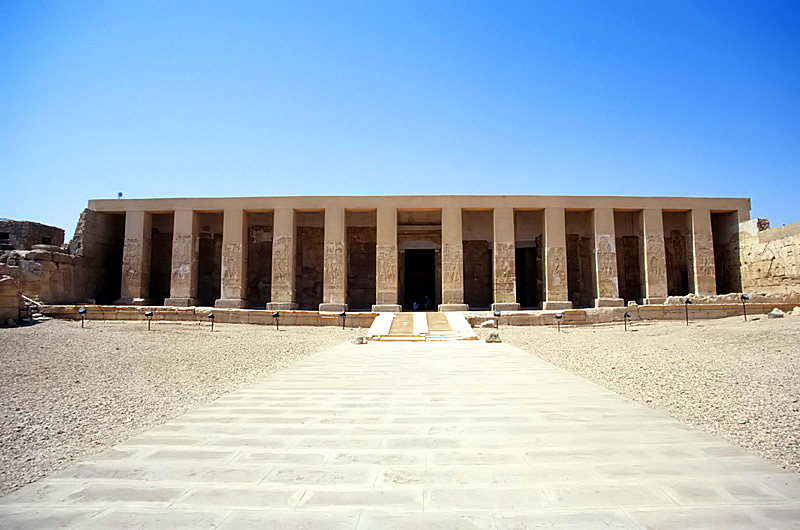
Today, Abydos is notable for the memorial temple of Seti I, which contains an inscription from the Nineteenth Dynasty known to the modern world as the Abydos King List. This is a chronological list showing cartouches of most dynastic pharaohs of Egypt from Menes until Seti I's father, Ramesses I. It is also notable for the Abydos graffiti, ancient Phoenician and Aramaic graffiti found on the walls of the Temple of Seti I.
The Great Temple and most of the ancient town are buried under the modern buildings to the north of the Seti temple. Many of the original structures and the artifacts within them are considered irretrievable and lost; many may have been destroyed by the new construction.
Most of Upper Egypt became unified under rulers from Abydos during the Naqada III period (3200–3000 BCE), at the expense of rival cities such as Nekhen. The conflicts leading to the supremacy of Abydos may appear on numerous reliefs of the Naqada II period, such as the Gebel el-Arak Knife, or the frieze of Tomb 100 at Hierakonpolis.
Tombs and at least one temple of rulers of the Predynastic period have been found at Umm El Qa'ab including that of Narmer, dating to c. 3100 BCE. The temple and town continued to be rebuilt at intervals down to the times of the Thirtieth Dynasty, and the cemetery was in continuous use.
The pharaohs of the First Dynasty were buried in Abydos, including Narmer, who is regarded as the founder of the First Dynasty, and his successor, Aha. It was in this time period that the Abydos boats were constructed. Some pharaohs of the Second Dynasty were also buried in Abydos. The temple was renewed and enlarged by these pharaohs as well. Funerary enclosures, misinterpreted in modern times as great 'forts', were built on the desert behind the town by three kings of the Second Dynasty; the most complete is that of Khasekhemwy, the Shunet El Zebib.
From the Fifth Dynasty, the deity Khentiamentiu, foremost of the Westerners, came to be seen as a manifestation of the dead pharaoh in the underworld. Pepi I (Sixth Dynasty) constructed a funerary chapel which evolved over the years into the Great Temple of Osiris, the ruins of which still exist within the town enclosure. Abydos became the centre of the worship of the Isis and Osiris cult.
Hub AI
Abydos, Egypt AI simulator
(@Abydos, Egypt_simulator)
Abydos, Egypt
Abydos /əˈbaɪdɒs/ (Arabic: أبيدوس, romanized: Abīdūs or Arabic: افود, romanized: Afūd; Sahidic Coptic: Ⲉⲃⲱⲧ Ebōt) is one of the oldest cities of ancient Egypt, and also of the eighth nome in Upper Egypt. It is located about 11 kilometres (6.8 miles) west of the Nile at latitude 26° 10' N, near the modern Egyptian towns of El Araba El Madfuna and El Balyana. In the ancient Egyptian language, the city was called Abedju (ꜣbḏw or AbDw)(Arabic Abdu عبد-و). The English name Abydos comes from the Greek Ἄβυδος, a name borrowed by Greek geographers from the unrelated city of Abydos on the Hellespont.
Considered one of the most important archaeological sites in Egypt, the sacred city of Abydos was the site of many ancient temples, including Umm el-Qa'ab, a royal necropolis where early pharaohs were entombed. These tombs began to be seen as extremely significant burials and in later times it became desirable to be buried in the area, leading to the growth of the town's importance as a cult site.
Today, Abydos is notable for the memorial temple of Seti I, which contains an inscription from the Nineteenth Dynasty known to the modern world as the Abydos King List. This is a chronological list showing cartouches of most dynastic pharaohs of Egypt from Menes until Seti I's father, Ramesses I. It is also notable for the Abydos graffiti, ancient Phoenician and Aramaic graffiti found on the walls of the Temple of Seti I.
The Great Temple and most of the ancient town are buried under the modern buildings to the north of the Seti temple. Many of the original structures and the artifacts within them are considered irretrievable and lost; many may have been destroyed by the new construction.
Most of Upper Egypt became unified under rulers from Abydos during the Naqada III period (3200–3000 BCE), at the expense of rival cities such as Nekhen. The conflicts leading to the supremacy of Abydos may appear on numerous reliefs of the Naqada II period, such as the Gebel el-Arak Knife, or the frieze of Tomb 100 at Hierakonpolis.
Tombs and at least one temple of rulers of the Predynastic period have been found at Umm El Qa'ab including that of Narmer, dating to c. 3100 BCE. The temple and town continued to be rebuilt at intervals down to the times of the Thirtieth Dynasty, and the cemetery was in continuous use.
The pharaohs of the First Dynasty were buried in Abydos, including Narmer, who is regarded as the founder of the First Dynasty, and his successor, Aha. It was in this time period that the Abydos boats were constructed. Some pharaohs of the Second Dynasty were also buried in Abydos. The temple was renewed and enlarged by these pharaohs as well. Funerary enclosures, misinterpreted in modern times as great 'forts', were built on the desert behind the town by three kings of the Second Dynasty; the most complete is that of Khasekhemwy, the Shunet El Zebib.
From the Fifth Dynasty, the deity Khentiamentiu, foremost of the Westerners, came to be seen as a manifestation of the dead pharaoh in the underworld. Pepi I (Sixth Dynasty) constructed a funerary chapel which evolved over the years into the Great Temple of Osiris, the ruins of which still exist within the town enclosure. Abydos became the centre of the worship of the Isis and Osiris cult.
Recent media