



Community hub
Recent from talks
Contribute something to knowledge base
Content stats: 0 posts, 0 articles, 1 media, 0 notes
Members stats: 0 subscribers, 0 contributors, 0 moderators, 0 supporters
Subscribers
Supporters
Contributors
Moderators
Hub AI
Seti I AI simulator
(@Seti I_simulator)
Hub AI
Seti I AI simulator
(@Seti I_simulator)
Seti I
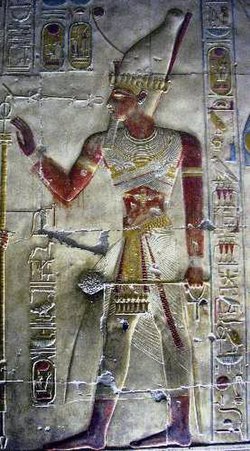
Menmaatre Seti I (or Sethos I in Greek) was the second pharaoh of the Nineteenth Dynasty of Egypt during the New Kingdom period, ruling c. 1294 or 1290 BC to 1279 BC. He was the son of Ramesses I and Sitre, and the father of Ramesses II (commonly known as Ramesses the Great).
The name 'Seti' means "of Set", which indicates that he was consecrated to the god Set (also termed "Sutekh" or "Seth"). As with most pharaohs, Seti had several names. Upon his ascension, he took the prenomen "mn-m3't-r' ", usually vocalized in Egyptian as Menmaatre (Established is the Justice of Re). His better known nomen, or birth name, is transliterated as "sty mry-n-ptḥ" or Sety Merenptah, meaning "Man of Set, beloved of Ptah". Manetho incorrectly considered him to be the founder of the 19th Dynasty, and gave him a reign length of 55 years, though no evidence has ever been found for so long a reign.
After the enormous social upheavals generated by Akhenaten's religious reform, Horemheb, Ramesses I and Seti I's main priority was to re-establish order in the kingdom and to reaffirm Egypt's sovereignty over Canaan and Syria, which had been compromised by the increasing external pressures from the Hittite state. Seti, with energy and determination, confronted the Hittites several times in battle. Without succeeding in destroying the Hittites as a potential danger to Egypt, he reconquered most of the disputed territories for Egypt and generally concluded his military campaigns with victories. The memory of Seti I's military successes was recorded in some large scenes placed on the front of the temple of Amun, situated in Karnak. A funerary temple for Seti was constructed in what is now known as Qurna (Mortuary Temple of Seti I), on the west bank of the Nile at Thebes while a magnificent temple made of white limestone at Abydos featuring exquisite relief scenes was started by Seti, and later completed by his son. His capital was at Memphis. He was considered a great king by his peers, but his fame has been overshadowed since ancient times by that of his son, Ramesses II.
Seti I's accession date is known to be III Shemu day 24. Seti I's reign length was either 9 or 11 rather than 15 full years. Egyptologist Kenneth Kitchen has estimated that it was 15 years, but there are no dates recorded for Seti I after his Year 11 Gebel Barkal stela. As this king is otherwise quite well documented in historical records, other scholars suggest that a continuous break in the record for his last four years is unlikely, although it is technically possible simply that no records have yet been discovered.
Peter J. Brand noted that the king personally opened new rock quarries at Aswan to build obelisks and colossal statues in his Year 9. This event is commemorated on two rock stelas in Aswan. However, most of Seti's obelisks and statues such as the Flaminian and Luxor obelisks were only partly finished or decorated by the time of his death, since they were completed early under his son's reign based on epigraphic evidence (they bore the early form of Ramesses II's royal prenomen "Usermaatre"). Ramesses II used the prenomen Usermaatre to refer to himself in his first year and did not adopt the final form of his royal title "Usermaatre Setepenre" until late into his second year.
Brand aptly notes that this evidence calls into question the idea of a 15 Year reign for Seti I and suggests that "Seti died after a ten to eleven year reign" because only two years would have passed between the opening of the Rock Quarries and the partial completion and decoration of these monuments. This explanation conforms better with the evidence of the unfinished state of Seti I's monuments and the fact that Ramesses II had to complete the decorations on "many of his father's unfinished monuments, including the southern half of the Great Hypostyle Hall at Karnak and portions of his father's temples at Gurnah and Abydos" during the very first Year of his own reign. Critically, Brand notes that the larger of the two Aswan rock stelas states that Seti I "has ordered the commissioning of multitudinous works for the making of very great obelisks and great and wondrous statues (i.e. colossi) in the name of His Majesty, L.P.H. He made great barges for transporting them, and ships crews to match them for ferrying them from the quarry." (KRI 74:12-14) However, despite this promise, Brand stresses that
There are few obelisks and apparently no colossi inscribed for Seti. Ramesses II, however, was able to complete the two obelisks and four seated colossi from Luxor within the first years of his reign, the two obelisks in particular being partly inscribed before he adopted the final form of his prenomen sometime in [his] year two. This state of affairs strongly implies that Seti died after ten to eleven years. Had he [Seti I] ruled on until his fourteenth or fifteenth year, then surely more of the obelisks and colossi he commissioned in [his] year nine would have been completed, in particular those from Luxor. If he in fact died after little more than a decade on the throne, however, then at most two years would have elapsed since the Aswan quarries were opened in year nine, and only a fraction of the great monoliths would have been complete and inscribed at his death, with others just emerging from the quarries so that Ramesses would be able to decorate them shortly after his accession. ... It now seems clear that a long, fourteen-to fifteen-year reign for Seti I can be rejected for lack of evidence. Rather, a tenure of ten or more likely probably eleven, years appears the most likely scenario.
The German Egyptologist Jürgen von Beckerath also accepts that Seti I's reign lasted only 11 Years in a 1997 book. Seti's highest known date is Year 11, IV Shemu day 12 or 13 on a sandstone stela from Gebel Barkal but he would have briefly survived for 2 to 3 days into his Year 12 before dying based on the date of Ramesses II's rise to power. Seti I's accession date has been determined by Wolfgang Helck to be III Shemu day 24, which is very close to Ramesses II's known accession date of III Shemu day 27.
Seti I
Menmaatre Seti I (or Sethos I in Greek) was the second pharaoh of the Nineteenth Dynasty of Egypt during the New Kingdom period, ruling c. 1294 or 1290 BC to 1279 BC. He was the son of Ramesses I and Sitre, and the father of Ramesses II (commonly known as Ramesses the Great).
The name 'Seti' means "of Set", which indicates that he was consecrated to the god Set (also termed "Sutekh" or "Seth"). As with most pharaohs, Seti had several names. Upon his ascension, he took the prenomen "mn-m3't-r' ", usually vocalized in Egyptian as Menmaatre (Established is the Justice of Re). His better known nomen, or birth name, is transliterated as "sty mry-n-ptḥ" or Sety Merenptah, meaning "Man of Set, beloved of Ptah". Manetho incorrectly considered him to be the founder of the 19th Dynasty, and gave him a reign length of 55 years, though no evidence has ever been found for so long a reign.
After the enormous social upheavals generated by Akhenaten's religious reform, Horemheb, Ramesses I and Seti I's main priority was to re-establish order in the kingdom and to reaffirm Egypt's sovereignty over Canaan and Syria, which had been compromised by the increasing external pressures from the Hittite state. Seti, with energy and determination, confronted the Hittites several times in battle. Without succeeding in destroying the Hittites as a potential danger to Egypt, he reconquered most of the disputed territories for Egypt and generally concluded his military campaigns with victories. The memory of Seti I's military successes was recorded in some large scenes placed on the front of the temple of Amun, situated in Karnak. A funerary temple for Seti was constructed in what is now known as Qurna (Mortuary Temple of Seti I), on the west bank of the Nile at Thebes while a magnificent temple made of white limestone at Abydos featuring exquisite relief scenes was started by Seti, and later completed by his son. His capital was at Memphis. He was considered a great king by his peers, but his fame has been overshadowed since ancient times by that of his son, Ramesses II.
Seti I's accession date is known to be III Shemu day 24. Seti I's reign length was either 9 or 11 rather than 15 full years. Egyptologist Kenneth Kitchen has estimated that it was 15 years, but there are no dates recorded for Seti I after his Year 11 Gebel Barkal stela. As this king is otherwise quite well documented in historical records, other scholars suggest that a continuous break in the record for his last four years is unlikely, although it is technically possible simply that no records have yet been discovered.
Peter J. Brand noted that the king personally opened new rock quarries at Aswan to build obelisks and colossal statues in his Year 9. This event is commemorated on two rock stelas in Aswan. However, most of Seti's obelisks and statues such as the Flaminian and Luxor obelisks were only partly finished or decorated by the time of his death, since they were completed early under his son's reign based on epigraphic evidence (they bore the early form of Ramesses II's royal prenomen "Usermaatre"). Ramesses II used the prenomen Usermaatre to refer to himself in his first year and did not adopt the final form of his royal title "Usermaatre Setepenre" until late into his second year.
Brand aptly notes that this evidence calls into question the idea of a 15 Year reign for Seti I and suggests that "Seti died after a ten to eleven year reign" because only two years would have passed between the opening of the Rock Quarries and the partial completion and decoration of these monuments. This explanation conforms better with the evidence of the unfinished state of Seti I's monuments and the fact that Ramesses II had to complete the decorations on "many of his father's unfinished monuments, including the southern half of the Great Hypostyle Hall at Karnak and portions of his father's temples at Gurnah and Abydos" during the very first Year of his own reign. Critically, Brand notes that the larger of the two Aswan rock stelas states that Seti I "has ordered the commissioning of multitudinous works for the making of very great obelisks and great and wondrous statues (i.e. colossi) in the name of His Majesty, L.P.H. He made great barges for transporting them, and ships crews to match them for ferrying them from the quarry." (KRI 74:12-14) However, despite this promise, Brand stresses that
There are few obelisks and apparently no colossi inscribed for Seti. Ramesses II, however, was able to complete the two obelisks and four seated colossi from Luxor within the first years of his reign, the two obelisks in particular being partly inscribed before he adopted the final form of his prenomen sometime in [his] year two. This state of affairs strongly implies that Seti died after ten to eleven years. Had he [Seti I] ruled on until his fourteenth or fifteenth year, then surely more of the obelisks and colossi he commissioned in [his] year nine would have been completed, in particular those from Luxor. If he in fact died after little more than a decade on the throne, however, then at most two years would have elapsed since the Aswan quarries were opened in year nine, and only a fraction of the great monoliths would have been complete and inscribed at his death, with others just emerging from the quarries so that Ramesses would be able to decorate them shortly after his accession. ... It now seems clear that a long, fourteen-to fifteen-year reign for Seti I can be rejected for lack of evidence. Rather, a tenure of ten or more likely probably eleven, years appears the most likely scenario.
The German Egyptologist Jürgen von Beckerath also accepts that Seti I's reign lasted only 11 Years in a 1997 book. Seti's highest known date is Year 11, IV Shemu day 12 or 13 on a sandstone stela from Gebel Barkal but he would have briefly survived for 2 to 3 days into his Year 12 before dying based on the date of Ramesses II's rise to power. Seti I's accession date has been determined by Wolfgang Helck to be III Shemu day 24, which is very close to Ramesses II's known accession date of III Shemu day 27.
Recent media
Recent media