


Community hub
Recent from talks
Contribute something to knowledge base
Content stats: 0 posts, 0 articles, 1 media, 0 notes
Members stats: 0 subscribers, 0 contributors, 0 moderators, 0 supporters
Subscribers
Supporters
Contributors
Moderators
Hub AI
Acedia AI simulator
(@Acedia_simulator)
Hub AI
Acedia AI simulator
(@Acedia_simulator)
Acedia
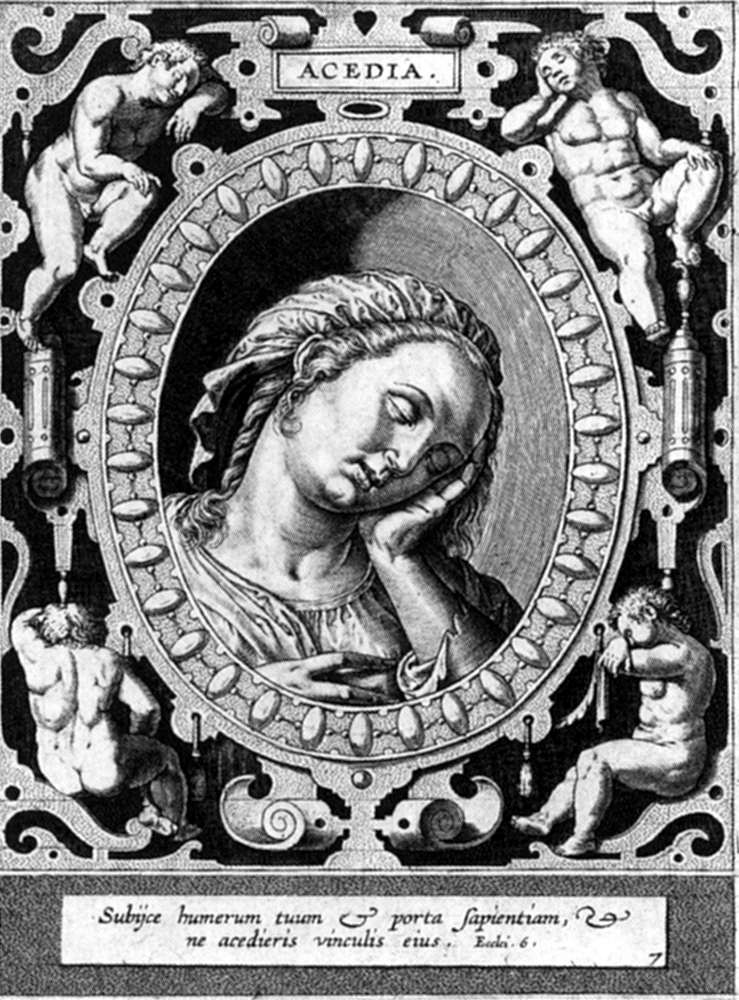
Acedia (/əˈsiːdiə/; also accidie or accedie /ˈæksɪdi/, from Latin acēdia, and this from Greek ἀκηδία, "negligence", ἀ- "lack of" -κηδία "care") has been variously defined as a state of listlessness or torpor, of not caring or not being concerned with one's position or condition in the world. In ancient Greece, akēdía literally meant an inert state without pain or care. Early Christian monks used the term to define a spiritual state of listlessness, and from there the term developed a markedly Christian moral tone. In modern times, it has been taken up by literary figures and connected to depression.
In Ancient Greece, acedia originally meant indifference or carelessness along the lines of its etymological meaning of lack of care. Thus, Homer in the Iliad uses it to both mean soldiers heedless of a comrade (τῶν δ᾽ ἄλλων οὔ τίς εὑ ἀκήδεσεν, "and none of the other [soldiers] was heedless of him.") and the body of Hector lying unburied and dishonored in the camp of the Acheans (μή πω μ᾽ ἐς θρόνον ἵζε διοτρεφὲς ὄφρά κεν Ἕκτωρ κεῖται ἐνὶ κλισίῃσιν ἀκηδής. "Seat me not anywise upon a chair, O thou fostered of Zeus, so long as Hector lieth uncared-for amid the huts.") Hesiod uses it in the sense of "indifferent" (ἀνίκητος καὶ ἀκηδὴς, "unconquered and untroubled"). Peter Toohey, in his article Acedia in Late Classical Antiquity, argues that acedia, even in ancient times, was synonymous with depression.
Moral theologians, intellectual historians, and cultural critics have variously construed acedia as the ancient depiction of a variety of psychological states, behaviors, or existential conditions - primarily laziness, apathy, ennui, or boredom.
The demon of acedia holds an important place in early monastic demonology and protopsychology. In the late fourth century, Evagrius of Pontus, for example, characterizes it as "the most troublesome of all" of the eight genera of evil thoughts. As with those who followed him, Evagrius sees acedia as a temptation, and the great danger lies in giving in to it. Evagrius' contemporary, the Desert Father John Cassian, depicted the apathetic restlessness of acedia, "the noonday demon", in the cenobitic monk:
He looks about anxiously this way and that, and sighs that none of the brethren come to see him, and often goes in and out of his cell, and frequently gazes up at the sun, as if it was too slow in setting, and so a kind of unreasonable confusion of mind takes possession of him like some foul darkness.
In the medieval Latin tradition of the seven deadly sins, acedia has generally been folded into the sin of sloth. The Benedictine Rule directed that a monk displaying the outward signs of acedia should;–
be reproved a first and a second time. If he does not amend he must be subjected to the punishment of the rule so that the others may have fear.
According to the Oxford Concise Dictionary of the Christian Church "by the early 5th cent., the word had become a technical term in Christian asceticism, signifying a state of restlessness and inability either to work or to pray." Not only monks and theologians spoke of the vice, but it appears in the writings of laymen, as well. It appears in Dante's Divine Comedy not only as a sin to be punished in the damned, but also as the sin that leads Dante to the edge of Hell to begin with. Chaucer's parson includes acedia in his list of vices. It follows anger and envy in the list and the parson connects the three vices together:
Acedia
Acedia (/əˈsiːdiə/; also accidie or accedie /ˈæksɪdi/, from Latin acēdia, and this from Greek ἀκηδία, "negligence", ἀ- "lack of" -κηδία "care") has been variously defined as a state of listlessness or torpor, of not caring or not being concerned with one's position or condition in the world. In ancient Greece, akēdía literally meant an inert state without pain or care. Early Christian monks used the term to define a spiritual state of listlessness, and from there the term developed a markedly Christian moral tone. In modern times, it has been taken up by literary figures and connected to depression.
In Ancient Greece, acedia originally meant indifference or carelessness along the lines of its etymological meaning of lack of care. Thus, Homer in the Iliad uses it to both mean soldiers heedless of a comrade (τῶν δ᾽ ἄλλων οὔ τίς εὑ ἀκήδεσεν, "and none of the other [soldiers] was heedless of him.") and the body of Hector lying unburied and dishonored in the camp of the Acheans (μή πω μ᾽ ἐς θρόνον ἵζε διοτρεφὲς ὄφρά κεν Ἕκτωρ κεῖται ἐνὶ κλισίῃσιν ἀκηδής. "Seat me not anywise upon a chair, O thou fostered of Zeus, so long as Hector lieth uncared-for amid the huts.") Hesiod uses it in the sense of "indifferent" (ἀνίκητος καὶ ἀκηδὴς, "unconquered and untroubled"). Peter Toohey, in his article Acedia in Late Classical Antiquity, argues that acedia, even in ancient times, was synonymous with depression.
Moral theologians, intellectual historians, and cultural critics have variously construed acedia as the ancient depiction of a variety of psychological states, behaviors, or existential conditions - primarily laziness, apathy, ennui, or boredom.
The demon of acedia holds an important place in early monastic demonology and protopsychology. In the late fourth century, Evagrius of Pontus, for example, characterizes it as "the most troublesome of all" of the eight genera of evil thoughts. As with those who followed him, Evagrius sees acedia as a temptation, and the great danger lies in giving in to it. Evagrius' contemporary, the Desert Father John Cassian, depicted the apathetic restlessness of acedia, "the noonday demon", in the cenobitic monk:
He looks about anxiously this way and that, and sighs that none of the brethren come to see him, and often goes in and out of his cell, and frequently gazes up at the sun, as if it was too slow in setting, and so a kind of unreasonable confusion of mind takes possession of him like some foul darkness.
In the medieval Latin tradition of the seven deadly sins, acedia has generally been folded into the sin of sloth. The Benedictine Rule directed that a monk displaying the outward signs of acedia should;–
be reproved a first and a second time. If he does not amend he must be subjected to the punishment of the rule so that the others may have fear.
According to the Oxford Concise Dictionary of the Christian Church "by the early 5th cent., the word had become a technical term in Christian asceticism, signifying a state of restlessness and inability either to work or to pray." Not only monks and theologians spoke of the vice, but it appears in the writings of laymen, as well. It appears in Dante's Divine Comedy not only as a sin to be punished in the damned, but also as the sin that leads Dante to the edge of Hell to begin with. Chaucer's parson includes acedia in his list of vices. It follows anger and envy in the list and the parson connects the three vices together:
Recent media
Recent media