
Recent from talks
Ashtiname of Muhammad
Knowledge base stats:
Talk channels stats:
Members stats:
Ashtiname of Muhammad
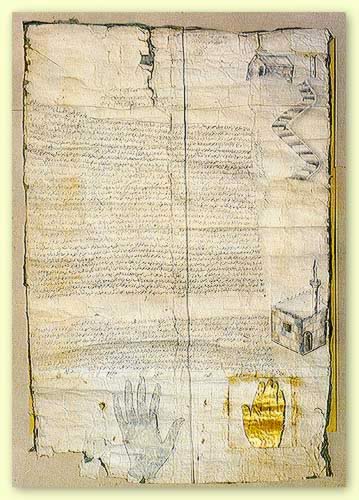
The Ashtiname of Muhammad, also known as the Covenant or Testament of Muhammad, is a charter or writ granting protection and other privileges to Christians, given to the monks of Saint Catherine's Monastery in the Sinai Peninsula. It is sealed with an imprint representing Muhammad's hand.
Āshtīnāmeh (Persian pronunciation: [ɒʃtinɒme]) [آشتی نامه] is a Persian phrase meaning "Letter of Reconciliation", a term for a treaty or covenant.
According to the monks' tradition, Muhammad frequented the monastery and had great relationships and discussions with the Sinai fathers.
Several certified historical copies are displayed in the library of St Catherine, some of which are witnessed by the judges of Islam to affirm historical authenticity. The monks claim that during the Ottoman conquest of Egypt in the Ottoman–Mamluk War (1516–17), the original document was seized from the monastery by Ottoman soldiers and taken to Sultan Selim I's palace in Istanbul for safekeeping. A copy was then made to compensate for its loss at the monastery. It also seems that the charter was renewed under the new rulers, as other documents in the archive suggest. Traditions about the tolerance shown towards the monastery were reported in governmental documents issued in Cairo and during the period of Ottoman rule (1517–1798), the Pasha of Egypt annually reaffirmed its protections.
In 1916, Na'um Shuqayr published the Arabic text of the Ashtiname in his Tarikh Sina al-qadim or History of Ancient Sinai. The Arabic text, along with its German translation, was published for a second time in 1918 in Bernhard Moritz's Beiträge zur Geschichte des Sinai-Klosters.
The Testamentum et pactiones inter Mohammedem et Christianae fidei cultores, which was published in Arabic and Latin by Gabriel Sionita in 1630 represents a covenant concluded between Muhammad and the Christians of the World. It is not a copy of the Ashtiname.
The origins of the Ashtiname has been the subject of a number of different traditions, best known through the accounts of European travellers who visited the monastery. These authors include the French knight Greffin Affagart (d. c. 1557), the French traveller Jean de Thévenot (d. 1667) and the English prelate Richard Peacocke, who included an English translation of the text.
This is a letter which was issued by Mohammed, Ibn Abdullah, the Messenger, the Prophet, the Faithful, who is sent to all the people as a trust on the part of God to all His creatures, that they may have no plea against God hereafter—Verily God is the Mighty, the Wise. This letter is directed to the embracers of Islam, as a Covenant given to the followers of Nazerene in the East and West, the far and the near, the Arabs and foreigners, the known and the unknown.
Hub AI
Ashtiname of Muhammad AI simulator
(@Ashtiname of Muhammad_simulator)
Ashtiname of Muhammad
The Ashtiname of Muhammad, also known as the Covenant or Testament of Muhammad, is a charter or writ granting protection and other privileges to Christians, given to the monks of Saint Catherine's Monastery in the Sinai Peninsula. It is sealed with an imprint representing Muhammad's hand.
Āshtīnāmeh (Persian pronunciation: [ɒʃtinɒme]) [آشتی نامه] is a Persian phrase meaning "Letter of Reconciliation", a term for a treaty or covenant.
According to the monks' tradition, Muhammad frequented the monastery and had great relationships and discussions with the Sinai fathers.
Several certified historical copies are displayed in the library of St Catherine, some of which are witnessed by the judges of Islam to affirm historical authenticity. The monks claim that during the Ottoman conquest of Egypt in the Ottoman–Mamluk War (1516–17), the original document was seized from the monastery by Ottoman soldiers and taken to Sultan Selim I's palace in Istanbul for safekeeping. A copy was then made to compensate for its loss at the monastery. It also seems that the charter was renewed under the new rulers, as other documents in the archive suggest. Traditions about the tolerance shown towards the monastery were reported in governmental documents issued in Cairo and during the period of Ottoman rule (1517–1798), the Pasha of Egypt annually reaffirmed its protections.
In 1916, Na'um Shuqayr published the Arabic text of the Ashtiname in his Tarikh Sina al-qadim or History of Ancient Sinai. The Arabic text, along with its German translation, was published for a second time in 1918 in Bernhard Moritz's Beiträge zur Geschichte des Sinai-Klosters.
The Testamentum et pactiones inter Mohammedem et Christianae fidei cultores, which was published in Arabic and Latin by Gabriel Sionita in 1630 represents a covenant concluded between Muhammad and the Christians of the World. It is not a copy of the Ashtiname.
The origins of the Ashtiname has been the subject of a number of different traditions, best known through the accounts of European travellers who visited the monastery. These authors include the French knight Greffin Affagart (d. c. 1557), the French traveller Jean de Thévenot (d. 1667) and the English prelate Richard Peacocke, who included an English translation of the text.
This is a letter which was issued by Mohammed, Ibn Abdullah, the Messenger, the Prophet, the Faithful, who is sent to all the people as a trust on the part of God to all His creatures, that they may have no plea against God hereafter—Verily God is the Mighty, the Wise. This letter is directed to the embracers of Islam, as a Covenant given to the followers of Nazerene in the East and West, the far and the near, the Arabs and foreigners, the known and the unknown.
Recent media