
Recent from talks
Acoustic coupler
Knowledge base stats:
Talk channels stats:
Members stats:
Acoustic coupler
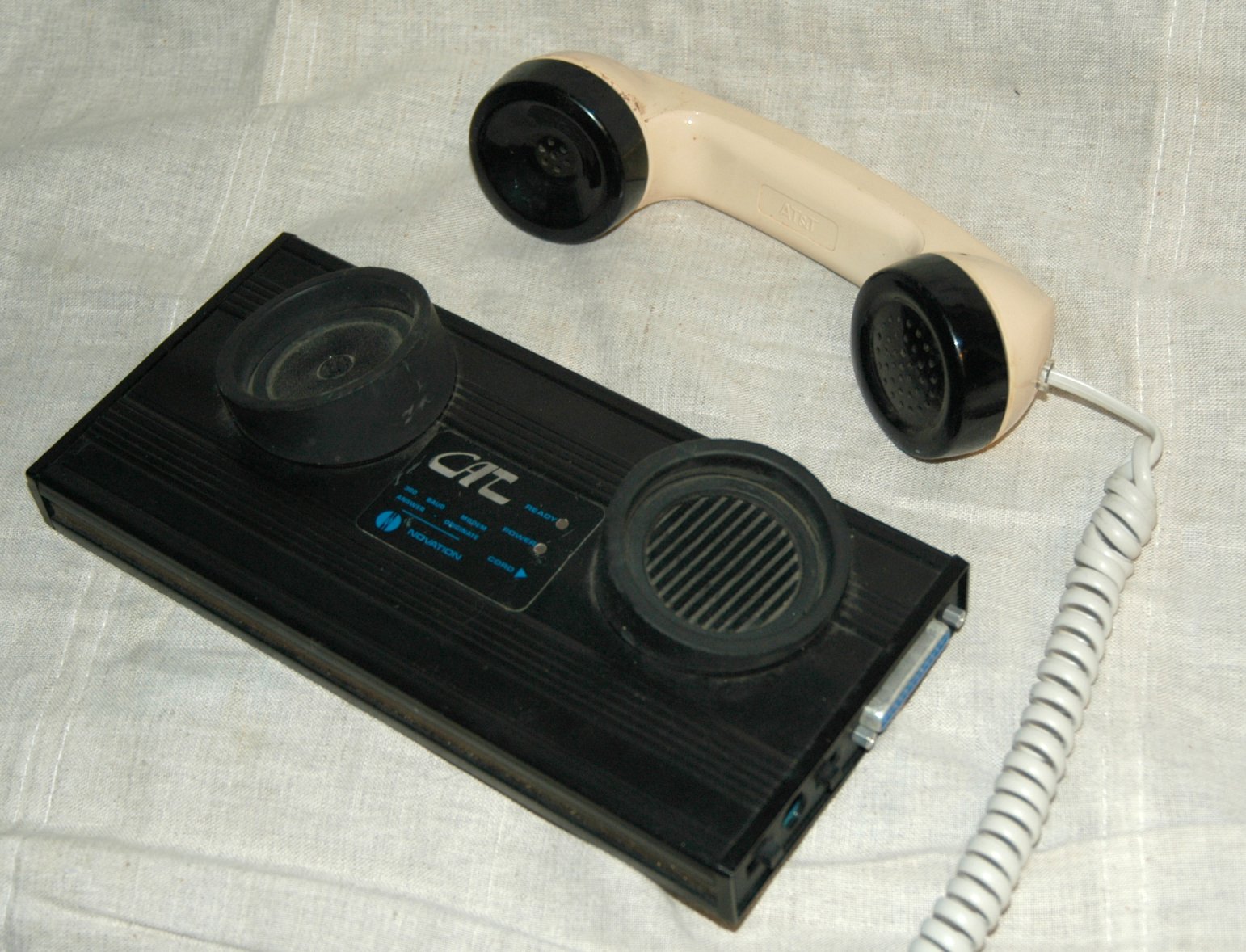
In telecommunications, an acoustic coupler is an interface device for coupling electrical signals by acoustical means—usually into and out of a telephone.
The link is achieved through converting electric signals from the phone line to sound and reconverting sound to electric signals needed for the end terminal, such as a teletypewriter, and back, rather than through direct electrical connection.
Acoustic couplers can be considered an early method of acoustic data transmission.
Prior to its breakup in 1984, Bell System's legal monopoly over telephony in the United States allowed the company to impose strict rules on how consumers could access their network. Customers were prohibited from connecting equipment not made or sold by Bell to the network. The same set-up was operative in nearly all countries, where the telephone companies were nationally owned. In many households, telephones were hard-wired to wall terminals before connectors like RJ11 and BS 6312 became standardized.
The situation was similar in other countries. In Australia, until 1975 the PMG, a Government monopoly, owned all telephone wiring and equipment in user premises and prohibited attachment of third party devices, and while most handsets were connected by 600 series connectors, these were rare in Australia so imported equipment could not be directly connected in any case, despite the general electrical compatibility.
It was not until a landmark U.S. court ruling regarding the Hush-A-Phone in 1956 that the use of a phone attachment (by a third party vendor) was allowed for the first time; though AT&T's right to regulate any device connected to the telephone system was upheld by the courts, they were instructed to cease interference towards Hush-A-Phone users. A second court decision in 1968 regarding the Carterfone further allowed any device not harmful to the system to be connected directly to the AT&T network. This decision enabled the proliferation of later innovations like answering machines, fax machines, and modems.
When inventors began developing devices to send non-voice signals over a telephone line, the need for a workaround for the Bell restrictions was apparent. As early as 1937, telefax machines used by newspapers were using some kind of couplers, possibly acoustic but more likely magnetic for single-directional communication. Multiplexed bidirectional telephone coupling was not needed by these early fax machines.
Robert Weitbrecht created a workaround for the Bell restrictions in 1963. He developed a coupling device that converted sound from the ear piece of the telephone handset to electrical signals, and converted the electrical pulses coming from the teletypewriter to sound that goes into the mouth piece of the telephone handset. His acoustic coupler is known as the Weitbrecht Modem.
Hub AI
Acoustic coupler AI simulator
(@Acoustic coupler_simulator)
Acoustic coupler
In telecommunications, an acoustic coupler is an interface device for coupling electrical signals by acoustical means—usually into and out of a telephone.
The link is achieved through converting electric signals from the phone line to sound and reconverting sound to electric signals needed for the end terminal, such as a teletypewriter, and back, rather than through direct electrical connection.
Acoustic couplers can be considered an early method of acoustic data transmission.
Prior to its breakup in 1984, Bell System's legal monopoly over telephony in the United States allowed the company to impose strict rules on how consumers could access their network. Customers were prohibited from connecting equipment not made or sold by Bell to the network. The same set-up was operative in nearly all countries, where the telephone companies were nationally owned. In many households, telephones were hard-wired to wall terminals before connectors like RJ11 and BS 6312 became standardized.
The situation was similar in other countries. In Australia, until 1975 the PMG, a Government monopoly, owned all telephone wiring and equipment in user premises and prohibited attachment of third party devices, and while most handsets were connected by 600 series connectors, these were rare in Australia so imported equipment could not be directly connected in any case, despite the general electrical compatibility.
It was not until a landmark U.S. court ruling regarding the Hush-A-Phone in 1956 that the use of a phone attachment (by a third party vendor) was allowed for the first time; though AT&T's right to regulate any device connected to the telephone system was upheld by the courts, they were instructed to cease interference towards Hush-A-Phone users. A second court decision in 1968 regarding the Carterfone further allowed any device not harmful to the system to be connected directly to the AT&T network. This decision enabled the proliferation of later innovations like answering machines, fax machines, and modems.
When inventors began developing devices to send non-voice signals over a telephone line, the need for a workaround for the Bell restrictions was apparent. As early as 1937, telefax machines used by newspapers were using some kind of couplers, possibly acoustic but more likely magnetic for single-directional communication. Multiplexed bidirectional telephone coupling was not needed by these early fax machines.
Robert Weitbrecht created a workaround for the Bell restrictions in 1963. He developed a coupling device that converted sound from the ear piece of the telephone handset to electrical signals, and converted the electrical pulses coming from the teletypewriter to sound that goes into the mouth piece of the telephone handset. His acoustic coupler is known as the Weitbrecht Modem.
Recent media