Hubbry Logo
search
logo
2312773

Acoustic coupler

logo
Community Hub0 Subscribers
Read side by side
from Wikipedia
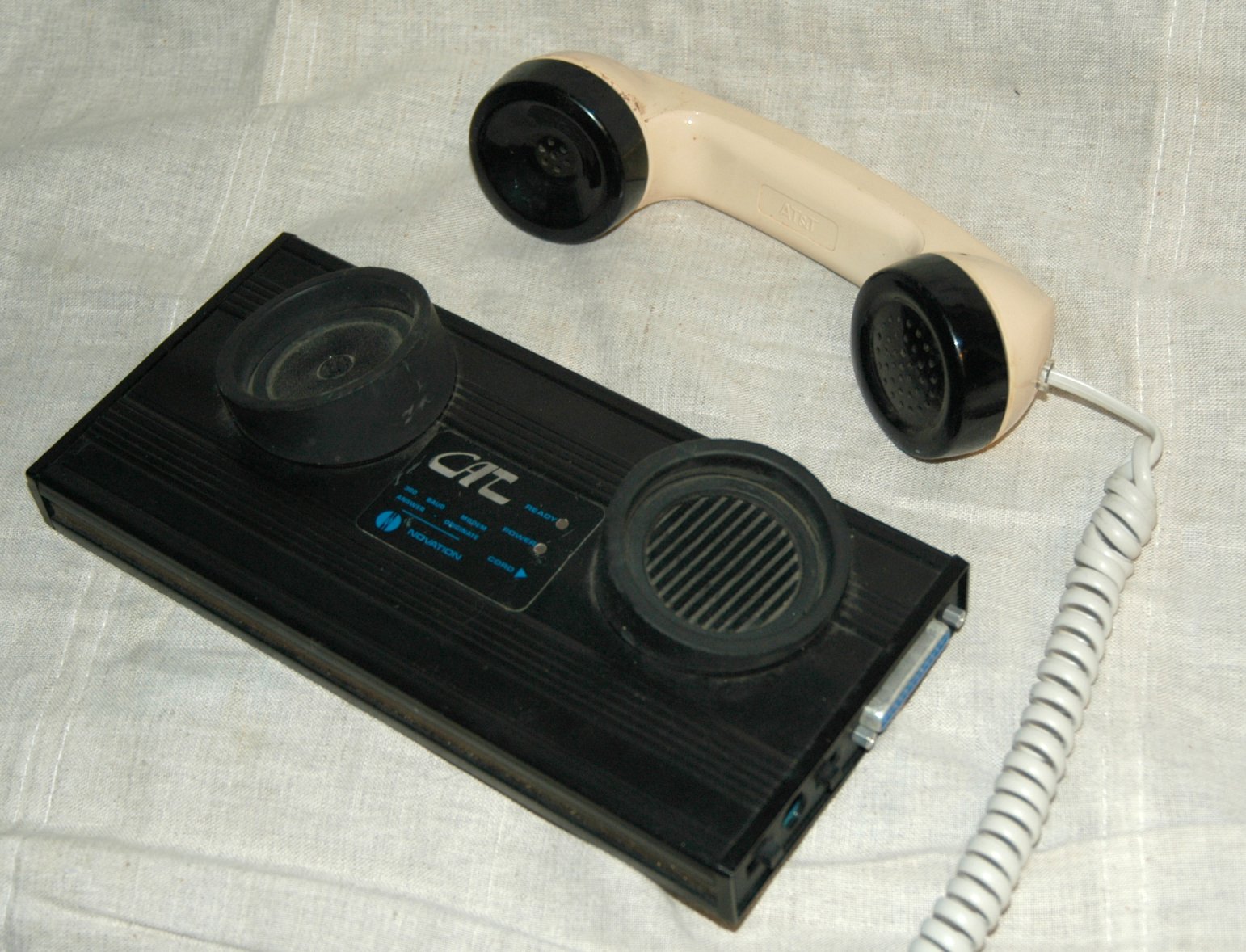
The Novation CAT acoustically coupled modem
Sendata Series 700

In telecommunications, an acoustic coupler is an interface device for coupling electrical signals by acoustical means—usually into and out of a telephone.

The link is achieved through converting electric signals from the phone line to sound and reconverting sound to electric signals needed for the end terminal, such as a teletypewriter, and back, rather than through direct electrical connection.

Acoustic couplers can be considered an early method of acoustic data transmission.

History and applications

[edit]

Prior to its breakup in 1984, Bell System's legal monopoly over telephony in the United States allowed the company to impose strict rules on how consumers could access their network. Customers were prohibited from connecting equipment not made or sold by Bell to the network. The same set-up was operative in nearly all countries, where the telephone companies were nationally owned. In many households, telephones were hard-wired to wall terminals before connectors like RJ11 and BS 6312 became standardized.

The situation was similar in other countries. In Australia, until 1975 the PMG, a Government monopoly, owned all telephone wiring and equipment in user premises and prohibited attachment of third party devices, and while most handsets were connected by 600 series connectors, these were rare in Australia so imported equipment could not be directly connected in any case, despite the general electrical compatibility.

It was not until a landmark U.S. court ruling regarding the Hush-A-Phone in 1956 that the use of a phone attachment (by a third party vendor) was allowed for the first time; though AT&T's right to regulate any device connected to the telephone system was upheld by the courts, they were instructed to cease interference towards Hush-A-Phone users.[1] A second court decision in 1968 regarding the Carterfone further allowed any device not harmful to the system to be connected directly to the AT&T network. This decision enabled the proliferation of later innovations like answering machines, fax machines, and modems.

When inventors began developing devices to send non-voice signals over a telephone line, the need for a workaround for the Bell restrictions was apparent. As early as 1937, telefax machines used by newspapers were using some kind of couplers, possibly acoustic but more likely magnetic for single-directional communication.[2] Multiplexed bidirectional telephone coupling was not needed by these early fax machines.

Robert Weitbrecht created a workaround for the Bell restrictions in 1963. He developed a coupling device that converted sound from the ear piece of the telephone handset to electrical signals, and converted the electrical pulses coming from the teletypewriter to sound that goes into the mouth piece of the telephone handset. His acoustic coupler is known as the Weitbrecht Modem.[3]

The Weitbrecht Modem inspired other engineers to develop other modems to work with 8-bit ASCII terminals at a faster rate. Such modems or couplers were developed around 1966 by John van Geen at the Stanford Research Institute (now SRI International), that mimicked handset operations.[4] An early commercial model was built by Livermore Data Systems in 1968.[5] One would dial the computer system (which would have telephone company datasets) on one's phone, and when the connection was established, place the handset into the acoustic modem. Since the handsets were all supplied by the telephone company, most had the same shape, simplifying the physical interface. A microphone and a speaker inside the modem box would pick up and transmit the signaling tones, and circuitry would convert those audio frequency-shift keying encoded binary signals for an RS232 output socket. With luck one could get 300 baud (~bits/second) transmission rates, but 150 baud was more typical. That speed was sufficient for typewriter-based terminals, as the IBM 2741, running at 134.5 baud, or a teleprinter, running at 110 baud.

The practical upper limit for acoustic-coupled modems was 1200 baud, first made available in 1973 by Vadic and 1977 by AT&T. 1200 baud endpoints became widespread in 1985 with the advent of the Hayes Smartmodem 1200A, though it used an RJ11 jack and was not an acoustic coupler. Such devices facilitated the creation of dial-up bulletin board systems, a forerunner of modern internet chat rooms, message boards, and e-mail.

Design

[edit]

Usually, a telephone handset was placed into a cradle that had been engineered to fit closely (by the use of rubber seals) around its microphone and earpiece. A modem would modulate a loudspeaker in the cup attached to the handset's microphone, and sound from the speaker in the telephone handset's earpiece would be picked up by a microphone in the cup attached to that. In this way signals could be passed in both directions. Despite the use of seals, acoustic couplers were sensitive to external noise and depended on the then-widespread standardization of the size and shape of handsets.

Once direct electrical connections to telephone networks were made legal, they rapidly became the preferred method of attaching modems, and the use of acoustic couplers dwindled. Acoustic couplers were still used until at least the late 1990s by people travelling in areas of the world where electrical connection to the telephone network was illegal or impractical.[6] Many models of Telecommunications Device for the Deaf (TDD) still have a built-in acoustic coupler, which allow more universal use with pay phones and for emergency calls by deaf people.

[edit]

An acoustic coupler (a Novation CAT 300 baud model) is prominently shown early in the 1983 film WarGames, when character David Lightman (portrayed by actor Matthew Broderick) places a telephone handset into the cradle of a prop acoustic modem to accentuate the act of using telephone lines for interconnection to the developing computer networks of the period—in this case, a military command computer. The earliest major motion picture depicting an acoustic coupler was probably the 1968 Steve McQueen film Bullitt.

See also

[edit]

Notes

[edit]
[edit]
Revisions and contributorsEdit on WikipediaRead on Wikipedia
from Grokipedia
An acoustic coupler is a telecommunications interface device that enables the transmission of digital data over analog telephone lines by acoustically coupling a computer's modem to a standard telephone handset, converting electrical signals into audible tones and vice versa.[1] The device features two rubber-lined receptacles or cups into which the handset's earpiece and mouthpiece are placed, with a loudspeaker transmitting tones to the telephone's microphone and a microphone capturing tones from the telephone's speaker for demodulation back into digital signals.[2][3] Developed in the mid-1960s, it originated from designs by physicist Robert H. Weitbrecht to connect teletypewriters for deaf communication via telephone handsets, later refined by Stanford Research Institute engineer John Van Geen for broader computer networking applications following the 1968 FCC Carterfone decision that permitted non-AT&T interconnections.[4] Acoustic couplers facilitated early remote computer access and data exchange without direct electrical connection to telephone wiring, prized for portability, security in restricted environments, and compliance with pre-regulatory constraints, achieving typical speeds of 300 baud and up to 1200 baud before being largely supplanted by direct-connect modems in the 1980s and 1990s.[4][1] Their acoustic nature, while innovative for enabling wide-area networks, introduced vulnerabilities to background noise and limited bandwidth due to reliance on voice-frequency audio transmission.[5]

Overview

Definition and Operating Principle

An acoustic coupler is a hardware interface that connects a computer terminal or modem to a standard telephone handset for data transmission over analog telephone lines, relying on sound waves rather than direct electrical contact.[1][4] This design circumvented early regulatory requirements for electrical connections to phone lines, as the Federal Communications Commission did not mandate certification for purely acoustic interfaces.[6] The device features a cradle with rubber acoustic cups or foam padding to secure the handset's receiver and mouthpiece, isolating a speaker for outgoing signals and a microphone for incoming ones.[1] The operating principle involves bidirectional acoustic-to-electrical and electrical-to-acoustic signal conversion. For data transmission, the modem encodes digital bits into modulated audio tones—typically using frequency-shift keying (FSK) at standards like Bell 103 for 300 bits per second—via electrical signals to the coupler's speaker, which generates sound waves matched to the handset's frequency response (around 300–3400 Hz voice band).[4] These sound waves are captured by the handset's microphone, converting them to electrical audio signals sent over the phone line. In reception, audio tones from the remote modem emerge as sound from the handset's speaker; the coupler's microphone detects them, converting the acoustic energy back to electrical signals for demodulation by the local modem into digital data.[4][1] This process introduces signal attenuation and susceptibility to ambient noise but enables portable, non-invasive connectivity.[4]

Historical Significance and Technological Context

The acoustic coupler emerged in the mid-1960s as a pivotal interface for transmitting data over telephone lines without direct electrical connection, primarily invented by deaf physicist Robert H. Weitbrecht to enable teletypewriter (TTY) communication for the hearing impaired. Weitbrecht's design, patented by SRI International in 1966, converted electrical signals from TTY devices into acoustic tones that could be coupled to a standard telephone handset's mouthpiece and earpiece, allowing deaf users to exchange text-based messages via the public switched telephone network (PSTN).[4][7] This innovation addressed the limitations of wired teletype systems, which required specialized infrastructure, by leveraging ubiquitous analog telephone handsets with their standardized dimensions and audio characteristics.[4] In the context of early computing, acoustic couplers held significance by facilitating remote terminal access to mainframe computers in an era dominated by AT&T's monopoly on telephone equipment, where federal regulations until 1968 prohibited "foreign attachments" that could electrically interface with phone lines. Devices like the 1964 Livermore Data Systems Model A exemplified this application, transmitting data at speeds around 300 baud using frequency-shift keying (FSK) tones audible over the phone's 300-3400 Hz bandwidth.[8] Their galvanic isolation—achieved through air-gapped acoustic transmission—proved essential for security-sensitive uses, such as military command systems, where direct connections risked signal interception or network disruption.[9] The 1968 FCC Carterfone decision, which permitted non-harmful interconnections, marked a regulatory turning point but did not immediately obsolete couplers, as they offered portability for field applications like journalism and early distributed computing.[4] Technologically, acoustic couplers bridged the analog telephony infrastructure of the 1950s-1970s with nascent digital data systems, operating amid rotary-dial phones and vacuum-tube or early transistorized terminals. By encoding binary data as distinct audio frequencies (typically 1070/1270 Hz for originate mode), they enabled rudimentary wide-area networking, predating packet-switched protocols and supporting ASCII-based interactions over long distances without dedicated leased lines.[4] Their limitations, including susceptibility to ambient noise and handset misalignment, underscored the transitional nature of this technology toward electrical modems, yet their role in democratizing data access—particularly for marginalized users and remote operators—laid foundational precedents for modern telecommunications interoperability.[8]

History

Early Invention and Prototypes (1950s–1960s)

The acoustic coupler, an interface device that transmits digital signals as audio tones via a telephone handset placed in rubber receptacles containing a speaker and microphone, was developed in response to regulatory restrictions imposed by AT&T, which prohibited direct electrical connections to its telephone network to prevent interference or liability.[4] Early efforts in the late 1950s focused on experimental data transmission over voice-grade lines, but practical prototypes emerged in the early 1960s to enable remote computer access without violating tariffs.[10] One of the first documented prototypes was the Livermore Data Systems Model A, introduced in 1964, which coupled a modem to a standard telephone handset for bidirectional data exchange at speeds around 110 baud, primarily for military and research applications where electrical isolation was required.[11] This device converted binary signals into audible frequencies within the telephone's bandwidth, allowing transmission over existing analog lines while isolating the computer from the network.[12] Significant advancements occurred in 1966 when John van Geen at Stanford Research Institute (SRI International) refined the design, creating acoustically coupled modems that accommodated ordinary handsets in a cradle with optimized acoustic chambers to minimize echo and distortion, supporting data rates up to 300 baud.[4][13] Van Geen's prototypes, patented that year, improved signal fidelity through better frequency matching to the telephone's 300–3400 Hz voice band and were tested for reliability in early computer-to-computer links, including precursors to wide-area networks.[14] These innovations also enabled applications beyond computing, such as telecommunication devices for the deaf by converting text to tones and vice versa.[14] Prototypes from this era, including SRI's models, emphasized mechanical simplicity and compliance with FCC rules emerging from the 1956 Hush-a-Phone and 1968 Carterfone decisions, which gradually permitted non-harmful attachments but initially favored acoustic methods for their non-invasive nature.[4] Limitations in early designs included susceptibility to ambient noise and lower throughput compared to theoretical voice channel capacity, prompting iterative testing at institutions like SRI to enhance coupling efficiency.[13]

Commercialization and Widespread Adoption (1960s–1970s)

The commercialization of acoustic couplers accelerated in the late 1960s following innovations in acoustical signal transmission. Stanford Research Institute (SRI) secured patents for two acoustical couplers in 1966, enabling deaf users to communicate via teletypewriters and laying groundwork for broader data applications by converting binary signals to acoustic tones transmitted over standard telephone handsets.[14] Anderson-Jacobson emerged as a pioneer, commencing production of acoustic data couplers in 1967, which allowed terminals to interface with telephone lines without direct electrical connection, operating at low speeds such as 110 bits per second.[15] Livermore Data Systems introduced an early commercial model around 1968, featuring a wooden enclosure with rubber cups to cradle the handset, facilitating dial-up connections to mainframe computers.[12] The U.S. Federal Communications Commission's Carterfone decision on June 26, 1968, significantly boosted commercialization by ruling AT&T's prohibition on non-proprietary attachments to the telephone network unlawful, thereby permitting acoustic couplers as a compliant alternative to direct wiring.[16] This regulatory shift encouraged manufacturers to scale production, with devices priced around $500–$1,000, targeting businesses and research institutions needing remote access.[17] Tymshare, a time-sharing service provider founded in 1965, integrated and sold acoustic couplers to link user terminals to its remote computing systems via public telephone lines.[18] Widespread adoption occurred in the 1970s amid the expansion of time-sharing networks and early packet-switching experiments, where acoustic couplers served as the primary interface for distributed computing. Users dialed into systems like those at universities and corporations, placing handsets into the coupler's acoustic cradle to transmit FSK-modulated tones at 300 baud, enabling applications from data retrieval to basic email precursors.[19] By mid-decade, improved designs from firms including Novation—whose CAT model debuted circa 1977—enhanced reliability and compatibility with Bell 103 standards, supporting the nascent personal computer market and ARPANET terminals before direct-connect modems proliferated.[8] Annual shipments grew into thousands, driven by demand for portable, regulation-compliant connectivity in an era when AT&T still restricted electrical interfaces.[4]

Transition to Direct-Connect Modems and Decline (1970s–1980s)

The U.S. Federal Communications Commission's Carterfone decision, issued on June 26, 1968, authorized the interconnection of non-harmful customer-owned devices to the public switched telephone network, thereby dismantling AT&T's longstanding prohibition on direct electrical attachments.[20][21] This regulatory shift directly enabled the development and commercialization of direct-connect modems, which bypassed the acoustic coupling mechanism by interfacing electrically with phone lines for more efficient data transmission.[4] Prior to this ruling, acoustic couplers had been the predominant solution since the 1950s, as they allowed compliance with AT&T's "foreign attachment" bans by transmitting signals via sound waves rather than wired connections.[22] In the early 1970s, direct-connect modems gained traction among businesses and early computer users, offering signal integrity superior to acoustic methods, which suffered from losses due to air gaps, handset misalignment, and environmental noise.[8] By the mid-1970s, third-party manufacturers began producing affordable direct-connect units operating at 300 baud, such as those compatible with Bell 103/113 standards, reducing connection errors and eliminating the manual placement of telephone handsets into rubber cups.[23] These advancements stemmed from the Carterfone ruling's encouragement of competition, which spurred innovation in modem design and lowered costs compared to AT&T's proprietary equipment.[21] The 1980s marked the rapid obsolescence of acoustic couplers, as direct-connect models proliferated with standardized interfaces like the Hayes Smartmodem introduced in 1981, which supported auto-dialing, error correction, and speeds up to 300 baud via AT command sets.[23] This transition was driven by direct-connect modems' ability to achieve higher reliability and scalability for emerging applications, including personal computing and bulletin board systems, rendering acoustic devices impractical for sustained use due to their vulnerability to acoustic interference and lower throughput limits.[8] Acoustic couplers persisted only in specialized scenarios, such as portable terminals or payphone access, but their market share dwindled as direct wiring became standard in fixed installations by the decade's end.[24]

Technical Design

Core Components

The primary physical component of an acoustic coupler is the handset coupling assembly, featuring two acoustically isolated chambers or cups contoured to fit the receiver (earpiece) and transmitter (mouthpiece) of a standard telephone handset, such as the Western Electric Model 500. These cups, often lined with foam or rubber, seal against the handset to maximize sound transfer efficiency and minimize ambient noise interference or acoustic crosstalk between transmit and receive paths.[6] Acoustic transducers form the interface between electrical signals and sound waves: a miniature loudspeaker in the transmit cup converts modulated electrical data signals into audible tones broadcast toward the telephone's microphone, while a microphone in the receive cup captures tones emitted from the telephone's speaker and converts them back to electrical signals. These transducers are selected for operation in the telephone voiceband (approximately 300–3400 Hz) to ensure compatibility with analog telephone networks, with typical designs employing dynamic or piezoelectric elements for reliable low-level signal transduction.[6][24] The electronic circuitry encompasses modulation and demodulation logic, typically implementing frequency-shift keying (FSK) per the Bell System 103J standard for full-duplex operation at 300 bits per second, using distinct frequency pairs—1070 Hz and 1270 Hz for originate mode mark and space, and 2025 Hz and 2225 Hz for answer mode—to enable simultaneous bidirectional communication over a single voice channel. Bandpass filters isolate transmit and receive frequency bands, while hybrid circuits or directional couplers suppress the local transmit signal from the receive path, preventing self-interference. Amplifiers condition signals for transducer drive and sensitivity, with the overall system interfacing to computers or terminals via RS-232 serial ports and powered by an external DC supply, often 12–15 V.[24][25]

Signal Transmission and Reception Process

The signal transmission process in an acoustic coupler begins with digital data from a computer or terminal being fed into the modem's modulation circuitry, where it is encoded into analog audio tones using techniques such as frequency-shift keying (FSK).[26] These tones, typically in the audible range of 300 to 3400 Hz to match telephone bandwidth, are generated by the modem and directed through a built-in loudspeaker positioned adjacent to one of the coupler's rubber cups.[15] The telephone handset is placed such that its microphone aligns with this cup, allowing the sound waves to impinge on the microphone diaphragm, which converts the acoustic pressure variations into corresponding electrical signals for transmission over the public switched telephone network (PSTN).[27] For full-duplex operation, as supported by standards like Bell 103, separate frequency pairs enable simultaneous transmission and reception: the originating station transmits at lower frequencies (e.g., 1070 Hz for mark, 1270 Hz for space) while receiving at higher ones (2025 Hz and 2225 Hz), minimizing crosstalk between the coupler's speaker and microphone.[6] The physical separation of the transmit and receive cups, combined with the directional characteristics of the handset, reduces acoustic interference, though background noise or misalignment could degrade signal quality.[28] Reception follows the inverse process: electrical signals arriving via the PSTN are converted by the telephone handset's earpiece into acoustic waves, which emanate into the coupler's receive cup containing a microphone.[26] This microphone captures the tones, converting them back to electrical audio signals that the modem demodulates into binary data for the terminal.[27] The coupler's design isolates the microphone from the outgoing speaker tones, relying on frequency separation and acoustic shielding to maintain signal integrity during bidirectional communication.[22] Typical data rates were limited to 300 bits per second due to the inefficiencies of acoustic-to-electrical conversion and susceptibility to environmental noise.[4]

Supported Speeds and Frequency Standards

Acoustic couplers primarily supported data transmission speeds of 300 bits per second (bps), equivalent to 300 baud in the frequency-shift keying (FSK) modulation schemes used, such as the Bell 103 standard introduced in the early 1960s.[4][2] This rate aligned with the capabilities of early teletype and terminal equipment, where the acoustic interface's reliance on the telephone handset's microphone and speaker introduced signal attenuation and noise, constraining practical throughput.[29] The Bell 103 standard, widely paired with acoustic couplers, utilized distinct frequency pairs for full-duplex operation over two-wire telephone lines: the originating station transmitted at 1070 Hz for binary 0 (space) and 1270 Hz for binary 1 (mark) in the lower voice band, while the answering station used 2025 Hz (space) and 2225 Hz (mark) in the higher band.[30][31] These frequencies fell within the standard telephone channel's 300–3400 Hz passband, enabling compatibility with acoustic coupling despite the 200 Hz shift per channel, which minimized crosstalk but limited speed due to the available bandwidth and acoustic fidelity.[32] Some later acoustic couplers, emerging in the 1970s, accommodated higher speeds up to 1200 baud, often via compatibility with Bell 202 or ITU V.23 standards, which employed asymmetric rates like 1200 bps receive and 75 bps transmit using FSK tones around 1200–2400 Hz.[24] However, these elevated rates proved unreliable in acoustic setups owing to increased susceptibility to echoes, background noise, and the handset's nonlinear response, frequently necessitating fallback to 300 baud for stable connections.[33] Experimental or niche models claimed support for even 2400 baud, but such performance remained exceptional and unstandardized, overshadowed by the shift to direct-connect modems post-1976 FCC deregulation.[34]

Advantages and Limitations

Key Advantages

Acoustic couplers provided galvanic isolation between the terminal equipment and the telephone line, preventing electrical surges, ground loops, and potential damage from lightning strikes or power line faults that could propagate through direct connections.[35][23] This isolation was achieved via acoustic signal transmission rather than electrical contact, ensuring no direct current path existed between the modem and the public switched telephone network (PSTN).[4] A primary benefit was universal compatibility with standard telephone handsets, such as the Western Electric 500-series, without requiring any electrical attachment, clipping, or modification to the phone itself.[36] Users simply placed the handset into the coupler's rubber cups, enabling operation with virtually any analog phone, including payphones or hotel room sets, which facilitated portability for travelers or field operators.[35][36] This design circumvented early regulatory restrictions imposed by telephone authorities, such as the U.S. Federal Communications Commission (FCC) and AT&T, which prohibited "foreign" electrical attachments to customer premises equipment to avoid interference or liability.[23] Acoustic couplers complied by using sound waves—typically in the voice frequency band of 300–3400 Hz—to couple signals, allowing data transmission at speeds up to 300 baud (bits per second) without violating tariffs that mandated non-invasive interfaces until direct-connect modems were approved in the late 1970s.[23][4] In secure or isolated environments, such as military or classified systems, the absence of electrical continuity reduced risks of unauthorized tapping or electromagnetic interference, though acoustic methods introduced vulnerabilities to eavesdropping via nearby microphones.[37]

Limitations and Criticisms

Acoustic couplers were constrained by low data transmission speeds, typically limited to 300 bits per second, which proved insufficient for applications requiring efficient file transfers or graphics beyond the earliest computing eras.[38][39] This cap stemmed from the narrow bandwidth of telephone handsets and the inefficiencies of acoustic modulation, preventing adaptation to higher baud rates like 1200 bps that became standard in the 1980s.[36] The acoustic interface introduced inherent signal degradation through repeated electrical-to-acoustic and acoustic-to-electrical conversions, resulting in attenuation, distortion, and heightened vulnerability to ambient noise, echoes, or vibrations that could interrupt connections.[36][38] Users often reported frustration with unreliable links in everyday environments, where background sounds interfered with the modulated tones, and the devices emitted audible high-frequency signals that could exceed comfortable sound pressure levels.[40] These shortcomings contributed to their obsolescence after the 1968 FCC Carterfone decision, which authorized direct electrical connections of non-harmful devices to AT&T lines, enabling modems with superior speed and stability that rendered acoustic couplers unnecessary for most users by the late 1970s.[4] Critics noted that while acoustic couplers provided essential early access amid regulatory restrictions, their persistence reflected technological compromises rather than optimal design, as direct methods eliminated conversion losses and physical handset placement hassles.[41]

Applications

Early Computing and Data Networking

Acoustic couplers enabled early digital data transmission over analog telephone networks by converting electrical signals from computer terminals into audible tones that a standard telephone handset could carry, thus bridging the gap between isolated computing systems and remote access without invasive wiring. The technology emerged in the mid-1960s, with Robert Weitbrecht inventing the first practical acoustic coupler in 1964 to interface teletypewriters (TTYs) with phones, a design rapidly repurposed for general computer data exchange at low speeds like 110 bits per second (bps).[42] This non-electrical coupling complied with Federal Communications Commission (FCC) restrictions on direct phone line attachments, which lacked standardized data ports until the late 1960s, allowing users to simply insert a handset into rubber acoustic cups for transmission.[22] In early computing environments, acoustic couplers supported timesharing systems, where multiple users accessed centralized mainframes remotely via dial-up connections. Terminals such as the Teletype ASR-33 connected to hosts like those at universities or research labs at 110 bps, facilitating interactive sessions for programming, data analysis, and resource sharing among geographically dispersed users as early as 1968.[19] This setup was instrumental in academic and military computing, where direct lines were impractical or prohibited, enabling the first waves of distributed collaboration before dedicated data networks.[43] For nascent data networking, acoustic couplers provided dial-up entry points to experimental systems, including precursors to packet-switched architectures. Improvements by SRI International in the late 1960s, such as John van Geen's enhanced designs, boosted signal robustness for reliable modem-to-phone interfacing, supporting broader connectivity in environments like ARPANET-affiliated research where leased-line backbones coexisted with acoustic dial-ups for terminal access.[4] Operating at frequencies aligned with voice-band standards (typically 300-3400 Hz), these devices transmitted binary data as frequency-shift keying (FSK) tones, though susceptible to ambient noise, they laid groundwork for scalable networking by leveraging ubiquitous telephony infrastructure.[44]

Accessibility for the Hearing Impaired

The acoustic coupler played a foundational role in enabling telephone accessibility for individuals with hearing impairments through its integration with telecommunications devices for the deaf (TDD) or teletypewriters (TTY). Invented in 1964 by Robert Weitbrecht, a deaf electronics engineer, the device converted electrical signals from a TTY into audible tones that could be transmitted via a standard telephone handset placed in the coupler's rubber cups, without requiring a direct electrical connection to the phone line. This non-invasive acoustic interface preserved the telephone's primary voice functionality while allowing text-based communication, addressing key barriers such as the need for specialized wiring or institutional modifications that could otherwise limit deployment in homes, schools, or public facilities.[45] By the 1970s, TTYs equipped with Weitbrecht's acoustic coupler had become standard tools for deaf communication, facilitating typed exchanges over standard analog phone lines at speeds up to 45 baud using frequency-shift keying protocols like the Bell 103 standard. Users would dial the recipient's number manually on the telephone, place the handset into the coupler, and type messages that were encoded as distinct audio tones (mark and space frequencies) for transmission; incoming tones were similarly demodulated back into text on the receiving TTY. This setup democratized long-distance text telephony for the hearing impaired, enabling connections between deaf individuals or via relay services with hearing parties, and was particularly vital before the advent of direct-connect modems in the late 1970s, which eventually superseded acoustic methods due to higher speeds and reliability but required phone line alterations incompatible with many existing setups.[46] The coupler's design emphasized portability and universality, as it worked with virtually any telephone handset regardless of model or jurisdiction, fostering broader adoption amid limited regulatory mandates for accessibility in telecommunications infrastructure during the era. Its limitations, including susceptibility to background noise interference and lower data rates compared to later electrical modems, were offset by its simplicity and safety—no risk of electrical surges or line faults affecting the TTY. This technology underpinned early advocacy for deaf telecommunications rights, influencing policies like the U.S. Telecommunications Relay Service established under the Americans with Disabilities Act of 1990, though acoustic couplers themselves faded from primary use with the shift to digital texting and video relay by the 2000s.[47]

Secure and Isolated Communications

Acoustic couplers facilitate secure communications by establishing a non-electrical interface between data terminals and telephone handsets, thereby providing galvanic isolation that prevents direct current flow or signal leakage across the connection.[48] This isolation mitigates risks associated with electrical pathways, such as potential eavesdropping through conducted signals, injection of disruptive voltages, or compromise via shared ground potentials in networked environments. In high-security settings, where air-gapped systems demand strict separation from external lines, the acoustic method ensures that data transmission occurs solely via modulated sound waves, eliminating conductive bridges that could enable side-channel attacks or fault propagation. The design's inherent electrical discontinuity was advantageous in environments requiring protection against line-induced surges or tampering, as the coupler's microphone and speaker components decouple the modem from the public switched telephone network (PSTN). For instance, in intrinsically safe communication systems used for rescue operations in hazardous areas, acoustic couplers enable isolated interconnections between devices, preserving system integrity without risking spark generation or electrical faults that could breach containment.[49] Such applications extend to scenarios where regulatory or operational mandates prioritize isolation, including early government facsimile transmissions that incorporated couplers to maintain separation during sensitive data exchange.[50] Historically, this isolation feature aligned with standards emphasizing minimal attachment complexity alongside robust separation, as outlined in ITU-T Recommendation V.15, which highlights acoustic coupling's role in limiting data rates while ensuring no galvanic path exists between endpoints.[48] In military or classified operations, where direct modem connections posed vulnerabilities to electromagnetic interference or surveillance, couplers offered a low-tech safeguard, though their low bandwidth (typically 300-1200 baud) confined use to non-real-time or low-volume secure transfers. Modern adaptations persist in niche isolated setups, such as interfacing legacy secure terminals with VoIP gateways, but direct electrical modems have largely supplanted them due to higher speeds and integrated isolation techniques like optocouplers.

Modern Niche and Hobbyist Uses

In retrocomputing circles, acoustic couplers serve hobbyists aiming to replicate authentic early networking experiences with vintage computers, such as connecting TRS-80 or Commodore systems to dial-up Bulletin Board Systems (BBS) at speeds like 300 baud without risking electrical damage to antique hardware. Enthusiasts often pair original 1970s-1980s units, like Tandy Radio Shack models, with modern adaptations for compatibility testing or nostalgia-driven logins to surviving BBS networks.[51][52] A 2019 experiment documented on Reddit successfully transmitted data from a retro setup to a BBS via a cellular phone handset placed in the coupler's cradles, highlighting their viability for bridging eras despite signal attenuation from non-standard audio paths.[53] DIY projects extend this niche, with makers fabricating replicas using accessible materials to emulate Bell 103/113 standards (1070/1270 Hz mark/space frequencies for originate mode). A 2022 YouTube demonstration featured a 3D-printed coupler integrating a USB microphone and speaker, running a Node.js-based BBS via Minimodem software to handle FSK modulation at 300 baud, allowing low-fidelity data exchange over simulated phone lines.[54] Such builds, often shared on forums like Vintage Computer Federation, address challenges like carrier tone detection and crosstalk, with users reporting effective connections up to 10-20 feet in quiet environments but noting degradation from ambient noise exceeding 50 dB SPL.[55] Beyond pure emulation, acoustic couplers appeal in experimental telemetry or isolated audio hacking, where electrical galvanic isolation prevents ground loops or EMI in prototype circuits. Hobbyists have adapted them for short-range data transfer in air-gapped testbeds, transmitting binary files via audio tones captured by smartphone apps, though throughput remains capped at 1200 baud maximum due to acoustic bandwidth limits around 300-3400 Hz.[56] These applications underscore the device's enduring utility in hands-on education about pre-digital signal processing, with communities documenting baud rate optimizations and error correction via parity bits to achieve packet success rates above 90% in controlled settings.[57]

Cultural and Media Impact

In the 1983 film WarGames, directed by John Badham, protagonist David Lightman employs an acoustic coupler to interface his IMSAI 8080 computer with a telephone handset, facilitating unauthorized access to a military network and simulating global thermonuclear war scenarios.[58] This depiction underscores the device's role in early personal computing, where it served as a bridge between isolated machines and remote systems amid regulatory restrictions on direct telephone wiring.[58] Although the production utilized a Cermetek 212A modem capable of direct connection, the acoustic coupler was portrayed to evoke the tactile, intermediary process of data transmission via sound waves.[58] The characteristic high-pitched screeching and warbling tones emitted by acoustic couplers during modulation have been recurrently mimicked in films and media to represent dial-up hacking or retro computing, amplifying dramatic tension in narratives of technological intrusion from the 1980s.[59] Such auditory signatures, derived from frequency-shift keying over audio channels, persist in cultural memory as icons of pre-broadband connectivity, often generalized beyond strict acoustic coupler usage to embody analog-era limitations.[58]

Influence on Computing Lore and Nostalgia

Acoustic couplers occupy a distinctive place in computing lore as artifacts of the transitional period from analog telephony to digital networking, embodying the makeshift ingenuity of early computer enthusiasts in the 1970s and 1980s. These devices, which transmitted data via audible tones through telephone handsets, enabled connections in environments lacking direct wiring, such as hotel rooms or payphones, thus facilitating the spread of personal computing experiments and informal networks. Their reliance on precise placement to avoid acoustic interference underscored the hands-on, error-prone nature of primitive data links, a theme recurrent in accounts of dial-up culture where users navigated screeching modems at speeds like 300 baud to access time-sharing services or bulletin board systems.[60][8] In hacker narratives, acoustic couplers represent an era when telecommunications hacking, or phreaking, intersected with computing, as early modems like the 1964 acoustic data coupler laid groundwork for computer-mediated phone exploits, evolving into the broader ethos of probing networked systems. This legacy persists in lore surrounding figures like John Draper, whose phreaking innovations paralleled the adoption of such couplers for unauthorized access and experimentation, blending telephony tones with binary data in a precursor to modern cybersecurity tales.[61][62] Contemporary nostalgia for acoustic couplers thrives in retro computing circles, where collectors restore vintage models, such as Radio Shack's TRS-80 compatible units, to recreate authentic low-bandwidth experiences and demonstrate compatibility with legacy hardware. Modern recreations, including 3D-printed couplers interfacing USB audio with desk phones, reflect ongoing appreciation for their role in isolated or secure connections, evoking the tactile romance of pre-RJ11 era communications amid a resurgence of analog tech revival. Enthusiast forums document speeds capped at 300 bps, prompting quests for rare higher-rate variants, which highlight the device's limitations as cherished quirks in historical reenactments.[35][39][63]

References

User Avatar
No comments yet.