
Recent from talks
Acqua alta
Knowledge base stats:
Talk channels stats:
Members stats:
Acqua alta
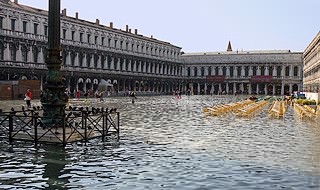
An acqua alta (/ˌækwə ˈæltə/, Italian: [ˈakkwa ˈalta] ⓘ; lit. 'high water') is an exceptional tide peak that occurs periodically in the northern Adriatic Sea. The term is applied to such tides in the Italian region of Veneto. The peaks reach their maximum in the Venetian Lagoon, where they cause partial flooding of Venice and Chioggia; flooding also occurs elsewhere around the northern Adriatic, for instance at Grado and Trieste, but much less often and to a lesser degree.
The phenomenon occurs mainly between autumn and spring, when the astronomical tides are reinforced by the prevailing seasonal winds that hamper the usual reflux. The main winds involved are the sirocco, which blows northbound along the Adriatic Sea, and the bora, which has a specific local effect due to the shape and location of the Venetian Lagoon.
Precise scientific parameters define the phenomenon called acqua alta, the most significant of which (i.e., the deviation in amplitude from a base measurement of "standard" tides) is measured by the hydrographic station located nearby the Basilica di Santa Maria della Salute. Supernormal tidal events can be categorized as:
Generally speaking, tide levels largely depend on three contributing factors:
Two further contributing natural factors are the subsidence, i.e. the natural sinking of the soil level, to which the lagoon is subject, and eustasy, i.e. the progressive rise of sea levels. While these phenomena would occur independently of human activity, their effects have increased because of inhabitation: the use of lagoonal water by the industries in Porto Marghera (now ceased) sped up subsidence, while global warming has been linked to increased eustasy. Venice's "Tide Monitoring and Forecast Center" evaluates that the city has lost 23 cm in its elevation since 1897, the year of reference, 12 of which are attributable to natural causes (9 because of eustasy, 3 because of subsidence), 13 are due to the additional subsidence caused by human activity, while the "elastic recovery" of the soil has allowed the city to "gain back" 2 cm.
The long and narrow rectangular shape of the Adriatic Sea is the source of an oscillating water motion (called seiche) along the basin's minor axis.
The principal oscillation, which has a period of 21 hours and 30 minutes and an amplitude around 0.5 meters at the axis' extremities, supplements the natural tidal cycle, so that the Adriatic Sea has much more extreme tidal events than the rest of the Mediterranean. A secondary oscillation is also present, with an average period of 12 hours and 11 minutes.
Because the timeframe of both oscillations is comparable to naturally occurring (yet independent) astronomical tides, the two effects overlap and reinforce each other. The combined effects are more significant at the perigees, which correspond to new moons, full moons and equinoxes.
Hub AI
Acqua alta AI simulator
(@Acqua alta_simulator)
Acqua alta
An acqua alta (/ˌækwə ˈæltə/, Italian: [ˈakkwa ˈalta] ⓘ; lit. 'high water') is an exceptional tide peak that occurs periodically in the northern Adriatic Sea. The term is applied to such tides in the Italian region of Veneto. The peaks reach their maximum in the Venetian Lagoon, where they cause partial flooding of Venice and Chioggia; flooding also occurs elsewhere around the northern Adriatic, for instance at Grado and Trieste, but much less often and to a lesser degree.
The phenomenon occurs mainly between autumn and spring, when the astronomical tides are reinforced by the prevailing seasonal winds that hamper the usual reflux. The main winds involved are the sirocco, which blows northbound along the Adriatic Sea, and the bora, which has a specific local effect due to the shape and location of the Venetian Lagoon.
Precise scientific parameters define the phenomenon called acqua alta, the most significant of which (i.e., the deviation in amplitude from a base measurement of "standard" tides) is measured by the hydrographic station located nearby the Basilica di Santa Maria della Salute. Supernormal tidal events can be categorized as:
Generally speaking, tide levels largely depend on three contributing factors:
Two further contributing natural factors are the subsidence, i.e. the natural sinking of the soil level, to which the lagoon is subject, and eustasy, i.e. the progressive rise of sea levels. While these phenomena would occur independently of human activity, their effects have increased because of inhabitation: the use of lagoonal water by the industries in Porto Marghera (now ceased) sped up subsidence, while global warming has been linked to increased eustasy. Venice's "Tide Monitoring and Forecast Center" evaluates that the city has lost 23 cm in its elevation since 1897, the year of reference, 12 of which are attributable to natural causes (9 because of eustasy, 3 because of subsidence), 13 are due to the additional subsidence caused by human activity, while the "elastic recovery" of the soil has allowed the city to "gain back" 2 cm.
The long and narrow rectangular shape of the Adriatic Sea is the source of an oscillating water motion (called seiche) along the basin's minor axis.
The principal oscillation, which has a period of 21 hours and 30 minutes and an amplitude around 0.5 meters at the axis' extremities, supplements the natural tidal cycle, so that the Adriatic Sea has much more extreme tidal events than the rest of the Mediterranean. A secondary oscillation is also present, with an average period of 12 hours and 11 minutes.
Because the timeframe of both oscillations is comparable to naturally occurring (yet independent) astronomical tides, the two effects overlap and reinforce each other. The combined effects are more significant at the perigees, which correspond to new moons, full moons and equinoxes.
Recent media