


Community hub
Recent from talks
Contribute something
Nothing was collected or created yet.
New moon
View on Wikipedia | This article has multiple issues. Please help improve it or discuss these issues on the talk page. (Learn how and when to remove these messages)
|


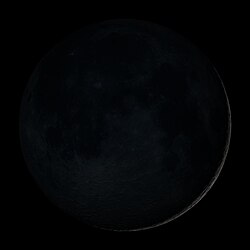
In astronomy, the new moon is the first lunar phase, when the Moon and Sun have the same ecliptic longitude.[2] At this phase, the lunar disk is not visible to the naked eye, except when it is silhouetted against the Sun during a solar eclipse.
The original meaning of the term 'new moon', which is still sometimes used in calendrical, non-astronomical contexts, is the first visible crescent of the Moon after conjunction with the Sun.[3] This thin waxing crescent is briefly and faintly visible as the Moon gets lower in the western sky after sunset, with the smallest arc angle possible between 5–7°.[4]: 100902–100904 The precise time and even the date of the appearance of the new moon by this definition will be influenced by the geographical location of the observer. The first crescent marks the beginning of the month in the Islamic calendar[5] and in some lunisolar calendars such as the Hebrew calendar. In the Chinese calendar, the beginning of the month is marked by the last visible crescent of a waning Moon.
The astronomical new moon occurs by definition at the moment of conjunction in ecliptical longitude with the Sun when the Moon is invisible from the Earth. This moment is unique and does not depend on location, and in certain circumstances, it coincides with a solar eclipse.
A lunation, or synodic month, is the period from one new moon to the next. At the J2000.0 epoch, the average length of a lunation is 29.53059 days (or 29 days, 12 hours, 44 minutes, and 3 seconds).[6] However, the length of any one synodic month can vary from 29.26 to 29.80 days (12.96 hours) due to the perturbing effects of the Sun's gravity on the Moon's eccentric orbit.[7]
Lunation number
[edit] | This section needs additional citations for verification. (May 2015) |
The Lunation Number or Lunation Cycle is a number given to each lunation beginning from a specific one in history. Several conventions are in use.
The most commonly used was the Brown Lunation Number (BLN), which defines "lunation 1" as beginning at the first new moon of 1923, the year when Ernest William Brown's lunar theory was introduced in the American Ephemeris and Nautical Almanac. [citation needed] Lunation 1 occurred at approximately 02:41 UTC, 17 January 1923. With later refinements, the BLN was used in almanacs until 1983.[8]
A more recent lunation number – called the Lunation Number (LN)[b] – was introduced by Jean Meeus in 1998,[9] and defines lunation 0 as beginning on the first new moon of 2000 (this occurred at approximately 18:14 UTC, 6 January 2000). The formula relating Meeus's Lunation Number to the Brown Lunation Number is BLN = LN + 953.
The Goldstine Lunation Number (GLN) refers to the lunation numbering used by Herman Goldstine,[10] with lunation 0 beginning on 11 January 1001 BCE, and can be calculated using GLN = LN + 37105.
The Hebrew Lunation Number (HLN) is the count of lunations in the Hebrew calendar with lunation 1 beginning on 6 October 3761 BCE.[11] It can be calculated using HLN = LN + 71234.
The Islamic Lunation Number (ILN) is the count of lunations in the Islamic Calendar with lunation 1 as beginning on the first day of the month of Muharram, which occurred in 622 CE (15 July, Julian, in the proleptic reckoning).[12] It can be calculated using ILN = LN + 17038.
The Thai Lunation Number (TLN) is called "มาสเกณฑ์" (Maasa-Kendha), defines lunation 0 as the beginning of Burmese era of the Buddhist calendar on Sunday, 22 March 638 CE.[citation needed] It can be calculated using TLN = LN + 16843.
Lunisolar calendars
[edit]Hebrew calendar
[edit]The new moon, in Hebrew Rosh Chodesh, signifies the start of every Hebrew month and is considered an important date and minor holiday in the Hebrew calendar. The modern form of the calendar practiced in Judaism is a rule-based lunisolar calendar, akin to the Chinese calendar, measuring months defined in lunar cycles as well as years measured in solar cycles, and distinct from the purely lunar Islamic calendar and the predominantly solar Gregorian calendar. The Jewish months are fixed to the annual seasons by setting the new moon of Aviv, the barley ripening, or spring, as the first moon and head of the year.[13] Since the Babylonian captivity, this month is called Nisan, and it is calculated based on mathematical rules designed to ensure that festivals are observed in their traditional season. Passover always falls in the springtime.[14] This fixed lunisolar calendar follows rules introduced by Hillel II and refined until the ninth century. This calculation makes use of a mean lunation length used by Ptolemy and handed down from Babylonians, which is still very accurate: ca. 29.530594 days vs. a present value (see below) of 29.530589 days. This difference of only 0.000005, or five millionths of a day, adds up to about only four hours since Babylonian times.[citation needed]
Chinese calendar
[edit]The new moon is the beginning of the month in the Chinese calendar. Some Buddhist Chinese keep a vegetarian diet on the new moon and full moon each month.[15]
Hindu calendar
[edit]
The new moon is significant in the lunar Hindu calendar. The first day of the calendar starts the day after the dark moon phase (Amavasya).[16]
There are fifteen moon dates for each of the waxing and waning periods. These fifteen dates are divided evenly into five categories: Nanda, Bhadra', Jaya, Rikta, and Purna, which are cycled through in that order.[17] Nanda dates are considered to be favorable for auspicious works; Bhadra dates for works related to community, social, family, and friends; and Jaya dates for dealing with conflict. Rikta dates are considered beneficial only for works related to cruelty. Purna dates are considered to be favorable for all work.[17]: 25
![[icon]](https://en.wikipedia.org/wiki/File:Wiki_letter_w_cropped.svg) | This section is empty. You can help by adding to it. (March 2021) |
Lunar calendars
[edit]Islamic calendar
[edit]The lunar Hijri calendar has exactly 12 lunar months in a year of 354 or 355 days.[18] It has retained an observational definition of the new moon, marking the new month when the first crescent moon is seen, and making it impossible to be certain in advance of when a specific month will begin (in particular, the exact date on which the month of Ramadan will begin is not known in advance). In Saudi Arabia, the new King Abdullah Centre for Crescent Observations and Astronomy in Mecca has a clock for addressing this as an international scientific project. [citation needed] In Pakistan, there is a "Central Ruet-e-Hilal Committee" whose head is Mufti Muneeb-ur-Rehman, assisted by 150 observatories of the Pakistan Meteorological Department, which announces the sighting of the new moon.[19]
An attempt to unify Muslims on a scientifically calculated worldwide calendar was adopted by both the Fiqh Council of North America and the European Council for Fatwa and Research in 2007. The new calculation requires that conjunction must occur before sunset in Mecca, Saudi Arabia, and that, on the same evening, the moonset must take place after sunset. These can be precisely calculated and therefore a unified calendar is possible should it become adopted worldwide.[20][21]
Solar calendars holding moveable feasts
[edit]Baháʼí calendar
[edit]The Baháʼí calendar is a solar calendar with certain new moons observed as moveable feasts. In the Baháʼí Faith, effective from 2015 onwards, the "Twin Holy Birthdays", refer to two successive holy days in the Baháʼí calendar (the birth of the Báb and the birth of Bahá'u'lláh), will be observed on the first and the second day following the occurrence of the eighth new moon after Naw-Rúz (Baháʼí New Year), as determined in advance by astronomical tables using Tehran as the point of reference.[22] This will result in the observance of the Twin Birthdays moving, year to year, from mid-October to mid-November according to the Gregorian calendar.[23]
Christian liturgical calendar
[edit]Easter, the most important feast in the Christian liturgical calendar, is a movable feast. The date of Easter is determined by reference to the ecclesiastical full moon, which, being historically difficult to determine with precision, is defined as being fourteen days after the (first crescent) new moon.[24][25]
See also
[edit]
- Black moon – Second new moon in a calendar month
- Blue moon – Name for three (unconnected) events
- Dark moon – Last visible crescent of waning moon
- Hilal (crescent moon) – First observation of a new moon
- Islamic New Year – Beginning of a new lunar Hijri year
- Lunar phase – Shape of the Moon's sunlit portion as viewed from Earth
- Solar eclipse – Natural phenomenon wherein the Sun is obscured by the Moon
- Wet moon – Horizontal (bowl appearance) crescent
Notes
[edit]- ^ Planetlight, zodiacal light, and starlight contribute a negligible amount of the total light that the lunar surface reflects.
- ^ [sic], not MLN
References
[edit]- ^ "New Moon". Flickr. NASA/GSFC. 15 June 2011. Archived from the original on 4 August 2020. Retrieved 9 February 2020.
- ^ Meeus 1991, p. 319.
- ^ "new moon". Oxford English Dictionary (Online ed.). Oxford University Press. (Subscription or participating institution membership required.)
- ^ Judhistira Aria Utama; Alif Rizza Zuhudi; Yudi Prasetyo; Abdul Rachman; A.R. Sugeng Riadi; Cep Nandi; Lala Septem Riza (April 2025). "New crescent moon detection using Circular Hough Transform (CHT)". Astronomy and Computing. 51 100902. doi:10.1016/j.ascom.2024.100902.
- ^ "Visibility of Muharram Crescent 1432 AH". Islamic Crescents' Observation Project. Archived from the original on 10 May 2012; seen on 6 December in Algeria, Iran, Saudi Arabia, South Africa.
{{cite web}}: CS1 maint: postscript (link) - ^ Seidelmann 1992, p. 576.
- ^ Espenak, Fred. "Eclipses and the Moon's Orbit". NASA Eclipse Web Site. NASA. Archived from the original on 22 January 2017. Retrieved 11 December 2016.
- ^ Chapront-Touzé, M; Chapront, J (2002). "Analytical Ephemerides of the Moon in the 20th Century" (PDF). Observatoire de Paris. pp. 21–22.
- ^ Meeus, Jean (1998). Astronomical algorithms (2nd ed.). Richmond, Va.: Willmann-Bell. ISBN 978-0-943396-61-3. OCLC 40521322.
- ^ Goldstine, Herman (1973). New and Full Moons: 1001 B.C. to A.D. 1651. Philadelphia: American Philosophical Society. ISBN 978-0-87169-094-4. OCLC 609368.
- ^ "Hebrew Calendar Calculator". webspace.science.uu.nl. Archived from the original on 2022-12-07. Retrieved 2023-02-07.
- ^ Ilyas, M. (1991-06-01). "Hijrah Day Number, Islamic Day Number and Islamic Lunation Number: New parameters for exacting the Islamic calendar". Journal of the British Astronomical Association. 101: 175–176. Bibcode:1991JBAA..101..175I. ISSN 0007-0297. Archived from the original on 2022-09-20. Retrieved 2021-05-03.
- ^ Exodus 12:1–2
- ^ Posner, Menachem (2016). "How Does the Spring Equinox Relate to the Timing of Passover?". Chabad. Archived from the original on 2 January 2017. Retrieved 9 December 2016.
- ^ "A Buddhist Perspective on Fasting". urbandharma.org. Retrieved 2016-09-18.
- ^ Long, Jeffery D. (9 September 2011). Historical Dictionary of Hinduism. Scarecrow Press. pp. 76–77. ISBN 978-0-8108-7960-7.
- ^ a b Wilhelm, Ernst (2003). Classical Muhurta. Kala Occult Publishers. pp. 23–25. ISBN 978-0-9709636-2-8. Retrieved 4 June 2022.
- ^ Seidelmann 1992, pp. 577.
- ^ "Senate body decides to draft Ruet-e-Hilal Constitution". Archived from the original on 2014-07-14. Retrieved 2014-07-12.
- ^ Fiqh Council of North America Decision: "Astronomical Calculations and Ramadan Archived 2010-08-28 at the Wayback Machine"
- ^ Islamic Society of North America Decision:"Revised ISNA Ramadan and Eid Announcement Archived 2007-11-11 at the Wayback Machine"
- ^ Momen, Moojan (2014). The Badí` (Baháʼí) Calendar: An Introduction Archived 2015-01-11 at the Wayback Machine.
- ^ The Universal House of Justice (2014-07-10). "To the Baháʼís of the World". Archived from the original on 2014-07-14. Retrieved 2015-01-01.
- ^ Mosshammer 2008, p. 76: "Theoretically, the epact 30=0 represents the new moon in conjunction with the sun. The epact of 1 represents the theoretical first visibility of the moon's first crescent. It is from that point as day one that the fourteenth day of the moon is counted."
- ^ Dershowitz & Reingold 2008, pp. 114–115.
Works cited
[edit]- Dershowitz, Nachum; Reingold, Edward M. (2008). Calendrical Calculations. Cambridge University Press. ISBN 978-0-521-88540-9.
- Meeus, Jean (1991). Astronomical Algorithms. Willmann-Bell. ISBN 978-0-943396-35-4.
- Mosshammer, Alden A. (2008). The Easter Computus and the Origins of the Christian Era. Oxford University Press. ISBN 978-0-19-954312-0.
- Seidelmann, P. Kenneth, ed. (1992). Explanatory Supplement to the Astronomical Almanac. University Science Books. ISBN 978-0-935702-68-2.
External links
[edit]- Moon Watch site (Archived 2011-03-03 at the Wayback Machine) of the Nautical Almanac Office
| Physical properties |  | |
|---|---|---|
| Orbit | ||
| Surface and features | ||
| Science | ||
| Exploration | ||
| Time-telling and navigation | ||
| Phases and names | ||
| Daily phenomena | ||
| Related |
| |

| International | |
|---|---|
| National | |
| Other | |

New moon
View on GrokipediaAstronomical Definition
Lunar Phases
The lunar phases refer to the changing appearance of the Moon as observed from Earth, resulting from the varying relative positions of the Sun, Earth, and Moon during the Moon's orbit around Earth. As the Moon orbits Earth in an approximately elliptical path, the angle between the Sun and the Moon, as seen from Earth, determines how much of the Moon's sunlit hemisphere is visible. The Moon is tidally locked to Earth, meaning it rotates on its axis at the same rate as it revolves around Earth—once every 27.3 days relative to the stars—always presenting the same face toward our planet. This synchronous rotation, caused by gravitational interactions over billions of years, ensures that the illuminated portion visible from Earth shifts predictably as the Moon moves through its orbit.[10] The cycle of phases is divided into eight primary stages, each characterized by the percentage of the Moon's disk that appears illuminated and its shape: new moon (0% illuminated, invisible from Earth as the sunlit side faces away); waxing crescent (up to 50% illuminated, a thin curving sliver on the right side in the Northern Hemisphere); first quarter (50% illuminated, half-disk with the right side lit); waxing gibbous (more than 50% illuminated, nearly full but with a left-side indentation); full moon (100% illuminated, entire disk visible); waning gibbous (more than 50% illuminated, nearly full but with a right-side indentation); last quarter (50% illuminated, half-disk with the left side lit); and waning crescent (less than 50% illuminated, a thin curving sliver on the left side). These phases progress in a continuous cycle, with the illuminated fraction increasing during the waxing phases (from new to full) and decreasing during the waning phases (from full to new). The term "waxing" derives from the Old English "weaxan," meaning to grow, reflecting the increasing illumination, while "waning" indicates a decrease; "crescent" comes from the Latin "crescere" (to grow), describing the curved shape, and "gibbous" from "gibbosus" (humpbacked), denoting the convex, more-than-half form.[12] This sequence repeats every synodic month, the time required for the Moon to complete one full cycle of phases relative to the Sun as seen from Earth, averaging 29.53059 days. The synodic month is longer than the sidereal orbital period because Earth orbits the Sun, causing the Moon to "lap" the Sun's position by about 360 degrees extra each cycle. From Earth's perspective, the phases represent the angle of illumination: 0° at new moon, 90° at first quarter, 180° at full moon, and 270° at last quarter, with intermediate phases filling the gaps. A textual representation of the progression might illustrate it as a clock face analogy, where the Moon starts aligned between Earth and Sun (new, 12 o'clock position), moves 90° counterclockwise to first quarter (3 o'clock), 180° to full (6 o'clock, opposite the Sun), and 270° to last quarter (9 o'clock), before returning to new; the visible lit portion grows from the right during waxing and shrinks from the left during waning in the Northern Hemisphere.[13][14] The naming and recognition of these phases originated from ancient astronomical observations, with early civilizations such as the Babylonians and Greeks systematically tracking the Moon's changing forms to understand celestial patterns. By the 4th century BCE, Greek philosophers like Aristotle had correctly deduced that the phases arise from the Moon's position relative to the Sun and Earth, recognizing the spherical nature of both Earth and Moon and rejecting myths of the Moon being a mirror or divine entity. The new moon serves as the starting point of this cycle, marking the moment when the Moon is conjunct with the Sun and invisible against the daylight sky.[15][16]Characteristics of New Moon
The new moon marks the lunar phase when the Moon is positioned in conjunction with the Sun from Earth's perspective, with the Moon's illuminated hemisphere facing away from Earth toward the Sun. This alignment occurs when the geocentric ecliptic longitudes of the Moon and the Sun are equal, rendering the Moon invisible to observers on Earth as its night side faces our planet and it rises and sets with the Sun.[17][14] The duration of the new moon phase, defined as the period during which the Moon appears entirely dark and unilluminated from Earth, is brief and typically spans a few hours to about one day. This short timeframe arises because the Moon's angular motion relative to the Sun averages 12 to 13 degrees per day, quickly shifting the elongation angle beyond the point where any sunlight reflects visibly toward Earth (generally when the elongation exceeds around 7 to 10 degrees).[18][14] A key phenomenon associated with the new moon is the potential for solar eclipses, which can only occur during this phase when the Moon passes between Earth and the Sun. If the conjunction happens near one of the Moon's orbital nodes—points where the Moon's orbit crosses the ecliptic plane—alignment may result in a total solar eclipse (where the Moon fully obscures the Sun), an annular eclipse (where a ring of sunlight remains due to the Moon's apparent smaller size at greater distance), or a partial eclipse (where only part of the Sun is covered). However, the Moon's orbital inclination of about 5 degrees relative to the ecliptic limits such alignments to roughly twice per year, preventing eclipses at every new moon.[4] Physically, the new moon results in the darkest nights of the lunar cycle due to the complete absence of moonlight, enhancing visibility of faint celestial objects like stars, planets, and the Milky Way for astronomers. Tidal effects during this phase are significant, producing spring tides with maximum high and low ranges similar to those at full moon, as the gravitational pulls of the Sun and Moon align constructively on Earth's oceans.[19][14] Variations in the new moon's characteristics stem primarily from the Moon's elliptical orbit and its 5-degree inclination to the ecliptic. Orbital eccentricity causes the Moon's distance from Earth to fluctuate between about 356,000 km at perigee and 407,000 km at apogee, leading to slight differences in the exact timing and apparent size of the conjunction (e.g., annular eclipses are more likely near apogee). The inclination introduces variability in eclipse potential, with the line of nodes precessing over an 18.6-year cycle, altering alignment opportunities. These factors result in minor shifts in the phase's onset and duration across lunations, typically by a few hours.[3]Timing and Prediction
Lunation Cycle
The lunation, or synodic month, is defined as the time interval between two consecutive new moons, representing the period of the Moon's phases as observed from Earth.[7] This cycle averages 29.53059 days, equivalent to 29 days, 12 hours, 44 minutes, and 3 seconds.[3] The lunation arises from the combination of the Moon's sidereal month—the time to complete one orbit relative to the fixed stars, approximately 27.32 days—and Earth's orbital motion around the Sun during that interval.[3] As Earth advances in its orbit, the Moon must travel an additional angular distance of about 29 degrees relative to the Sun to return to the new moon conjunction, extending the observed phase cycle beyond the sidereal period.[3] This interplay results in a gradual westward precession of the Moon's orbital nodes over longer timescales, influencing the exact timing of lunations.[3] Longer-term patterns in the lunation cycle include anomalies such as the Metonic cycle, a period of 19 tropical years (approximately 235 lunations) after which the Moon's phases recur on nearly the same calendar dates.[7] Another key cycle is the saros, spanning about 18 years and 11 days (223 lunations), during which configurations for lunar eclipses repeat with similar geometry, though shifted slightly due to Earth's orbital progression.[20] Ancient civilizations recognized the lunation's variable length, typically approximating it by dividing months into 29 or 30 days to form years of 12 or 13 such months.[21] To reconcile the lunar year (about 354 days) with the solar year (approximately 365 days), they employed intercalation rules, inserting extra months periodically—such as in years 3, 6, 8, 11, 14, 17, and 19 of a 19-year cycle in Babylonian systems—to maintain seasonal alignment.[21] In modern astronomy, lunation measurements achieve sub-second precision through lunar laser ranging (LLR), where ground-based lasers timed by atomic clocks measure the Earth-Moon distance to millimeter accuracy, with GPS enhancing station positioning for global observations. This enables refined ephemerides that track lunation timings with uncertainties far below one second. The lunation cycle thus serves as the foundational period for initiating months in lunar and lunisolar calendars.[7]Computational Models
Computational models for predicting the occurrence of a new moon, defined astronomically as the instant of geocentric conjunction when the ecliptic longitudes of the Sun and Moon are equal, rely on mathematical algorithms that approximate or precisely compute celestial positions. A foundational approximate method is provided by Jean Meeus' algorithm in Astronomical Algorithms, which calculates the Julian date (JD) of the mean new moon as JD ≈ 2451545.0 + k × 29.530588861, where k is the lunation number relative to the epoch of JD 2451545.0 (2000 January 6.0 TT), corresponding to the first new moon of the 2000s. This formula yields results accurate to within about 1 day over several millennia but requires refinement for higher precision. To derive more accurate predictions, models account for the mean anomaly of the Moon, the geocentric longitudes of the Sun and Moon, and perturbations due to planetary gravitational influences. The mean anomaly describes the Moon's position in its orbit relative to its perigee, while longitudes are computed using low-precision series expansions or full ephemerides. Perturbations from Venus, Earth, Jupiter, and other bodies are incorporated via truncated Fourier series. Seminal ephemerides include VSOP87 for the Sun, which provides heliocentric coordinates through spherical harmonics up to high orders for accuracy over 4000 years, and ELP-2000 for the Moon, a numerical integration yielding geocentric positions with periodic terms for perturbations, accurate to about 0.001 arcseconds in lunar position over centuries. High-precision computations employ NASA's Jet Propulsion Laboratory (JPL) ephemerides, such as DE430 or DE440, which integrate the equations of motion for the solar system using numerical methods and fit observational data from spacecraft, radar, and laser ranging. These standards align with International Astronomical Union (IAU) definitions for apparent geocentric positions, incorporating relativistic effects. Software implementations include the open-source Stellarium astronomy simulator, which uses JPL ephemerides for real-time phase predictions, and the Python library Skyfield, which loads DE files to compute conjunction times via iterative root-finding on the Sun-Moon elongation function. Modern models achieve errors reduced to milliseconds for new moon timings within the 20th to 21st centuries, a vast improvement over historical methods like those in the 19th-century Nautical Almanac, which had errors up to several minutes due to incomplete perturbation terms; post-20th-century advancements stem from laser ranging data and improved numerical integrations. This precision enables reliable indexing via lunation numbers for long-term predictions. A detailed step-by-step computation of the conjunction time, as in refined Meeus-style algorithms or JPL-based methods, proceeds as follows:- Select an approximate epoch JD₀ near the desired new moon using the basic formula above.
-
Compute the time T in Julian centuries from J2000.0:
-
Calculate the mean longitude of the Sun λ☉ and Moon λ☽ using series expansions, e.g., for low precision:
(with additional terms for eccentricity and perturbations from VSOP87).
Similarly for the Moon:
- Iterate to find the time Δt where λ☉(JD₀ + Δt) = λ☽(JD₀ + Δt), using Newton's method on the difference f(Δt) = λ☽ - λ☉ ≈ 0, with initial guess from mean motion.
-
Apply nutation corrections (Δψ, Δε from IAU 1980 model, ~17 arcseconds max) to obtain true ecliptic longitudes:
where ε is obliquity. -
Correct for aberration (annual, ~20 arcseconds) to get apparent positions:
with δλ_aberr ≈ - (v/c) tan(λ') for velocity v of Earth. - Refine iteratively until convergence, yielding the geocentric conjunction time to sub-second precision using full ELP-2000 or JPL series.
Observational Techniques
Historical Methods
In ancient Mesopotamia, Egypt, and Greece dating back to around 2000 BCE, the primary method for detecting the new moon involved naked-eye observations of the first visible lunar crescent shortly after its conjunction with the Sun. These practices relied on systematic skywatching at dusk or dawn to identify the thin, illuminated sliver emerging from the Sun's glare, marking the start of a new lunar month. Mesopotamian astronomers, for instance, recorded such sightings on clay tablets to track the 29- or 30-day lunation cycle, enabling predictions of month lengths based on the crescent's appearance.[22][23][24] To assist these observations, ancient cultures developed simple tools for alignment and timing. In Egypt, the merkhet—a bronze bar with a plumb line and often a sighting notch—served as an "instrument of knowing" for aligning observations with stars or the horizon during nocturnal watches. Water clocks, or clepsydrae, complemented these by measuring intervals for precise recording of crescent visibility. During the Islamic Golden Age (8th–14th centuries CE), more advanced astrolabes allowed observers to compute the Moon's position relative to the Sun and horizon, aiding crescent sightings through rotatable dials and star maps calibrated for local latitudes.[25][26][27] Such methods faced significant challenges, including atmospheric extinction, cloud cover, and low horizon visibility, which could obscure the faint crescent and introduce timing errors of 1–2 days. Observations often depended on communal efforts, with multiple witnesses confirming sightings to mitigate individual biases or illusions, particularly in regions with variable weather. Cultural variations emerged, as Babylonian astronomers integrated zodiacal divisions—early 12-sign frameworks—to contextualize the Moon's path and anticipate new moon timings within stellar bands. Similarly, Greek practices emphasized heliacal risings, treating the crescent's first dawn appearance as a key indicator of lunar phases, building toward more refined positional astronomy. These observational techniques profoundly shaped early lunisolar calendars by providing empirical data for month synchronization.[28][29][22][30] The transition to greater precision occurred in the 19th century, when astronomical almanacs, such as the U.S. Nautical Almanac, began incorporating telescopic observations of lunar positions to refine new moon predictions beyond naked-eye limits. Efforts by figures like Benjamin Peirce integrated these data into mathematical tables, reducing reliance on direct sightings while validating historical methods against instrumental evidence.[31][32]Modern Astronomy
In modern astronomy, telescopic observations enable the detection of the thin lunar crescent immediately following conjunction, allowing scientists to verify the timing of the new moon phase with high precision. Using magnification, telescopes can reveal the crescent when the Moon is as close as 5° from the Sun under ideal conditions, extending visibility beyond naked-eye limits.[33] Spectroscopic techniques, particularly during total solar eclipses that coincide with new moon, capture the solar corona's emission lines, such as those from highly ionized iron, to study plasma dynamics and magnetic fields. Observatories on Mauna Kea, including the Canada-France-Hawaii Telescope, have facilitated such coronal observations during the 1991 eclipse, leveraging the site's clear skies for infrared and optical spectroscopy.[34][35] Space-based instruments provide continuous, real-time imaging of lunar-sun conjunctions. NASA's Solar Dynamics Observatory (SDO), operational since 2010, captures lunar transits—where the Moon passes directly in front of the Sun—offering detailed views of the alignment in extreme ultraviolet and visible wavelengths. These observations, such as the 2016 transit lasting 60 minutes, document the Moon's silhouette against the solar disk and aid in calibrating solar models.[36] The Lunar Reconnaissance Orbiter (LRO), launched in 2009, complements this by mapping the lunar surface during all phases, including near-conjunction periods, to track surface features and validate positional data relative to Earth-Sun geometry.[37] Lunar laser ranging (LLR) utilizes retroreflectors placed by Apollo missions to measure the Earth-Moon distance with millimeter precision, confirming the exact alignment during new moon syzygy. The Apache Point Observatory Lunar Laser-ranging Operation (APOLLO) achieves a median nightly accuracy of 1.7 mm, equivalent to sub-centimeter resolution over 384,000 km, by timing laser pulse round-trips and refining orbital parameters that pinpoint conjunctions.[38] These measurements validate computational predictions of new moon timings to within seconds. Global networks like the International Occultation Timing Association (IOTA) coordinate worldwide observations of solar eclipses and lunar occultations tied to new moon events, providing precise timings through automated prediction tools and observer alerts. IOTA's databases generate event predictions and facilitate real-time reporting, enhancing accuracy for eclipse paths and contact times.[39] Satellite data integration incorporates new moon periods—characterized by moonlight absence—into environmental and climate analyses, as the lack of lunar illumination influences nighttime remote sensing. For instance, without moonlight, satellite sensors like those on NOAA platforms face challenges in distinguishing high cirrus clouds from low-level liquid clouds in infrared imagery, affecting storm circulation models and long-term climate records. This absence also impacts calibration efforts, where moonlight serves as a stable benchmark for Earth-observing instruments, prompting adjustments in data processing for unbiased environmental studies. Such integrations occasionally verify computational models by cross-referencing observed alignments with predicted moonlight nulls.Calendrical Role
Lunisolar Calendars
In lunisolar calendars, the new moon serves as the primary marker for the commencement of each lunar month, typically defined as the moment when the moon is in conjunction with the sun, rendering it invisible from Earth. This alignment initiates a synodic month of approximately 29.53 days, resulting in 12 lunar months totaling about 354 days per year, which is roughly 11 days shorter than the solar year of 365.25 days. To prevent seasonal drift, these calendars incorporate intercalary or embolismic months—additional lunar months inserted periodically, often every two to three years—to synchronize the lunar cycle with the solar year and maintain alignment with agricultural and seasonal cycles.[7] Prominent examples illustrate these mechanics. The Hebrew calendar employs a 19-year Metonic cycle, during which 235 lunar months (including seven intercalary months) approximate 19 solar years, with months beginning at the calculated new moon to ensure holidays remain in their seasonal positions. The Chinese lunisolar calendar structures its 12 or 13 months around new moons, integrating 24 solar terms—astronomical markers dividing the solar year into 15-degree segments—to guide intercalations and align festivals with seasonal changes. Similarly, the Hindu Vikram Samvat calendar uses amanta reckoning, where months run from new moon to new moon, and adds adhik maas (intercalary months) roughly every 2.7 years based on solar transits to reconcile the 354-day lunar year with the sidereal solar year. Ancient Babylonian calendars laid foundational practices, starting months upon sighting the new crescent after conjunction and inserting embolismic months post specific lunar periods, such as after the sixth or twelfth month, to approximate the solar year.[21][21][21][40] The historical evolution of lunisolar calendars traces back to Babylonian innovations around the 6th century BCE, which influenced subsequent systems through empirical observations of new moons and intercalations for agricultural needs. These practices spread to Hebrew, Greek, and Indian traditions, evolving into fixed arithmetic cycles by the 4th century CE for predictability. In the 20th century, reforms adapted them for civil use: India's 1957 national calendar formalized a lunisolar system aligned with the Gregorian leap year, while China's 1912 Republican era introduced the solar calendar for official purposes, retaining the traditional lunisolar variant for cultural observances.[21][21][21][41]Lunar Calendars
In purely lunar calendars, each month begins with the onset of the new moon, typically marked by the first visible crescent following conjunction. This structure results in a year comprising 12 lunar months totaling about 354 days, causing the calendar to advance approximately 11 days earlier each solar year and leading to progressive seasonal drift.[7][21] The Islamic Hijri calendar serves as the foremost example of such a system, featuring 12 months of alternating 29 or 30 days, with the start of each determined historically by the sighting of the new moon's crescent, though astronomical calculations are employed in some regions for precision.[42][43][44] Methods for these determinations became more standardized across Muslim communities over time, balancing tradition with computational reliability.[45] Less formalized instances appear in certain Indigenous systems, such as the Anishinaabe calendar of North American First Nations, which recognizes 13 lunations per year to track environmental cycles.[46][47] Adjustments to mitigate drift were infrequent in these calendars; pre-Islamic Arabian traditions occasionally inserted an extra month, but the Hijri calendar explicitly avoids intercalation to preserve its strictly lunar nature.[45] Contemporary debates among Muslim communities often center on whether to prioritize direct moon sightings—rooted in observational traditions—or adopt verifiable astronomical calculations for month beginnings.[48][49] The inherent drift has significant implications, as key observances like Ramadan shift through the seasons, completing a full cycle relative to the solar year roughly every 33 years and exposing participants to varying climatic conditions.[7][50]Solar Calendars with Movable Feasts
Solar calendars, such as the Gregorian calendar with its average year length of 365.2425 days, primarily align with the Earth's orbit around the Sun but incorporate lunar elements to determine specific movable feasts, often referencing the new moon as the starting point of lunations for calculating subsequent phases like the full moon. This hybrid approach allows fixed solar structures to accommodate religious or cultural observances tied to lunar cycles, ensuring that certain holidays shift annually relative to the solar year while maintaining overall seasonal consistency.[51] In the Christian liturgical calendar, Easter exemplifies this principle, falling on the first Sunday after the Paschal full moon, which is an ecclesiastical approximation of the full moon occurring on or after March 21 (the nominal vernal equinox). The Paschal full moon is derived from the 14th day of the lunar month beginning with the new moon, using tables that simulate astronomical lunations without direct observation.[52] Similarly, the Baháʼí calendar employs a fixed solar framework of 19 months of 19 days each, starting Naw-Rúz at the vernal equinox, but adjusts the Twin Holy Festivals (commemorating the births of the Báb and Bahá'u'lláh) to the first and second days after the eighth new moon following Naw-Rúz, blending solar stability with lunar timing for global uniformity since 2015.[53] The computation of Easter, known as the computus, relies on the 19-year Metonic cycle to approximate lunar-solar alignment, with solar corrections via the seven-day weekly cycle and golden number tables to pinpoint the Paschal new moon's date. This method, formalized after the Council of Nicaea in 325 CE, deliberately avoids coincidence with the Jewish Passover (Nisan 14), which is lunar-based, to distinguish Christian observance from Jewish traditions and ensure Easter follows the full moon independently.[54] Discussions from 1997 to 2017, led by the World Council of Churches, explored reforming Easter to a unified date using precise astronomical criteria for the new moon and equinox, aiming to align Western and Eastern churches while respecting Nicaea's principles, though no consensus was reached.[55]Cultural and Religious Significance
Judaism and Hebrew Calendar
In Judaism, the new moon, known as rosh chodesh or "head of the month," initiates each lunar month in the Hebrew calendar and is marked by communal celebrations emphasizing renewal and sanctification.[56] Observances include additional prayers such as the musaf service, blessings recited over wine, and the recitation of Psalms 104 and 148, reflecting the moon's role in divine order.[57] Historically, the new moon's appearance prompted trumpet blasts on the shofar from hilltops to announce the month's start, a practice rooted in biblical commands.[58] Women traditionally receive a special dispensation, often refraining from certain labors to honor the moon's renewal as a symbol of feminine spiritual power.[59] The Hebrew calendar integrates the new moon through the molad, a calculated approximation of the astronomical conjunction between the sun and moon, serving as the theoretical start of each month despite variations from actual visibility.[60] To prevent holidays from falling on undesirable days, postponement rules—known as lo ADU Rosh—defer the observance if the molad occurs on Sunday, Wednesday, or Friday after certain hours, ensuring Rosh Hashanah aligns properly with the week.[61] This fixed system was established in 359 CE by Hillel II, the Nasi of the Sanhedrin, transitioning from empirical sightings to mathematical computations to unify Jewish practice amid dispersion and Roman persecution.[62] Historically, the new moon's onset relied on eyewitness testimonies presented to the Sanhedrin in Jerusalem, which would declare the month after verifying sightings; this shifted to calculations post-359 CE due to the Sanhedrin's dissolution.[63] Talmudic debates, recorded in tractate Rosh Hashanah, addressed visibility challenges, with Rabbi Yoḥanan ben Nuri arguing that witnesses claiming to see the crescent within 29.5 days of the prior month's end were unreliable, as the moon could not appear so soon after conjunction.[64] These discussions balanced astronomical reality with communal needs, favoring acceptance of credible testimonies to sanctify the month promptly.[65] Symbolically, the new moon represents renewal and divine blessing, as commanded in the Torah for special sacrifices at the month's beginning, including burnt offerings of two young bulls, one ram, and seven lambs, alongside a sin offering goat (Numbers 28:11-15). This ritual underscored the month's sanctification, linking the lunar cycle to themes of atonement and fresh starts in Jewish life.[66] In modern practice, Rosh Chodesh features synagogue Torah readings from the monthly portion and Hallel psalms, with community events like study sessions or festive meals fostering connection, particularly among women-led groups. In the Diaspora, where uncertainty about exact timings persisted historically, months with 30 days extend Rosh Chodesh to two days as a safeguard, while astronomical software now aids precise molad calculations for global uniformity.[67]Islam and Islamic Calendar
In Islam, the new moon, known as the hilal, holds profound theological significance as a divine sign for reckoning time, as stated in the Quran: "They ask you about the new moons. Say, 'They are measurements of time for the people and for the Hajj.'"[68] This verse from Surah Al-Baqarah (2:189) underscores the moon's role in structuring human affairs, particularly religious observances, emphasizing its visibility as a natural indicator ordained by God. The Prophet Muhammad further reinforced this by prioritizing eyewitness sighting over astronomical calculations, as in the hadith: "Do not fast until you see the crescent moon, and do not stop fasting until you see it; if it is obscured from you, then complete thirty days of Sha'ban."[69] The Islamic calendar, or Hijri calendar, originated in 622 CE with the Prophet Muhammad's migration (Hijrah) from Mecca to Medina, marking the epoch of Year 1 AH and establishing a purely lunar system that abandoned pre-Islamic lunisolar adjustments like the nasi intercalation to align strictly with lunar cycles.[45] This shift ensured the calendar's independence from solar influences, focusing on the new moon's sighting to begin each of the 12 months, with years consisting of 354 or 355 days. The hilal's sighting is central to key observances, determining the start of Ramadan for fasting, Eid al-Fitr marking its end, Eid al-Adha coinciding with Hajj rituals, and the Hajj pilgrimage itself on the 8th to 12th of Dhu al-Hijjah.[70] Globally, moon-sighting committees facilitate this process; for instance, Pakistan's Central Ruet-e-Hilal Committee convenes with zonal panels to collect eyewitness testimonies and announce dates, ensuring communal verification before official declarations.[71] Debates persist between traditional sighting and astronomical methods, exemplified by Saudi Arabia's Umm al-Qura calendar, which relies on pre-calculated lunar visibility projections rather than physical sightings, leading to discrepancies with regions adhering to eyewitness reports.[72] In the 2000s, several fatwas permitted calculations as a reliable alternative when sightings are impossible, such as the Fiqh Council of North America's 2007 ruling that "reliable astronomical methods provide a sound basis for determining Islamic dates," aiming to unify practices amid modern challenges.[73] Culturally, hilal sighting fosters anticipation and unity, culminating in family gatherings for iftar meals during Ramadan and joyous Eid celebrations with feasts, prayers, and gift exchanges. International variations in sightings often result in multiple Eid dates across communities, highlighting diverse interpretations while strengthening local bonds.[74]Other Traditions
In Hinduism, the new moon, known as Amavasya, plays a central role in the tithi system of the Hindu lunar calendar, marking the end of the month in the amanta tradition and serving as a day for spiritual reflection and renewal.[75] Amavasya is considered a potent time when the absence of moonlight amplifies inner presence and cosmic energies, often dedicated to rituals such as fasting, meditation, and ancestor veneration.[75] During Pitru Paksha, the 15-day dark fortnight leading to the new moon, Hindus perform shraddha ceremonies to honor deceased forebears, culminating on Sarvapitru Amavasya, the "new moon of all ancestors," believed to facilitate the souls' peace and blessings for the living.[76] Solar eclipses, which occur only at the new moon when the sun, moon, and earth align, are viewed as inauspicious in Hindu tradition, prompting avoidance of auspicious activities and special purification rites to ward off negative influences.[77] In Chinese and broader East Asian traditions, the new moon defines key cultural events, particularly the Lunar New Year, or Chunjie, which falls on the second new moon after the winter solstice, symbolizing renewal and the expulsion of misfortune through vibrant celebrations.[78][79] Families gather for feasts, fireworks, and dragon dances to invoke prosperity and protection, with the dragon representing imperial power and rain-bringing forces tied to seasonal cycles.[78] Folklore prominently features the moon goddess Chang'e, who ascended to the moon after consuming an immortality elixir, embodying themes of longing, beauty, and the eternal lunar cycle; her legend is recounted during Mid-Autumn Festival but echoes the new moon's themes of hidden potential and rebirth.[78] Among Indigenous peoples, such as the Lakota, the new moon aligns with their 13-moon calendar that tracks seasonal and spiritual rhythms for communal reflection and storytelling.[80] In contemporary Pagan traditions like Wicca, the new moon esbat is a ritual gathering focused on beginnings, where practitioners cast spells for intention-setting, growth, and manifestation, drawing on the moon's invisible energy to symbolize potential and the sowing of magical seeds.[81] Ancient Egyptian mythology associates the new moon with rebirth and divine intervention, particularly through Thoth, the ibis-headed god of wisdom and the moon, who restores the Eye of Horus—symbolizing wholeness and regeneration—during this phase, as depicted in funerary texts linking lunar renewal to the afterlife's cyclical triumph over chaos.[82] In ancient Greece, the noumenia marked the new moon's first visible crescent as a household festival honoring deities like Apollo and the hearth gods, while the preceding dark moon deipnon was dedicated to Hekate, goddess of crossroads and magic, involving offerings to appease her and purify the home from malevolent spirits.[83][84] In modern secular contexts, the new moon inspires astrological practices where individuals set intentions and goals, viewing it as a cosmic reset for personal manifestation and aligning actions with zodiac influences to foster new chapters in life. In astrology, new moons are considered excellent for planting seeds of intention, initiating projects, and harnessing visionary, optimistic, big-picture energy.[85][86][87] Astrophotographers also embrace the new moon for its dark skies, which minimize light interference and enable clearer captures of faint celestial objects like the Milky Way, though challenges include precise timing to avoid residual twilight and the need for long exposures in remote, low-pollution sites.[88][89]References
- https://science.[nasa](/page/NASA).gov/moon/moon-phases/