
Recent from talks
Acromelanism
Knowledge base stats:
Talk channels stats:
Members stats:
Acromelanism
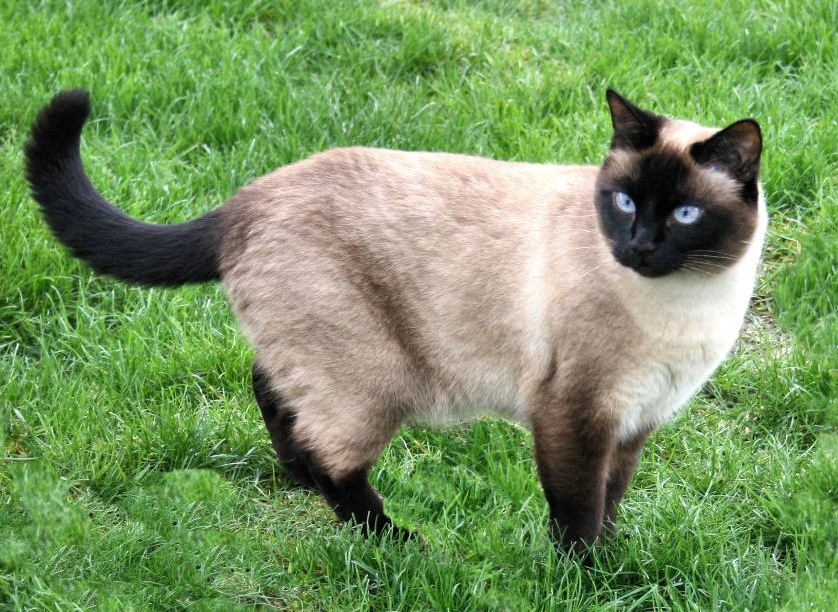
Acromelanism is a genetic condition that results in pigmentation being affected by temperature. Generally it creates a colourpoint pattern where the main body is light while the colder parts such as legs and ears are dark. It is commonly known for the colouration of Siamese, and other colourpoint cats, but can be found in many other species including dogs, rabbits, rats, mice, guinea pigs, minks, and gerbils. It is a specific type of point colouration, as the extremities of an animal are a different colour to the rest of the body.
Colourpoint patterns are where the extremities (paws, face, ears and tail) of the animal are coloured differently compared to the rest of the body. The areas with different colour may be referred as 'points' or being 'pointed'. Colour can spread to the rest of the body, but is concentrated on the extremities.
Colourpoint patterns occur due to acromelanism, which is a type of partial albinism where pigmentation is affected by temperature. Cold temperatures trigger pigment development while warm temperatures decrease pigment development. The extremities are colder than the rest of the body which is why they darken.
The C locus in mammals is most often associated with the TYR gene, which controls the production of the tyrosinase enzyme that produces melanin.
The colour point allele is at the C locus, where some forms of typical albinism are also located. Point is recessive for all animals. In cats, two copies of cs, one from each parent, are needed for points to be expressed.
Point colouration in domestic cats originated in random-bred populations in Southeast Asia. Although the pattern is most commonly associated with the Siamese breed, the vast majority of colourpoint cats worldwide are not descended from these modern pedigree Siamese (or Thai) cats and are domestic shorthairs or longhairs without any Siamese ancestry. The pattern predates the development of formal cat breeds, which only started around 1875, and was dispersed globally centuries before through ship cats during the era of maritime exploration. Coat colour alone does not reliably indicate recent descent from either Southeast Asia or any specific breed, as the recessive colourpoint allele can appear in otherwise fully pigmented litters. It only indicates that both parent cats carry a colourpoint gene.
Colourpoint is a form of partial albinism resulting from a mutation of tyrosinase (TYR), an enzyme involved with melanin production. There exist multiple allele variants of the colourpoint; as of 2026, the known variants are cs (point), cb (sepia), cm (mocha), and the combination of cscb (mink) is also found.
The mutated enzyme is thermolabile (temperature-dependent); it fails to work at normal body temperatures, but becomes active in cooler areas of the skin. As a result, dark pigment is limited to the coldest areas of the body, that is, the extremities; the nose, ears, feet, and tail. Pointed cscs kittens are born solid-white, due to the warmth of uterus. As the kitten ages, the cooler areas darken while warmer areas remain cream to white in colour. Colourpoints can usually be observed at four weeks.
Hub AI
Acromelanism AI simulator
(@Acromelanism_simulator)
Acromelanism
Acromelanism is a genetic condition that results in pigmentation being affected by temperature. Generally it creates a colourpoint pattern where the main body is light while the colder parts such as legs and ears are dark. It is commonly known for the colouration of Siamese, and other colourpoint cats, but can be found in many other species including dogs, rabbits, rats, mice, guinea pigs, minks, and gerbils. It is a specific type of point colouration, as the extremities of an animal are a different colour to the rest of the body.
Colourpoint patterns are where the extremities (paws, face, ears and tail) of the animal are coloured differently compared to the rest of the body. The areas with different colour may be referred as 'points' or being 'pointed'. Colour can spread to the rest of the body, but is concentrated on the extremities.
Colourpoint patterns occur due to acromelanism, which is a type of partial albinism where pigmentation is affected by temperature. Cold temperatures trigger pigment development while warm temperatures decrease pigment development. The extremities are colder than the rest of the body which is why they darken.
The C locus in mammals is most often associated with the TYR gene, which controls the production of the tyrosinase enzyme that produces melanin.
The colour point allele is at the C locus, where some forms of typical albinism are also located. Point is recessive for all animals. In cats, two copies of cs, one from each parent, are needed for points to be expressed.
Point colouration in domestic cats originated in random-bred populations in Southeast Asia. Although the pattern is most commonly associated with the Siamese breed, the vast majority of colourpoint cats worldwide are not descended from these modern pedigree Siamese (or Thai) cats and are domestic shorthairs or longhairs without any Siamese ancestry. The pattern predates the development of formal cat breeds, which only started around 1875, and was dispersed globally centuries before through ship cats during the era of maritime exploration. Coat colour alone does not reliably indicate recent descent from either Southeast Asia or any specific breed, as the recessive colourpoint allele can appear in otherwise fully pigmented litters. It only indicates that both parent cats carry a colourpoint gene.
Colourpoint is a form of partial albinism resulting from a mutation of tyrosinase (TYR), an enzyme involved with melanin production. There exist multiple allele variants of the colourpoint; as of 2026, the known variants are cs (point), cb (sepia), cm (mocha), and the combination of cscb (mink) is also found.
The mutated enzyme is thermolabile (temperature-dependent); it fails to work at normal body temperatures, but becomes active in cooler areas of the skin. As a result, dark pigment is limited to the coldest areas of the body, that is, the extremities; the nose, ears, feet, and tail. Pointed cscs kittens are born solid-white, due to the warmth of uterus. As the kitten ages, the cooler areas darken while warmer areas remain cream to white in colour. Colourpoints can usually be observed at four weeks.
Recent media