Hubbry Logo
Major League Baseball rostersMajor League Baseball rostersMain
Open search
Major League Baseball rosters
Community hub
Major League Baseball rosters
logo
8 pages, 0 posts
0 subscribers
Be the first to start a discussion here.
Major League Baseball rosters
from Wikipedia

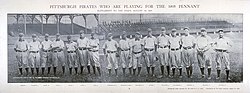
August 1905 photo of players on the Pittsburgh Pirates' roster.

A Major League Baseball roster is a list of players who are allowed, by league agreement, to play for a Major League Baseball (MLB) team. Each MLB team maintains two rosters: an active roster of players eligible to participate in an MLB game, and an expanded roster encompassing the active roster plus additional reserve players.

Beginning with the 2021 season, the active roster size is 26 players, and the expanded roster size is 40 players (the expanded roster is commonly referred to as the "40-man roster"). Historically, the active roster size was 25 players, with exceptions made in some seasons, most recently in 2020 when teams could have 28 active players.

Active roster

[edit]

Since 1910, when teams were first allowed to carry players under contract in excess of those allowed to participate in regular season games, the latter has been called the "active roster." With exceptions through the years for varying economic conditions (primarily during World War I, the Great Depression, post-World War II, and from 1986 to 1989 when the limit was set at 24 because of rising player salaries), the active roster has allowed up to 25 players to participate for a Major League team within specified dates, currently Opening Day to September 1. In 1968, the 25-player maximum for active rosters was made a part of the first collective bargaining agreement (CBA) between the major leagues and the Major League Baseball Players Association (MLBPA). Starting in 1977, teams were required to carry a minimum of 24 players on their active rosters as well.

Active rosters include the starting eight position players, starting pitching rotation, and reserve players on the team. Players on the active roster are also on the 40-man roster. These players are generally the only ones who dress in uniform and are the only ones who may take the field in a game at any time.

Typically, in modern-day play, an active roster will consist of five starting pitchers, eight relief pitchers, two catchers, six infielders, and five outfielders. Teams can vary this somewhat according to preference and circumstance, and indeed the "typical" roster makeup has changed somewhat over the years. (Starting rotations used to consist of four pitchers, not five, well into the 1970s; third-string catchers used to be much more common; many other minor variations exist.) A full-time designated hitter (DH) is usually classified as either an infielder or an outfielder, not a DH, because most DHs do play defensive positions from time to time.

Since 2012, teams have been allowed to carry one additional active player for "day-night" doubleheaders – two games scheduled on the same day, but with the stadium cleared between games, and separate tickets sold for each game – as long as the doubleheaders have been scheduled with at least 48 hours of advance notice.[1] Teams are also allowed an additional active player for games played at neutral sites, such as the MLB Little League Classic.[2]

Changes made in 2020

[edit]

On March 14, 2019, MLB and the MLBPA reached an agreement on midterm changes to the then-current CBA, with the changes officially unveiled on February 12, 2020. Two significant changes were announced, which were planned to take effect during the 2020 season:

26-man roster

[edit]

Under the agreement, teams would be allowed 26-man active rosters from the start of the season through August 31, as well as the postseason. From September 1 to the end of the regular season, two additional players (28 total) would be active. Teams would be limited to carrying 13 pitchers, except from September 1 to the end of the regular season, when this limit would increase to 14. Prior conditions that allowed an extra active player (such as day-night doubleheaders) would persist, with the extra player not counting against the limit for pitchers.

Restrictions on position players pitching

[edit]

The agreement also introduced a playing rule placing severe limits on pitching by position players. Each team must designate players as either "position players" or "pitchers" before the start of the season, and that designation cannot be changed during the season. Only players who are designated as "pitchers" will be allowed to pitch in any regular-season or postseason game, with the following exceptions:[3][4][5][6]

  • One team is ahead by at least 7 runs when the player has assumed a pitching role.
  • The game is in extra innings.
  • The player serving as pitcher has earned the status of "two-way player".

A player earns two-way status by satisfying both of the following criteria, in either the current season or the immediately preceding season:[3][5]

  • Pitching at least 20 MLB innings.
  • Playing in at least 20 MLB games as a position player or designated hitter, with at least three plate appearances in each of the 20 games.

For the 2020 season only, a player who met the above qualifications in either 2018 or 2019 would be considered a two-way player.

Delayed implementation

[edit]

Due to the impact of the COVID-19 pandemic on the 2020 season, the planned changes were deferred. Teams were allowed to begin the shortened season with 30 active players, and were allowed to have 28 active players from early August through the postseason.[7]

For the 2021 season, the 26-man active roster size took effect; however, the roster limit of 13 pitchers was waived, as were restrictions on position players pitching.[8] The 13-pitcher limit, two-way player rule, and restrictions on position players pitching finally went into effect during the 2022 season.

Expanded roster

[edit]

Also called the "40-man roster", the expanded roster is composed of all the players in a Major League club's organization who are signed to a major-league contract. The 40-man roster limit has been in effect since 1921, except for 1945 and 1946 when it was raised to 48 to accommodate the number of returning players whose careers had been interrupted by military service in World War II, from 1962 to 1965 when it was raised to 41 to add a reserve spot for first-year players acquired before implementation of a player draft was approved prior to the 1965 season, and in 1994 for a strike that canceled the remainder of that season.

The expanded roster includes all players who are eligible for call-up to the active roster at any given time. Also on the 40-man roster are any players on the 10-day (for position players) or 15-day (for pitchers) injured list (known as the "disabled list" prior to the 2019 season) and minor league players who are signed to a major-league contract but are on an "optional assignment" to the minors (each player has three "option years" to be sent to the minors once on the expanded roster before he must be placed on waivers to be sent there). A player who is on the 40-man roster but is later placed on the 60-day injured list is removed from the 40-man roster until his time on the injured list is over. The same applies to players who are suspended. Because players on the 60-day injured list are taken off the 40-man roster with no risk of losing the player, MLB teams often transfer injured players from the 10-day or 15-day injured lists to the 60-day injured list so that the team can add another player to the 40-man roster without having to put a player through the designated for assignment (DFA) process. DFA is the removal of a player from the expanded roster; the team has seven days to trade the player, release him, or send him to the minor leagues.[9]

September call-ups

[edit]
Fred Lynn made his MLB debut as a September call up in 1974; he was later the American League's Rookie of the Year and MVP in 1975.

September call-ups are players who, historically, were added to MLB rosters late in the season.

Historical practice

[edit]

Through the 2019 season, every MLB team's roster expanded on September 1 from the 25-man active roster to the entire 40-man roster. Thus, any player on the expanded roster on September 1 or later could play for the MLB team through the end of the regular season.

September call-ups were often younger players who were being given major league experience and, especially for teams in playoff contention, players who could provide positional depth, such as a third catcher or additional relief pitchers. In practice, teams usually did not have the entire 40-man roster on hand for games; typically, clubs would have about six additional players available over the usual limit of 25. There were exceptions – for example; during the 2018 season, the Los Angeles Dodgers and Philadelphia Phillies used their full rosters,[10] and in 2019 the Boston Red Sox carried 36 players (including 21 pitchers).[11] In 2003, the Montreal Expos were contending for the National League wild card berth, and in what many people[who?] deemed to be a conflict of interest, Major League Baseball, which owned the Expos at the time, refused to allow them to call any players up,[12] claiming they could not afford the additional expenses, yet the following season with the Expos out of contention, September call ups were allowed.[citation needed]

During the final years of the 40-man active roster, one perceived problem was that teams were allowed to carry any number of players between 25 and 40 on their September rosters. Shortly after the decision to curtail September roster expansion was announced, former Milwaukee Brewers general manager Doug Melvin, who had advocated changes to September roster rules for more than a decade, made the following remarks to a USA Today writer:[10]

I think people got sick of me talking about it, but it was about the integrity of the game.... It got to be such a huge imbalance. It would be one thing if teams just had a couple of more players than the other team in September, but we were seeing differences by more than 10 players a game. To me, it was destroying the integrity of it. No other sport has uneven rosters at any point in the season, and we were doing it [in] the pennant race.

Current practice

[edit]

From 2020 forward, expanding the active roster late in the season so it is equivalent to the expanded roster has been eliminated. Each team is still allowed to have up to 40 players under major-league contracts, and active rosters are now normally 26 players, with a limited expansion—to 28 players—from September 1 through the end of the regular season.[4][5] Additionally, all teams are now required to have 28 players on their active rosters after August 31—they cannot carry a lower number of players. Adjustments to these limits may be implemented by MLB, such as during the delayed and shortened 2020 season, when teams were allowed to begin the season with 30 players on their active rosters.[13]

Postseason roster

[edit]
Adalberto Mondesí made his MLB debut during the 2015 World Series, the only player in MLB history to do so.[14]

A postseason roster takes effect only if a team clinches a playoff berth. Players who are part of the team's final roster at the end of the regular season are eligible to participate in the postseason. Any player who has been traded from a different team, spent time in the Minor Leagues, or signed later in the season with the team (no later than August 31) is eligible to participate in the postseason; players who are suspended for drug use are not allowed to participate in the postseason. From 2020, a postseason roster is allowed up to 26 active players (up from 25 through 2019), with a maximum of 13 pitchers (new for 2020); qualifying two-way players do not count against the limit on pitchers.[6] Other players who are not on the 26-man active roster will be assigned to the postseason secondary squad. Players who are on the injured list or any other non-active transaction by the end of the regular season will have their transactions passed on in the postseason. Rosters for a series are set at the beginning of the series and no changes to the 26-man active roster are allowed except when a player is moved to the injured list or any other inactive transaction. If a player is moved to the injured list or another inactive transaction during a series, he then becomes ineligible to be returned to the 26-man active roster for the remainder of the series as well as the next series if applicable. If any player goes on any inactive transaction, any player from the 40-man roster can be promoted to the 26-man active roster for the remainder of the series if applicable.[15]

For a player to be eligible for the postseason active roster, he must have either been on his club's expanded roster or injured list as of midnight (ET) on August 31 of that year and not placed on the 60-day injured list after August 1.[16] The one exception is for replacing players on the injured list. Since the 2014 season, an injured player eligible for postseason play may be replaced by any player within his club's organization, including players assigned to the club's minor league affiliates who are not on the major league 40-man roster. Prior to 2014, only players who were on a club's 40-man roster (including those added to the expanded roster after August 31, who would not otherwise be eligible for the postseason) at the conclusion of the regular season were eligible to replace injured players on postseason rosters. The 2015 Kansas City Royals were the first club to exploit this new provision when they added Adalberto Mondesí – who at the time was assigned to the Royals' Double-A affiliate and was not on the 40-man roster – to their World Series roster.

Non-roster players

[edit]

All other professional players affiliated with Major League Baseball are signed to minor-league contracts. They can receive an invitation to spring training with their organization's Major League team without being on the 40-man roster. Two types of players generally receive a non-roster invitation: prospect players who are there to gain experience and face tougher competition as well as receive instruction from the Major League team's coaching staff; and veteran players who were not offered any major league contract by a club. The veteran player is usually signed to a "two-way" salary option – one for their time in the minors and another if they are placed on the 40-man during the season. All spring training invitees are under some sort of contract, to avoid liability if an injury were to occur to the player.

All-Star roster

[edit]

Since 1933, an annual Major League Baseball All-Star Game has been played at approximately the mid-point of each season, except for 1945 and 2020. The game features an American League team versus a National League team. The number of players on All-Star rosters has varied; since 2010, there are 34 players on each league's roster.

See also

[edit]

References

[edit]
Revisions and contributorsEdit on WikipediaRead on Wikipedia
from Grokipedia
In (MLB), rosters refer to the structured lists of players affiliated with each of the 30 teams, comprising an active roster for games, a broader 40-man roster for protection and eligibility, and additional mechanisms like injured lists to manage player availability throughout the season. The active roster, which forms the core of a team's on-field personnel, consists of 26 players from through and during the postseason, expanding to exactly 28 players from through the end of the regular season to allow for additional call-ups and strategic flexibility. Teams must maintain a minimum of 25 players on the active roster at all times, with every player designated as either a or a ; position players are generally restricted from pitching except in , when their team is trailing by eight or more runs, or leading by ten or more runs. A maximum of 13 pitchers is permitted on the 26-player roster (increasing to 14 on the 28-player roster), though teams may designate up to two "two-way players" who count toward the position player total but can pitch in any situation without restriction, providing versatility in lineup construction. The 40-man roster serves as a protective reserve list, including all active players, those on s, and select minor leaguers, and is essential for shielding talent from the annual held each December during the Winter Meetings. To call up a minor leaguer to the active roster, a spot must first be cleared on the 40-man roster through actions such as designating a player for assignment, trading, releasing, or transferring to the 60-day ; players signed at age 18 or younger must be added within five professional seasons, while those signed at 19 or older have four seasons, or they become eligible for selection in the . This system ensures competitive balance by allowing clubs with incomplete 40-man rosters to select unprotected players, who must then remain on the active roster for the full next season or be offered back to their original team. Injured lists provide roster management flexibility: the 10-day for position players and 15-day for pitchers accommodate short-term absences, while the 60-day list allows longer-term placements without occupying active or 40-man spots, enabling teams to add temporary replacements. Option rules govern assignments for players with remaining options, requiring a minimum 10-day stint for position players and 15 days for pitchers or before recall, though no minimum applies for doubleheader "27th players" or injury substitutes. For the postseason in 2025, teams submit a 26-player roster per series using players who were on the 40-man roster or 60-day as of noon ET on September 1, with limited exceptions for injury replacements approved by the Commissioner's Office; restricted list players are eligible unless suspended for performance-enhancing drugs that season, and post-August 31 acquisitions are ineligible. These rules, governed by the agreement between MLB and the MLB Players Association, evolve periodically to balance competition, player development, and game strategy, with recent expansions like the provision introduced in 2020 to honor versatile talents such as .

Standard Active Roster

Size and Limits

The active roster in consists of 26 players during the regular season from through August 31, a limit established in 2020 as an increase from the previous 25-player maximum to provide teams with greater flexibility in managing injuries and player development. This expansion was part of broader rule changes agreed upon between MLB and the MLB Players Association, aimed at balancing roster depth with competitive play. Teams must maintain at least 25 players on this roster at all times, ensuring sufficient personnel for games while preventing excessive inactivity. A key composition rule limits the active roster to a maximum of 13 pitchers, requiring at least 13 position players to promote offensive and defensive balance. This pitcher cap, introduced alongside the 26-player expansion in 2020, helps mitigate bullpen overuse and encourages strategic lineup decisions. For doubleheaders, teams may temporarily add a 27th player, who must be designated in advance and can only participate in the second game, allowing adaptation to the demanding schedule without permanent roster inflation. Roster maintenance involves daily transactions governed by collective bargaining rules, such as placing players on the injured list (IL) or optioning them to the minors. The 10-day IL applies to position players, requiring a minimum 10-day absence, while pitchers and two-way players use the 15-day IL with a minimum 15-day stay; both lists temporarily remove players from the active roster but keep them on the 40-man roster. For longer-term injuries, the 60-day IL opens a spot on the 40-man roster by removing the player from it, facilitating additions from the minors. Players with remaining minor league options—up to three per career—can be sent to Triple-A without waivers, enabling seamless shuttling between levels to address immediate needs. These mechanisms ensure teams can dynamically adjust their active roster while adhering to size limits.

Pitcher Restrictions

In , the active roster is limited to a maximum of 13 pitchers out of the 26 total players, a rule implemented in 2020 to ensure at least 13 position players are available and to promote balanced team construction. This cap prevents teams from overloading their roster with pitching depth at the expense of offensive and defensive versatility. A key regulation governing pitcher usage is the three-batter minimum rule, introduced in , which requires any —starting or —to face at least three batters or pitch to the completion of a half-inning before being removed, unless injured or substituted for a change. Exceptions apply if the pitcher enters the game with two outs and a runner on base, potentially allowing the half-inning to end sooner, or in when a runner starts on second base under the ghost runner rule. These provisions accommodate situational gameplay while maintaining the rule's intent to reduce mid-inning substitutions and pace of play disruptions. The three-batter minimum has significantly altered management by eliminating short-stint specialists, such as left-handed one-out pitchers, and compelling managers to select relievers capable of handling multiple batters, often spanning disadvantages. This shift encourages longer outings from starting pitchers to preserve arms, though MLB imposes no explicit innings limits on starters; instead, pitcher workloads are indirectly regulated through () placements, which require a minimum 15-day stay for pitchers and two-way players. When pitching resources are exhausted, teams may turn to position players in low-leverage situations as an alternative. As of 2025, the standard active roster pitcher limit remains at 13, but it increases to 14 during expansions to 28 players, allowing greater flexibility in late-season usage without altering the core restrictions.

Position Players Pitching Rules

In , position players are generally prohibited from pitching to preserve the integrity of games and protect pitching resources, with strict exceptions designed to limit their use primarily to lopsided contests or prolonged games. Under current rules, a designated as such on the active roster may only take the if the game enters , the team is trailing by at least eight runs when the position player enters to pitch, or the team is leading by at least 10 runs in the ninth inning. These conditions aim to prevent unnecessary exposure of non-pitchers while allowing flexibility in extreme situations, such as exhaustion. The restrictions originated from a collective bargaining agreement between MLB and the MLB Players Association, which formalized the requirement that players be designated as either pitchers or prior to the season, barring them from switching roles mid-season except under the specified exceptions. This was further tightened in 2023 by the Joint Competition Committee to address a rise in position player appearances on the mound—132 in compared to 90 in —by increasing the score differentials required for eligibility and specifying thresholds for leading teams. Although temporary expansions occurred in 2020 due to the pandemic's impact on roster management, the post-2020 rules reverted to and refined the 2019 framework, emphasizing extreme differentials to curb frequent use. Players are designated as either pitchers or position players at the start of the season, with those designated as position players subject to these pitching restrictions. Two-way players, who qualify by appearing in at least 20 Major League games as a non-pitcher or (with at least three plate appearances in at least two of those games) and by pitching at least 20 in the current or previous season, are exempt from these restrictions and can pitch freely, as exemplified by Shohei Ohtani's . Violations, such as attempting to use an ineligible outside the exceptions, result in the player being removed from the pitching role, with umpires and league officials reviewing compliance in real-time. Historically, position players have occasionally pitched in blowouts dating back to the early , often for novelty or necessity, but rule evolution since the has shifted toward regulation to avoid undermining competitive balance. Notable pre-restriction instances include outfielder Canseco's 1986 home run allowed while pitching and infielder Michael Taylor's 2018 relief outing, which highlighted the need for limits as such events increased in the late . The and 2023 updates represent the primary milestones in this progression, reducing appearances while preserving the tradition in mercy-rule scenarios.

September Roster Expansion

Historical Practices

The practice of expanding Major League Baseball rosters in September originated in the early , allowing teams to call up additional players from their reserve lists once minor league seasons typically concluded around . By 1910, clubs maintained active rosters of 25 players during the regular season but could expand to 40 starting on , a rule designed to provide late-season depth, reward promising rs, and accommodate the end of affiliated league schedules without incurring full-season salaries. This framework solidified with the establishment of the 25-man active roster limit in 1920, evolving through the mid-20th century as MLB's farm systems expanded in the to emphasize player development and late-season flexibility. Prior to 2020, the standard procedure permitted teams to activate any player on their 40-man roster beginning , potentially increasing active rosters from 25 to a full 40 players and enabling mass call-ups of up to 15 individuals from the minors. This allowed organizations to evaluate prospects, bolster depth for playoff pushes, and give young talent major league experience without long-term service time implications. In 2019, the final year of unrestricted expansions, numerous teams utilized the full limit, with clubs like the New York Yankees and Astros adding multiple pitchers and position players, often resulting in "taxi squads" of bench players who traveled but saw limited action. While these expansions rewarded minor league development and provided strategic options, they drew significant criticism for contributing to roster bloat, uneven between contenders and non-contenders, and prolonged games due to excessive usage. Rushed promotions of underprepared players also raised concerns about increased risks, as prospects faced the intense MLB schedule without adequate transition time, potentially stunting their long-term growth. The 2020 season marked a pivot amid the , when MLB temporarily limited September rosters to 28 players to address these issues; this controlled expansion emphasizing fewer, more targeted call-ups has continued annually since then.

Current Rules and Limitations

Since 2020, teams have expanded their active rosters from 26 to 28 players on September 1, allowing the addition of only two players from the 40-man roster. These additions are restricted to one and one , or two s, due to the overall limit of 14 pitchers on the September roster—up from 13 during the regular season. All players added must have been on the team's 40-man roster as of August 31, ensuring that call-ups provide targeted depth rather than wholesale changes. This framework was first adopted in 2020 in response to the and retained under subsequent rules, including the 2022 agreement administered by MLB's Joint Competition Committee, to curb the roster volatility seen in prior full expansions and promote competitive balance in late-season games. The rules aim to reduce chaos from excessive player movement, discourage tanking by limiting mass promotions that could dilute non-contenders' efforts, and emphasize meaningful play by keeping rosters streamlined for contenders. For the 2025 season, these provisions remained unchanged, with the same 28-player cap, 14-pitcher maximum, and two-addition limit tied to 40-man status by , prioritizing complementary support over broad experimentation. The limitations have resulted in fewer overall promotions compared to historical practices, allowing teams to selectively integrate prospects or veterans for specific needs while preserving minor league development time. For instance, in 2025, the Chicago Cubs added Kevin Alcantara and right-hander to bolster their lineup and rotation depth, while the called up infielder Max Schuemann and right-hander for similar targeted roles. Such moves highlight how the rules foster focused contributions from high-profile talents without overwhelming team dynamics.

Postseason Roster

Size and Eligibility

In Major League Baseball, postseason rosters for all playoff series, including the , , , and , are limited to 26 players. This size aligns with the standard active roster during the regular season from through August 31, and it includes a maximum of 13 pitchers to maintain balance between pitching and position players. Unlike the regular season's expansion to 28 players, postseason rosters do not allow for any increases in size, ensuring a fixed composition throughout the playoffs. Eligibility for postseason rosters is determined by a player's status as of noon Eastern Time on , drawing from the pool established during the regular season's expanded roster period. Specifically, any player on a team's 40-man roster or the 60-day at that cutoff is eligible, provided they are not on the restricted list due to a performance-enhancing drug suspension during the season. Players cannot be added from the after , and those acquired via trade or other means in September are ineligible. For the 2025 season, this window remains in effect, permitting injured players on the 60-day as of to return if activated prior to the start of a playoff series, subject to standard activation rules such as serving the minimum time on the list. Rosters are finalized and submitted prior to the start of each playoff round, allowing teams to adjust selections from the eligible pool but without exceeding the 26-player limit or altering the 13-pitcher maximum. Replacements during a series are permitted only for documented injuries, with pitchers replaceable solely by other pitchers and position players by position players, to prevent strategic mid-series expansions. Historically, postseason rosters consisted of 25 players prior to the 2020 season, when the limit expanded to 26 in conjunction with regular-season roster changes implemented under the .

Selection and Changes

The selection process for postseason rosters begins with each advancing team's manager submitting a 26-player roster to prior to the start of each playoff round, including the Wild Card Series, , Championship Series, and . These rosters are drawn exclusively from players who were on the team's 40-man roster or the 60-day as of noon ET on September 1 of the postseason year, ensuring eligibility is tied to end-of-regular-season status. To comply with pitcher restrictions, every roster must include at least 13 position players, as no more than 13 pitchers are permitted. Between series, teams gain significant flexibility to adjust their rosters while maintaining the 26-player limit, allowing managers to submit an entirely new composition from the eligible pool for subsequent rounds following the or . This enables strategic swaps or full adjustments to address performance or issues, provided the overall balance adheres to pitcher limits and no demotions to the occur during the . For instance, in the 2025 , the received approval to substitute Tanner with Justin Wrobleski due to , illustrating how such changes preserve competitiveness without expanding the roster size. Mid-series adjustments are more restricted, limited to one-for-one replacements for injured players, where a can only be swapped for another and a for another ; the original injured player becomes ineligible for the remainder of the postseason. Strategic considerations in roster selection emphasize balancing starting pitchers, specialists, and versatile players to optimize matchups against opponents' lineups and adapt to the shorter, high-stakes series format. Managers often prioritize depth in bullpens for late-inning reliability while ensuring positional flexibility for defensive shifts, as teams frequently tweak their rosters between series to incorporate recovering players or adjust for . These decisions require weighing player , hot streaks, and advantages without violating eligibility or composition rules. The current framework evolved notably in 2022 with the introduction of the expanded 12-team , which formalized roster resets between all rounds to better accommodate and performance evaluations, providing greater flexibility than prior single-game Wild Card structures. This rule was refined in subsequent seasons, including 2025, with minor clarifications to injury replacement protocols but no major alterations to the core selection and change mechanisms, maintaining focus on competitive integrity.

Special and Additional Rosters

All-Star Game Roster

The features rosters of 32 players per league, consisting of 20 position players and 12 pitchers, selected to highlight the season's top performers in an exhibition contest held annually in mid-July. This format ensures broad representation, with at least one player from every MLB team, and serves to engage fans while generating significant revenue through broadcasts, sponsorships, and events. The rosters emphasize elite active players from the 26-man active rosters, focusing on statistical excellence, fan popularity, and peer recognition without the constraints of regular-season roster limits. Selection begins with fan voting for the nine starting position players per league, including one catcher, first baseman, second baseman, shortstop, third baseman, three outfielders, and designated hitter, conducted in two phases: an initial ballot narrowing candidates followed by a finals showdown for the top spots. Reserves and pitchers are chosen through a player ballot process, where MLB players vote to select 17 additional spots—nine position player reserves (one backup per starting position) and eight pitchers (five starters and three relievers)—with the Commissioner's Office filling the remaining six slots (two position players and four pitchers) to complete the roster and guarantee team representation. Rosters are announced in early July during a televised selection show, and injured players are replaced by alternates from the player ballot or Commissioner's choices, prioritizing positional needs for pitchers while allowing flexibility for position players. No duplicate positions are permitted among reserves, maintaining a balanced lineup. The has been a standard feature in the since , used by both leagues regardless of the host , allowing pitchers to focus solely on throwing without batting duties. This rule aligns with the 2022 adoption of the universal in the regular season, ensuring consistency and emphasizing offensive showcase over pitching matchups, with no changes implemented for 2025. Historically, rosters expanded to 34 players in to accommodate more talent amid growing league size, but were reduced to the current 32 in 2017 under the agreement to streamline selections while preserving inclusivity and fan-driven excitement.

Non-Roster Invitees

Non-roster invitees (NRIs) are players, typically minor leaguers or free agents, who are not on a Major League Baseball (MLB) club's 40-man roster but receive an invitation to attend the team's major league camp. These invitations serve as tryouts, allowing participants to demonstrate their skills alongside rostered players in practices and exhibition games, with the goal of earning a or roster spot. In , MLB teams typically have around 60-70 players in major league camp, including the 40-man roster members and 20-30 additional NRIs to fill out squads for drills, intrasquad scrimmages, and Grapefruit League or Cactus League games. NRIs provide organizational depth, enabling teams to evaluate talent without immediate commitment to the 40-man roster, which protects players from waivers and eligibility. However, NRIs are ineligible for the active 26-man roster during the regular season unless first added to the 40-man roster, limiting their immediate impact to developmental opportunities. Teams typically announce NRI invitations in January or early February, ahead of spring training camps that begin in mid-February, such as those for the 2025 season. Successful performers may secure minor league assignments, invitations to extended spring training, or, in rare cases, addition to the 40-man roster for a major league debut. For instance, prospects like outfielder Fernando Tatis Jr. and pitcher Chris Paddack impressed enough as NRIs in 2019 to break camp with the San Diego Padres and contribute significantly in their rookie seasons. NRIs have been a long-standing feature of MLB spring training, used for , player development, and providing for established players. Notable success stories include infielder , who joined the as an NRI in 2014 and evolved into a key contributor, batting .526 in the . Similarly, infielder made the Philadelphia Phillies' roster as an NRI in 2022, going on to play a prominent role in the team's lineup. These examples highlight how NRIs can serve as a pathway for breakout prospects or veterans seeking resurgence, though only a small percentage achieve major league status directly from camp. Key limitations for NRIs include their inability to be optioned to or recalled without first being placed on the 40-man roster, which requires clearing space through trades, waivers, or outright assignments. Their primary focus remains on skill evaluation and physical conditioning rather than active contributions, as they often wear higher uniform numbers to distinguish them from rostered players and may split time between league camps. If not selected for further advancement, NRIs typically report to their affiliates post-spring training, continuing development without major league pay or exposure.

References

Add your contribution
Related Hubs
User Avatar
No comments yet.