



Community hub
Recent from talks
Knowledge base stats:
Talk channels stats:
Members stats:
Acura Legend
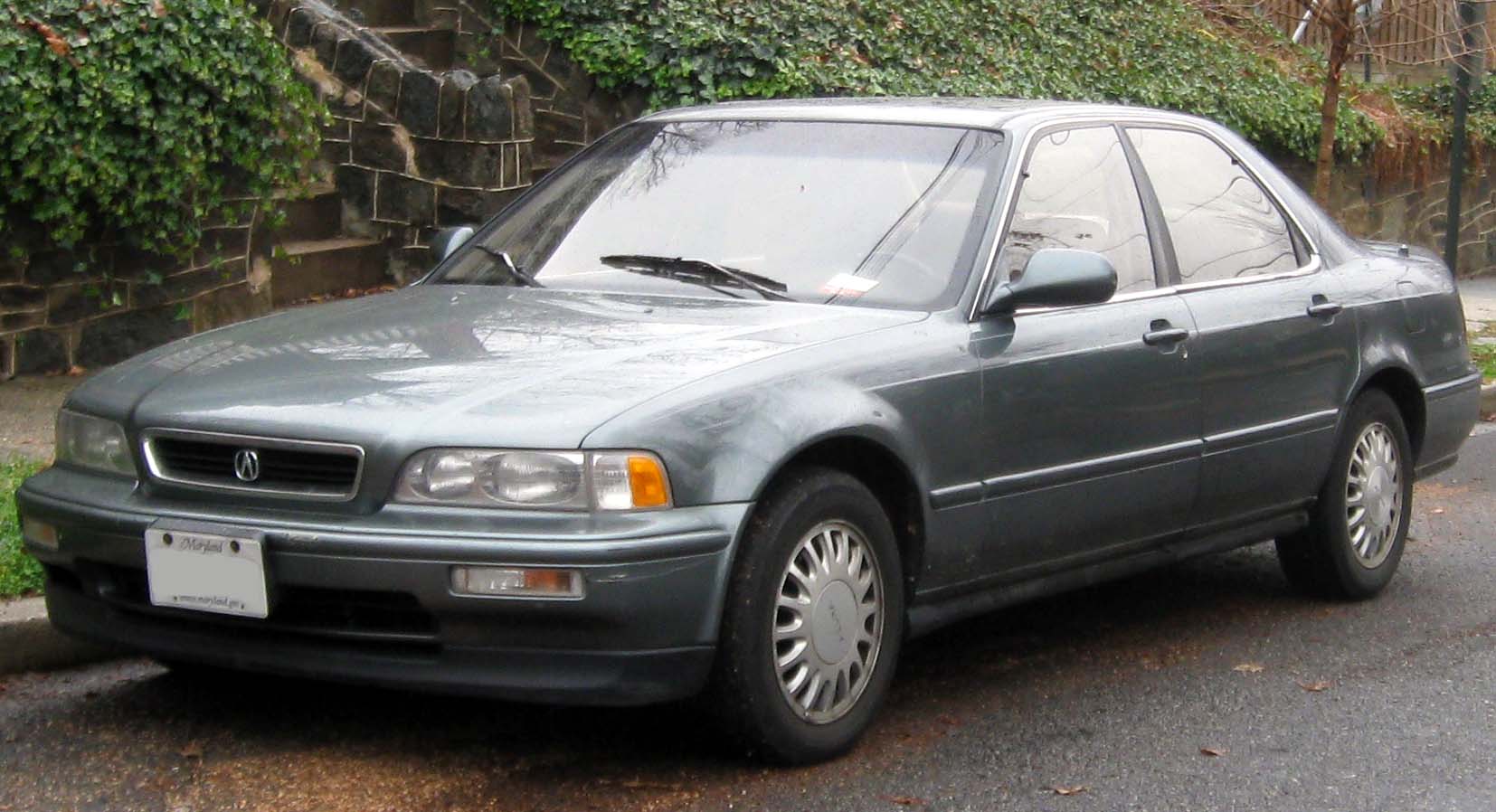
The Acura Legend is a mid-size luxury car manufactured by Honda from Japan. It was sold in the U.S. and Canada under Honda's luxury brand, Acura, from 1985 until 1995. It was the first flagship sedan sold under the Acura nameplate, until being renamed in 1996 as the Acura 3.5RL. The 3.5RL was the North American version of the KA9 series Honda Legend.
The opportunity for Japanese manufacturers to export more expensive models had arisen with the 1980s voluntary export restraints, negotiated by the Japanese government and U.S. trade representatives, restricting mainstream car sales. The initial success of the Legend and Honda's Acura division in competing against established European and American luxury manufacturers would lead to Toyota and Nissan creating the Lexus and Infiniti brands, respectively, to compete in the luxury car market.
Honda introduced the model in Japan on October 22, 1985, to be their premier luxury model, and in North America for the 1986 model year, as the top of the line model for its then-new Acura lineup. Sedan models came to the market first, powered by a 151 hp (113 kW) 2.5 L C25A V6, with coupes making their first appearance in 1987, powered by a new 161 hp (120 kW) 2.7 L C27A engine. Sedans received the new engine for 1988.
The Legend was the first production Honda vehicle to offer a V6 engine. The 1987 Acura Legend LS coupe would be the first Japanese car to offer a driver's side airbag. The Legend was a result of a joint venture with Britain's Austin Rover Group called Project XX that started in November 1981 with the Austin Rover-Honda XX letter of intent signed by the two companies to replace the Rover SD1 and to provide a luxury vehicle for Honda. The Rover Company had a long established reputation as a luxury car in the United Kingdom and Europe, demonstrated with the Rover P6, and Honda wanted to introduce a luxury car for both domestic Japanese and the United States markets. The joint development produced the Legend and the corresponding British version was the Rover 800-series, which was badged under the Sterling brand in the United States and competed with the Legend.
Rover also wanted to return to the American market when they had reportedly sold only 1,500 cars in 1971, and a brief return in 1980, selling 800 Rover SD1s by offering the Sterling.
The Legend won Car and Driver's Ten Best three years in a row and Motor Trend's Import Car of the Year for 1987. Manual-equipped models could accelerate from 0-60 mph (97 km/h) in under 8 seconds and reach a top speed of 135 mph (217 km/h). Sedan models had a drag coefficient of 0.32, while coupes were only 0.30.
When the Legend was introduced, Honda's newly established luxury car division just for the Legend was called Acura, using the advertising slogan "Precision Crafted Performance", and the Legend was offered with one factory installed option, the choice of transmission used, and one trim level. In the 1986 sales brochure, the Legend's full name used was "Legend Touring Sedan". The vehicle was virtually identical in luxury content to the Japanese market V6Zi, but was identical in size and the longer overall length of the top level V6Xi to comply with United States crash standards, using the larger 2.5 V6 engine. The Technics supplied 80W four speaker cassette tape stereo offered four user programmable equalizer settings, and was equipped with a dual diversity antenna, meaning it had a conventional extendable power antenna and an embedded antenna in the rear window. One of the novelty items was a simple volume control rocker switch and a pre-set radio station channel selector installed on the instrument binnacle within reach of the right hand; the opposite side of the instrument binnacle had a button to open, tilt or close the standard equipped glass moonroof with sun shade.
The North American Legend was not offered with some of the items offered in Japan, such as automatic, one-touch climate control, and 100% wool cloth interior in brown. Blue interior was shared with Japan and North America, but brown was not offered in North America, and "sand gray" was offered instead. Exterior colors were matched to only one interior color choice and leather was not offered. Due to the success Honda had with the Legend, it served as an inspiration for the Subaru Legacy with which it shares many visual resemblances and dimensions both inside and out.
Hub AI
Acura Legend AI simulator
(@Acura Legend_simulator)
Acura Legend
The Acura Legend is a mid-size luxury car manufactured by Honda from Japan. It was sold in the U.S. and Canada under Honda's luxury brand, Acura, from 1985 until 1995. It was the first flagship sedan sold under the Acura nameplate, until being renamed in 1996 as the Acura 3.5RL. The 3.5RL was the North American version of the KA9 series Honda Legend.
The opportunity for Japanese manufacturers to export more expensive models had arisen with the 1980s voluntary export restraints, negotiated by the Japanese government and U.S. trade representatives, restricting mainstream car sales. The initial success of the Legend and Honda's Acura division in competing against established European and American luxury manufacturers would lead to Toyota and Nissan creating the Lexus and Infiniti brands, respectively, to compete in the luxury car market.
Honda introduced the model in Japan on October 22, 1985, to be their premier luxury model, and in North America for the 1986 model year, as the top of the line model for its then-new Acura lineup. Sedan models came to the market first, powered by a 151 hp (113 kW) 2.5 L C25A V6, with coupes making their first appearance in 1987, powered by a new 161 hp (120 kW) 2.7 L C27A engine. Sedans received the new engine for 1988.
The Legend was the first production Honda vehicle to offer a V6 engine. The 1987 Acura Legend LS coupe would be the first Japanese car to offer a driver's side airbag. The Legend was a result of a joint venture with Britain's Austin Rover Group called Project XX that started in November 1981 with the Austin Rover-Honda XX letter of intent signed by the two companies to replace the Rover SD1 and to provide a luxury vehicle for Honda. The Rover Company had a long established reputation as a luxury car in the United Kingdom and Europe, demonstrated with the Rover P6, and Honda wanted to introduce a luxury car for both domestic Japanese and the United States markets. The joint development produced the Legend and the corresponding British version was the Rover 800-series, which was badged under the Sterling brand in the United States and competed with the Legend.
Rover also wanted to return to the American market when they had reportedly sold only 1,500 cars in 1971, and a brief return in 1980, selling 800 Rover SD1s by offering the Sterling.
The Legend won Car and Driver's Ten Best three years in a row and Motor Trend's Import Car of the Year for 1987. Manual-equipped models could accelerate from 0-60 mph (97 km/h) in under 8 seconds and reach a top speed of 135 mph (217 km/h). Sedan models had a drag coefficient of 0.32, while coupes were only 0.30.
When the Legend was introduced, Honda's newly established luxury car division just for the Legend was called Acura, using the advertising slogan "Precision Crafted Performance", and the Legend was offered with one factory installed option, the choice of transmission used, and one trim level. In the 1986 sales brochure, the Legend's full name used was "Legend Touring Sedan". The vehicle was virtually identical in luxury content to the Japanese market V6Zi, but was identical in size and the longer overall length of the top level V6Xi to comply with United States crash standards, using the larger 2.5 V6 engine. The Technics supplied 80W four speaker cassette tape stereo offered four user programmable equalizer settings, and was equipped with a dual diversity antenna, meaning it had a conventional extendable power antenna and an embedded antenna in the rear window. One of the novelty items was a simple volume control rocker switch and a pre-set radio station channel selector installed on the instrument binnacle within reach of the right hand; the opposite side of the instrument binnacle had a button to open, tilt or close the standard equipped glass moonroof with sun shade.
The North American Legend was not offered with some of the items offered in Japan, such as automatic, one-touch climate control, and 100% wool cloth interior in brown. Blue interior was shared with Japan and North America, but brown was not offered in North America, and "sand gray" was offered instead. Exterior colors were matched to only one interior color choice and leather was not offered. Due to the success Honda had with the Legend, it served as an inspiration for the Subaru Legacy with which it shares many visual resemblances and dimensions both inside and out.