
Recent from talks
Acute coronary syndrome
Knowledge base stats:
Talk channels stats:
Members stats:
Acute coronary syndrome
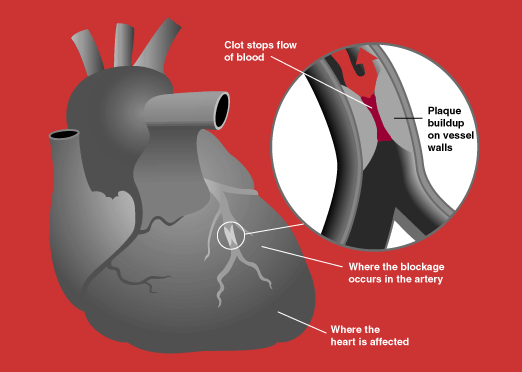
Acute coronary syndrome (ACS) is a syndrome due to decreased blood flow in the coronary arteries such that part of the heart muscle is unable to function properly or dies. The most common symptom is centrally located pressure-like chest pain, often radiating to the left shoulder or angle of the jaw, and associated with nausea and sweating. Many people with acute coronary syndromes present with symptoms other than chest pain, particularly women, older people, and people with diabetes mellitus.
Acute coronary syndrome is subdivided in three scenarios depending primarily on the presence of electrocardiogram (ECG) changes and blood test results (a change in cardiac biomarkers such as troponin levels): ST elevation myocardial infarction (STEMI), non-ST elevation myocardial infarction (NSTEMI), or unstable angina. STEMI is characterized by complete blockage of a coronary artery resulting in necrosis of part of the heart muscle indicated by ST elevation on ECG, NSTEMI is characterized by a partially blocked coronary artery resulting in necrosis of part of the heart muscle that may be indicated by ECG changes, and unstable angina is characterised by ischemia of the heart muscle that does not result in cell injury or necrosis.
ACS should be distinguished from stable angina, which develops during physical activity or stress and resolves at rest. In contrast with stable angina, unstable angina occurs suddenly, often at rest or with minimal exertion, or at lesser degrees of exertion than the individual's previous angina ("crescendo angina"). New-onset angina is also considered unstable angina, since it suggests a new problem in a coronary artery.
Symptoms of the acute coronary syndromes are similar. The cardinal symptom of critically decreased blood flow to the heart is chest pain, experienced as tightness, pressure, or burning. Localization is most commonly around or over the chest and may radiate or be located to the arm, shoulder, neck, back, upper abdomen, or jaw. This may be associated with sweating, nausea, or shortness of breath. Previously, the word "atypical" was used to describe chest pain not typically heart-related, however, this word is not recommended and has been replaced by "noncardiac" to describe chest pain that indicates a low likelihood of heart-related pain.
In unstable angina, symptoms may appear on rest or on minimal exertion. The symptoms can last longer than those in stable angina, can be resistant to rest or medicine, and can get worse over time.
Though ACS is usually associated with coronary thrombosis, it can also be associated with cocaine use. Chest pain with features characteristic of cardiac origin (angina) can also be precipitated by profound anemia, brady- or tachycardia (excessively slow or rapid heart rate), low or high blood pressure, severe aortic valve stenosis (narrowing of the valve at the beginning of the aorta), pulmonary artery hypertension and a number of other conditions.
In those who have ACS, atheroma rupture is most commonly found 60% when compared to atheroma erosion (30%), thus causes the formation of thrombus which block the coronary arteries. Plaque rupture is responsible for 60% in ST elevated myocardial infarction (STEMI) while plaque erosion is responsible for 30% of the STEMI and vice versa for Non ST elevated myocardial infarction (NSTEMI). In plaque rupture, the content of the plaque is lipid rich, collagen poor, with abundant inflammation which is macrophage predominant, and covered with a thin fibrous cap. Meanwhile, in plaque erosion, the plaque is rich with extracellular matrix, proteoglycan, glycoaminoglycan, but without fibrous caps, no inflammatory cells, and no large lipid core. After the coronary arteries are unblocked, there is a risk of reperfusion injury due spreading inflammatory mediators throughout the body. Investigations is still underway on the role of cyclophilin D in reducing the reperfusion injury.
Other, less common, causes of acute coronary syndrome include spontaneous coronary artery dissection, ischemia in the absence of obstructive coronary artery disease (INOCA), and myocardial infarction in the absence of obstructive coronary artery disease (MINOCA).
Hub AI
Acute coronary syndrome AI simulator
(@Acute coronary syndrome_simulator)
Acute coronary syndrome
Acute coronary syndrome (ACS) is a syndrome due to decreased blood flow in the coronary arteries such that part of the heart muscle is unable to function properly or dies. The most common symptom is centrally located pressure-like chest pain, often radiating to the left shoulder or angle of the jaw, and associated with nausea and sweating. Many people with acute coronary syndromes present with symptoms other than chest pain, particularly women, older people, and people with diabetes mellitus.
Acute coronary syndrome is subdivided in three scenarios depending primarily on the presence of electrocardiogram (ECG) changes and blood test results (a change in cardiac biomarkers such as troponin levels): ST elevation myocardial infarction (STEMI), non-ST elevation myocardial infarction (NSTEMI), or unstable angina. STEMI is characterized by complete blockage of a coronary artery resulting in necrosis of part of the heart muscle indicated by ST elevation on ECG, NSTEMI is characterized by a partially blocked coronary artery resulting in necrosis of part of the heart muscle that may be indicated by ECG changes, and unstable angina is characterised by ischemia of the heart muscle that does not result in cell injury or necrosis.
ACS should be distinguished from stable angina, which develops during physical activity or stress and resolves at rest. In contrast with stable angina, unstable angina occurs suddenly, often at rest or with minimal exertion, or at lesser degrees of exertion than the individual's previous angina ("crescendo angina"). New-onset angina is also considered unstable angina, since it suggests a new problem in a coronary artery.
Symptoms of the acute coronary syndromes are similar. The cardinal symptom of critically decreased blood flow to the heart is chest pain, experienced as tightness, pressure, or burning. Localization is most commonly around or over the chest and may radiate or be located to the arm, shoulder, neck, back, upper abdomen, or jaw. This may be associated with sweating, nausea, or shortness of breath. Previously, the word "atypical" was used to describe chest pain not typically heart-related, however, this word is not recommended and has been replaced by "noncardiac" to describe chest pain that indicates a low likelihood of heart-related pain.
In unstable angina, symptoms may appear on rest or on minimal exertion. The symptoms can last longer than those in stable angina, can be resistant to rest or medicine, and can get worse over time.
Though ACS is usually associated with coronary thrombosis, it can also be associated with cocaine use. Chest pain with features characteristic of cardiac origin (angina) can also be precipitated by profound anemia, brady- or tachycardia (excessively slow or rapid heart rate), low or high blood pressure, severe aortic valve stenosis (narrowing of the valve at the beginning of the aorta), pulmonary artery hypertension and a number of other conditions.
In those who have ACS, atheroma rupture is most commonly found 60% when compared to atheroma erosion (30%), thus causes the formation of thrombus which block the coronary arteries. Plaque rupture is responsible for 60% in ST elevated myocardial infarction (STEMI) while plaque erosion is responsible for 30% of the STEMI and vice versa for Non ST elevated myocardial infarction (NSTEMI). In plaque rupture, the content of the plaque is lipid rich, collagen poor, with abundant inflammation which is macrophage predominant, and covered with a thin fibrous cap. Meanwhile, in plaque erosion, the plaque is rich with extracellular matrix, proteoglycan, glycoaminoglycan, but without fibrous caps, no inflammatory cells, and no large lipid core. After the coronary arteries are unblocked, there is a risk of reperfusion injury due spreading inflammatory mediators throughout the body. Investigations is still underway on the role of cyclophilin D in reducing the reperfusion injury.
Other, less common, causes of acute coronary syndrome include spontaneous coronary artery dissection, ischemia in the absence of obstructive coronary artery disease (INOCA), and myocardial infarction in the absence of obstructive coronary artery disease (MINOCA).
Recent media