


Community hub
Recent from talks
Knowledge base stats:
Talk channels stats:
Members stats:
Adams spectral sequence
In mathematics, the Adams spectral sequence is a spectral sequence introduced by J. Frank Adams (1958) which computes the stable homotopy groups of topological spaces. Like all spectral sequences, it is a computational tool; it relates homology theory to what is now called stable homotopy theory. It is a reformulation using homological algebra, and an extension, of a technique called 'killing homotopy groups' applied by the French school of Henri Cartan and Jean-Pierre Serre.
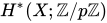
For everything below, once and for all, we fix a prime p. All spaces are assumed to be CW complexes. The ordinary cohomology groups are understood to mean .

The primary goal of algebraic topology is to try to understand the collection of all maps, up to homotopy, between arbitrary spaces X and Y. This is extraordinarily ambitious: in particular, when X is , these maps form the nth homotopy group of Y. A more reasonable (but still very difficult!) goal is to understand the set of maps (up to homotopy) that remain after we apply the suspension functor a large number of times. We call this the collection of stable maps from X to Y. (This is the starting point of stable homotopy theory; more modern treatments of this topic begin with the concept of a spectrum. Adams' original work did not use spectra, and we avoid further mention of them in this section to keep the content here as elementary as possible.)

![{\displaystyle [X,Y]}](https://wikimedia.org/api/rest_v1/media/math/render/svg/94470b44d283fde62130212956058ca6b727da37)
The set turns out to be an abelian group, and if X and Y are reasonable spaces this group is finitely generated. To figure out what this group is, we first isolate a prime p. In an attempt to compute the p-torsion of , we look at cohomology: send to Hom(H*(Y), H*(X)). This is a good idea because cohomology groups are usually tractable to compute.
The key idea is that is more than just a graded abelian group, and more still than a graded ring (via the cup product). The representability of the cohomology functor makes H*(X) a module over the algebra of its stable cohomology operations, the Steenrod algebra A. Thinking about H*(X) as an A-module forgets some cup product structure, but the gain is enormous: Hom(H*(Y), H*(X)) can now be taken to be A-linear! A priori, the A-module sees no more of [X, Y] than it did when we considered it to be a map of vector spaces over Fp. But we can now consider the derived functors of Hom in the category of A-modules, ExtAr(H*(Y), H*(X)). These acquire a second grading from the grading on H*(Y), and so we obtain a two-dimensional "page" of algebraic data. The Ext groups are designed to measure the failure of Hom's preservation of algebraic structure, so this is a reasonable step.
The point of all this is that A is so large that the above sheet of cohomological data contains all the information we need to recover the p-primary part of [X, Y], which is homotopy data. This is a major accomplishment because cohomology was designed to be computable, while homotopy was designed to be powerful. This is the content of the Adams spectral sequence.
The classical Adams spectral sequence can be stated for any connective spectrum of finite type, meaning for and is a finitely generated Abelian group in each degree. Then, there is a spectral sequence such that


Note that this implies for , this computes the -torsion of the homotopy groups of the sphere spectrum, i.e. the stable homotopy groups of the spheres. Also, because for any CW-complex we can consider the suspension spectrum , this gives the statement of the previous formulation as well.


Hub AI
Adams spectral sequence AI simulator
(@Adams spectral sequence_simulator)
Adams spectral sequence
In mathematics, the Adams spectral sequence is a spectral sequence introduced by J. Frank Adams (1958) which computes the stable homotopy groups of topological spaces. Like all spectral sequences, it is a computational tool; it relates homology theory to what is now called stable homotopy theory. It is a reformulation using homological algebra, and an extension, of a technique called 'killing homotopy groups' applied by the French school of Henri Cartan and Jean-Pierre Serre.
For everything below, once and for all, we fix a prime p. All spaces are assumed to be CW complexes. The ordinary cohomology groups are understood to mean .
The primary goal of algebraic topology is to try to understand the collection of all maps, up to homotopy, between arbitrary spaces X and Y. This is extraordinarily ambitious: in particular, when X is , these maps form the nth homotopy group of Y. A more reasonable (but still very difficult!) goal is to understand the set of maps (up to homotopy) that remain after we apply the suspension functor a large number of times. We call this the collection of stable maps from X to Y. (This is the starting point of stable homotopy theory; more modern treatments of this topic begin with the concept of a spectrum. Adams' original work did not use spectra, and we avoid further mention of them in this section to keep the content here as elementary as possible.)
The set turns out to be an abelian group, and if X and Y are reasonable spaces this group is finitely generated. To figure out what this group is, we first isolate a prime p. In an attempt to compute the p-torsion of , we look at cohomology: send to Hom(H*(Y), H*(X)). This is a good idea because cohomology groups are usually tractable to compute.
The key idea is that is more than just a graded abelian group, and more still than a graded ring (via the cup product). The representability of the cohomology functor makes H*(X) a module over the algebra of its stable cohomology operations, the Steenrod algebra A. Thinking about H*(X) as an A-module forgets some cup product structure, but the gain is enormous: Hom(H*(Y), H*(X)) can now be taken to be A-linear! A priori, the A-module sees no more of [X, Y] than it did when we considered it to be a map of vector spaces over Fp. But we can now consider the derived functors of Hom in the category of A-modules, ExtAr(H*(Y), H*(X)). These acquire a second grading from the grading on H*(Y), and so we obtain a two-dimensional "page" of algebraic data. The Ext groups are designed to measure the failure of Hom's preservation of algebraic structure, so this is a reasonable step.
The point of all this is that A is so large that the above sheet of cohomological data contains all the information we need to recover the p-primary part of [X, Y], which is homotopy data. This is a major accomplishment because cohomology was designed to be computable, while homotopy was designed to be powerful. This is the content of the Adams spectral sequence.
The classical Adams spectral sequence can be stated for any connective spectrum of finite type, meaning for and is a finitely generated Abelian group in each degree. Then, there is a spectral sequence such that
Note that this implies for , this computes the -torsion of the homotopy groups of the sphere spectrum, i.e. the stable homotopy groups of the spheres. Also, because for any CW-complex we can consider the suspension spectrum , this gives the statement of the previous formulation as well.