


Community hub
Recent from talks
Knowledge base stats:
Talk channels stats:
Members stats:
Homology (mathematics)
In mathematics, the term homology, originally introduced in algebraic topology, has three primary, closely related usages relating to chain complexes, mathematical objects, and topological spaces respectively. First, the most direct usage of the term is to take the homology of a chain complex, resulting in a sequence of abelian groups called homology groups. Secondly, as chain complexes are obtained from various other types of mathematical objects, this operation allows one to associate various named homologies or homology theories to these objects. Finally, since there are many homology theories for topological spaces that produce the same answer, one also often speaks of the homology of a topological space. (This latter notion of homology admits more intuitive descriptions for 1- or 2-dimensional topological spaces, and is sometimes referenced in popular mathematics.) There is also a related notion of the cohomology of a cochain complex, giving rise to various cohomology theories, in addition to the notion of the cohomology of a topological space.
To take the homology of a chain complex, one starts with a chain complex, which is a sequence of abelian groups (whose elements are called chains) and group homomorphisms (called boundary maps) such that the composition of any two consecutive maps is zero:


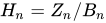
The th homology group of this chain complex is then the quotient group of cycles modulo boundaries, where the th group of cycles is given by the kernel subgroup , and the th group of boundaries is given by the image subgroup . One can optionally endow chain complexes with additional structure, for example by additionally taking the groups to be modules over a coefficient ring , and taking the boundary maps to be -module homomorphisms, resulting in homology groups that are also quotient modules. Tools from homological algebra can be used to relate homology groups of different chain complexes.






To associate a homology theory to other types of mathematical objects, one first gives a prescription for associating chain complexes to that object, and then takes the homology of such a chain complex. For the homology theory to be valid, all such chain complexes associated to the same mathematical object must have the same homology. The resulting homology theory is often named according to the type of chain complex prescribed. For example, singular homology, Morse homology, Khovanov homology, and Hochschild homology are respectively obtained from singular chain complexes, Morse complexes, Khovanov complexes, and Hochschild complexes. In other cases, such as for group homology, there are multiple common methods to compute the same homology groups.
In the language of category theory, a homology theory is a type of functor from the category of the mathematical object being studied to the category of abelian groups and group homomorphisms, or more generally to the category corresponding to the associated chain complexes. One can also formulate homology theories as derived functors on appropriate abelian categories, measuring the failure of an appropriate functor to be exact. One can describe this latter construction explicitly in terms of resolutions, or more abstractly from the perspective of derived categories or model categories.
Regardless of how they are formulated, homology theories help provide information about the structure of the mathematical objects to which they are associated, and can sometimes help distinguish different objects.
Perhaps the most familiar usage of the term homology is for the homology of a topological space. For sufficiently nice topological spaces and compatible choices of coefficient rings, any homology theory satisfying the Eilenberg-Steenrod axioms yields the same homology groups as the singular homology (see below) of that topological space, with the consequence that one often simply refers to the "homology" of that space, instead of specifying which homology theory was used to compute the homology groups in question.
For 1-dimensional topological spaces, probably the simplest homology theory to use is graph homology, which could be regarded as a 1-dimensional special case of simplicial homology, the latter of which involves a decomposition of the topological space into simplices. (Simplices are a generalization of triangles to arbitrary dimension; for example, an edge in a graph is homeomorphic to a one-dimensional simplex, and a triangle-based pyramid is a 3-simplex.) Simplicial homology can in turn be generalized to singular homology, which allows more general maps of simplices into the topological space. Replacing simplices with disks of various dimensions results in a related construction called cellular homology.
Hub AI
Homology (mathematics) AI simulator
(@Homology (mathematics)_simulator)
Homology (mathematics)
In mathematics, the term homology, originally introduced in algebraic topology, has three primary, closely related usages relating to chain complexes, mathematical objects, and topological spaces respectively. First, the most direct usage of the term is to take the homology of a chain complex, resulting in a sequence of abelian groups called homology groups. Secondly, as chain complexes are obtained from various other types of mathematical objects, this operation allows one to associate various named homologies or homology theories to these objects. Finally, since there are many homology theories for topological spaces that produce the same answer, one also often speaks of the homology of a topological space. (This latter notion of homology admits more intuitive descriptions for 1- or 2-dimensional topological spaces, and is sometimes referenced in popular mathematics.) There is also a related notion of the cohomology of a cochain complex, giving rise to various cohomology theories, in addition to the notion of the cohomology of a topological space.
To take the homology of a chain complex, one starts with a chain complex, which is a sequence of abelian groups (whose elements are called chains) and group homomorphisms (called boundary maps) such that the composition of any two consecutive maps is zero:
The th homology group of this chain complex is then the quotient group of cycles modulo boundaries, where the th group of cycles is given by the kernel subgroup , and the th group of boundaries is given by the image subgroup . One can optionally endow chain complexes with additional structure, for example by additionally taking the groups to be modules over a coefficient ring , and taking the boundary maps to be -module homomorphisms, resulting in homology groups that are also quotient modules. Tools from homological algebra can be used to relate homology groups of different chain complexes.
To associate a homology theory to other types of mathematical objects, one first gives a prescription for associating chain complexes to that object, and then takes the homology of such a chain complex. For the homology theory to be valid, all such chain complexes associated to the same mathematical object must have the same homology. The resulting homology theory is often named according to the type of chain complex prescribed. For example, singular homology, Morse homology, Khovanov homology, and Hochschild homology are respectively obtained from singular chain complexes, Morse complexes, Khovanov complexes, and Hochschild complexes. In other cases, such as for group homology, there are multiple common methods to compute the same homology groups.
In the language of category theory, a homology theory is a type of functor from the category of the mathematical object being studied to the category of abelian groups and group homomorphisms, or more generally to the category corresponding to the associated chain complexes. One can also formulate homology theories as derived functors on appropriate abelian categories, measuring the failure of an appropriate functor to be exact. One can describe this latter construction explicitly in terms of resolutions, or more abstractly from the perspective of derived categories or model categories.
Regardless of how they are formulated, homology theories help provide information about the structure of the mathematical objects to which they are associated, and can sometimes help distinguish different objects.
Perhaps the most familiar usage of the term homology is for the homology of a topological space. For sufficiently nice topological spaces and compatible choices of coefficient rings, any homology theory satisfying the Eilenberg-Steenrod axioms yields the same homology groups as the singular homology (see below) of that topological space, with the consequence that one often simply refers to the "homology" of that space, instead of specifying which homology theory was used to compute the homology groups in question.
For 1-dimensional topological spaces, probably the simplest homology theory to use is graph homology, which could be regarded as a 1-dimensional special case of simplicial homology, the latter of which involves a decomposition of the topological space into simplices. (Simplices are a generalization of triangles to arbitrary dimension; for example, an edge in a graph is homeomorphic to a one-dimensional simplex, and a triangle-based pyramid is a 3-simplex.) Simplicial homology can in turn be generalized to singular homology, which allows more general maps of simplices into the topological space. Replacing simplices with disks of various dimensions results in a related construction called cellular homology.